Technology Strategy
Software Vendor Due Diligence: 15 Questions Before You Sign
Buying software is easy. Choosing the right vendor is not.
The demo will look clean. The sales team will sound confident. The proposal will say all the right things: scalable, secure, integrated, configurable, AI-ready, future-proof. Lovely words. Also almost useless if you cannot verify what they mean.
The mistake many teams make is treating vendor selection as a feature comparison. They ask: Can the product do this? A better question is: Can this vendor help us create the business outcome, operate safely, and adapt when reality changes?
That is what software vendor due diligence is for. It turns a purchase decision into a risk decision.
Use these 15 questions before you sign.
Table of Contents
- What software vendor due diligence really means
- The four-lens vendor check
- The 15 questions to ask before you sign
- How to score vendors without pretending the score is science
- The due diligence flow
- Red flags that should slow the decision down
- FAQ
What software vendor due diligence really means
Software vendor due diligence is the structured process of checking whether a vendor is the right fit before you commit budget, data, processes, and people to their system.
It is not only procurement. It is not only legal review. It is not only security review.
Good due diligence checks five things:
- Strategic fit — does the product solve the real business problem?
- Delivery proof — can the vendor implement in your context, not just in their demo environment?
- Technical and security risk — can the system integrate, scale, and protect data?
- Operating control — can your team run, govern, and exit the system if needed?
- Commercial terms — does the contract support reality, not just optimism?
If you skip this, you can still buy software. You just may also buy hidden workflow debt, weak adoption, integration drag, and a contract that punishes you for learning too late.
The four-lens vendor check
A strong vendor should survive four lenses: strategic fit, delivery proof, operating control, and commercial terms.
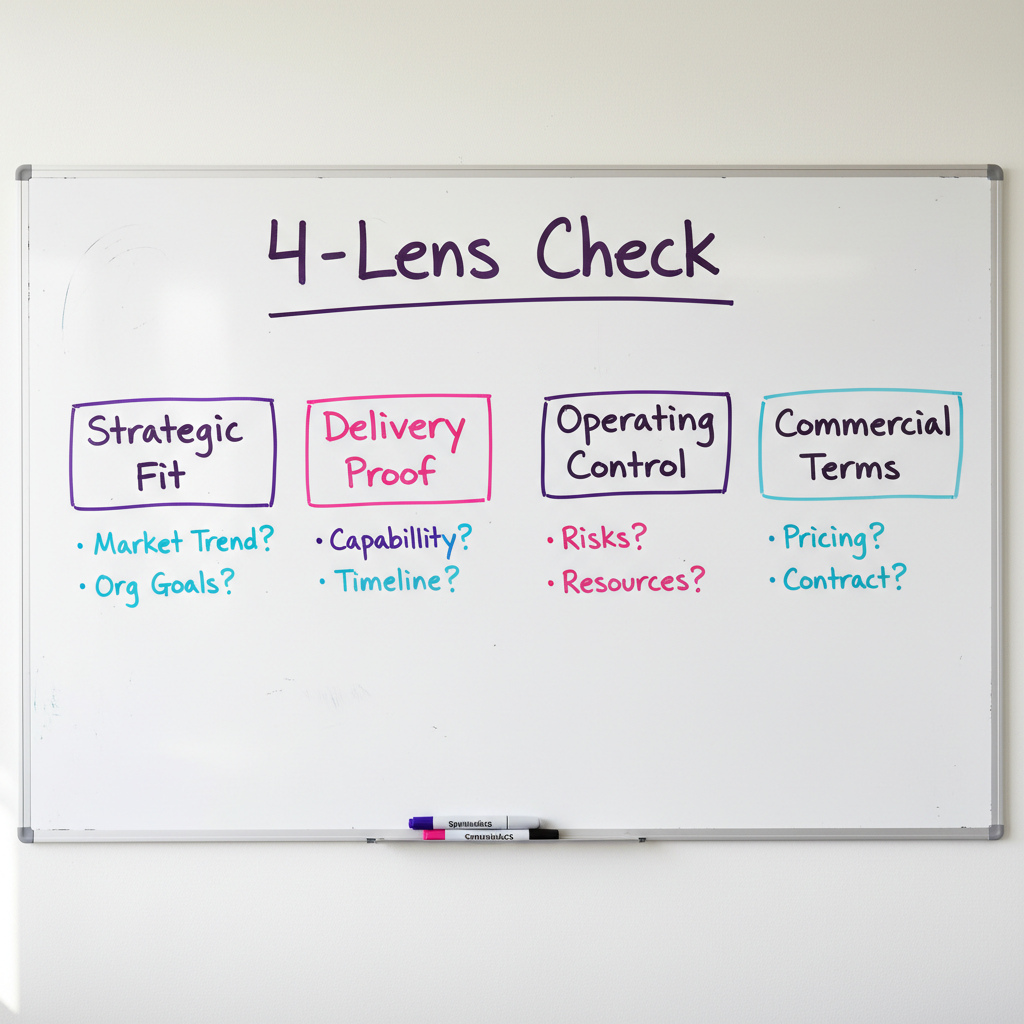
Most bad software decisions happen because one lens dominates the others.
- Business teams over-index on the demo.
- IT teams over-index on architecture.
- Procurement over-indexes on price.
- Legal over-indexes on liability language.
Each lens matters. None is enough alone.
Vendor due diligence checklist at a glance
| Area | What you are checking | Evidence to request | Who should review it |
|---|---|---|---|
| Strategic fit | The software solves the priority workflow, not a generic use case | Use-case walkthrough, process map, pilot plan | Business owner, product/ops lead |
| Delivery proof | The vendor can implement in your environment | Case studies, reference calls, implementation plan | Business owner, project lead |
| Technical fit | Integration, scalability, data, and maintainability are realistic | Architecture diagram, API docs, sandbox, data model | Tech lead, security lead |
| Security and compliance | The vendor protects data and follows secure practices | Security policy, audit reports, access model, incident process | Security, legal, compliance |
| Operating control | Your team can run the system after go-live | Admin model, training plan, reporting, support SLA | Operations, customer success, IT |
| Commercial terms | The contract protects both launch and future change | Pricing schedule, SLA, exit terms, change-request rules | Finance, legal, executive sponsor |
The 15 questions to ask before you sign
1. What business outcome will this vendor be accountable to?
Do not start with features. Start with the outcome.
A vendor can deliver every item in the scope and still fail if the scope was not tied to a measurable business result. Before signing, define the outcome in plain language:
- reduce order processing time by 40%
- improve sales follow-up speed from days to hours
- cut manual reconciliation work across finance and operations
- create a single source of truth for inventory, customers, or approvals
Then ask the vendor how their implementation plan supports that outcome.
If the answer is mostly feature talk, the project is already drifting.
2. Which workflow does the product fit out of the box, and which workflow must change?
Every software system has opinions. It assumes a way of working.
The question is whether those assumptions match your operating reality. Ask the vendor to map your current workflow against their recommended workflow. Mark each step as:
- supported out of the box
- configurable
- requires integration
- requires customization
- should be changed by your team
This matters because software projects often fail at the seam between product capability and operating behavior. A gap is not automatically bad. An invisible gap is.
3. What will the vendor refuse to customize?
A mature vendor has boundaries.
If a vendor says yes to every customization, be careful. That may feel helpful in sales, but it can create an expensive, fragile version of the product that is hard to upgrade and harder to support.
Ask:
- Which requests do you normally reject?
- Which parts of the product should stay standard?
- What customizations have caused problems for clients?
- How do custom features affect upgrades, support, and cost?
You are not looking for unlimited flexibility. You are looking for disciplined flexibility.
4. Can we see a real implementation plan, not just a timeline?
A timeline says when things happen. An implementation plan says how risk will be removed.
Ask for a plan that includes:
- discovery activities
- data migration steps
- integration dependencies
- user acceptance testing
- training and onboarding
- go-live criteria
- support handover
- decision gates
If the plan is just a Gantt chart with optimistic dates, keep digging. Dates are cheap. Decisions are where the project succeeds or fails.
5. Who exactly will do the work after the contract is signed?
Sales teams sell. Delivery teams deliver. Sometimes those are very different worlds.
Before signing, ask to meet the implementation lead, solution architect, or customer success manager who will actually run the work. Ask about their experience with similar clients, similar systems, and similar constraints.
Also clarify:
- which work is done by the vendor
- which work is done by your team
- which work is done by third-party partners
- who owns project management
- who has authority to make trade-off decisions
A good vendor makes delivery ownership visible early.
6. What proof do you have from clients like us?
Case studies are useful, but only if they are specific.
Do not ask, “Have you worked with companies in our industry?” Ask:
- What was the starting problem?
- What changed after implementation?
- What was harder than expected?
- What did the client have to change internally?
- Can we speak to a reference who used the product after go-live?
A reference call with an actual operator is often more valuable than a polished logo slide.
7. What are the top three reasons implementations fail?
This is one of the best questions in vendor due diligence.
Good vendors know where projects break. They have scars. They can tell you when clients fail because of bad data, unclear ownership, weak adoption, over-customization, procurement delays, or unrealistic timelines.
Weak vendors act as if failure only happens to other people.
Listen for honesty. You want a partner who can name risk before it becomes invoiceable pain.
8. What data will the system store, process, export, and delete?
Data questions are not paperwork. They define control.
Ask the vendor to document:
- data categories stored in the system
- where data is hosted
- who can access it
- how data is encrypted
- how backups work
- how long data is retained
- how data can be exported
- how data is deleted after termination
If the system touches customer data, employee data, financial data, health data, or regulated operational data, involve security and legal early.
For secure software practices, the NIST Secure Software Development Framework is a useful reference point for what mature development practices should cover.
9. How does the vendor handle security incidents?
Do not only ask whether the system is secure. Ask what happens when something goes wrong.
You need to know:
- how incidents are detected
- how quickly customers are notified
- who is responsible for communication
- what logs are available
- how vulnerabilities are patched
- whether penetration tests or audits are performed
- what is covered in the SLA
Security is not a checkbox. It is an operating capability. CISA’s Secure by Design guidance is a strong reminder that vendors should build security into product and process, not bolt it on after procurement asks.
10. What integrations are required for the first release?
Integration is where “simple” software buys a shovel and starts digging.
Ask the vendor to separate integrations into three groups:
- Required for go-live — without this, the workflow does not work.
- Important after launch — improves efficiency but can wait.
- Nice to have — useful, but not a launch dependency.
Then inspect the API docs, authentication model, data formats, rate limits, webhooks, and error handling. If possible, run a small technical proof before signing the full contract.
11. What happens if our process changes in six months?
Your business will change. The software must not make every change expensive.
Ask how changes are handled:
- configuration versus customization
- workflow changes
- role and permission changes
- report changes
- pricing changes when usage grows
- change-request process
- product roadmap influence
The goal is not infinite adaptability. The goal is to know which changes are easy, which are expensive, and which are impossible without switching systems.
12. What does adoption look like after go-live?
Go-live is not the finish line. It is the moment the system meets habits.
Ask the vendor to define adoption metrics:
- active users by role
- workflow completion rate
- time saved
- data quality improvement
- reduction in manual workarounds
- support tickets by category
- usage by team or branch
Also ask what enablement is included: training, admin coaching, office hours, documentation, and manager reporting.
If nobody owns adoption, the system becomes another login people avoid.
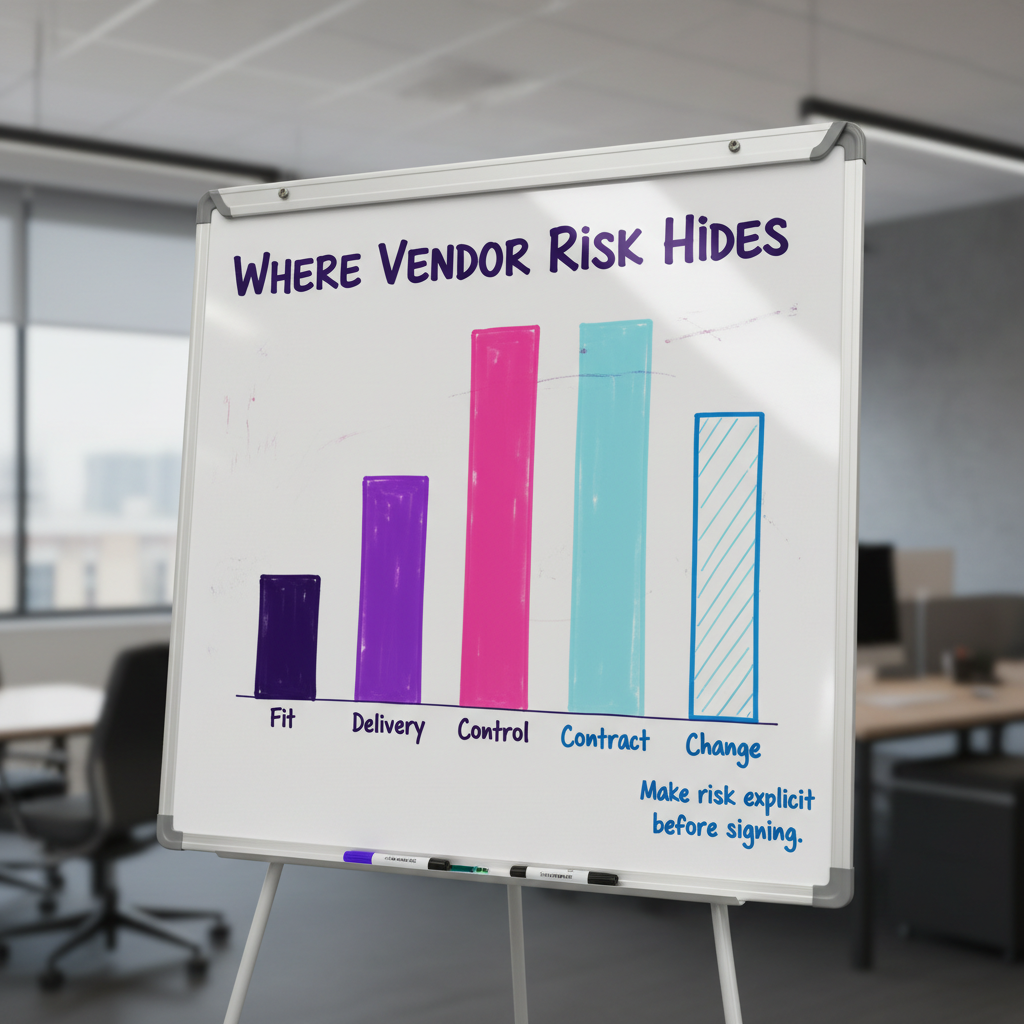
13. What support is included, and what costs extra?
Support terms can look fine until you need help during a real business interruption.
Clarify:
- support channels
- support hours and timezone
- response times by severity
- resolution targets
- escalation path
- named support roles
- premium support fees
- limits on training or admin support
Also ask what support looks like during the first 30–90 days after launch. That window is where adoption, bugs, and operational confusion collide.
14. How do we exit if this does not work?
Exit terms are not pessimism. They are governance.
Before signing, know:
- how to export data
- what format exports use
- whether attachments, logs, and metadata are included
- termination notice period
- refund or cancellation rules
- transition support fees
- data deletion process
- post-termination access window
A vendor that makes exit impossible is asking for trust without accountability.
15. What should we pilot before committing fully?
For high-risk systems, do not jump from demo to full rollout.
Design a pilot that tests the riskiest assumptions:
- one business unit
- one workflow
- one integration
- one data migration sample
- one reporting cycle
- one adoption group
The pilot should have clear pass/fail criteria. Not “users liked it.” Something sharper:
- 80% of target users complete the workflow without manual support
- order processing time drops by 30%
- migrated records hit 98% accuracy
- managers can see the dashboard they need for weekly decisions
A pilot is not bureaucracy. It is cheap insurance against a large wrong decision.
How to score vendors without pretending the score is science
A scorecard helps, but it is not objective truth. It is a structured argument.
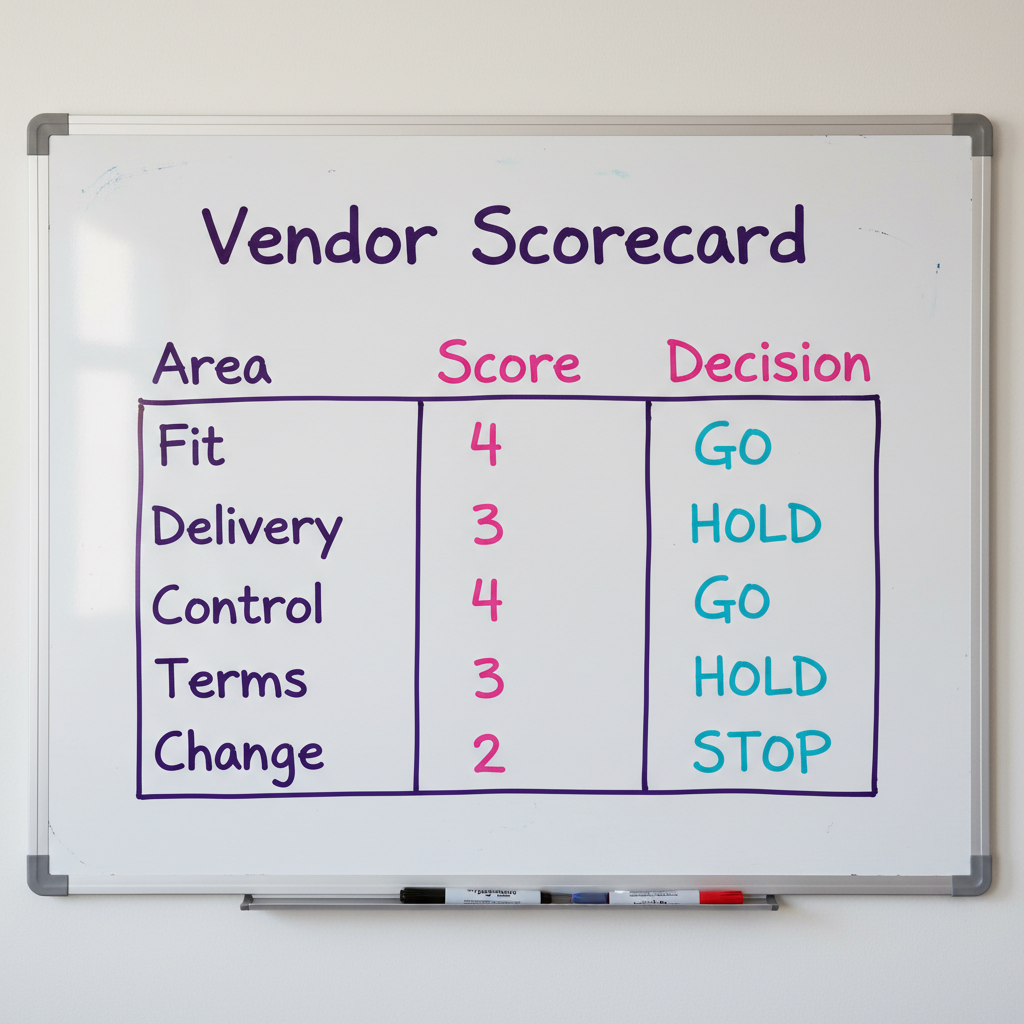
Use weighted scoring to make trade-offs visible:
| Criteria | Suggested weight | What good looks like |
|---|---|---|
| Strategic fit | 25% | Solves the priority workflow and supports the business outcome |
| Delivery proof | 20% | Clear implementation plan, strong references, experienced delivery team |
| Security and data control | 20% | Clear access, encryption, retention, incident, and export practices |
| Integration reality | 15% | APIs, data model, and technical proof support first-release needs |
| Adoption support | 10% | Training, reporting, and post-go-live support are practical |
| Commercial flexibility | 10% | Pricing, SLA, change, renewal, and exit terms are clear |
Then add two rules:
- Set minimum thresholds. A vendor should not win if security, data control, or exit terms fall below your acceptable level.
- Write the reason behind each score. If you cannot explain the score, it is just procurement theater with numbers.
The due diligence flow
Vendor due diligence should happen before the contract, not after the implementation has already created sunk cost.
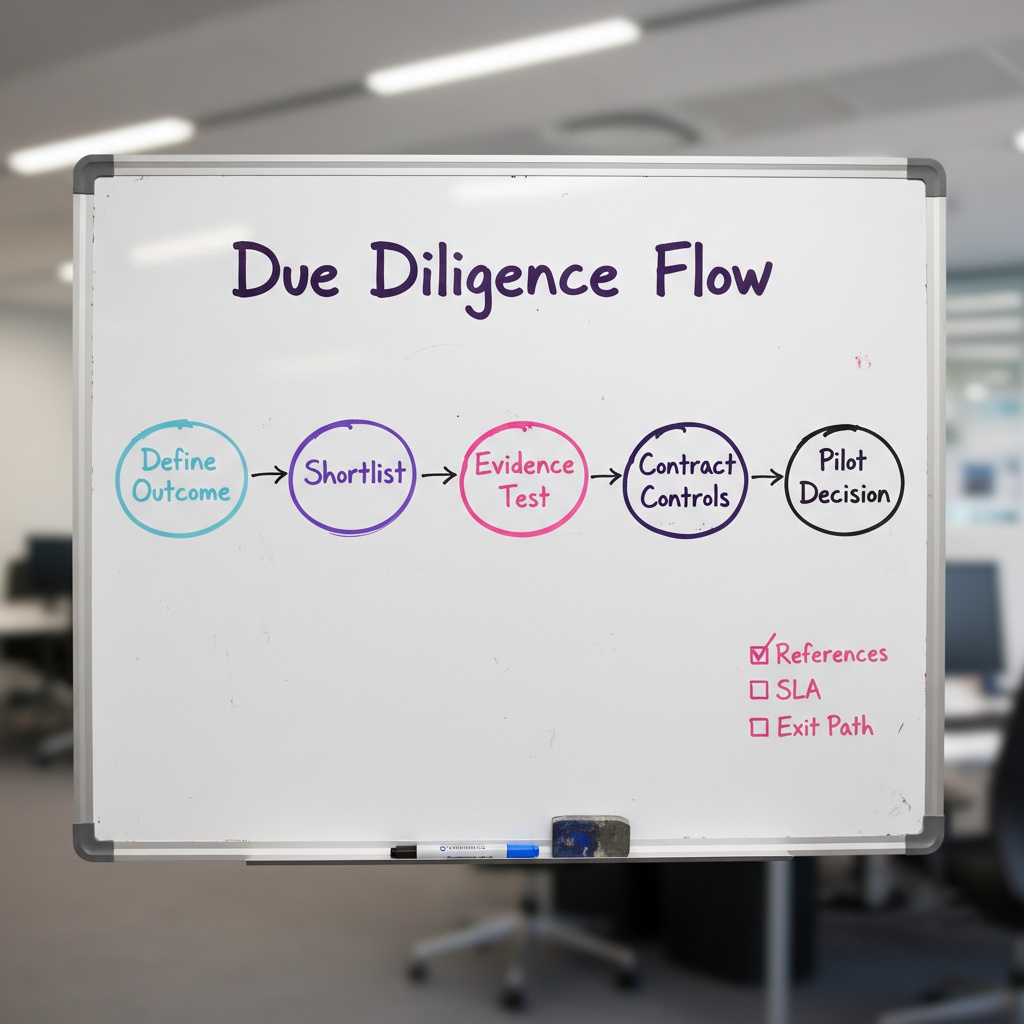
A practical flow:
- Define the outcome. What business result must change?
- Map the workflow. Where will the system touch real operations?
- Shortlist vendors. Choose based on fit, not brand noise.
- Test evidence. Review docs, references, sandbox, security, and delivery plan.
- Negotiate control. Lock in SLA, data rights, support, change rules, and exit terms.
- Pilot if needed. Test the highest-risk assumption before scaling.
- Decide with evidence. Sign, pause, renegotiate, or walk away.
The contract should reflect what you learned. Not what the sales deck promised.
Red flags that should slow the decision down
Slow down if you see these patterns:
- The vendor cannot explain where projects usually fail.
- The implementation team is invisible before signing.
- Every hard question gets answered with “yes, we can customize that.”
- Security answers stay vague or purely policy-based.
- Data export is limited, expensive, or undocumented.
- The contract makes renewal easy but exit painful.
- The timeline assumes perfect data, perfect stakeholder alignment, and no process change.
- References are only executives, not operators.
- The vendor sells transformation but has no adoption plan.
None of these automatically means “do not buy.” But each one deserves investigation before the signature.
Final thought: choose the vendor that makes risk visible
The best vendor is not always the one with the most features. It is often the one that helps you see the trade-offs clearly.
A good vendor will tell you:
- what they do well
- where they are not a fit
- what your team must own
- what needs to be tested
- what should not be customized
- what could go wrong
That honesty is valuable. Because the real cost of software is rarely the license. It is the operating change around it.
Before you sign, ask the 15 questions. Then make the decision with your eyes open.
FAQ
What is software vendor due diligence?
Software vendor due diligence is the process of evaluating a vendor’s strategic fit, implementation capability, technical risk, security posture, operating support, and commercial terms before signing a contract.
When should vendor due diligence happen?
It should happen after you have a clear business need and shortlist, but before contract signature. For high-risk systems, include a sandbox test, reference call, security review, and pilot before full rollout.
Who should be involved in software vendor due diligence?
At minimum: the business owner, operations lead, technical lead, security or compliance owner, finance, procurement, and legal. The exact group depends on the software’s business impact and data sensitivity.
Is the cheapest vendor usually the riskiest?
Not always. A cheap vendor can be the right fit for a narrow need. The risk comes from mismatch: weak support, hidden implementation work, poor data control, painful exit terms, or a product that does not fit the workflow.
Should every vendor go through a pilot?
No. Low-risk tools may only need a lightweight review. But if the software affects core operations, sensitive data, revenue workflows, or multiple teams, a pilot is often the safest way to test reality before scaling.
Need help putting this into practice?
Book a Blueprint session and we'll turn the ideas in this article into your next validated release.
Book a Discovery Call