Product Strategy
The Real Cost of Build vs. Buy: A Framework for Software Decisions
“Let’s just build it ourselves.”
This sentence has launched a thousand projects—and killed a thousand budgets. Building custom software feels empowering. You get exactly what you want. No compromises. No vendor lock-in.
But that feeling often hides the true cost. After helping dozens of companies navigate this decision, we’ve developed a framework that cuts through the emotion and focuses on what actually matters: total cost of ownership over time.
This guide gives you a practical way to evaluate build vs. buy—and avoid the traps that catch most teams.
Why This Decision Is Hard
Build vs. buy isn’t a technical decision—it’s a business strategy decision with technical implications. That’s why it trips up so many teams.
The Emotional Pull of Building
Building feels proactive. Strategic. Differentiated. When you build, you’re creating something unique. You control the roadmap. You own the IP.
Buying feels reactive. Dependent. Commoditized. When you buy, you’re accepting someone else’s vision. You’re one of many customers.
This emotional framing leads smart people to build when they should buy—and occasionally to buy when they should build.
The Hidden Variables
The obvious comparison—build cost vs. subscription cost—ignores several variables:
- Opportunity cost: What else could your team be building?
- Time to value: How long until you’re getting benefits?
- Maintenance burden: Who fixes bugs for the next 5 years?
- Iteration speed: How quickly can you adapt to changing needs?
- Risk profile: What happens if requirements change dramatically?
A fair comparison needs to account for all of these.
The True Cost of Building
Most teams underestimate build costs by 50-200%. Here’s what they miss:
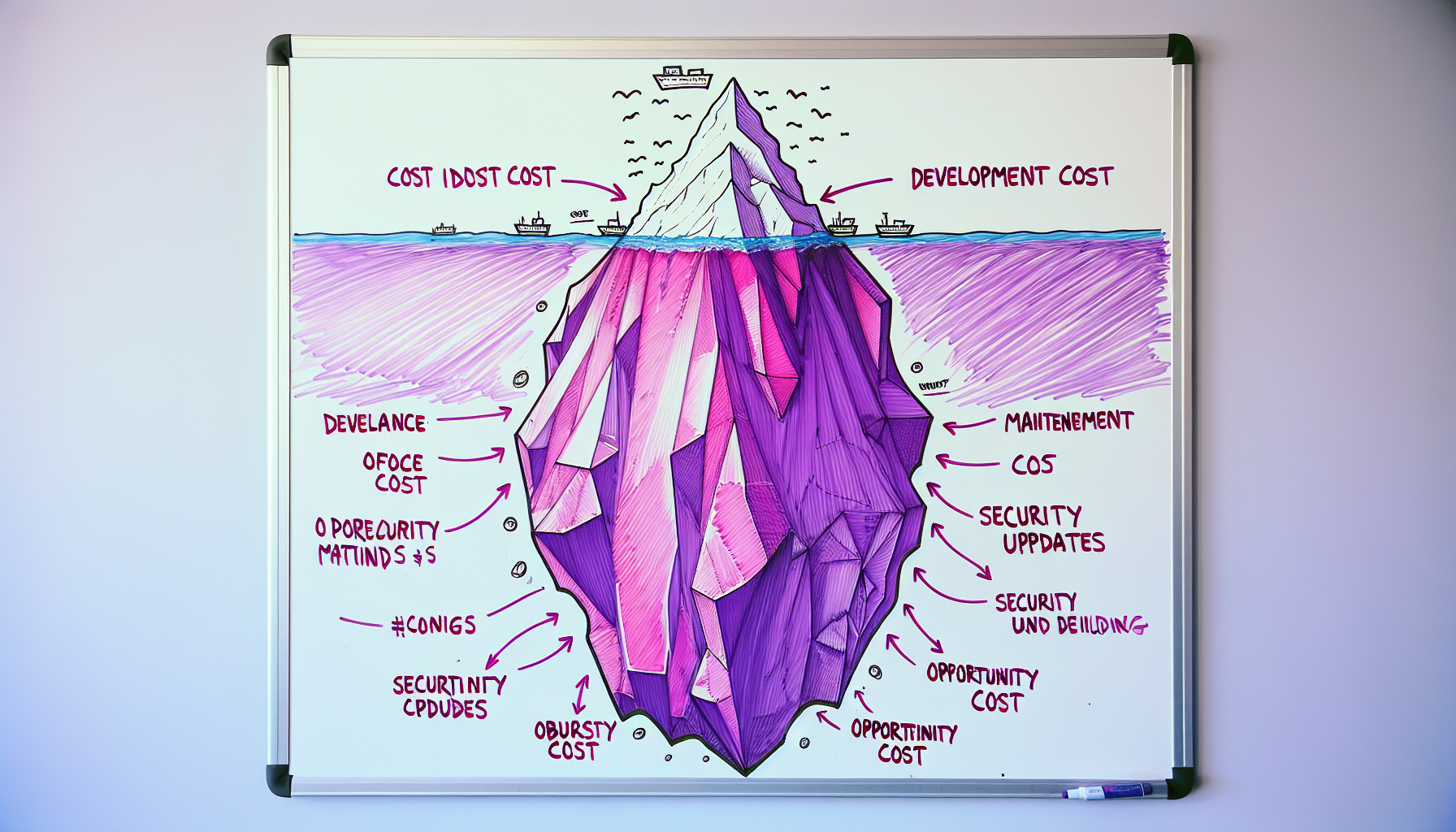
Development Cost (The Visible Part)
This is what everyone calculates:
Estimated hours × hourly rate = development costFor a mid-complexity internal tool:
- Estimate: 400 hours × $50/hr = $20,000
- Reality: Usually 600-800 hours = $30,000-40,000
Why the gap?
- Scope creep (inevitable)
- Integration complexity (always underestimated)
- Testing and edge cases (rarely budgeted properly)
- Documentation (often skipped, paid for later)
Maintenance Cost (The Hidden Part)
Software doesn’t stop costing money when it ships. Budget for:
- Bug fixes: ~20% of initial dev cost per year
- Security updates: Ongoing, non-negotiable
- Dependency updates: Frameworks and libraries evolve
- Feature requests: Users will want more
Rule of thumb: Annual maintenance = 15-25% of initial build cost.
A $40,000 build becomes $50,000-60,000 over three years—assuming no major changes.
Opportunity Cost (The Ignored Part)
Every hour your developers spend on internal tools is an hour not spent on your core product.
Questions to ask:
- What’s the revenue impact of delaying product features?
- Could this engineering time ship something that generates revenue?
- Is this build a distraction from your main competitive advantage?
For startups especially, developer time is the scarcest resource. Spending it on non-differentiating systems has real costs.
The True Cost of Buying
Buying isn’t free either. Here’s the full picture:
Subscription Cost (The Visible Part)
SaaS pricing is transparent:
Monthly fee × users × 12 months = annual costFor a typical B2B tool:
- 20 users × $30/user/month × 12 = $7,200/year
Over three years: $21,600
Integration Cost (Often Underestimated)
Off-the-shelf solutions rarely work out of the box:
- API integration: Connecting to your existing systems
- Data migration: Moving from current workflows
- Customization: Making it fit your process
- Training: Getting teams up to speed
Budget 2-4 weeks of developer time for most integrations.
Lock-in Cost (The Long-Term Risk)
When you buy, you depend on someone else:
- Price increases: SaaS vendors raise prices over time
- Feature changes: Features you rely on may change or disappear
- Vendor risk: What if they get acquired or shut down?
- Data portability: Can you leave if needed?
Evaluate vendor stability and data export options before committing.
Friction Cost (The Daily Tax)
When software doesn’t fit perfectly, you pay in friction:
- Workarounds for missing features
- Manual processes to fill gaps
- Employee frustration and reduced productivity
- Training new hires on non-standard workflows
This cost is hard to quantify but real.
The Build vs. Buy Matrix
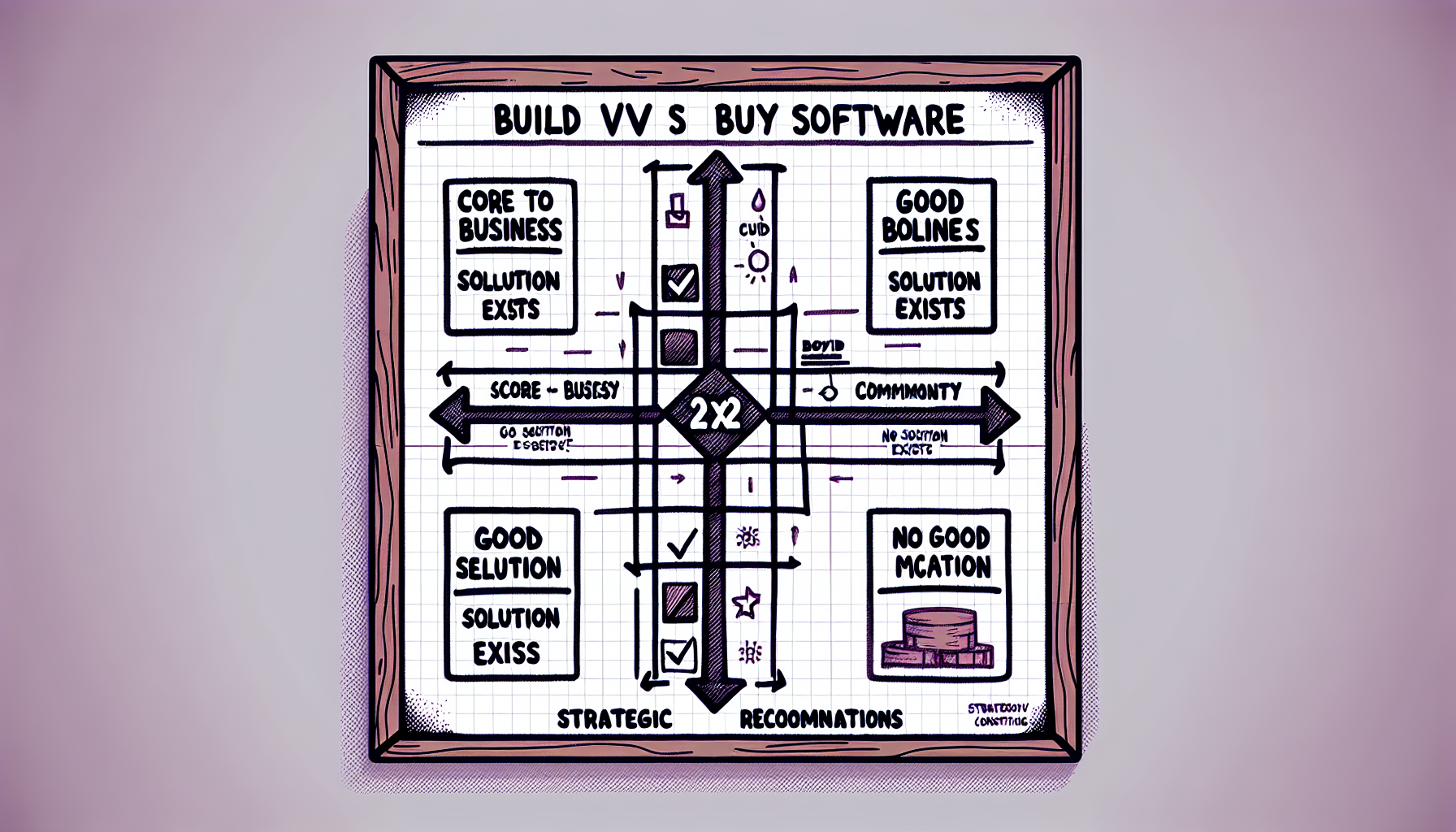
Use this matrix for initial orientation:
| Factor | Build | Buy |
|---|---|---|
| Core to your product | ✅ Build | ❌ Buy |
| Competitive differentiator | ✅ Build | ❌ Buy |
| Standard business function | ❌ Buy | ✅ Buy |
| Stable requirements | Either | ✅ Buy |
| Rapidly changing needs | ✅ Build | ❌ Buy |
| Deep integration needed | ✅ Build | ⚠️ Depends |
| Small team | ❌ Buy | ✅ Buy |
| Engineering is core competency | ✅ Build | ⚠️ Depends |
Reading the matrix:
If most factors point to “build,” building probably makes sense. If most point to “buy,” buying probably makes sense. Mixed results require deeper analysis.
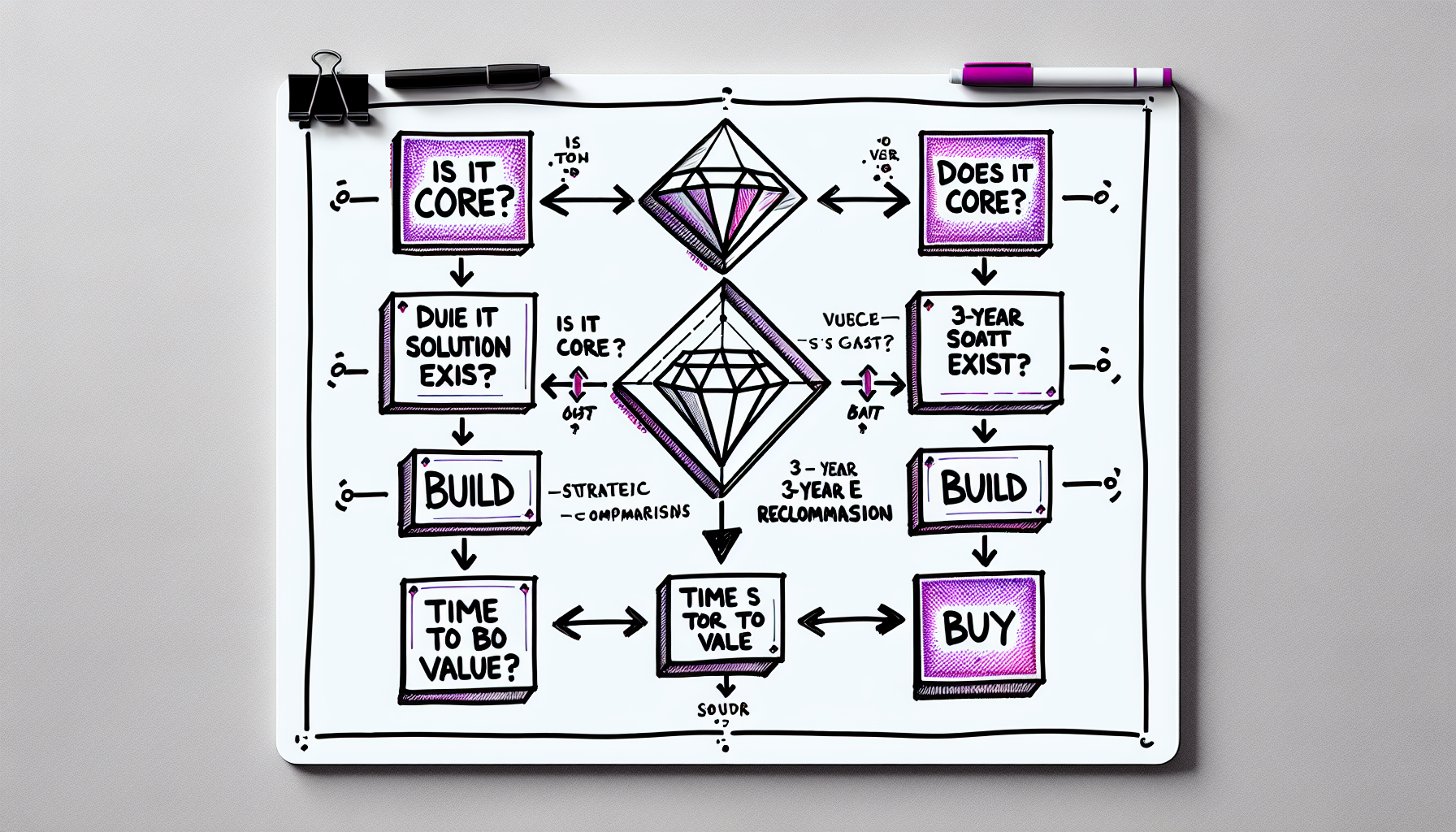
Decision Framework: 5 Questions
Work through these questions in order:
Question 1: Is This Core to Your Business?
Core: Directly generates revenue or creates competitive advantage. Non-core: Supports operations but doesn’t differentiate you.
Examples:
- E-commerce company → Product catalog system is core. HR software is not.
- Software agency → Project management might be core. Accounting is not.
- Healthcare startup → Patient data system is core. Email marketing is not.
Rule: Build core. Buy non-core.
Question 2: Does a Good Solution Exist?
Before building, seriously evaluate what’s available:
- Search for solutions in your specific domain
- Talk to peers about what they use
- Test 3-5 options with real scenarios
- Check integration capabilities
If a good solution exists: The burden of proof is on building. You need strong reasons to build what already exists.
If no good solution exists: Building becomes more defensible—but verify the gap is real, not just undiscovered.
Question 3: What’s the 3-Year Total Cost?
Calculate total cost of ownership over three years:
Build:
Development cost
+ (Annual maintenance × 3)
+ Opportunity cost estimate
= 3-year build cost
Buy:
(Annual subscription × 3)
+ Integration cost
+ Training cost
+ Estimated friction cost
= 3-year buy cost
Compare honestly. If build is 2x+ more expensive, you need compelling business reasons to justify it.
Question 4: What’s the Time to Value?
How quickly do you need the solution working?
| Timeline | Recommendation |
|---|---|
| This week | Buy (or use spreadsheets) |
| This month | Strongly favor buy |
| This quarter | Either, lean buy |
| This year | Either, evaluate fully |
Building takes longer than buying. If speed matters, that weights the decision.
Question 5: What Happens If Requirements Change?
Requirements will change. Which approach handles change better?
Build handles change better when:
- Changes are specific to your business
- You have ongoing engineering capacity
- The domain is evolving rapidly
Buy handles change better when:
- Changes are common across many businesses
- Vendor has a good track record of updates
- You want to follow industry best practices
Hybrid Approaches
Pure build and pure buy aren’t the only options:
Build on Top of Buy
Use a platform and extend it:
- Salesforce + custom Lightning components
- Shopify + custom apps
- Notion + automations and integrations
Best when: Platform covers 70%+ of needs. Custom work fills gaps.
Buy Core, Build Integrations
Purchase the main solution, build the connections:
- Use standard CRM, build custom data pipeline
- Use standard analytics, build custom dashboards
- Use standard auth, build custom permissions
Best when: Core functionality is commodity. Differentiation is in how systems connect.
Build MVP, Migrate Later
Build quick and dirty to learn, then migrate:
- Build internal tool in weeks to test workflow
- If it works, evaluate build vs. buy for production version
- Migration is a sunk cost, but learning isn’t
Best when: Requirements are uncertain. Speed of learning matters more than efficiency.
Common Mistakes
Mistake 1: Comparing Sticker Price Only
“The SaaS costs $10K/year, building costs $30K—we’ll save money in three years!”
This ignores maintenance, opportunity cost, and time to value. Run the full calculation.
Mistake 2: Building for Edge Cases
“We need custom because of one specific requirement…”
Challenge this. Is the edge case worth 10x the cost? Often you can adapt your process to fit available tools rather than building custom tools to fit your process.
Mistake 3: Underestimating Integration
“We’ll just connect it via API…”
Integration is rarely simple. APIs have quirks. Data models don’t match perfectly. Error handling is complex. Budget 3x your initial integration estimate.
Mistake 4: Ignoring Vendor Trajectory
“This startup’s tool is perfect and cheap!”
Consider: Will this vendor exist in three years? Are they growing? Do they have funding? A dead vendor means emergency migration—budget for that risk.
Mistake 5: Not Involving Users Early
Whether building or buying, test with actual users before committing:
- Demo tools to the people who will use them
- Prototype custom solutions before full build
- User resistance kills more projects than bad technology
FAQ
When is building always the right choice?
When the software IS your product. If you’re a software company, your core product should almost always be built. If software is how you differentiate, build it.
When is buying always the right choice?
When it’s truly commodity: email, accounting, basic CRM, document storage. Unless you’re in those industries, buy solutions from companies that specialize.
Should we hire an agency to build or do it in-house?
Agency: When you need to move fast, don’t have capacity, or need specialized skills. Budget 20-50% premium over in-house rates but faster delivery.
In-house: When you need ongoing development, have a development team, and plan to iterate heavily.
What about low-code/no-code tools?
Good middle ground for internal tools and simple customer-facing apps. Evaluate carefully—low-code can become high-lock-in. Make sure you can export data and have escape routes.
How do we handle resistance to buying?
Resistance often comes from engineers who want to build. That’s natural—building is fun. Counter with math: show the true cost comparison. Emphasize that buying non-core frees time to build things that actually matter.
Next Steps
Every build vs. buy decision should go through this process:
- Classify: Core or non-core?
- Research: What solutions exist?
- Calculate: 3-year total cost comparison
- Consider: Time to value and change tolerance
- Test: Validate with actual users
Most decisions become clear after step 3. If still unclear, default to buying—building’s hidden costs usually tip the scales.
Need help evaluating a specific decision? Our Blueprint process includes technical architecture where we help you make these calls based on evidence, not instinct.
Related Posts
Need help putting this into practice?
Book a Blueprint session and we'll turn the ideas in this article into your next validated release.
Book a Discovery Call