Product Strategy
Why 80% of Products Fail (And How to Avoid It)
Here’s an uncomfortable truth: 8 out of 10 digital products fail. Not because of bad code. Not because of poor design. They fail because teams build the wrong thing.
After 12 years of building products—and watching many fail—we’ve identified a pattern. The teams that succeed share one habit: they validate before they build. The teams that fail share another: they assume they know what users want.
This guide breaks down the three warning signs of product failure, why validation matters more than features, and a practical framework to dramatically improve your odds.
The Real Reason Products Fail
CB Insights analyzed 101 startup post-mortems and found the #1 reason for failure: “No market need” — cited by 42% of failed startups.
Not funding. Not competition. Not bad timing.
They built something nobody wanted.
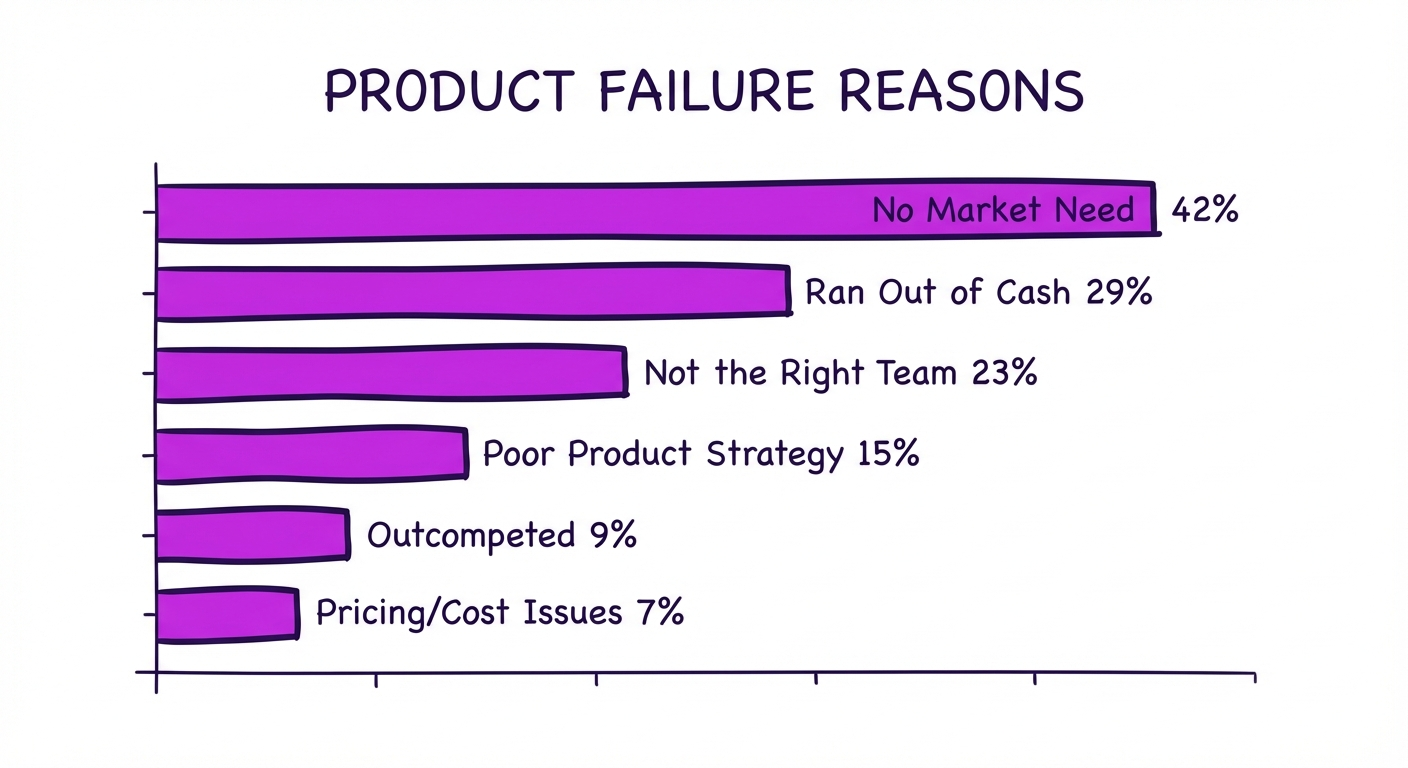
This happens because most teams follow a flawed process:
- Someone has an “idea”
- Stakeholders add feature requests
- Developers build for months
- Product launches
- Users don’t care
By the time real users see the product, the budget is spent. The runway is gone. Pivoting means starting over.
The Assumption Trap
Every product starts with assumptions:
- “Users will pay for this feature”
- “Our target market is X”
- “The main pain point is Y”
- “They’ll find us through Z channel”
These assumptions feel like facts because they came from smart people in a conference room. But assumptions aren’t facts until users prove them.
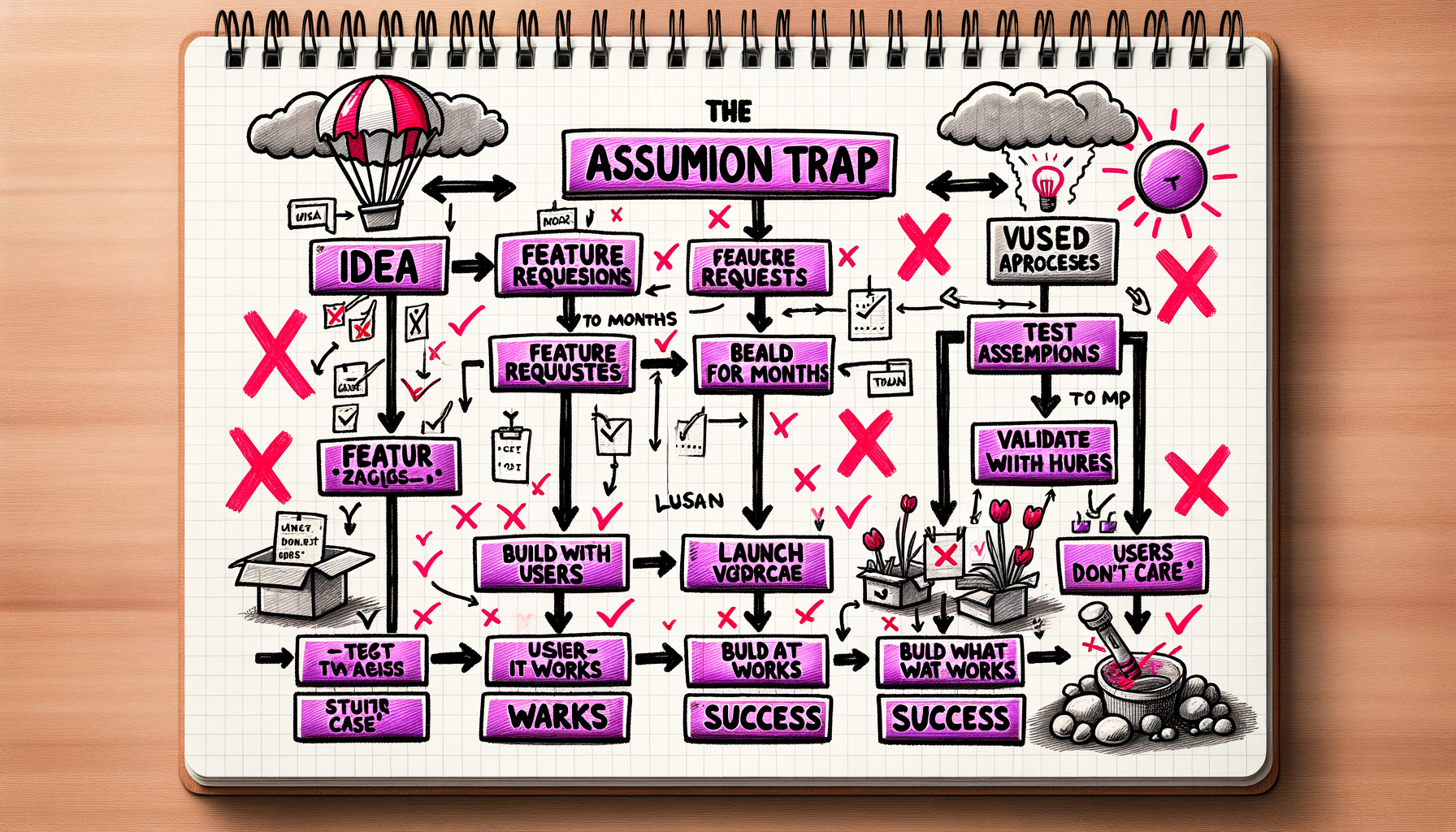
The difference between successful and failed products? Successful teams test assumptions before building. Failed teams discover their assumptions were wrong after the money runs out.
3 Warning Signs Your Product Will Fail
After working on hundreds of products, we’ve identified three early warning signs that predict failure with uncomfortable accuracy.
Warning Sign #1: No Clear Problem Statement
Ask your team: “What specific problem does this product solve, and for whom?”
If you get different answers from different people, you have a problem. If the answer takes more than 30 seconds, you have a problem. If the answer includes the word “everything” or “everyone,” you definitely have a problem.
The test: Can you complete this sentence in under 15 words?
“We help [specific user] solve [specific problem] so they can [specific outcome].”
If you can’t, your product is solving a vague problem for a vague audience. That’s not a product—it’s a hope.
Warning Sign #2: Feature-First Roadmaps
Open your product roadmap. Does it list features, or does it list problems to solve?
Feature-first roadmap (bad):
- Build user dashboard
- Add payment integration
- Create admin panel
- Implement notifications
Problem-first roadmap (good):
- Help users understand their progress → metrics they check weekly
- Remove friction from purchasing → one-click checkout
- Enable team management → role-based access
- Keep users engaged → contextual alerts
Feature-first roadmaps assume you know the solution. Problem-first roadmaps keep you focused on value.
Warning Sign #3: Validation After Launch
When will real users first interact with your product?
If the answer is “after launch,” you’re gambling. You’re betting months of development time that your assumptions are correct.
What validation looks like:
- Week 1-2: User interviews (not surveys)
- Week 3-4: Smoke tests or landing page experiments
- Week 5-6: Prototype testing with real users
- Week 7-8: MVP with paying customers
What assumption looks like:
- Months 1-4: Building
- Month 5: Launch
- Month 6: “Why aren’t users converting?”
The teams that validate early can pivot cheaply. The teams that validate late can only pivot painfully—or not at all.
The Validation-First Approach
Validation isn’t about asking users what they want. Users are notoriously bad at predicting their own behavior. Validation is about observing what users do and testing whether they’ll pay.
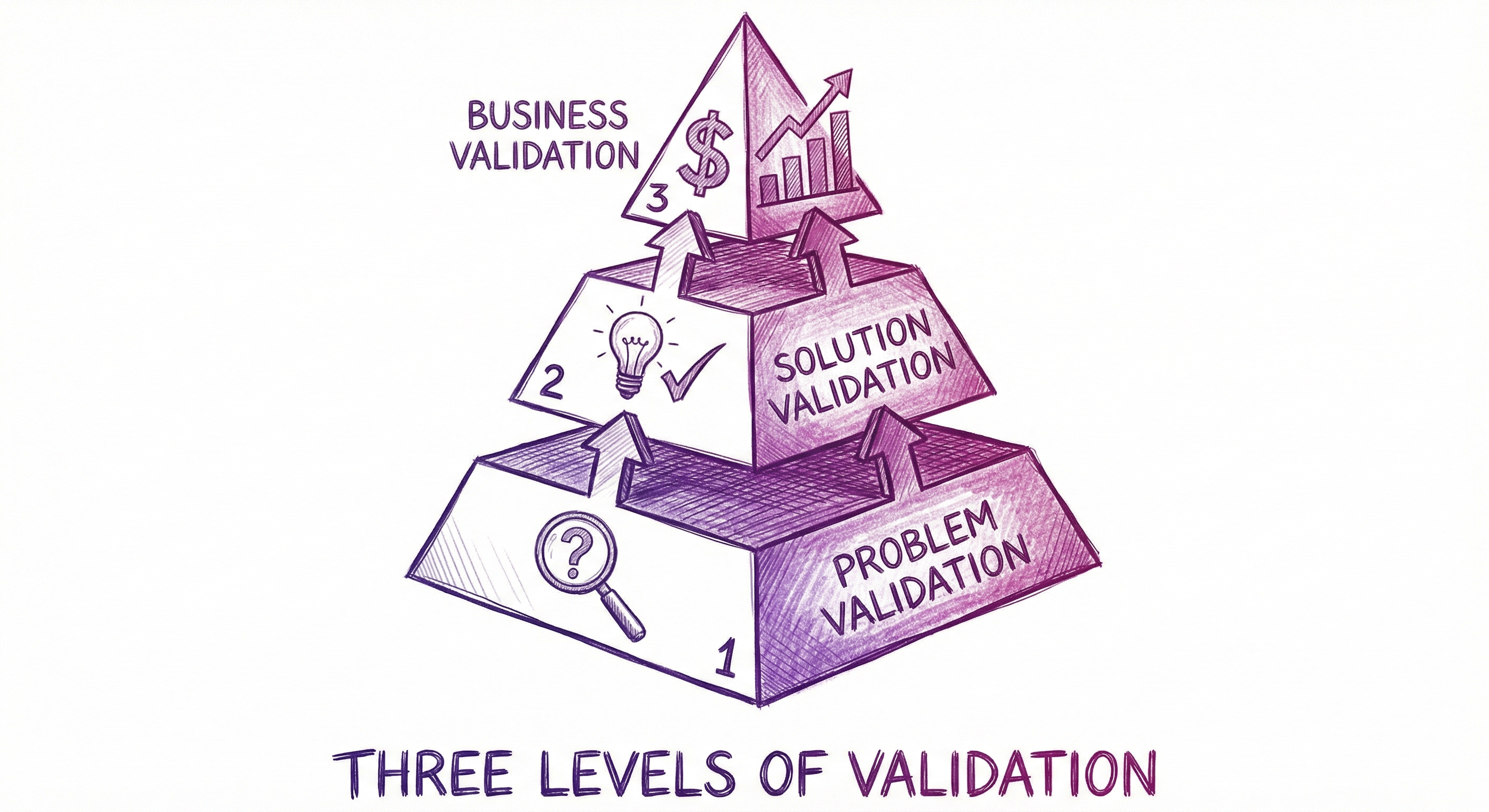
The 3 Levels of Validation
Level 1: Problem Validation Does this problem exist, and is it painful enough to solve?
- Interview 10-15 potential users
- Ask about their current workflow and pain points
- Listen for emotion—frustration, workarounds, complaints
- Don’t pitch your solution yet
Level 2: Solution Validation Does our proposed solution actually solve the problem?
- Show prototypes or mockups
- Observe users attempting tasks
- Note confusion, hesitation, workarounds
- Iterate before writing code
Level 3: Business Validation Will users pay for this solution?
- Smoke tests with real payment flows
- Pre-orders or waitlist signups
- Concierge MVP (manual delivery of value)
- Track conversion rates, not just interest
Each level filters out bad ideas before you invest more resources. By the time you build, you have evidence—not assumptions.
The Blueprint Framework
At Synetica, we use a structured two-week process called Blueprint to validate before building. Here’s how it works:
Week 1: Capture Reality
Days 1-2: Stakeholder alignment
- Interview internal stakeholders
- Map assumptions explicitly
- Define success metrics upfront
Days 3-5: User research
- Conduct 8-12 user interviews
- Document jobs-to-be-done
- Identify pain points and triggers
Days 6-7: Assumption mapping
- List every assumption the product depends on
- Rank by risk (impact × uncertainty)
- Identify the “killer assumptions” that must be true
Week 2: Design the Test
Days 8-9: Experiment design
- For each killer assumption, design a test
- Choose the fastest, cheapest method
- Define success criteria in advance
Days 10-11: Prototype or test build
- Create whatever’s needed to test
- Landing pages, clickable prototypes, concierge flows
- No production code yet
Days 12-14: Validation sprints
- Run tests with real users
- Collect quantitative and qualitative data
- Make go/no-go decisions based on evidence
Blueprint Deliverables
By the end of two weeks, you have:
- Validated problem statement — evidence that the problem exists and matters
- Prioritized feature map — what to build first, with reasoning
- Technical architecture sketch — how the solution will work
- Validation results — data from real user tests
- 60-day roadmap — build and launch plan with milestones
This isn’t a document that sits in a drawer. It’s a decision-making tool that keeps the build honest.
Metrics That Actually Matter
Most teams track vanity metrics—page views, signups, time on site. These feel good but don’t predict success.
Here are the metrics that actually matter:
Problem Clarity Score
Can your team answer three questions?
- Who is the primary user? (specific role/persona)
- What triggers them to seek a solution? (specific moment)
- What outcome do they want? (specific, measurable)
Score: 3/3 = clear, 2/3 = fuzzy, 1/3 = guessing
Validation Velocity
How quickly do you test assumptions?
- Fast: Test 2-3 assumptions per week
- Medium: Test 1 assumption per sprint
- Slow: Test assumptions only after launch
Faster validation = faster learning = less wasted build time.
Evidence-to-Opinion Ratio
In your last product meeting, how many decisions were based on:
- Evidence: User research, test results, data
- Opinion: “I think users want…”, “Competitors do…”
Healthy ratio: 70% evidence, 30% opinion Risky ratio: 30% evidence, 70% opinion
Riskiest Assumption Tested
What’s your single riskiest assumption, and have you tested it?
If you haven’t tested the thing most likely to kill your product, you’re building on faith.
Case Study: How Validation Saved a $2M Project
A fintech startup came to us with a “can’t miss” idea: a mobile app for small business invoicing. They had a deck, a feature list, and a 12-month development plan.
Their assumptions:
- Small businesses hate current invoicing tools
- They’d pay $29/month for a better solution
- Mobile-first was the key differentiator
What Blueprint revealed:
- Small businesses did complain about invoicing—but their real pain was getting paid on time, not creating invoices
- $29/month was fine, but only if the tool automated follow-ups and integrated with their accounting software
- Mobile-first was a nice-to-have, not a must-have—most invoicing happened on desktop
The pivot:
Instead of building a mobile invoicing app (estimated $600K, 8 months), they built a desktop-first tool with automated payment reminders and QuickBooks integration (estimated $180K, 3 months).
Results:
- 40% of beta users converted to paid within 30 days
- Average revenue per user 2x their original projection
- Breakeven in 6 months instead of 18
Blueprint didn’t just validate their idea—it transformed it into something users actually wanted.
FAQ
What’s the difference between validation and market research?
Market research tells you what people say they’ll do. Validation reveals what people actually do. Market research might show 70% of respondents “would consider” your product. Validation shows whether they’ll put down a credit card. Focus on behavior, not stated intent.
How much does validation cost compared to just building?
Blueprint costs roughly 5-10% of a typical build budget. But it routinely saves 30-50% by killing bad ideas early and focusing development on validated features. The question isn’t whether you can afford validation—it’s whether you can afford to skip it.
Can’t I just launch an MVP and iterate?
You can, but “MVP” has become an excuse for shipping unvalidated products. A true MVP tests a specific hypothesis with the minimum required functionality. If your MVP takes 3+ months to build, it’s not minimum—it’s a full product built on assumptions. Validate the hypothesis before you build the MVP.
What if my stakeholders want to skip validation?
Show them the numbers: 80% failure rate without validation vs. ~30% failure rate with proper validation (based on industry benchmarks). Validation isn’t a delay—it’s insurance. Two weeks of validation can save six months of building the wrong thing.
How do I know when I’ve validated enough?
You’ve validated enough when you can answer “yes” to all three:
- Do we have evidence (not opinions) that the problem exists?
- Do we have evidence that users will pay for our solution?
- Do we know what to build first based on test results?
Next Steps
Every week you spend building without validation is a gamble. The house edge is 80% against you.
You have two options:
Option 1: Keep building on assumptions. Hope users show up. Join the 80%.
Option 2: Spend two weeks validating. Get evidence. Build what users actually want. Join the 20%.
We built the Blueprint framework specifically for this. In two weeks, you get a validated plan and a clear go/no-go decision—before you commit serious resources.
Ready to validate your product idea? Book a discovery call and let’s find out if your assumptions hold up.
Related Posts
Need help putting this into practice?
Book a Blueprint session and we'll turn the ideas in this article into your next validated release.
Book a Discovery Call