Technology
Choosing the Right Tech Stack in 2026: A Practical Guide
Every few months, a new framework trends on Twitter. Engineers debate tabs vs. spaces, React vs. Vue, microservices vs. monoliths. Conference talks promise 10x productivity with the latest tool.
Meanwhile, successful products ship on “boring” tech stacks. Rails apps handle billions of requests. PHP powers 40% of the web. jQuery still runs on more sites than any modern framework.
The truth: your tech stack matters less than you think—until it doesn’t.
This guide cuts through the hype. We’ll cover how to choose technology that serves your product goals, avoids common traps, and scales when you need it to.
The Tech Stack Selection Framework
Before evaluating any technology, answer three questions:
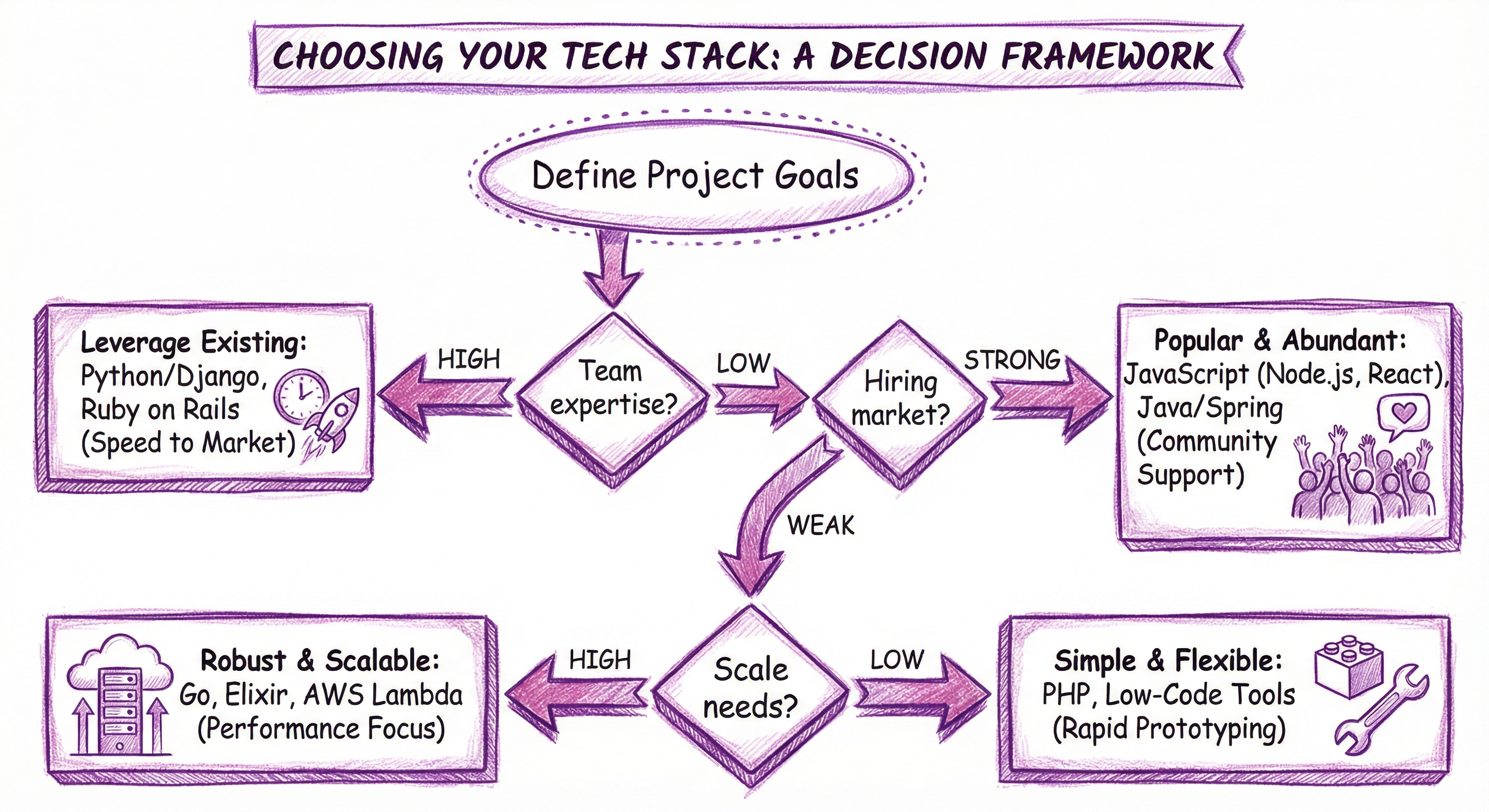
1. What Are You Actually Building?
Different products have different technical requirements:
| Product Type | Key Requirements | Stack Implications |
|---|---|---|
| Marketplace | Real-time inventory, payments, search | Strong database, payment integrations |
| SaaS B2B | Multi-tenancy, permissions, integrations | API-first, webhook support |
| Consumer App | Scale, mobile, engagement | CDN, push notifications, analytics |
| Internal Tool | Speed to build, maintenance | Low-code options, simple stack |
A marketplace has different needs than a content site. An internal tool has different needs than a consumer app. Start with the problem, not the tool.
2. What’s Your Team’s Reality?
The best technology is the one your team can execute:
- Existing expertise: What does your team already know?
- Hiring market: Can you find developers for this stack in your location?
- Learning curve: How long until new hires are productive?
- Community size: Are answers available when you get stuck?
In Indonesia, PHP (Laravel) and JavaScript (Node.js, React) developers are abundant. Go and Rust developers are scarcer. That’s not a judgment on the languages—it’s a hiring reality.
3. What’s Your Stage?
Early-stage products have different needs than scaling ones:
Pre-Product-Market Fit:
- Optimize for speed of iteration
- Avoid premature optimization
- Monolith > microservices
- Simple deployment
Post-Product-Market Fit:
- Optimize for reliability and scale
- Invest in observability
- Consider service extraction
- Automate everything
Choosing microservices for an unvalidated idea is like buying a warehouse before you have inventory. Scale when you need to—not when it seems cool.
Backend: What Actually Matters
The backend is where your business logic lives. Choose based on these factors:
Speed of Development
For early-stage products, development speed is everything. You need to iterate fast, test assumptions, and change direction.
Fastest to build:
- Ruby on Rails — Convention over configuration, batteries included
- Laravel (PHP) — Excellent documentation, huge ecosystem
- Django (Python) — Great for data-heavy apps, admin out of the box
Fast with more control:
- Node.js (Express/Fastify) — Flexible, JavaScript everywhere
- Next.js API routes — If frontend is already Next.js
- Go (Gin/Echo) — When you need performance early
Performance Characteristics
Different languages have different performance profiles:
| Language | Request Latency | Memory Usage | CPU Efficiency |
|---|---|---|---|
| Go | Excellent | Excellent | Excellent |
| Rust | Excellent | Excellent | Excellent |
| Node.js | Good | Medium | Good |
| Python | Medium | Medium | Medium |
| Ruby | Medium | High | Medium |
| PHP | Good | Medium | Good |
But here’s the thing: for 90% of products, performance differences between languages don’t matter. Your database queries, external API calls, and network latency will dominate response time. A well-written Laravel app will outperform a poorly-written Go app.
Optimize your queries before switching languages.
Our Recommendation for 2026
For most new products: Start with Node.js (TypeScript) or Laravel.
- Large talent pool
- Extensive ecosystem
- Fast development
- Scales far enough for most needs
- Easy to find help
For performance-critical systems: Consider Go.
- Excellent performance
- Simple deployment (single binary)
- Growing ecosystem
- Good for microservices (when you actually need them)
Frontend: The Modern Landscape
Frontend development has settled somewhat after years of framework churn. Here’s the current landscape:
The Big Three
React — Still the dominant choice
- Largest ecosystem and community
- Most job postings, most developers
- Meta framework options: Next.js, Remix
- JSX is love-it-or-hate-it
Vue — The approachable alternative
- Gentler learning curve
- Great documentation
- Meta framework: Nuxt
- Strong in Asia-Pacific
Svelte — The compiler approach
- Less code, smaller bundles
- Growing rapidly
- Meta framework: SvelteKit
- Smaller ecosystem (for now)
Meta Frameworks Are the Standard
Raw React/Vue/Svelte is increasingly rare. Meta frameworks (Next.js, Nuxt, SvelteKit) provide:
- Server-side rendering
- File-based routing
- API routes
- Built-in optimization
- Deployment integration
Our recommendation: If you’re starting fresh in 2026, use a meta framework from day one.
Mobile Considerations
Need a mobile app? Options in order of recommendation:
- Responsive web app — Often enough for MVPs
- PWA (Progressive Web App) — Offline support, installable
- React Native / Expo — Cross-platform native, JavaScript team
- Flutter — Cross-platform native, Dart language
- Native (Swift/Kotlin) — Best experience, 2x development cost
Start with web. Add native mobile only when user research proves it’s necessary.
Infrastructure: Cloud Choices in 2026
Your infrastructure choices affect cost, reliability, and operational burden.
The Big Three Clouds
AWS — The default enterprise choice
- Widest service selection
- Most mature
- Complex pricing
- Best for: Enterprise, complex requirements
Google Cloud (GCP) — Strong for data and AI
- Excellent managed services
- Better pricing model
- Stronger AI/ML offerings
- Best for: Data-heavy apps, AI integration
Azure — Microsoft ecosystem
- Best Microsoft integration
- Enterprise relationships
- Growing rapidly
- Best for: Microsoft shops, enterprise deals
For most startups, the cloud doesn’t matter much. Pick based on team familiarity or specific service needs.
Simplify When Possible
Before spinning up Kubernetes, consider simpler options:
Platform-as-a-Service:
- Vercel — Perfect for Next.js
- Netlify — Great for JAMstack
- Railway — Simple app hosting
- Render — Heroku alternative
Container Platforms:
- AWS ECS/Fargate — Managed containers without Kubernetes
- Google Cloud Run — Serverless containers
- Fly.io — Edge deployment
When you actually need Kubernetes:
- Running 20+ services
- Complex networking requirements
- Multi-region with specific needs
- Team has Kubernetes expertise
Most products never need Kubernetes. Don’t adopt complexity for complexity’s sake.
AI Integration: Where It Makes Sense
AI is the hot topic of 2026. Here’s a practical view on where it adds value:
High-Value AI Use Cases
Developer productivity:
- Code review assistants (GitHub Copilot, custom)
- Test generation
- Documentation generation
- Bug detection
Customer-facing features:
- Search and recommendations
- Content generation (with human review)
- Chatbots for support (with escalation)
- Personalization
Operations:
- Anomaly detection
- Predictive maintenance
- Log analysis
- Security monitoring
Low-Value AI Use Cases (For Now)
- AI for AI’s sake (“we need AI features”)
- Replacing core business logic
- Autonomous decision-making in critical systems
- Features users didn’t ask for
Practical Integration
API-based (recommended for most):
- OpenAI API
- Anthropic API
- Google Vertex AI
- OpenRouter (multi-model)
Self-hosted (when needed):
- Ollama for local LLMs
- Hugging Face models
- Open-source alternatives
Start with APIs. Self-host only when you have specific requirements (data privacy, latency, cost at scale).
The Synetica Stack
Here’s what we typically use and recommend:
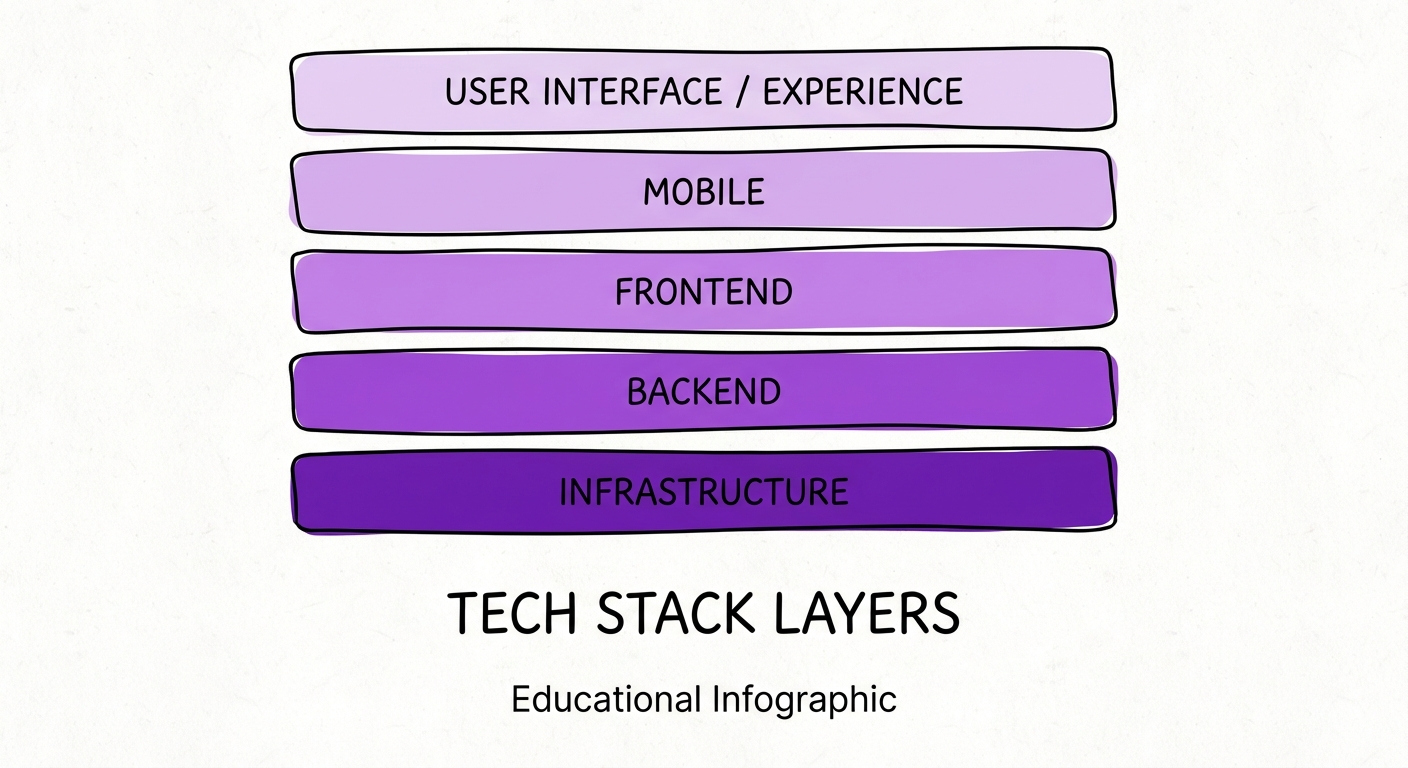
Default Stack (Most Projects)
Frontend:     Next.js 14+ (React, TypeScript)
Backend:      Node.js (TypeScript) or Laravel
Database:     PostgreSQL (primary), Redis (cache)
Auth:         Auth0 or Clerk
Payments:     Xendit (Indonesia), Stripe (global)
Hosting:      Vercel (frontend), Railway or AWS (backend)
Monitoring:   Sentry, Datadog or Grafana Cloud
CI/CD:        GitHub Actions
When We Deviate
| Scenario | Alternative | Why |
|---|---|---|
| High performance needed | Go backend | Better resource efficiency |
| Complex data models | Django | ORM and admin tools |
| Enterprise integration | .NET | Client requirement |
| Real-time heavy | Elixir/Phoenix | Concurrent connection handling |
| Mobile-first | React Native + Expo | Native features needed |
Why TypeScript Everywhere
We use TypeScript on both frontend and backend for:
- Type safety — Catch errors before runtime
- Developer experience — Better autocomplete, refactoring
- Team efficiency — Same language across stack
- Maintainability — Self-documenting code
The productivity gains from full-stack TypeScript outweigh the minor overhead of type definitions.
Tech Stack Checklist
Before finalizing your stack, verify these items:
Hiring & Team
- Can we hire developers for this stack within 30 days?
- Does our current team have experience (or appetite to learn)?
- Is there a strong community for support?
- Are there enough learning resources?
Development
- Can we deploy and iterate quickly?
- Are testing tools mature?
- Does it integrate with our other tools?
- Is the local development experience good?
Operations
- Do we understand the hosting options?
- Can we monitor and debug effectively?
- Do we know how it scales?
- Is the security model clear?
Business
- Does the stack match our timeline?
- Is the total cost (hosting, licenses, talent) acceptable?
- Does it limit our options unfairly?
- Can we evolve it as needs change?
If you can’t answer “yes” to most of these, reconsider your choice.
FAQ
Should I use microservices?
Probably not—at least not yet. Start with a modular monolith. Extract services only when you have clear reasons: independent scaling, different tech requirements, separate team ownership. Most products never need microservices. Those that do usually start as monoliths first.
Is PHP dead?
No. PHP 8.x is a modern, performant language. Laravel is one of the best web frameworks available. Billions of sites run on PHP. The “PHP is dead” meme comes from people who haven’t used modern PHP. Judge technologies by current capabilities, not old reputations.
Should I build a mobile app?
Not until you’ve validated on web. Mobile apps have higher development costs, slower iteration cycles, and app store dependencies. Start with a responsive web app. Add a PWA for offline/install features. Build native only when user behavior demands it.
What about blockchain/Web3?
If you’re building specifically for Web3 use cases (DeFi, NFTs, DAOs), you need Web3 tech. For everything else, traditional databases are simpler, faster, and cheaper. “Put it on the blockchain” is rarely the answer to a real user problem.
How do I migrate from a bad tech choice?
Incrementally, not all at once. Identify the highest-pain areas. Extract or rewrite those components first. Use the strangler fig pattern to gradually replace the old system. Complete rewrites are risky and usually take 2-3x longer than estimated.
Next Steps
Your tech stack should serve your product goals—not the other way around.
Here’s a practical path forward:
- Define your product requirements — What are you building? For whom?
- Assess your team — What do they know? What can you hire?
- Start simple — Choose boring, proven technology
- Validate first — Use our Blueprint process before committing
- Evolve as needed — Add complexity only when you’ve earned it
Technology is a means to an end. The end is a product users love. Don’t let stack decisions distract from that goal.
Need help choosing? Our Blueprint phase includes technical architecture as part of the deliverables. We’ll help you choose a stack that matches your specific needs—not generic best practices.
Related Posts
Need help putting this into practice?
Book a Blueprint session and we'll turn the ideas in this article into your next validated release.
Book a Discovery Call