Guide
SaaS Development Company: How We Build SaaS
Most SaaS products don’t fail because of bad code. They fail because someone built the wrong thing, with the wrong architecture, at the wrong time.
We’ve watched founders burn through $200K building features nobody wanted. We’ve rescued SaaS platforms that couldn’t handle 500 concurrent users because someone chose a monolith when they needed microservices—or microservices when a monolith would’ve been fine.
After 200+ software builds across fintech, healthcare, logistics, and e-commerce, the pattern is obvious: the difference between SaaS products that scale and SaaS products that stall is almost never the technology. It’s the decisions made in the first 6 weeks.
This guide covers what actually matters when building a SaaS product—from architecture to go-to-market—and how we do it at Synetica.
What Does SaaS Development Actually Involve?
SaaS (Software as a Service) development is building software that’s hosted centrally, sold on subscription, and accessed via the browser. Sounds simple. It isn’t.
Unlike traditional software, SaaS products carry ongoing architectural obligations:
- Multi-tenancy — Multiple customers share infrastructure while keeping data isolated
- Subscription billing — Recurring payments, plan upgrades, downgrades, trials, and dunning
- Authentication & authorisation — User management, roles, permissions, SSO, and team-based access
- Continuous deployment — You ship updates to all customers simultaneously
- Availability — Downtime directly equals lost revenue
Building a SaaS product is building a business inside software. Every technical decision has a commercial consequence. Choose the wrong billing model and you’ll haemorrhage margin. Choose the wrong tenancy model and you’ll hit a scaling wall at 100 customers.
This is why picking the right SaaS development company matters more than picking the right framework.
Key Architecture Decisions
These four decisions shape everything downstream. Get them right early or pay to redo them later.
1. Multi-Tenancy Model
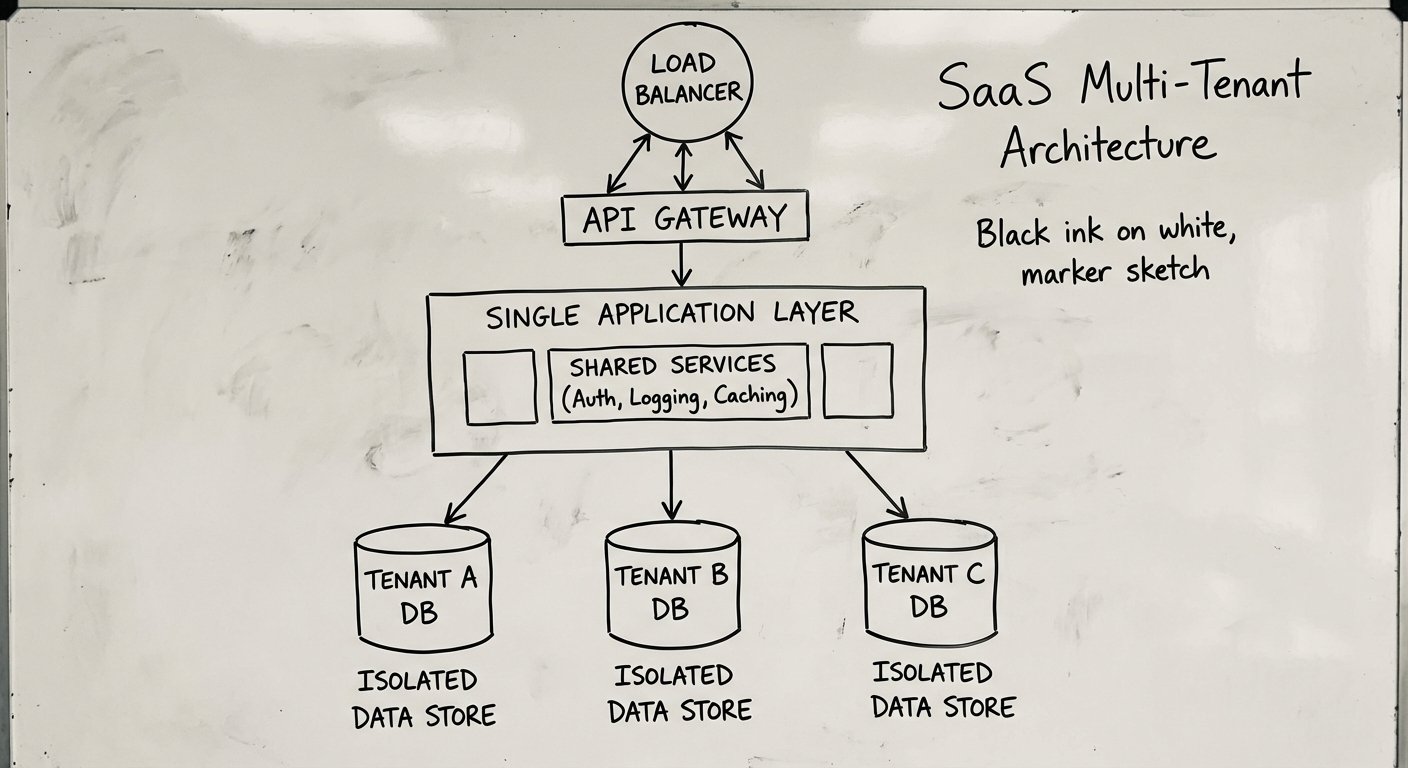
Multi-tenancy is how you serve multiple customers from shared infrastructure.
| Model | How It Works | Best For |
|---|---|---|
| Shared database, shared schema | All tenants in one database, separated by tenant ID | Early-stage SaaS, cost efficiency |
| Shared database, separate schemas | One database, each tenant gets their own schema | Mid-stage, moderate isolation needs |
| Separate databases | Each tenant gets a dedicated database | Enterprise SaaS, compliance-heavy industries |
Our recommendation: Start with shared schema (it’s cheapest and simplest). Move to separate databases only when a customer’s compliance requirements demand it. Most SaaS products never need full isolation.
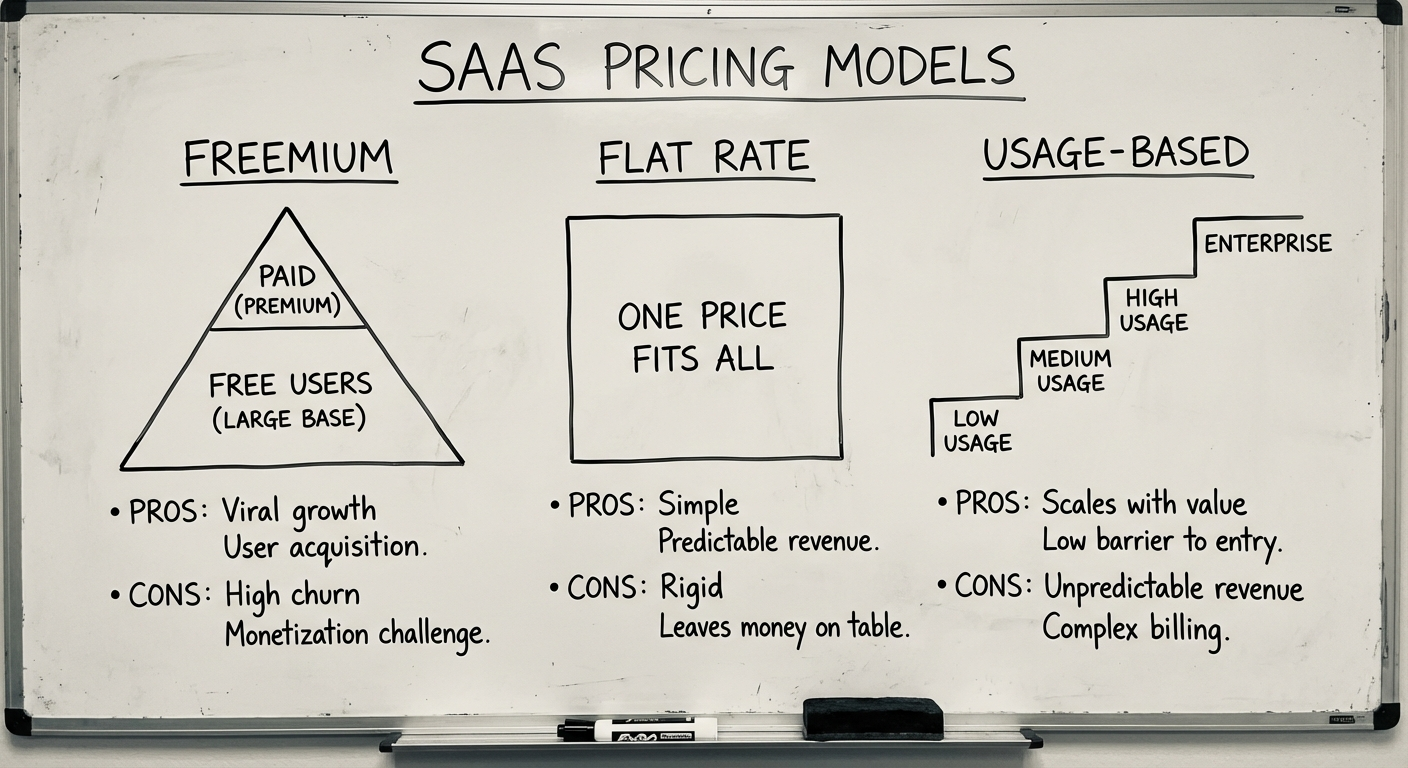
2. Billing & Subscription Management
Billing is the most underestimated complexity in SaaS. It looks simple—charge monthly, done. Then you encounter:
- Pro-rated upgrades mid-cycle
- Usage-based pricing tiers
- Failed payment retry logic (dunning)
- Tax compliance across jurisdictions
- Free trials converting to paid
- Annual vs monthly discounting
Don’t build billing from scratch. Use Stripe Billing or Chargebee. Build your pricing logic on top of their primitives. The hours you save will fund two entire features.
3. Authentication & Authorisation
Modern SaaS needs more than email/password login:
- SSO (Single Sign-On) — Enterprise customers will require SAML or OIDC
- Role-based access control (RBAC) — Admin, editor, viewer, custom roles
- Team/organisation hierarchy — Users belong to organisations, organisations have billing
- API keys — For developer-facing products
Use Auth0, Clerk, or Supabase Auth. Roll your own only if auth IS your product.
4. Scalability Architecture
Design for 10x your current load, not 100x. Over-engineering kills more startups than under-engineering.
Practical scalability checklist:
- Stateless application servers — Scale horizontally without session headaches
- Database read replicas — Separate read-heavy dashboards from write operations
- Background job queues — Move slow tasks (emails, reports, webhooks) out of the request cycle
- CDN for static assets — Don’t serve images from your application server
- Caching layer — Redis for session data, frequently-read configurations, and rate limiting
Start with a well-structured monolith. Extract services only when you have clear, measured bottlenecks.
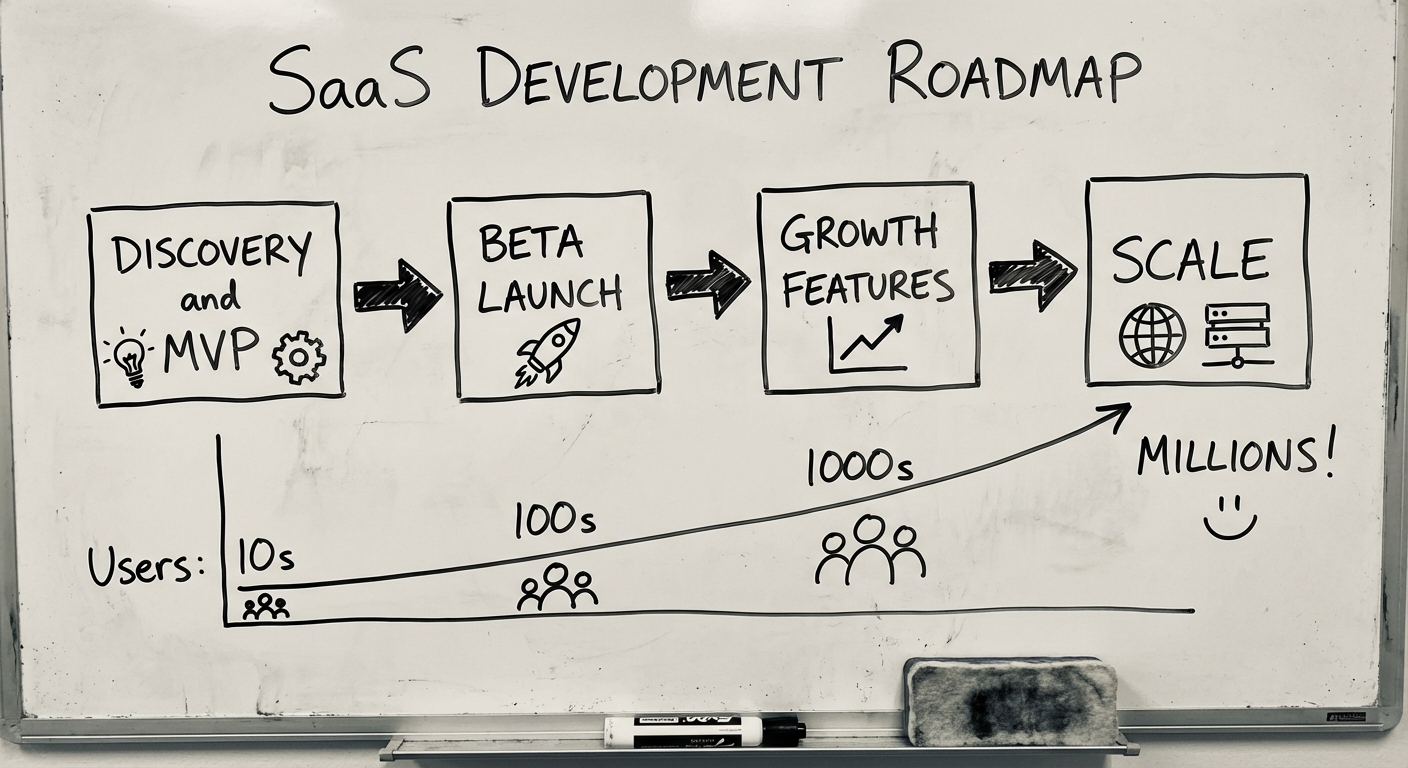
The SaaS Development Process
Every SaaS development company has a “process.” Most are just waterfall with extra steps. Here’s how building SaaS actually works when you’re optimising for speed-to-revenue.
Phase 1: Discovery & Validation (2-4 weeks)
Before writing code, answer three questions:
- Who is the customer? — Not “everyone.” A specific person with a specific pain.
- What’s the current workaround? — If they’re not solving this problem already (even badly), it’s not painful enough.
- What would they pay? — Talk to 10-15 potential customers. If you can’t get 3 to pre-commit, rethink the idea.
Output: Problem definition, user personas, initial feature map, pricing hypothesis.
For a deeper look at discovery, see our Blueprint methodology.
Phase 2: MVP Build (6-10 weeks)
The MVP is the smallest version of your product that delivers the core value proposition. Not a prototype. Not a demo. A usable product that someone would pay for.
MVP scope rules:
- One user type, one core workflow — Resist the “but what about…” impulse
- Manual where possible — Onboarding, billing support, and data migration can be manual at first
- Ugly is fine, broken isn’t — Ship something that works reliably, even if it’s not polished
An MVP that takes longer than 12 weeks isn’t minimal. It’s a Phase 1 product with MVP branding.
Phase 3: Iterate With Real Users (Ongoing)
Once you have paying customers, the product roadmap writes itself:
- Track what users actually do — Not what they say they want. Instrument everything.
- Two-week release cycles — Ship small, measure, adjust
- Kill features that don’t move metrics — Sunk cost is not a product strategy
Phase 4: Scale (When Revenue Demands It)
Scaling is a response to demand, not a precaution. Scale when:
- Response times degrade under real load
- Customer segments need different infrastructure (enterprise vs SMB)
- You’re expanding to new geographies with data residency requirements
Tech Stack for SaaS in 2026
There’s no “best” stack. There’s the stack your team can ship with. That said, here’s what we see working consistently:
| Layer | Recommended Options | Why |
|---|---|---|
| Frontend | Next.js, Remix, Astro | Server-side rendering, great DX, strong ecosystems |
| Backend | Node.js (Express/Fastify), Go, Python (FastAPI) | Fast iteration, strong async support, mature ecosystems |
| Database | PostgreSQL + Redis | Postgres handles 95% of SaaS workloads. Redis for caching and queues |
| Auth | Clerk, Auth0, Supabase Auth | Don’t build your own unless auth is your product |
| Billing | Stripe Billing, Chargebee | Handles 90% of billing complexity out of the box |
| Infra | AWS, Vercel, Railway | AWS for enterprise. Vercel/Railway for speed-to-market |
| Monitoring | Sentry, Datadog, PostHog | Error tracking, performance monitoring, product analytics |
The best tech stack is the one your team already knows. Switching to Rust won’t save your SaaS if you can’t ship features fast enough to retain customers.
Common SaaS Development Mistakes
We’ve seen these patterns across 200+ builds. Each one is expensive to fix after launch.
1. Building Features Before Validating Demand
The most expensive code you’ll ever write is code for a feature nobody uses. Talk to customers first. Always.
2. Under-Investing in Billing Infrastructure
“We’ll just add Stripe later” turns into a 3-month billing rewrite when you need usage-based pricing, multi-currency, or tax compliance.
3. Ignoring Multi-Tenancy Until It’s Too Late
Retrofitting multi-tenancy into a single-tenant application is one of the most painful rewrites in SaaS. Design for tenancy from day one, even if you start with one customer.
4. Over-Engineering for Scale You Don’t Have
Kubernetes, microservices, event-driven architecture—all powerful tools. All overkill for a product with 50 users. A well-structured monolith on a $50/month server can handle more than you think.
5. Skipping Onboarding Design
Your SaaS product’s first 5 minutes determine whether a trial converts. Time-to-value is a product metric, not a marketing metric. Build onboarding flows, not just features.
How Synetica Builds SaaS Products
We’re a SaaS development company that’s also built our own SaaS products. That changes how we think about every project.
Our process follows three phases:
Blueprint (2-4 weeks)
Before any code, we run a structured discovery sprint. This isn’t just requirements gathering—it’s business model validation.
- Market and competitor analysis
- User research and persona mapping
- Technical architecture decisions (tenancy, billing, auth, infra)
- MVP scope definition with clear success metrics
- Detailed technical specification
Output: A complete Blueprint document—your product’s technical and commercial foundation. Learn more about our Blueprint methodology.
Build (8-12 weeks)
We build in 2-week sprints with continuous deployment:
- Week 1-2: Core infrastructure (auth, tenancy, CI/CD pipeline)
- Week 3-6: Core product features (the thing users pay for)
- Week 7-10: Billing integration, onboarding, admin dashboard
- Week 11-12: QA, performance testing, security audit
Every sprint ends with a working demo. You see progress every two weeks, not after three months of silence.
Go-to-Market (2-4 weeks)
Most development companies stop at deployment. We don’t—because a deployed product isn’t a launched product.
- Landing page and conversion funnel setup
- Analytics and product instrumentation
- Customer onboarding flow testing
- Monitoring and alerting configuration
- Launch support and first-customer handholding
We measure success by your first 10 paying customers, not by lines of code shipped.
Costs & Timeline
Transparency matters. Here’s what SaaS development actually costs in 2026:
| Phase | Timeline | Investment |
|---|---|---|
| Blueprint | 2-4 weeks | $5,000-$15,000 |
| MVP Build | 8-12 weeks | $40,000-$120,000 |
| Post-Launch Iteration | Ongoing | $8,000-$25,000/month |
Total to first revenue: 12-16 weeks, $50,000-$135,000.
These ranges depend on complexity. A simple B2B tool with 3 user roles costs less than a marketplace with real-time features, payment escrow, and mobile apps.
What drives cost up:
- Complex billing logic (usage-based, multi-currency)
- Real-time features (chat, collaboration, live dashboards)
- Compliance requirements (SOC 2, HIPAA, data residency)
- Multiple platforms (web + iOS + Android)
- Third-party integrations (ERP, CRM, payment gateways)
For a detailed breakdown of software development costs, see our complete guide to custom software development.
Ready to Build Your SaaS Product?
The best time to start building was when you first had the idea. The second best time is now—but with a plan.
If you’re serious about building a SaaS product, start with a conversation. We’ll tell you honestly whether your idea needs custom development, an off-the-shelf solution, or more validation before either.
No pitch decks. No 47-slide proposals. Just a straight conversation about what you’re trying to build and the fastest path to revenue.
Need help putting this into practice?
Book a Blueprint session and we'll turn the ideas in this article into your next validated release.
Book a Discovery Call