Industry
From Agency to Product Studio: Why the Model Is Shifting
For 20 years, the software agency model stayed roughly the same: client has an idea, agency estimates hours, team builds to spec, client launches, relationship ends (or continues with maintenance).
This model works—for certain projects. But it’s fundamentally misaligned with how successful products actually get built.
The shift we’re seeing now isn’t just a rebrand. Agencies calling themselves “product studios” aren’t just chasing buzzwords. The underlying model is changing in ways that matter for anyone building software.
Here’s what’s different, why it matters, and how to evaluate which model fits your needs.
The Traditional Agency Model
The agency model emerged when software development was expensive, specialized, and scarce. Companies needed software but didn’t have developers. Agencies filled the gap.
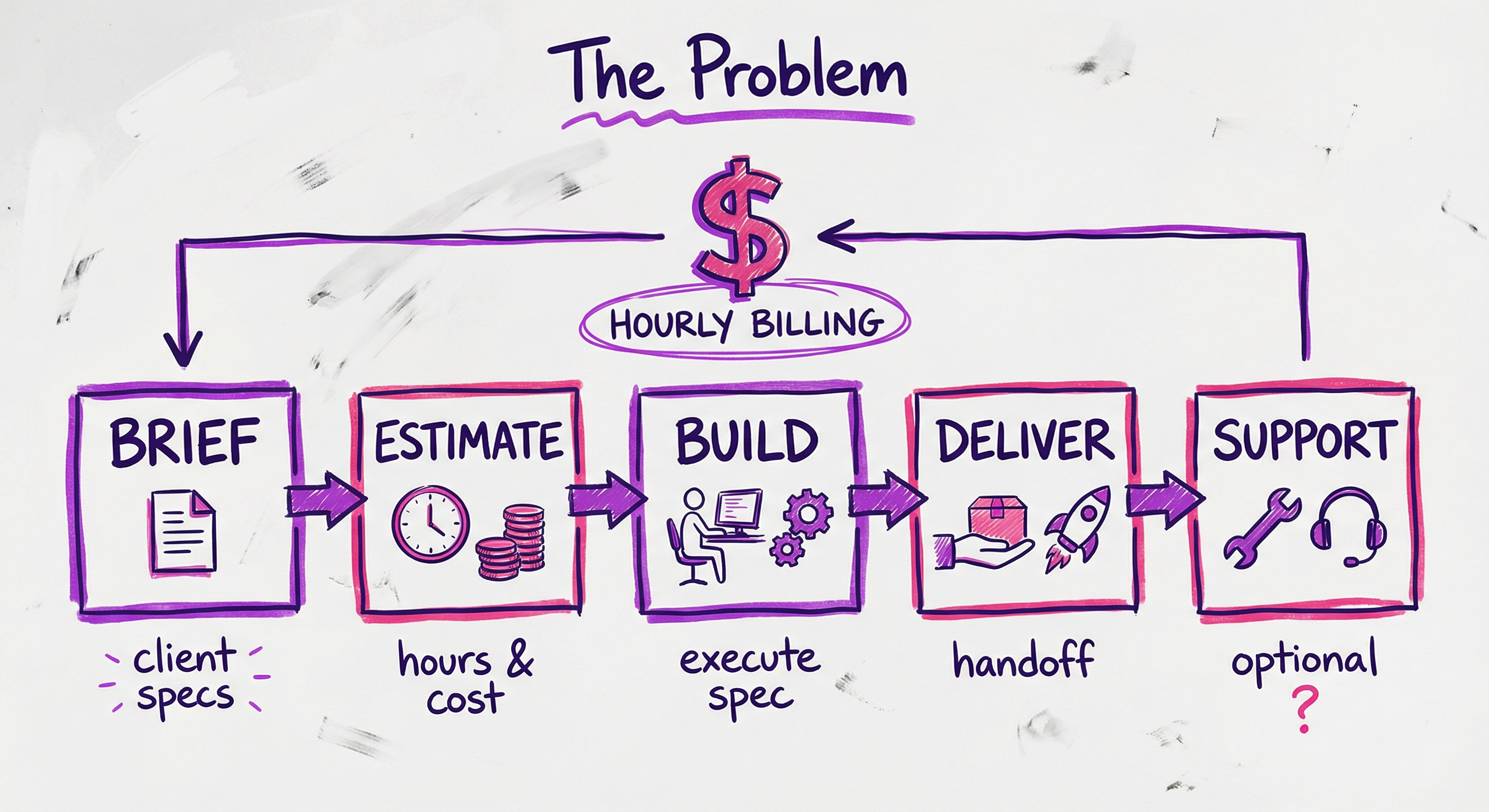
How It Works
- Brief: Client describes what they want
- Estimate: Agency scopes hours and cost
- Build: Developers execute the specification
- Deliver: Working software is handed over
- Support: Optional maintenance contract
The Incentive Structure
Agencies make money by billing hours. This creates predictable incentives:
- More scope = more revenue. Agencies aren’t motivated to cut features.
- Longer projects = more revenue. Efficiency isn’t directly rewarded.
- Client satisfaction = repeat business. But satisfaction often means “built what was asked for,” not “built what succeeded.”
Who It Serves Well
The agency model works when:
- Requirements are clear and stable
- The client has product expertise internally
- Success means “working software,” not “successful product”
- Budget is fixed and scope is flexible
Classic examples: corporate websites, internal tools, one-time integrations.
What’s Broken About Agencies
For products that need to find market fit, the agency model has structural problems.
Problem 1: Wrong Success Metric
Agencies are measured by delivery: Did we build what was specified? Products are measured by outcomes: Did users adopt it? Did the business grow?
These metrics diverge constantly. You can deliver exactly what was specified and still build something nobody wants. In fact, this happens most of the time—80% of products fail, even when built to spec.
Problem 2: The Requirements Paradox
Agency projects start with requirements. But requirements are assumptions—guesses about what users need.
The traditional process:
- Client writes requirements (assumptions)
- Agency builds requirements (assumptions made concrete)
- Product launches (assumptions meet reality)
- Reality often disagrees
By the time you learn requirements were wrong, the budget is spent.
Problem 3: Misaligned Incentives
When agencies bill hourly:
- Recommending simpler solutions = less revenue
- Suggesting “don’t build this” = no project
- Finishing early = less billing
- Scope creep = opportunity
This isn’t malice—it’s economics. People work toward how they’re measured.
Problem 4: Knowledge Walks Out the Door
At project end, the agency moves to other clients. The accumulated knowledge about your users, technology, and domain leaves with them.
You’re left with code but not context. When something needs to change, you’re starting from scratch—either relearning internally or briefing a new agency.
The Product Studio Model
Product studios emerged from a simple observation: the agency model rewards the wrong thing.
Core Philosophy
Studios focus on product success, not just delivery completion.
This changes everything:
- Success is measured by user adoption and business metrics
- The studio is a partner in outcomes, not a vendor for hours
- Work continues until the product works, not until the contract ends
How It Works
- Discovery: Understand the problem and users—before defining solutions
- Validation: Test assumptions with real users—before building fully
- Build: Develop iteratively based on evidence
- Launch: Get real users, measure what matters
- Iterate: Learn and improve continuously
The Incentive Structure
Good product studios align incentives with outcomes:
- Flat phases with clear milestones (not hourly billing)
- Skin in the game (equity, success fees, or long-term partnerships)
- Reputation on outcomes (case studies focus on product success, not just delivery)
When the studio wins only if the product wins, incentives align.
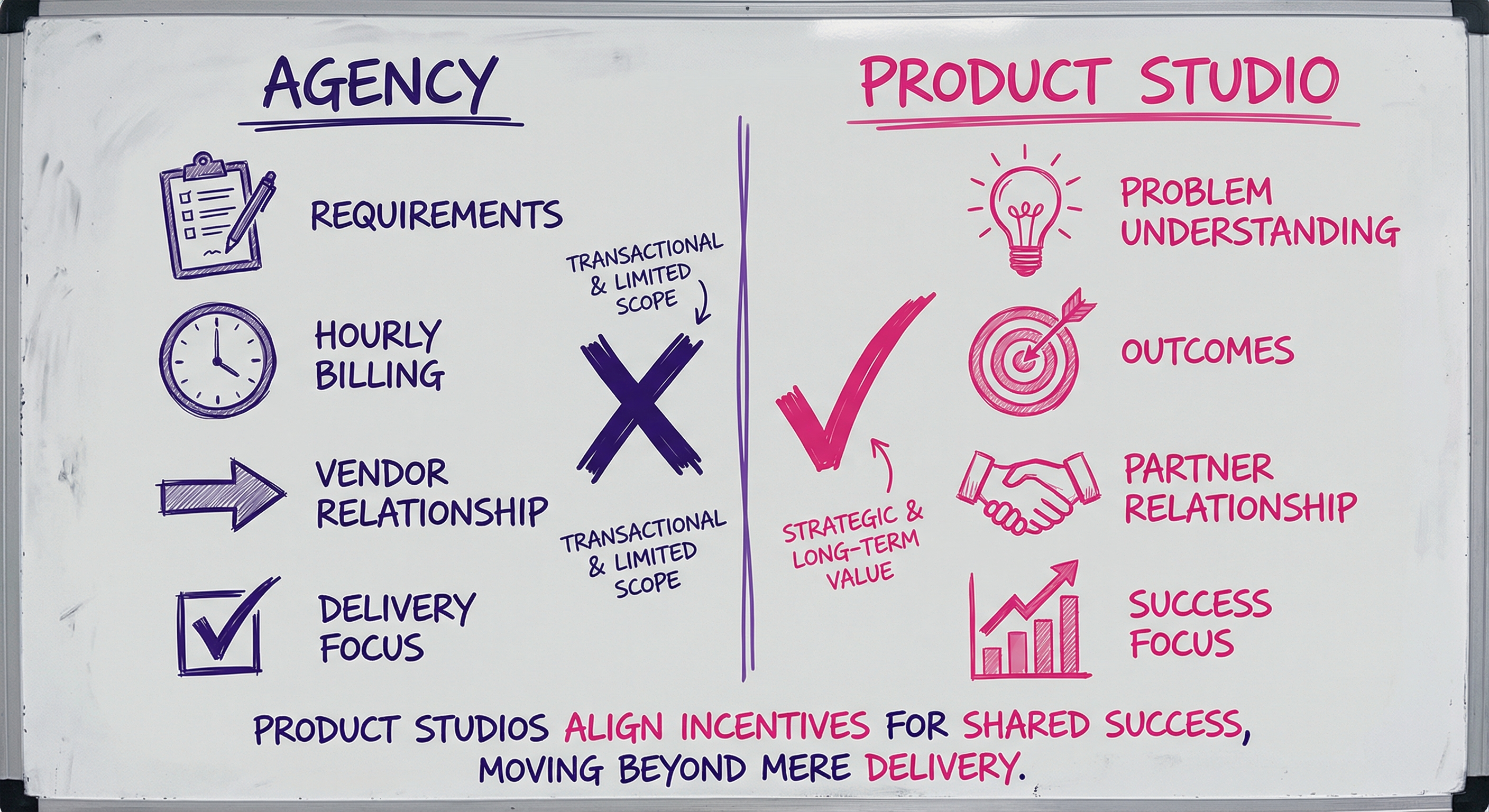
Key Differences
| Aspect | Agency | Product Studio |
|---|---|---|
| Starts with | Requirements | Problem understanding |
| Measures | Delivery | Outcomes |
| Billing | Hourly/project | Phase-based/outcome-aligned |
| Relationship | Vendor | Partner |
| Duration | Project-based | Ongoing (often) |
| Expertise | Execution | Strategy + execution |
| Risk | On client | Shared |
How to Spot the Difference
Many agencies now call themselves studios. Here’s how to tell if the model actually changed:
1. How Do They Start Projects?
Agency behavior: “Send us your requirements and we’ll estimate.”
Studio behavior: “Let’s understand your users and validate assumptions first.”
If they’ll quote a six-month build based on a slide deck, they’re an agency wearing studio clothing.
2. What’s in Their Case Studies?
Agency case studies: “We built an app with X features using Y technology.”
Studio case studies: “The product achieved X users / Y revenue / Z conversion rate.”
If they never mention outcomes—only outputs—they’re not thinking like a product studio.
3. How Do They Handle “Bad” Ideas?
Agency response: “Sure, we can build that. Here’s the estimate.”
Studio response: “Let’s test that assumption before committing resources.”
Studios should push back. They should challenge requirements. If they agree to everything, they’re order-takers.
4. What’s Their Discovery Process?
Agency discovery: “Let’s review your PRD and estimate.”
Studio discovery: “Let’s do user research and validate the core assumptions.”
If they skip user involvement, they’re building on guesses—and they know it.
5. How Do They Price?
Agency pricing: Hourly rates, time estimates, change orders.
Studio pricing: Fixed-price phases, clear deliverables, outcome milestones.
Pricing structure reveals incentives. Hourly billing creates agency behavior regardless of what they call themselves.
When Each Model Works
Neither model is universally better. Context matters.
Choose an Agency When:
- Requirements are truly fixed. Government contracts, compliance systems, exact replicas.
- You have internal product expertise. Your team knows what to build; you need hands.
- Budget is absolute. You can’t afford discovery; you need execution.
- The project is truly one-time. No iteration expected.
- Speed matters more than fit. You need something shipped, even if imperfect.
Choose a Product Studio When:
- You’re building a new product. Market fit is unproven.
- Requirements are assumptions. You think you know what users need, but haven’t validated.
- Success means outcomes, not output. Revenue, users, engagement—not just working software.
- You need a thinking partner. Not just hands, but minds.
- You plan to iterate. The first version is the beginning, not the end.
The Hybrid Case
Some projects start as studio engagements (discovery, MVP) and evolve into agency-style relationships (scale, maintain). That’s fine—the model should match the phase.
The Synetica Approach
We built Synetica as a product studio because we saw the agency model fail too many times.
Our Model: 2B2G
Blueprint → Build → Go-to-Market → Grow
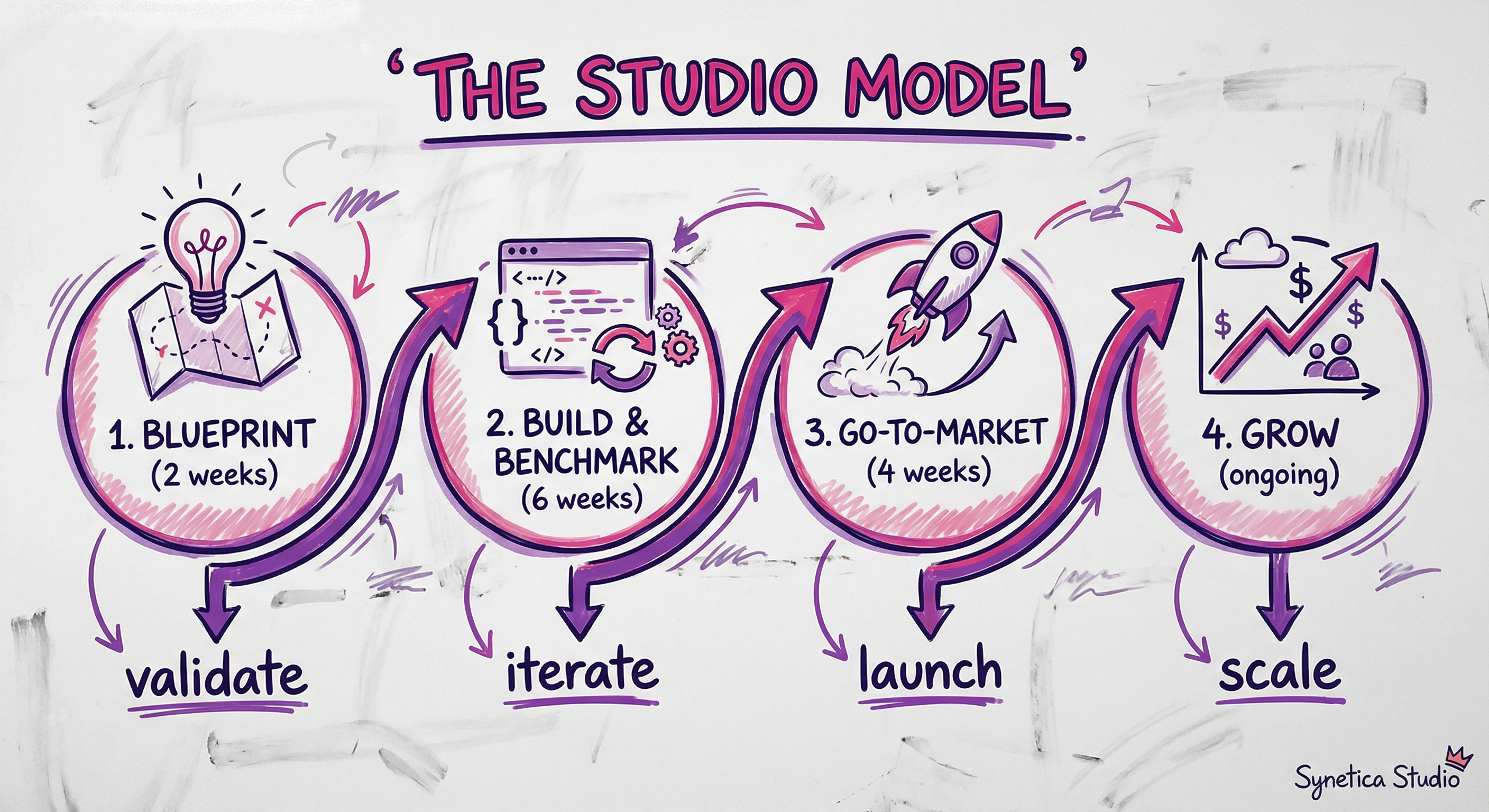
Phase 1: Blueprint (2 weeks)
- User research and assumption mapping
- Validation experiments
- Evidence-based roadmap
- Go/no-go decision point
Phase 2: Build & Benchmark (6 weeks)
- MVP development with real users
- Marketing budget from day one
- Weekly iterations based on data
- Launch to actual market
Phase 3: Go-to-Market (4 weeks)
- Scale what works
- Optimize conversions
- Establish sustainable growth
Phase 4: Grow (ongoing)
- Product iteration based on metrics
- Feature development tied to outcomes
- Strategic partnership
Why This Works
Each phase has clear success criteria. Blueprint might reveal the idea won’t work—that’s a success (we saved months of build). Build might reveal users need something different—we iterate.
We don’t get paid more if projects drag on. We get paid for phases with outcomes. If we help you succeed, you come back. If we don’t, you shouldn’t.
What We Don’t Do
- Build from requirements without validation
- Take on projects where we can’t impact outcomes
- Bill hourly (except specific support cases)
- Optimize for project size over client success
This means we turn down projects that don’t fit. That’s okay—we’re not trying to be the biggest. We’re trying to be the best at products that succeed.
FAQ
Is the product studio model more expensive?
Often no—and frequently cheaper when you count outcomes.
Studios spend time on validation that agencies skip. That feels like “extra cost.” But studios also cut features that won’t work, pivot early when needed, and avoid building the wrong thing.
A $50K studio engagement that produces a validated product is cheaper than a $40K agency project that produces something nobody uses.
Can I use a studio for just part of the project?
Yes. Common patterns:
- Studio for discovery + MVP, internal team for scale
- Studio for strategy + validation, agency for execution
- Studio for the first product, agency for subsequent features
Match the model to the uncertainty level. High uncertainty = studio. Low uncertainty = agency (or internal).
How do I evaluate product studio claims?
Ask for:
- Case studies with outcome metrics (not just “we built X”)
- References from founders, not just project managers
- Their process for handling invalidated assumptions
- How they’ve pivoted or killed projects
True studios will have stories of projects they stopped or significantly changed mid-stream.
What if I have fixed requirements that can’t change?
Then you need execution, not discovery. An agency might be the right fit.
But question whether requirements truly can’t change. Often “fixed requirements” means “we haven’t validated these, so let’s just assume they’re right.” That’s the path to the 80% failure rate.
The Shift Is Real
The agency-to-studio shift isn’t marketing. It’s a response to reality: most software projects fail, and the agency model doesn’t address why.
Studios address the root cause—building on assumptions—by making validation part of the process.
Not every project needs a studio. Not every studio delivers on the promise. But the model itself is better aligned with how successful products actually get made.
Ready to explore whether the studio model fits your project? Book a discovery call and let’s discuss your specific situation.
Related Posts
Need help putting this into practice?
Book a Blueprint session and we'll turn the ideas in this article into your next validated release.
Book a Discovery Call