Guide
AI Development Company: Choosing an AI-Native Partner
Everyone wants AI now. The boardroom heard about it, the competitors claim they’re using it, and suddenly you need an ai development company yesterday.
Here’s the problem: the market is flooded with firms that slapped “AI” onto their existing dev shop landing page sometime around 2023. Some are genuinely brilliant. Others will burn through your budget building a demo that never makes it to production.
Choosing the wrong AI partner doesn’t just waste money—it poisons your organisation’s trust in AI altogether. We’ve seen it happen. A failed pilot becomes “we tried AI and it didn’t work,” when the real issue was the wrong team, wrong scope, or wrong approach entirely.
There’s a second shift hiding inside the first: AI isn’t just something partners build for you—it’s transforming how the partners themselves work. The firms worth hiring in 2026 are AI-native: they use AI to move faster, and they have the engineering discipline to verify everything it produces. This guide helps you tell the difference.
TL;DR — the whole guide in five lines:
- AI-native partners use AI for speed and humans for verification — a firm with only one half of that bargain is a risk you inherit.
- Evaluate production, not prototypes — ask how many models are still running, who owns MLOps, and for before/after metrics from a deployed system.
- Data quality decides 80% of AI project success — a partner who skips the data conversation is optimising for the sale, not the outcome.
- For SaaS-with-AI builds, probe four architecture calls — multi-tenancy, billing, auth, and designing for 10x load (not 100x).
- A $20K feasibility study that kills a bad idea saves $200K — never sign a full build before the data is validated.

What Does an AI Development Company Actually Do?
An ai development company builds intelligent systems that learn from data, make predictions, or automate decisions that previously required human judgement.
That sounds simple. It isn’t.
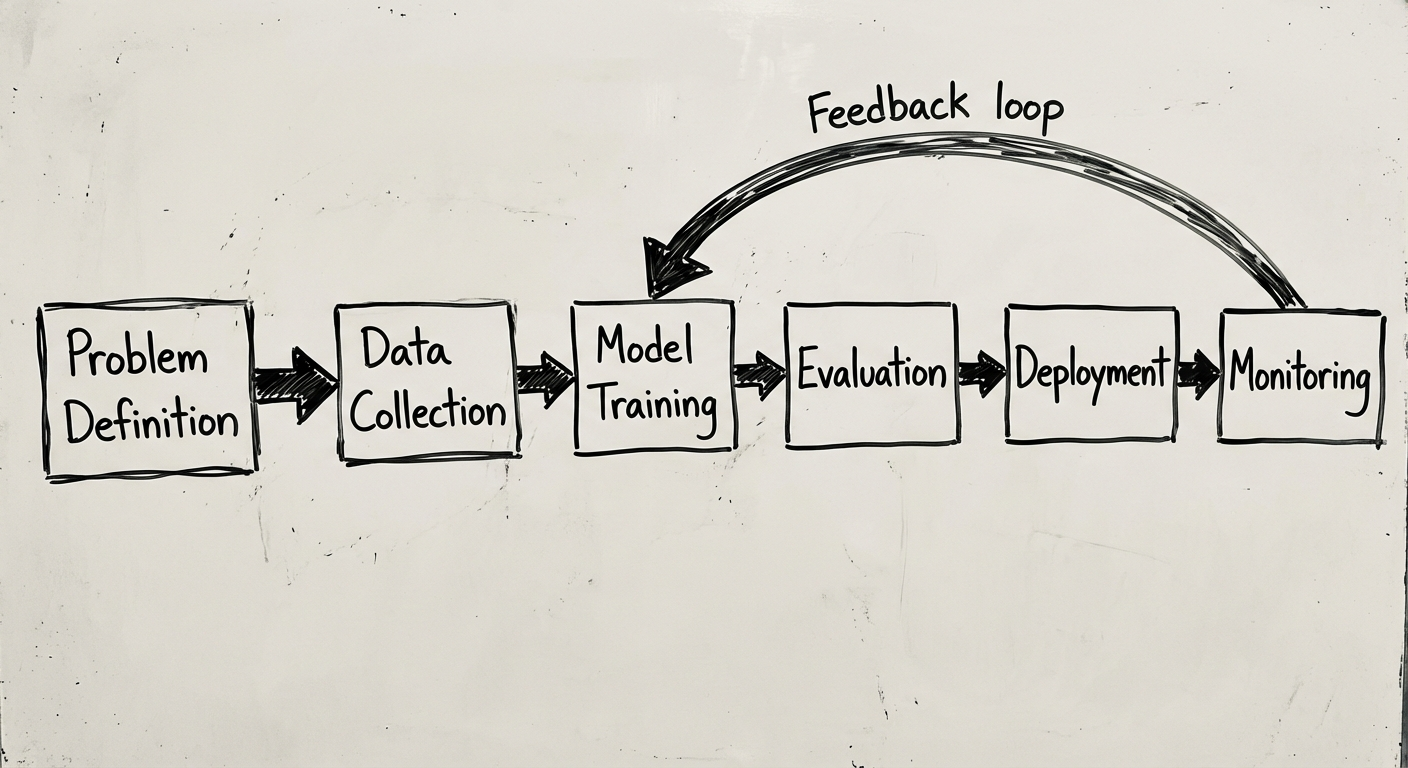
Unlike traditional software development—where you define inputs, logic, and outputs upfront—AI systems are probabilistic. They deal in confidence scores, training data, and model accuracy. The development process looks fundamentally different:
- Data assessment and preparation — Often 60-80% of the project timeline
- Model selection and training — Choosing the right algorithm for the problem
- Integration engineering — Connecting AI outputs to your existing systems
- Monitoring and retraining — Models degrade over time as data patterns shift
- MLOps infrastructure — The plumbing that keeps models running in production
A good AI partner handles all of this. A mediocre one builds a notebook in Jupyter and calls it a day.
If you’re also evaluating broader software partners, our custom software development guide covers the fundamentals of choosing any development partner.
Types of AI Projects
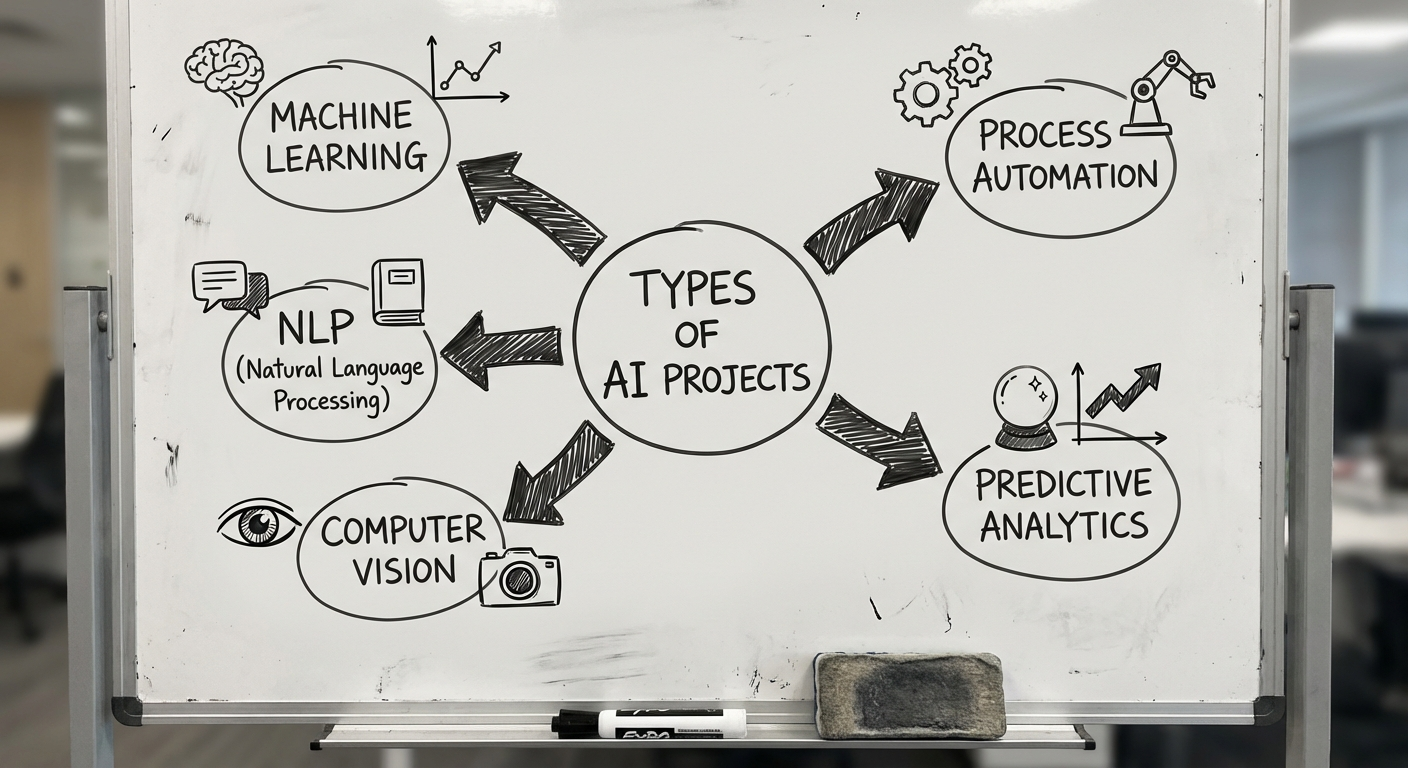
Not all AI is created equal. Understanding the category helps you evaluate whether a company has relevant experience.
Machine Learning Models
The bread and butter. Predictive models that learn patterns from historical data: demand forecasting, churn prediction, credit scoring, recommendation engines. These require clean data pipelines and solid statistical foundations.
Natural Language Processing (NLP)
Making machines understand and generate human language. Chatbots, document classification, sentiment analysis, summarisation. Post-GPT, the landscape has shifted dramatically—many NLP tasks that required custom models can now be solved with well-orchestrated LLM APIs.
Computer Vision
Teaching systems to interpret images and video. Quality inspection on manufacturing lines, medical imaging analysis, security monitoring, OCR for document processing. These projects are hardware-adjacent and often require edge deployment.
Process Automation (Intelligent RPA)
Going beyond simple rule-based automation. AI-powered automation handles the messy cases that traditional RPA chokes on—invoices with inconsistent formats, emails that need judgement calls, data entry from unstructured sources.
AI Integration & Augmentation
Not building models from scratch, but integrating existing AI capabilities (OpenAI, Google Cloud AI, AWS Bedrock) into your products and workflows. This is increasingly the smart play—using frontier models as building blocks rather than reinventing them.
AI Is Transforming the Firms You Hire, Too
Before evaluating partners, it’s worth understanding what AI is doing to professional services as a whole—because the same forces reshaping consultancies are reshaping development shops, and they explain what “AI-native” actually means.
ChatGPT hit 100 million users in two months—the fastest adoption of any technology in history. 73% of Southeast Asian companies are using or planning to use AI in operations. Information that used to be the expert’s exclusive domain—tax rules, code patterns, architecture templates—is now available to everyone in seconds.
What AI Can and Cannot Do
| AI excels at | AI struggles with |
|---|---|
| Answering factual questions | Business-specific context |
| Standard calculations and code generation | Judgement calls requiring risk assessment |
| Summarising regulations and documentation | Gray-area interpretation |
| Generating templates, drafts, boilerplate | Relationships and negotiation |
| Automating repetitive tasks | Accountability when things go wrong |
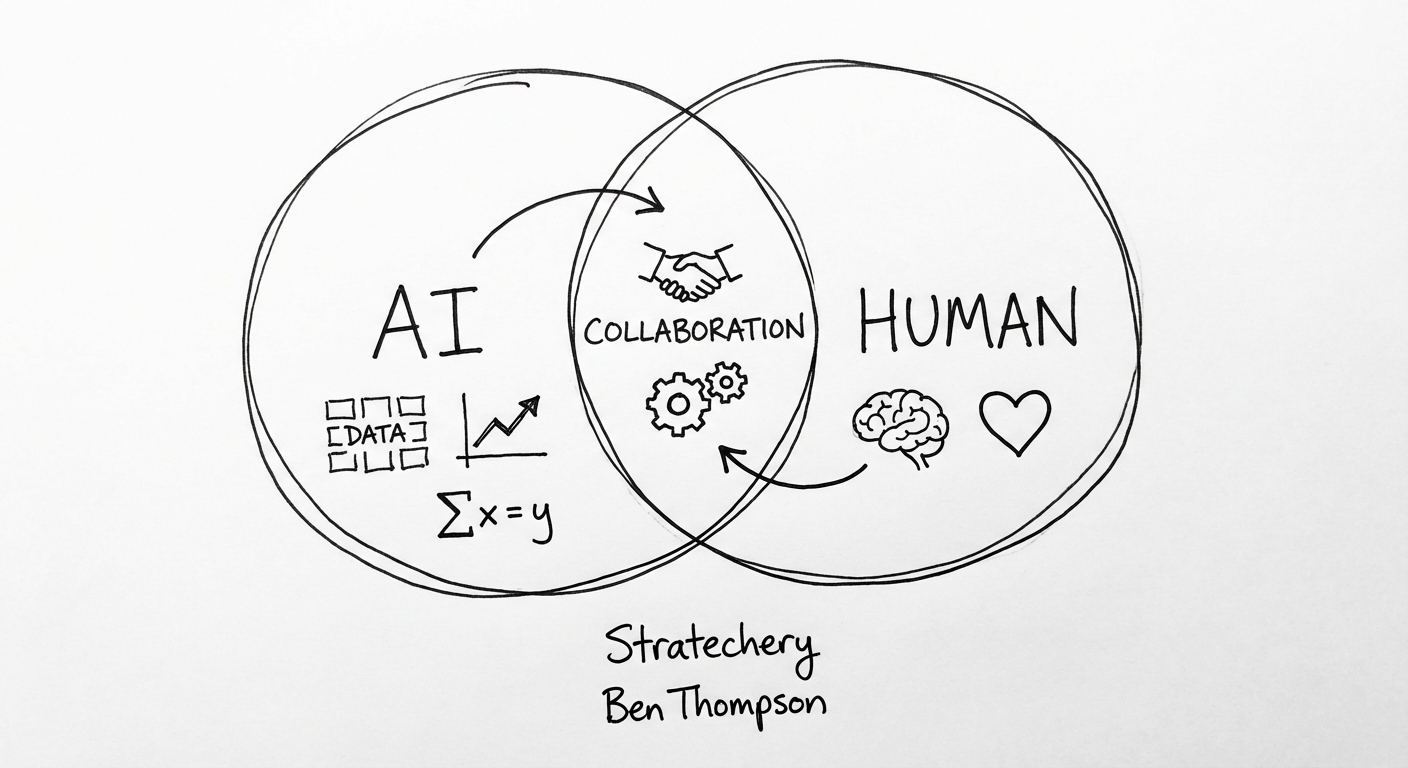
The key insight: AI masters information. Humans master wisdom—the judgement that comes from experience and context.
The Three Forces at Work
- Commodity services are under pricing pressure. Routine returns, standard calculations, boilerplate CRUD apps—clients rightly ask why they’re paying expert rates for work software does for a fraction of the price.
- Client expectations are rising. People who use AI daily now expect instant responses, transparent pricing, self-service dashboards, and proactive insights. The bar has moved; meeting it is table stakes.
- But complexity is rising too. Digital-economy regulation, integration sprawl, security obligations. The paradox: more information available means more people realise they don’t know what they don’t know.
What This Means for Choosing a Partner
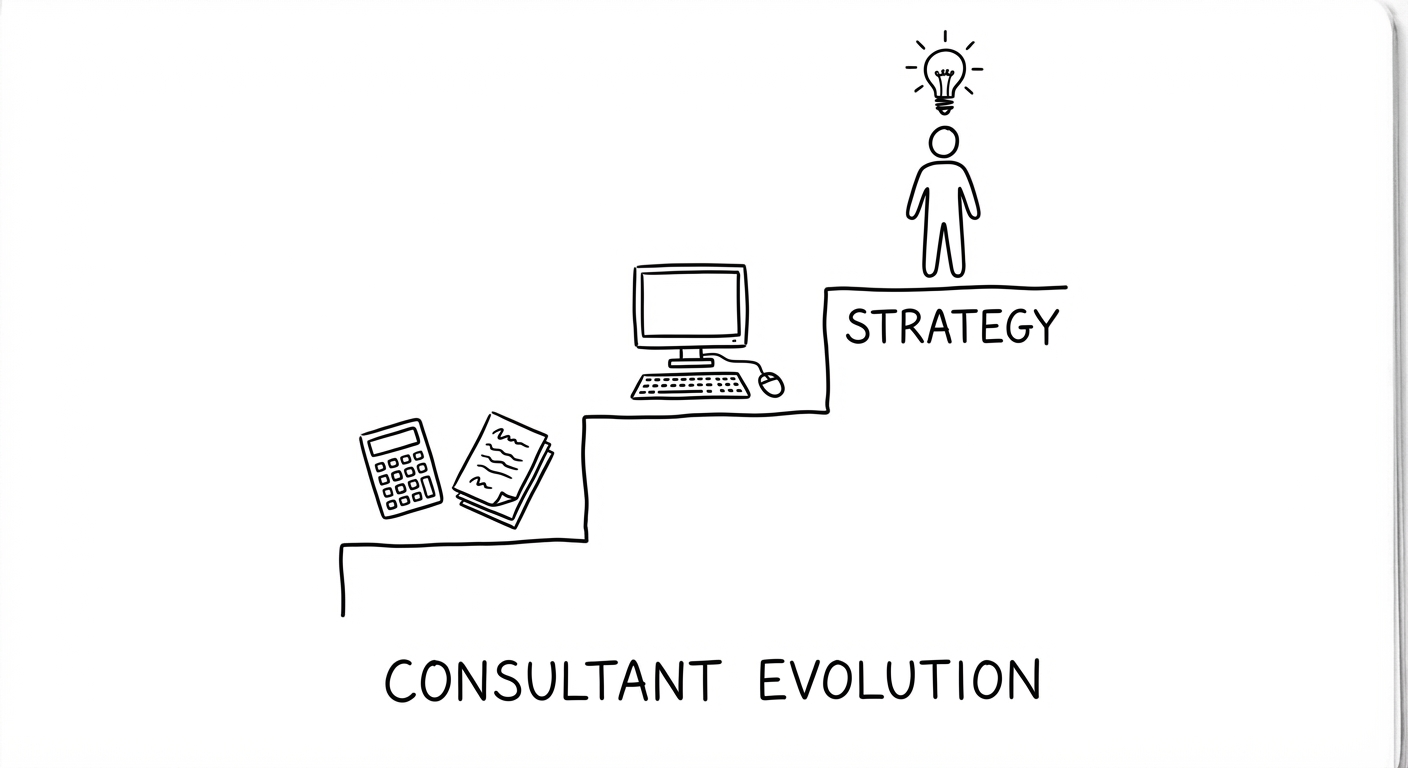
The firms that survive this shift move up the value chain—from “we execute tasks” to “we make judgement calls in your business context.” They adopt AI aggressively as a tool, specialise deeply, and increasingly offer hybrid service models: AI-powered tier-one work, human review for complex cases, full advisory for strategic matters.
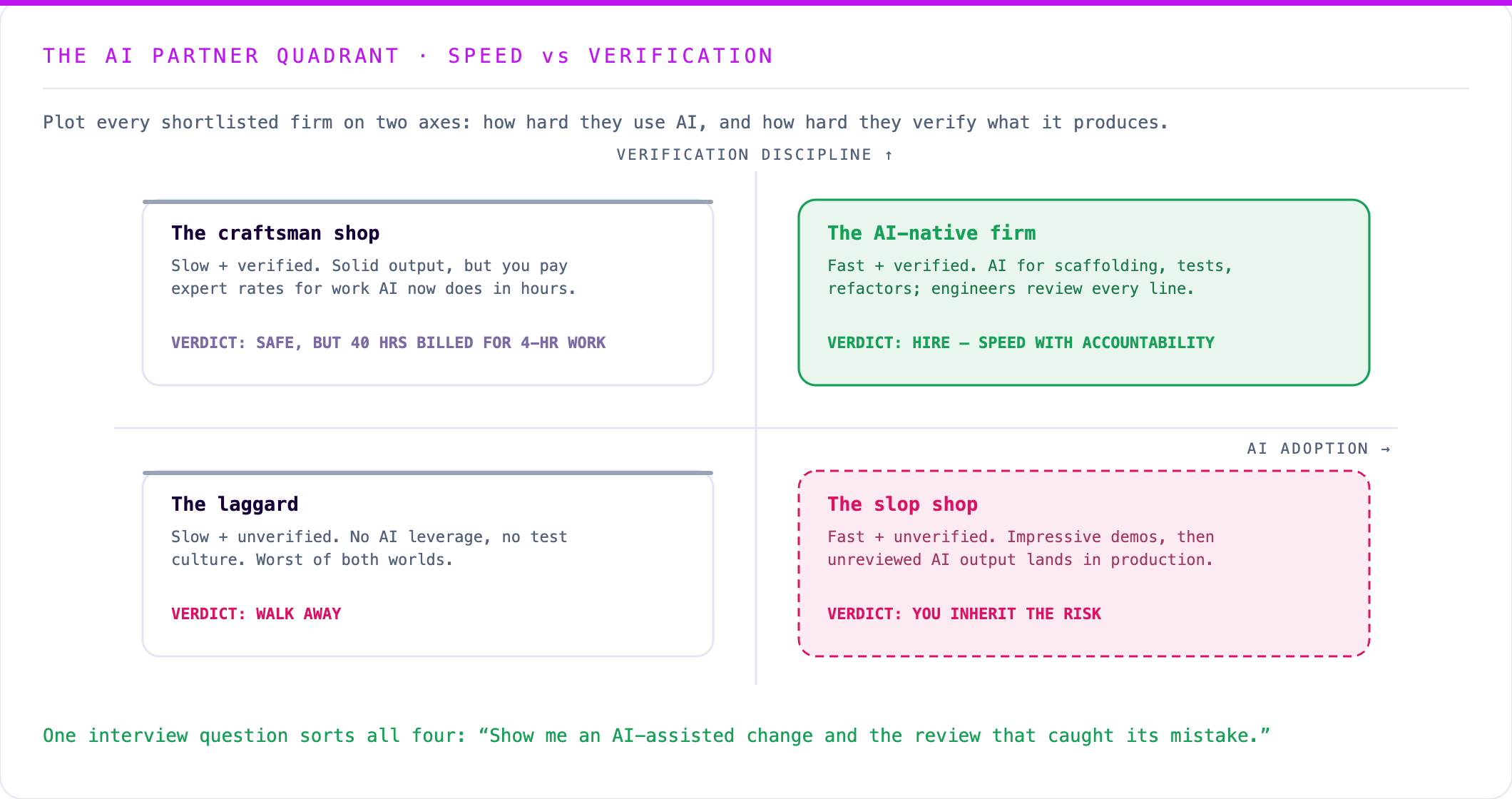
AI won’t replace good development partners. But partners who use AI will replace those who don’t. So when you evaluate a firm, ask how they use AI internally. A partner that bills 40 hours for work AI does in four is charging you for their own inefficiency. A partner that uses AI with no verification process is shipping you unreviewed risk. You want the firm that does both halves: AI for speed, humans for judgement and accountability.
Validate it in 2 weeks. Before committing to any AI build, a Blueprint session assesses your data, defines success metrics, and tests a prototype slice with real users — see how Blueprint & Prototype works.
How to Evaluate an AI Development Partner
This is where most buyers get it wrong. They evaluate AI companies the same way they’d evaluate a web agency. The criteria are different.
1. Portfolio: Production, Not Prototypes
Ask specifically about models that went to production and stayed there. Anyone can build a demo. The hard part is deploying a model that handles real-world data, edge cases, and scale.
Questions to ask:
- “How many of your AI projects are currently running in production?”
- “What’s the longest a client has maintained one of your models?”
- “Can you show me before/after metrics from a deployed system?”
If they can only show you Kaggle competitions and proof-of-concepts, keep looking.
2. Team Composition
A real AI team isn’t just data scientists. Look for:
- ML Engineers — Bridge the gap between research and production
- Data Engineers — Build the pipelines that feed models
- Domain Specialists — Understand your industry’s data patterns
- DevOps/MLOps — Keep models running, monitored, and updated
If a company can’t explain who on their team handles MLOps, they probably don’t have anyone. And that means your model dies the day after deployment.
3. Methodology: How They Handle Uncertainty
AI projects carry more uncertainty than traditional software. Good partners acknowledge this with:
- Feasibility phases before committing to full builds
- Clear success metrics defined upfront (accuracy thresholds, latency requirements)
- Iterative development with regular model performance reviews
- Honest communication when the data doesn’t support the desired outcome
Bad partners promise 99% accuracy in the proposal.
4. Ethics and Data Governance
This matters more than most buyers realise. Ask about:
- Bias testing — How do they detect and mitigate model bias?
- Data privacy — Where does your data live during training? Who has access?
- Explainability — Can the model’s decisions be explained to regulators or customers?
- Compliance — Are they familiar with your industry’s regulatory requirements?
If they look confused when you ask about bias testing, that tells you everything.
Red Flags: When to Walk Away
Years of working in this space have taught us the warning signs. Here’s what should make you nervous:
🚩 “We can do any AI project”
Genuine AI expertise is specialised. A company that claims equal competence in computer vision, NLP, reinforcement learning, and robotics is either massive (think Google) or lying. Good firms know what they’re great at and refer out the rest.
🚩 No discussion of data quality
If a company jumps straight to model architecture without asking about your data, they’re building a house on sand. Data quality determines 80% of AI project success. Any partner who skips this conversation is optimising for the sale, not the outcome.
🚩 Proprietary lock-in
Watch out for companies that:
- Won’t give you access to your own model weights
- Build on proprietary frameworks you can’t maintain without them
- Don’t provide documentation or knowledge transfer
- Make it contractually difficult to leave
🚩 No MLOps story
“We build it, you maintain it” is a red flag when the company hasn’t invested in MLOps. Models need monitoring, retraining triggers, data drift detection. If there’s no plan for Day 2, you’re buying a depreciating asset.
🚩 Buzzword density exceeds substance
If the proposal mentions “revolutionary,” “disruptive,” and “cutting-edge” more often than specific methodologies, accuracy targets, and data requirements—it’s marketing, not engineering.
If You’re Building a SaaS Product: The Extra Evaluation Layer
A large share of AI development engagements are really SaaS engagements with AI inside. If that’s you, your partner needs more than ML skills—building a SaaS product is building a business inside software. Every technical decision has a commercial consequence, and most SaaS products don’t fail because of bad code. They fail because someone built the wrong thing, with the wrong architecture, at the wrong time. The difference between SaaS products that scale and SaaS products that stall is almost never the technology—it’s the decisions made in the first 6 weeks.
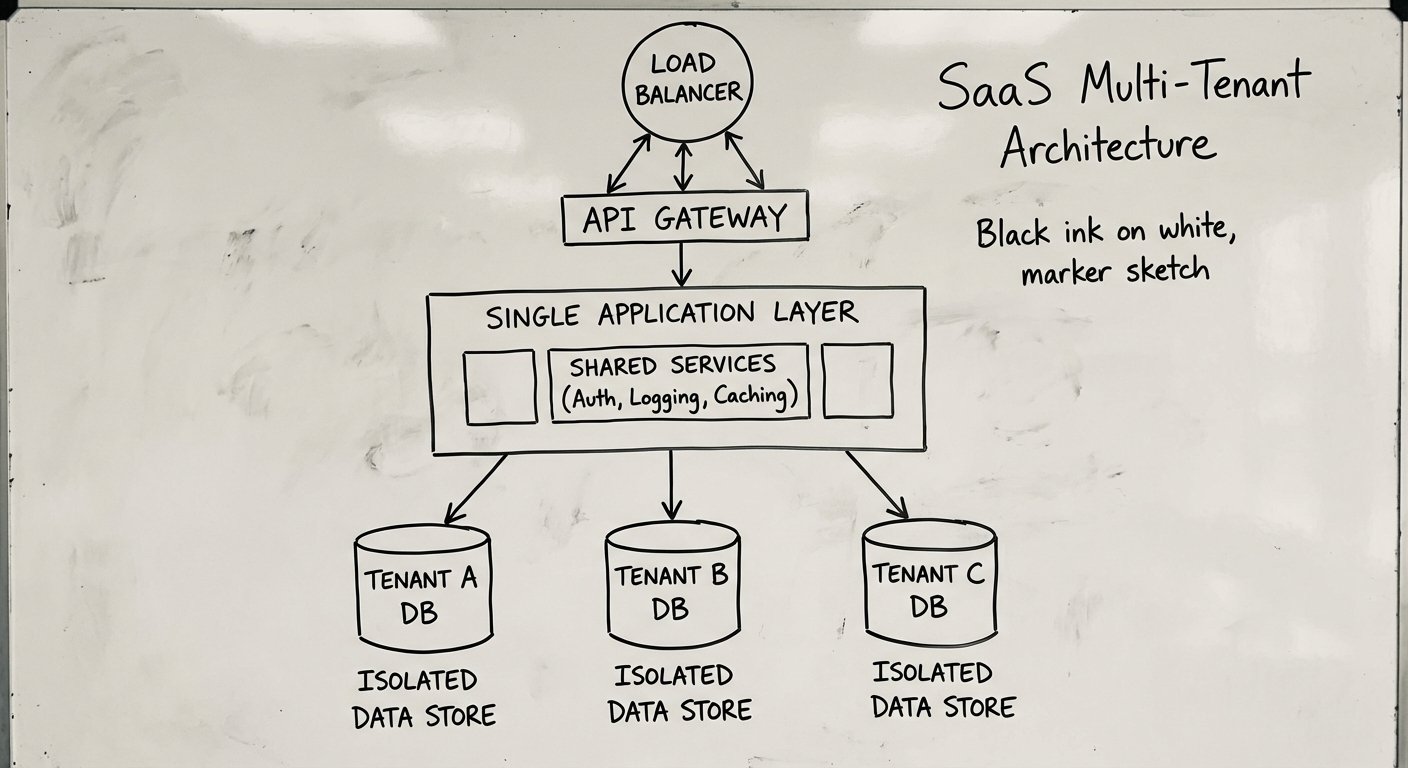
Four Architecture Decisions to Probe Your Partner On
1. Multi-tenancy. How will multiple customers share infrastructure while keeping data isolated?
| Model | How It Works | Best For |
|---|---|---|
| Shared database, shared schema | All tenants in one database, separated by tenant ID | Early-stage SaaS, cost efficiency |
| Shared database, separate schemas | One database, each tenant gets their own schema | Mid-stage, moderate isolation needs |
| Separate databases | Each tenant gets a dedicated database | Enterprise SaaS, compliance-heavy industries |
A good partner recommends starting with shared schema and moving to isolation only when compliance demands it. Retrofitting multi-tenancy later is one of the most painful rewrites in SaaS—design for tenancy from day one, even with one customer.
2. Billing. The most underestimated complexity in SaaS: pro-rated upgrades, usage tiers, dunning, tax compliance, trial conversion. The right answer is almost always Stripe Billing or Chargebee with your pricing logic on top—not a from-scratch build.
3. Authentication. SSO (SAML/OIDC) for enterprise customers, RBAC, organisation hierarchies, API keys. Use Auth0, Clerk, or Supabase Auth; roll your own only if auth IS the product.
4. Scalability. Design for 10x your current load, not 100x. Over-engineering kills more startups than under-engineering. A well-structured monolith with stateless servers, read replicas, job queues, and a caching layer handles more than you think. Be wary of any partner that opens with Kubernetes and microservices for a product with 50 users.
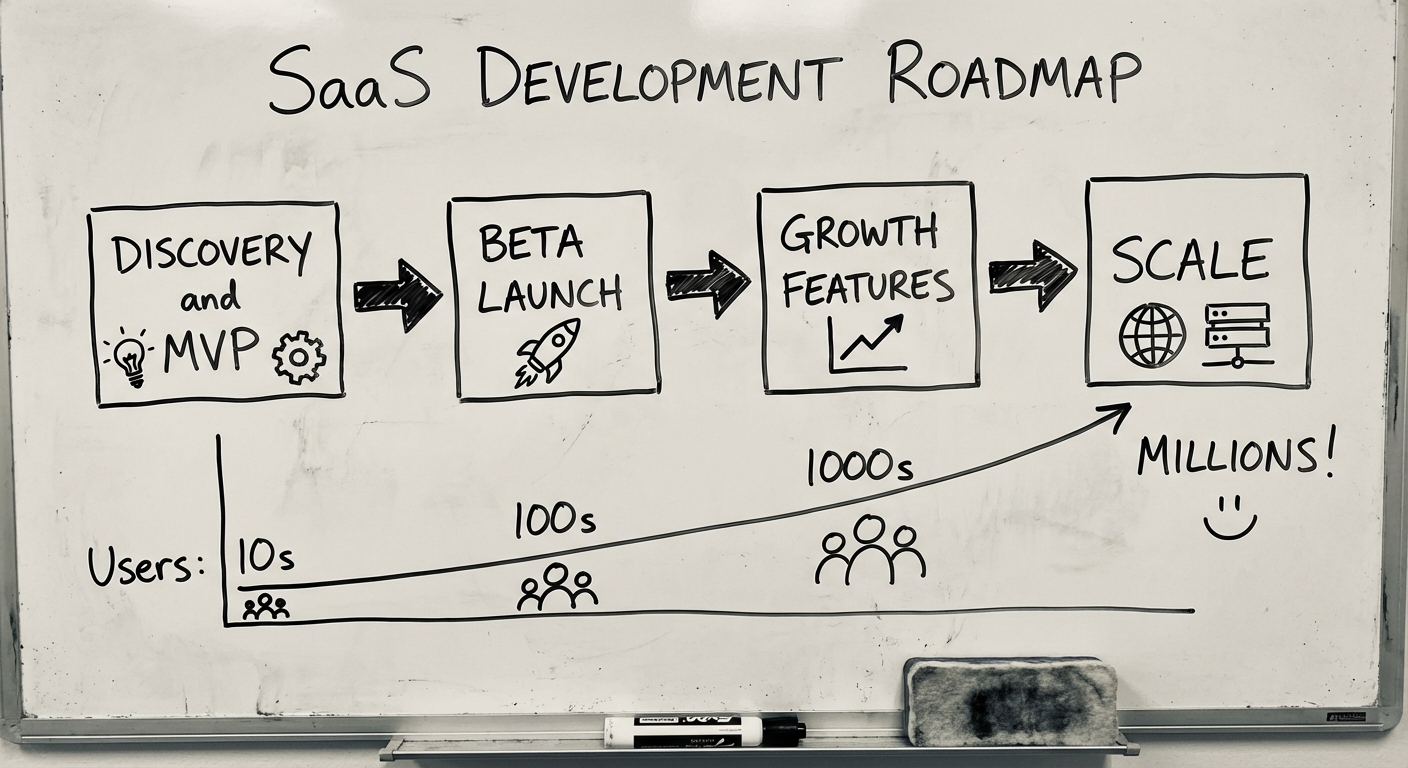
Process Signals That Separate Good SaaS Partners
- Validation before code. Who is the customer, what’s their current workaround, what would they pay? If a partner doesn’t push you to talk to 10-15 potential customers first, they’re optimising for billable hours.
- A genuinely minimal MVP. One user type, one core workflow, manual where possible. An MVP that takes longer than 12 weeks isn’t minimal. It’s a Phase 1 product with MVP branding.
- Go-to-market thinking. A deployed product isn’t a launched product. Onboarding design, instrumentation, and conversion funnels are part of the build—the first 5 minutes determine whether a trial converts.
- The stack they know. There’s no “best” stack—Next.js, Node/Go/Python, PostgreSQL + Redis cover 95% of SaaS workloads. The best tech stack is the one the team can ship with.
Build In-House vs. Outsource AI
This is the classic question, and the answer is—predictably—“it depends.”
Build In-House When:
- AI is core to your product — If AI IS what you sell, you need internal capability
- You have proprietary data advantages — Sensitive data that can’t leave your walls
- You’re playing the long game — Building a 5-year competitive moat
- You can attract talent — And you can afford to. Senior ML engineers command $200-400K+ in markets like Australia
Outsource When:
- You need to validate quickly — Test an AI hypothesis in 8-12 weeks, not 12 months
- The project is bounded — Clear scope, defined outcome, specific timeline
- You lack internal expertise — And building a team isn’t justified for one project
- You want production quality fast — An experienced partner has the MLOps infrastructure already
The Hybrid Approach
The smartest companies often do both. They outsource the initial build and validation, then gradually bring capability in-house as the AI becomes core. Your outsource partner becomes a strategic advisor rather than a full-time builder.
Synetica’s Approach: AI-Accelerated, Human-Verified
We should be transparent about our own position here, since we are, in fact, an ai development company—and an AI-native one. Our philosophy is simple: practical AI, not hype.
We Start with the Business Problem
Not the technology. We’ve turned away projects where a well-designed dashboard would solve the problem better than a machine learning model. If your problem doesn’t need AI, we’ll tell you. We’d rather build something useful than something impressive.
We Validate Before We Build
Every AI engagement starts with a feasibility phase. We assess your data, define success metrics, and build a minimal proof-of-concept before anyone commits to a full build. If the data doesn’t support the outcome, we say so early—when it’s cheap to pivot.
We Use AI to Build—With Humans Verifying Every Line
We use AI throughout our build process to move faster: scaffolding, test generation, refactoring, documentation. But speed without verification is how you ship AI slop. Every AI-assisted output passes through engineer review, automated testing, and security checks before it reaches production. That’s the AI-native bargain: AI-accelerated delivery, human-verified quality. You can read more in how we develop without AI slop.
We Build for Production, Not Demos
Our engineering team includes ML engineers and DevOps specialists who build deployment pipelines, monitoring systems, and retraining workflows from day one. The model isn’t done when it hits 90% accuracy in a notebook. It’s done when it’s running reliably in production and delivering measurable business value.
We Transfer Knowledge
We don’t want you dependent on us forever. Every project includes documentation, knowledge transfer sessions, and—where appropriate—training for your internal team to maintain and extend the system.
What Does AI Development Cost?
Let’s talk numbers. These are realistic ranges based on market rates in Australia and our own project experience.
| Project Type | Typical Range (AUD) | Timeline |
|---|---|---|
| Feasibility Study / POC | $15,000 - $40,000 | 2-4 weeks |
| MVP / Pilot Deployment | $50,000 - $150,000 | 6-12 weeks |
| Production AI System | $150,000 - $500,000+ | 3-9 months |
| SaaS MVP (AI-enabled) | $40,000 - $120,000 | 8-12 weeks |
| Ongoing MLOps & Maintenance | $3,000 - $15,000/month | Continuous |
What Drives Costs Up
- Data preparation complexity — Messy, siloed, or insufficient data
- Custom model training — vs. fine-tuning or using existing APIs
- Integration complexity — Legacy systems, real-time requirements
- Compliance requirements — Healthcare, finance, government
- Scale — Processing millions of records vs. thousands
What Keeps Costs Down
- Clean, well-structured data — This alone can cut timelines by 40%
- Using existing AI APIs where appropriate (OpenAI, Google, AWS)
- Clear, bounded scope — “Predict X for Y” beats “make us AI-powered”
- Phased approach — Validate before scaling
The most expensive AI project is the one that fails after six months because nobody validated the data first. A $20K feasibility study that kills a bad idea saves $200K in wasted development.
Making Your Decision
Choosing an ai development company comes down to four questions:
- Do they understand your problem before proposing a solution? If the first meeting is all about their technology stack, be cautious.
- Can they show production results, not just demos? Demos are easy. Production is hard.
- How do they use AI themselves—and how do they verify it? AI-native firms move faster and have a review process. Firms with one but not the other are a risk.
- Do they have a plan for after launch? Models need care. Partners who disappear after deployment aren’t partners.
The AI space will keep evolving. Models will get more capable. Costs will come down. But the fundamentals of choosing a good engineering partner haven’t changed: look for competence, honesty, and a genuine interest in solving your problem.
FAQ
How much does AI development cost? A feasibility study or POC runs AUD $15K–$40K over 2-4 weeks; an MVP or pilot $50K–$150K; a production AI system $150K–$500K+. Budget $3K–$15K/month for ongoing MLOps — a model without monitoring is a depreciating asset.
How do I choose an AI development company? Four filters: production results (not demos), a team that includes MLOps, a methodology with a feasibility phase and honest success metrics, and clear answers on bias testing and data governance. If the first meeting is about their tech stack instead of your problem, keep looking.
Should I build an AI team in-house or outsource? Outsource to validate fast (8-12 weeks) or for bounded projects; build in-house when AI is the product or your data can’t leave your walls. The smartest path is often hybrid: outsource the initial build, bring capability in-house as AI becomes core.
What questions should I ask an AI development company? “How many of your models are running in production today?”, “Who handles MLOps?”, “Where does my data live during training?”, and “Show me an AI-assisted change and the review that caught its mistake.” The last one separates AI-native firms from slop shops in one answer.
Ready to Talk?
We don’t do sales pitches. We do working sessions.
Tell us what you’re trying to solve, and we’ll be honest about whether AI is the right approach—and whether we’re the right team.
Sources
Related posts: How We Develop Without AI Slop · Custom Software Development Guide · Outsource Software Development
Two weeks to a real answer
Need help putting this into practice?
Book a Blueprint session and we'll turn the ideas in this article into a tested prototype in front of real users—2 weeks, from $3,000.