Guide
Outsource Software Development: The 2026 Guide for Product Leaders
If you’re researching how to outsource software development, you’ve probably noticed most guides are written by the vendors trying to win the contract — this one is too, so here’s the honest version, including when you shouldn’t hire a team like ours.
I’ve spent 12 years on the vendor side of outsourcing: 110+ shipped projects for clients from Astra and Traveloka to two-person founding teams, with a 600-developer pool behind us. I’ve seen partnerships that compounded for years, and I’ve watched buyers burn full budgets on teams that shipped exactly what was asked — and nothing that was needed.
Here’s what that experience says about when to outsource, which model to pick, what it really costs, and the one step that predicts success better than any rate card.
TL;DR — the whole guide in five lines:
- Outsource when speed beats headcount and the work has a defined end state; keep core-IP thinking in-house.
- Pick the model by the shape of the problem — validated launch for new products, dedicated team for 6+ month roadmaps, augmentation for skill gaps.
- True cost runs up to 2× the rate card once management, rework, and churn land — and rework is the biggest line.
- Evaluate the process, not the portfolio — four gates, one killer question each.
- Never sign a full build before a real user touches a prototype — a 2-week, $3,000 blueprint is the cheapest insurance in software.
What is software development outsourcing?
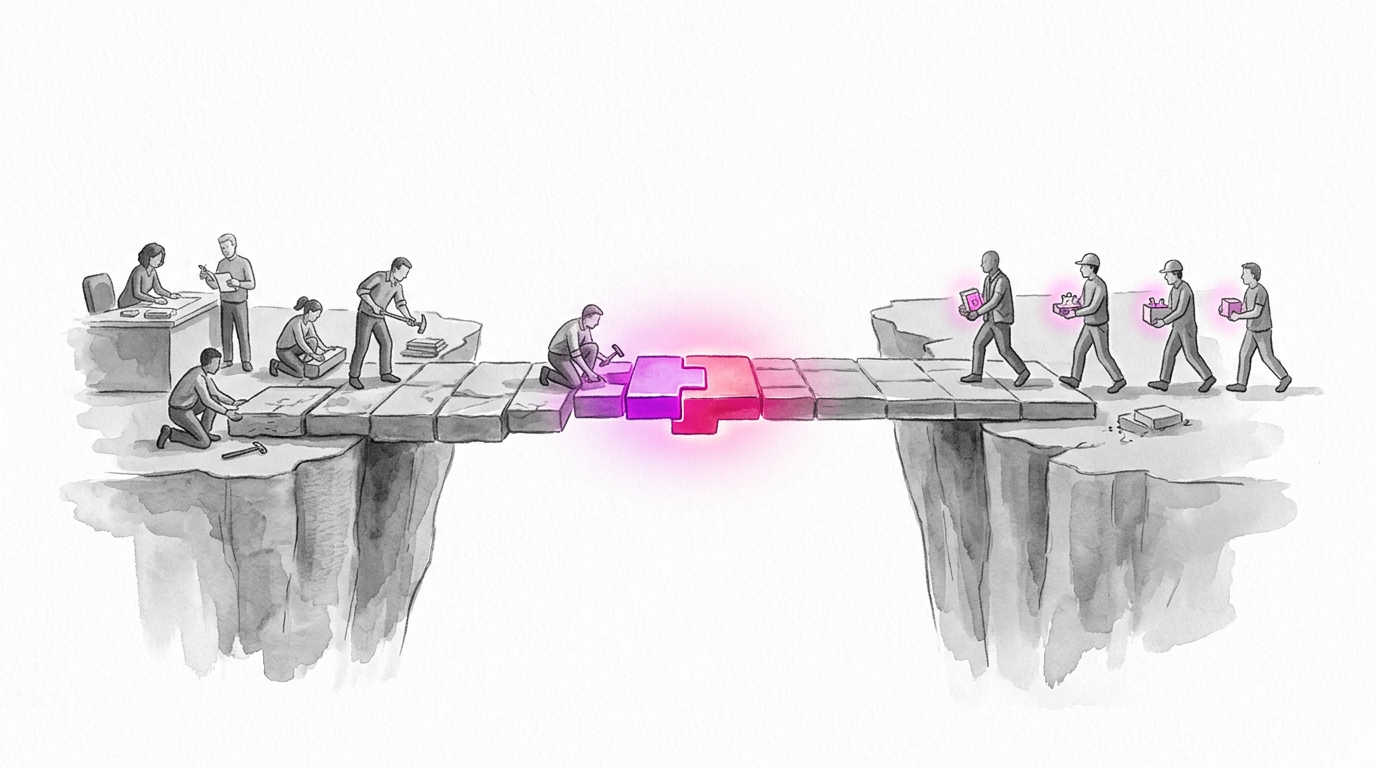
Software development outsourcing is contracting an external team to design, build, or maintain your software instead of — or alongside — an in-house engineering team. The modern version isn’t “throw a spec over the wall”: good partnerships run as embedded teams with shared tooling, your rituals, and joint ownership of outcomes.
It’s also not exotic. IBM outsourced its PC operating system to a tiny company called Microsoft in 1980. That worked out reasonably well for one of the parties involved.
Outsourcing models compared
The model you choose matters more than the country you choose. Pick by the shape of your problem:
| Model | Best for | Typical cost (USD) | The catch |
|---|---|---|---|
| Validated launch (blueprint → build) | New products, unproven ideas | $3,000 for 2 weeks, then from $13,000 for the 8-week build | You must accept that the answer might be “don’t build” |
| Dedicated team | Ongoing platforms, 6+ months of roadmap | $8,000–$25,000/mo for a 3–5 person squad | You manage priorities; commitment is monthly |
| Project-based | Well-defined scope with an end state | $30,000–$150,000 fixed | Change requests cost extra — by design |
| Staff augmentation | Filling 1–3 skill gaps inside your team | $3,000–$9,000/mo per engineer | You carry the management load |
Validate it in 2 weeks. Before committing to any of these models for a new product, a Blueprint session turns the idea into a tested prototype in front of real users — see how Blueprint & Prototype works.
When to outsource vs hire in-house
Outsource when:
- Speed beats headcount. Hiring a senior engineer takes 2–3 months in most markets; a full team takes half a year. If the window closes by Q3, the math is already done.
- The work has a defined end state. MVP builds, migrations, legacy rewrites.
- You need skills temporarily. Mobile, DevOps, AI integration — specialists for a season, not a decade.
- Your core team is at capacity and the backlog item isn’t core IP.
Keep in-house when:
- The work IS the competitive advantage. Your core algorithm, your proprietary data pipeline.
- Institutional knowledge is the product. Domain edge cases that take years to learn.
- Compliance demands it. Strict data-residency or defence-grade requirements.
The sweet spot from 12 years of doing this: outsource the building, keep the thinking. You own strategy and product decisions; the external team executes with evidence checkpoints along the way.
What outsourcing really costs
Sticker rates are the start of the bill, not the bill:
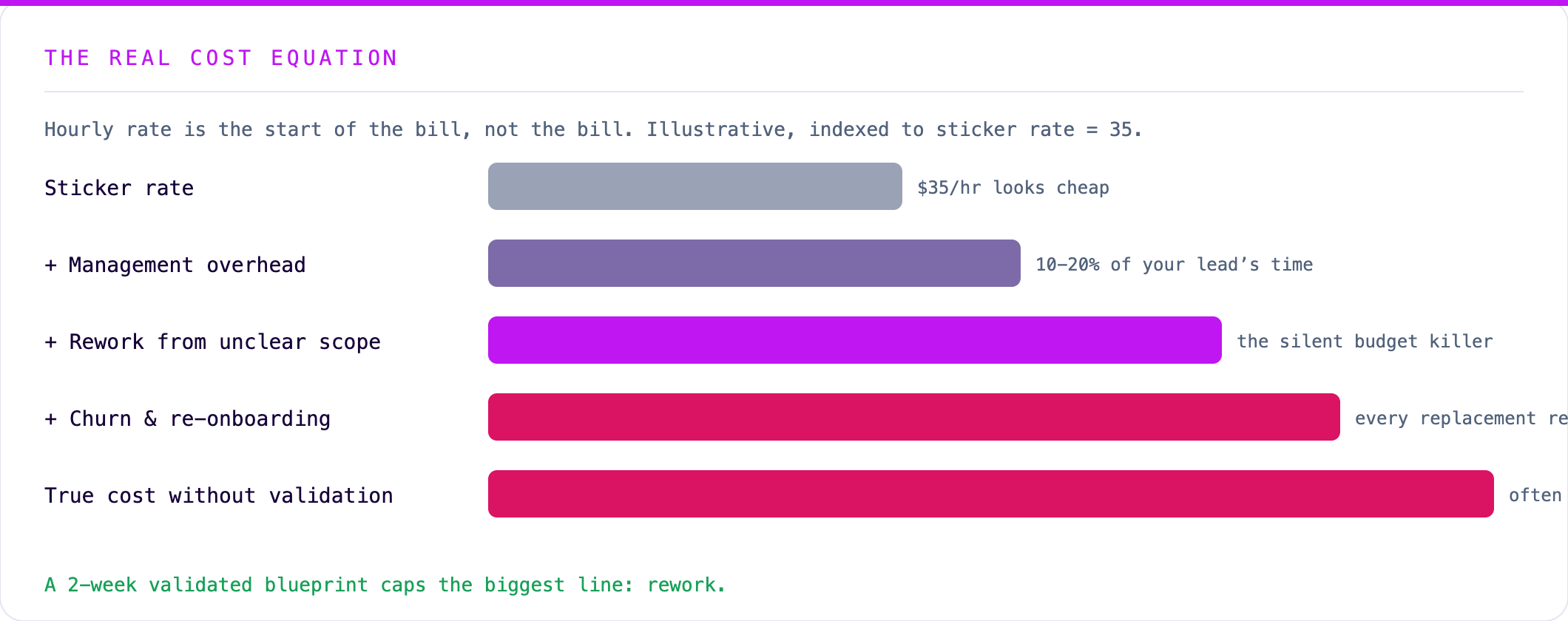
- Management overhead — 10–20% of your lead’s time goes to coordination.
- Rework from unclear scope — the silent budget killer, and the single biggest line on failed projects. Standish CHAOS data puts one-shot waterfall success at just 13%, versus 42% for iterative delivery.
- Churn and re-onboarding — every replacement developer resets context. Ask any vendor for their average engineer tenure before you sign.
A $35/hr developer who needs constant supervision costs more than a $70/hr developer who ships autonomously. Optimize for validated output, not rate cards.
Regional reality check (mid-to-senior full-stack, 2026): US/Australia $120–250/hr · Eastern Europe $50–100/hr · Southeast Asia $25–75/hr. Indonesia specifically combines a deep talent pool, strong English in product teams, and timezone overlap with both Asia-Pacific and (partially) Europe — it’s where our 600-developer pool lives.
How to evaluate an outsourcing partner
The technical assessment is only 30% of the decision. Process maturity and communication culture predict outcomes better than the framework list.
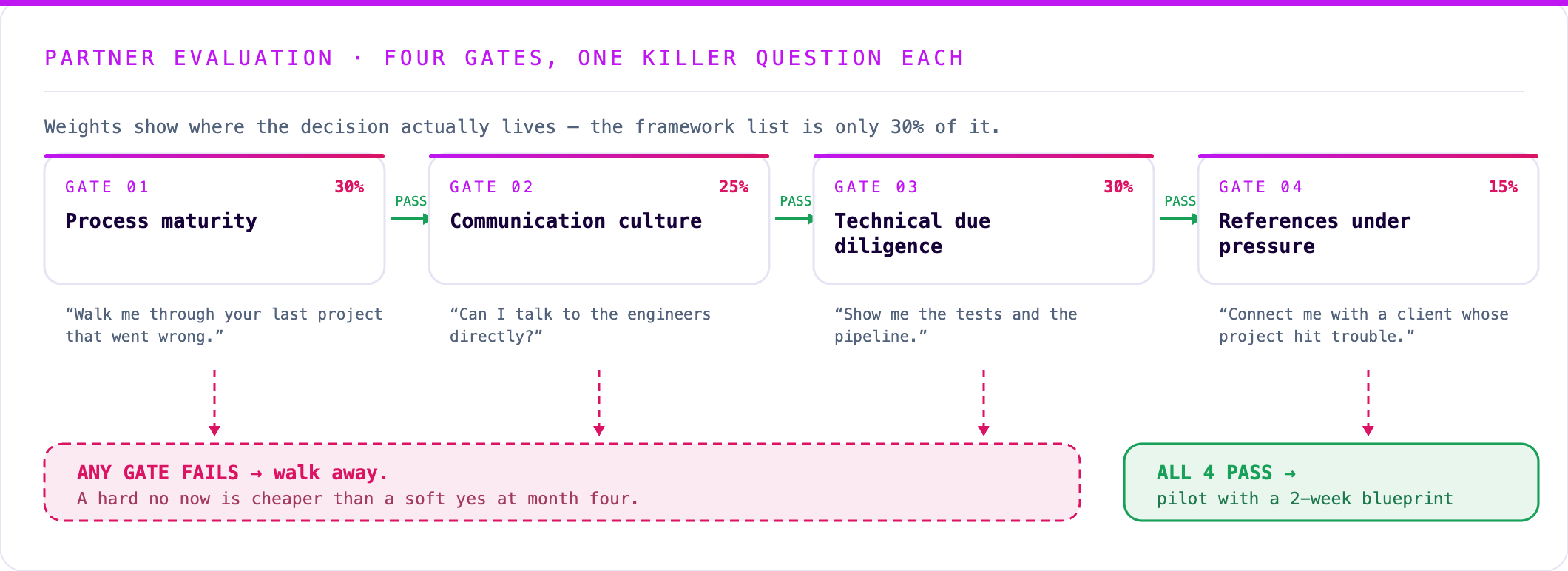
- Process over portfolio. A portfolio proves they finished something; it says nothing about the journey. Ask: “Walk me through your last project that went wrong.” “What do the first two weeks after signing look like?” Partners with a structured discovery phase are dramatically more likely to deliver — ad hoc kickoffs are a red flag.
- Communication culture. Async-first with written decisions, or a meeting for everything? Can you talk to the engineers directly, or only through a PM?
- Technical due diligence. Anonymized code samples, automated testing as default, CI/CD as standard — not as an upsell.
- References that matter. Don’t ask for happy references. Ask for references from clients whose projects hit trouble — how a partner behaves in a rough patch is the whole game.
Red flags: when to walk away
- 🚩 “We can build anything.” Experts in everything are experts in nothing.
- 🚩 A quote without discovery. A partner who prices your project without understanding your business is either reckless or desperate.
- 🚩 Opaque pricing. No hourly breakdowns, no team composition — you’ll get surprised, and not the good kind.
- 🚩 No IP transfer clause. If the contract doesn’t say you own the code, docs, and pipeline — don’t sign.
- 🚩 No user checkpoint before full build. If the plan goes spec → 6 months of silence → launch, you’re funding a guess. 80% of features end up rarely or never used when nobody checks.
The Blueprint-first model — by Synetica
This is the part where the vendor writing the guide tells you about their offer, so I’ll keep it short and concrete.
Every engagement we take starts with a 2-week Blueprint & Prototype ($3,000 / IDR 49jt, fixed): week one produces a decision-ready blueprint — scope, architecture, feature map — and week two puts a working prototype slice in front of real users. You end with evidence and a recommendation: build, adjust, wait, or stop.
In my own words, from twelve years of watching the alternative: the most expensive sentence in software is “we’ll find out at launch.” The Blueprint exists so you find out in week two instead — for about 15–25% of a build budget. If the answer is “build,” the blueprint becomes the production spec for the 8-week build. If the answer is “stop,” it’s the cheapest stop you’ll ever buy.

The decision gate is the point: we’re paid to find the truth fast, not to maximize billable hours — the difference is the subject of our agency-to-product-studio essay.
A simple decision framework
- Need a team in under 8 weeks? → Outsource.
- New product, unproven demand? → Validated launch (blueprint first).
- Defined scope, clear end state? → Project-based.
- 6+ months of roadmap? → Dedicated team — see extended capacity.
- Core IP? → Keep architecture in-house; outsource execution with evidence checkpoints.
FAQ
Is outsourcing software development a good idea in 2026? Yes, when the work has a defined shape and the partner has a validation step. It fails when buyers outsource the thinking along with the building.
How much does it cost to outsource software development? Augmentation runs $3,000–$9,000/month per engineer; dedicated squads $8,000–$25,000/month; fixed projects $30,000–$150,000. Validation first costs ~$3,000 and routinely saves a six-figure mistake.
Should I outsource to Indonesia? Indonesia offers Southeast Asia’s deepest talent pool at $25–75/hr with strong English in product teams. Vet for process maturity exactly as you would anywhere else.
What’s the biggest outsourcing mistake? Signing a full-build contract before any real user has touched a prototype. Scope rework — not rates — is what blows budgets.
What I’d tell a product leader weighing this up
- Buy evidence before you buy a build. Two weeks of validation beats six months of hope.
- Pick the model for the problem, not the cheapest rate card — supervision costs are real.
- Interview the process, not the portfolio, and get references from projects that went sideways.
- If you want the lowest-risk first step with us: a 30-minute call, then a fixed-price Blueprint. You walk away with the plan and the prototype either way — even if you build with someone else.
Sources
Related posts: The 2-Week Blueprint · Why 80% of Products Fail · Build vs Buy Software
Two weeks to a real answer
Need help putting this into practice?
Book a Blueprint session and we'll turn the ideas in this article into a tested prototype in front of real users—2 weeks, from $3,000.