Methodology
The 2-Week Blueprint: Know What to Build Before You Pay to Build It
A company spends IDR 400 million on custom software. Eight months of development. Launch day arrives. Users open it once, get confused, and go back to WhatsApp and spreadsheets.
Nobody was lazy. The requirements doc was thorough. The code worked. The team hit their deadlines.
The product still died — because the team spent eight months building before a single real user touched it. We’ve watched this happen enough times to give it a name: the project graveyard. It’s why Synetica exists, and it’s why 80% of products fail — not bad code, not bad luck. The wrong thing, built well.
TL;DR — the whole guide in five lines:
- Building the wrong thing is the expensive part of software — 80% of features end up rarely or never used.
- Validate first, build second: iterative projects succeed at 42% versus 13% for big-bang waterfall.
- Two weeks, two phases — week 1 produces a decision-ready blueprint, week 2 puts a working prototype slice in front of real users.
- Day 10 ends in one of four calls — build, adjust, wait, or stop — backed by recorded user sessions, not opinions.
- IDR 49jt buys the decision; the IDR 200jt+ production budget moves only after user signal.
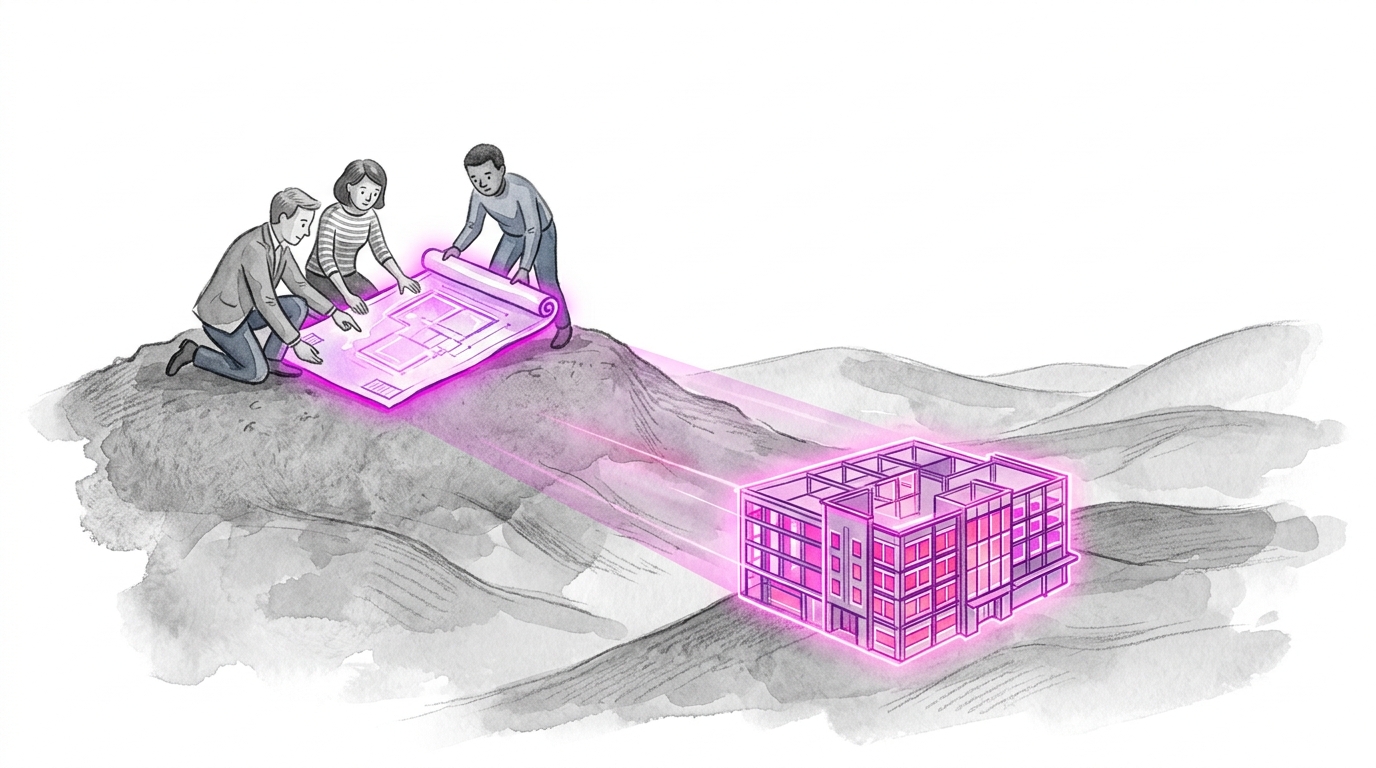
The expensive part of software isn’t building it. It’s building the wrong thing.
What Is the Blueprint Method?
The Blueprint method is a two-week validation sprint that turns a raw product idea into a decision-ready plan and a tested prototype — before any production budget is committed. Week one produces the blueprint: requirements, designs, architecture, and estimation, all mapped to evidence from real user interviews. Week two builds a working slice of the product and puts it in front of real users, ending in one of four clear calls: build, adjust, wait, or stop.
In short: it’s due diligence for software. You spend roughly 15–25% of a build budget to find out whether the other 75–85% is justified. Here’s how it compares to the discovery phase most vendors sell:
| Traditional discovery | Blueprint & Prototype | |
|---|---|---|
| Duration | 4–12 weeks | 2 weeks |
| Output | Documents — PRD, wireframes, roadmap | A decision: build, adjust, wait, or stop |
| User contact | Usually none before build | Real users test a working slice on day 9 |
| Cost of being wrong | Discovered at launch | Discovered by day 14 |
Here’s why that order matters, and exactly how the two weeks run.
Why planning harder doesn’t fix it
The standard reaction to a failed project is more planning. Longer requirement documents. More stakeholder meetings. More sign-offs before development starts.
It doesn’t work, because the problem was never a lack of planning. The problem is that nobody — not you, not us, not your most experienced manager — can predict what users will actually use.
The data is blunt. Pendo’s 2019 Feature Adoption Report found that 80% of features are rarely or never used. Every one of those features was planned, specced, approved, built, and paid for. Planning produced them. Users ignored them.
The Standish Group’s CHAOS 2020 report shows the way out: projects delivered in small steps with real user feedback succeed at 42%, versus 13% for big-bang waterfall projects. Roughly three times the success rate — not from better planning, but from earlier contact with reality.
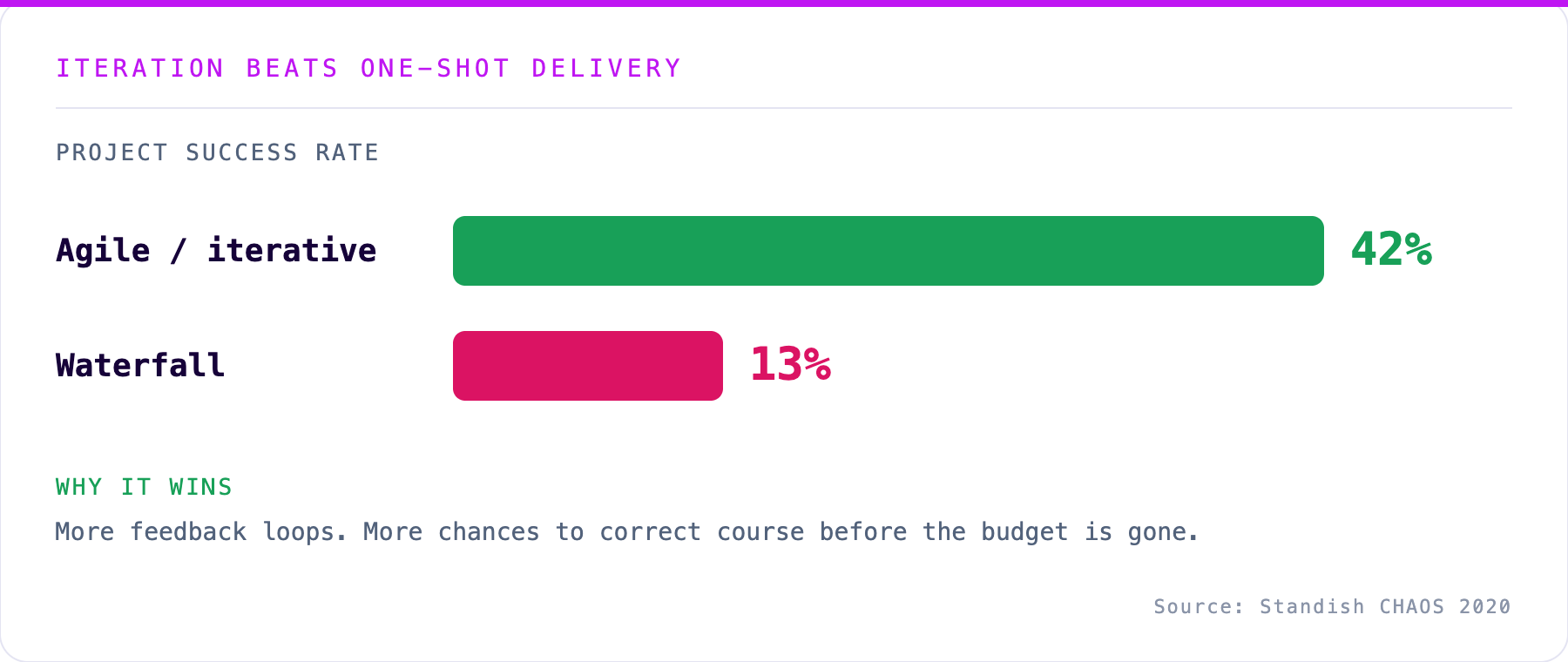
So the fix isn’t a thicker document. It’s flipping the order: validate first, build second.
Think of it like mining for gold. The usual way is months of digging on faith — you find out whether the gold exists only after the money is spent. The smarter way is to scan the ground first, then dig only where the scan says dig.

That scan is what Blueprint & Prototype does. Two weeks. Here’s exactly how.
The 2-week system, day by day
Blueprint & Prototype is 10 working days, two phases. Week 1 turns your idea into a decision-ready blueprint. Week 2 builds a working prototype slice and puts it in front of real users.
The whole process runs on Skematika, our blueprint platform — interviews, requirements, and scope decisions become a test-ready plan without weeks of document ping-pong.
| Day | Phase | What happens | Milestone |
|---|---|---|---|
| 1 | Blueprint | Kickoff + scope — goals, constraints, riskiest assumptions | Client kickoff |
| 2 | Blueprint | User research — interviews with the people who’ll actually use this | — |
| 3 | Blueprint | Requirements + design — features mapped to evidence, mockups drafted | Design sign-off |
| 4 | Blueprint | System & design — architecture, data model, integrations | — |
| 5 | Blueprint | Plan + pack complete — estimation, full blueprint assembled | Blueprint sign-off |
| 6 | Prototype | Slice scope — pick the one flow that carries the most risk | — |
| 7 | Prototype | Build the slice — working software, mobile and web | — |
| 8 | Prototype | Finish the slice, prepare test sessions | Ready to test |
| 9 | Prototype | Launch + user sessions — real users, real tasks, recorded | — |
| 10 | Prototype | Readout — what users did, what it means, what to do next | Recommendation |
Two details matter here.
The prototype is working software, not a clickable mockup. Users perform real tasks in it. A Figma prototype tests whether people understand your idea; a working slice tests whether they’ll actually use it. (If you’re weighing the options, here’s when to build a prototype, a pilot, or an MVP.)
The users are real. Not your team, not your friends. The people who’d actually pay for or work in this product. What they do in the sessions counts for more than what they say — and we capture both.
What you walk away with
Day 10 isn’t a slide deck — it’s a complete, decision-ready package that any development team can build from:
- Business requirements (BRD) — the problem, the users, and the business case in one document
- Feature requirements — every feature mapped to the evidence behind it, with explicit out-of-scope lines
- Full design mockup — the complete product designed, not just the tested slice
- Technical architecture — system components, technology choices, integration points
- Data model — entities, relationships, and flows, ready for engineering
- Project plan & estimation — what the production build costs and how long it takes, scoped from evidence
Plus the prototype itself — a clickable, working slice on mobile and web — and the user session results: adoption signal, comprehension signal, and where people got stuck.
Any development team can build from this package. Including, but not necessarily, us.
Validate it in 2 weeks. A Blueprint session turns your idea into a tested prototype in front of real users — see how Blueprint & Prototype works.
The decision gate: build, adjust, wait, or stop
The last deliverable is the one most agencies won’t give you: a straight recommendation. Four possible calls, each with real meaning.
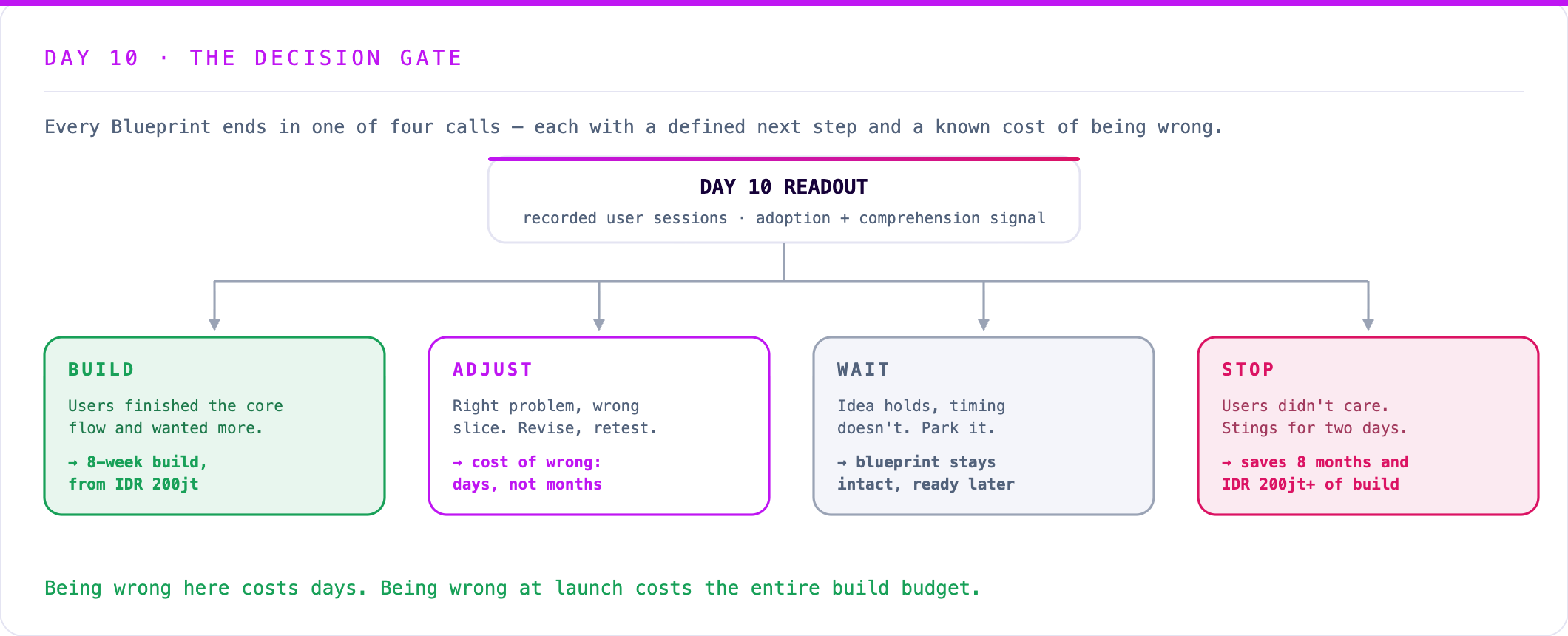
- Build. Users completed the core flow and wanted more. The signal is strong. Move to production — 8 weeks, from $13,000 / IDR 200jt — building only what the evidence supports.
- Adjust. The problem is real, but the solution needs to change. Users hesitated somewhere specific. Revise the slice, retest. Cost of being wrong: days, not months.
- Wait. The idea holds but the timing doesn’t — the market, the budget, or the organization isn’t ready. Park it with the blueprint intact. Common for teams testing a new market before committing headcount.
- Stop. Users didn’t care. That stings for two days — and saves you eight months and IDR 200jt+. A stop at week 2 is the cheapest outcome in product development.
Notice the incentive: we recommend stop when the evidence says stop, even though “build” is what we’d get paid for. The blueprint is yours either way. That’s the point of separating the validation fee from the build fee.
What it costs vs. what it saves
Blueprint & Prototype starts at $3,000 / IDR 49jt. Production-grade development starts at $13,000 / IDR 200jt — and most custom builds in Indonesia run IDR 300jt or more before a single real user has touched anything.
So the real comparison is:
| Committed before user feedback | First real user signal | Cost of being wrong | |
|---|---|---|---|
| Build first | IDR 200–400jt+ | Month 4–8, at launch | Months of rework — or a dead product |
| Validate first | IDR 49jt | Day 9 | One revised prototype slice |
The blueprint fee is roughly 15–25% of the build cost, and it’s the only stage where “we were wrong” costs days instead of months. If the answer is build, you’ve lost nothing — the blueprint becomes the production spec. If the answer is anything else, IDR 49jt just bought you out of an IDR 200jt+ mistake.
FAQ
How much does product validation cost?
Blueprint & Prototype starts at $3,000 / IDR 49jt — roughly 15–25% of a typical production build, which starts at IDR 200jt and often runs past IDR 300jt in Indonesia. Compare the two failure modes: a wrong assumption caught on day 14 costs the blueprint fee; the same assumption caught at launch costs the entire build budget. Validation isn’t an extra line item — it’s the cheap version of a lesson you’ll pay for either way.
What if I already know what to build?
Maybe you do. The Pendo data says most teams who were sure still shipped features nobody used. If you’re right, two weeks produces the evidence to prove it — to your board, your investors, your own engineers — plus a build-ready spec. If you’re wrong, you find out for IDR 49jt instead of IDR 200jt. Confidence without evidence is just optimism with a budget.
Blueprint vs traditional discovery — what’s the difference?
Traditional discovery runs 4–12 weeks and produces documents: a PRD, wireframes, a roadmap — and still no proof that users want the thing. Blueprint runs 2 weeks and produces a decision: assumptions are made explicit and tested against real users in working software, and the output is a build / adjust / wait / stop call backed by recorded sessions. Documents tell you what the team agreed on. Decisions tell you what users did.
Can we run product validation ourselves?
The method isn’t secret: interview users, scope a slice, build it, test it. What’s hard internally is honesty and speed. Your team has opinions to defend and a roadmap to protect; a deadline that’s “two weeks” internally becomes two months. We have no attachment to your idea surviving — only to the answer being right by day 10. If you do run it yourself, start with the discovery questions we ask founders.
Is two weeks enough for real research?
For a market study, no. For a build decision, yes — because the strongest evidence isn’t another interview, it’s watching real users attempt real tasks in working software. Day 9 of this process produces more decision-grade signal than a month of surveys. Behavior beats opinion.
What happens if the recommendation is stop?
You keep everything: the blueprint, the designs, the architecture, the user session findings. Several of our best client relationships started with a stop — they came back months later with a sharper idea and skipped straight to a confident build. The teams in the project graveyard never got that option, because their first user feedback arrived after the money was gone.
The next step
If you’re sitting on an idea — or a budget request for one — don’t start with a development quote. Start with two weeks of evidence.
- Book a 30-minute call. We’ll tell you honestly whether Blueprint & Prototype fits — and if your case is already proven, we’ll say so and skip straight to scoping the build.
- Week 1: decision-ready blueprint, signed off.
- Week 2: working prototype, tested with your real users.
- Day 10: build, adjust, wait, or stop — with the evidence to back it.
Two weeks. IDR 49jt. One decision you won’t have to defend on faith.
See how Blueprint & Prototype works → or book a discovery call.
Sources
- CB Insights: The Top Reasons Startups Fail
- Nielsen Norman Group: Why You Only Need to Test with 5 Users
Related Posts
Two weeks to a real answer
Need help putting this into practice?
Book a Blueprint session and we'll turn the ideas in this article into a tested prototype in front of real users—2 weeks, from $3,000.