Product Strategy
Pilot, Prototype, or MVP? What Founders Should Build First
Founders use pilot, prototype, and MVP as if they mean the same thing.
They don’t. And the confusion is expensive.
One team says it needs an MVP when it really needs a prototype — so it spends months engineering software just to learn the workflow is wrong. Another runs a pilot when it needs a product people can use repeatedly — so it proves interest but not repeatability. A third builds a polished prototype, gets positive feedback, and mistakes that for market validation.
Different artifacts answer different questions. Pick the wrong one and you don’t just waste time — you learn the wrong thing.
Our rule: don’t start by asking what you can build fastest. Start by asking what uncertainty matters most.
TL;DR — the whole guide in five lines:
- Prototype, pilot, and MVP answer different questions — “does this make sense?”, “does this work in reality?”, and “will people use and pay for this?”
- Pick the artifact that removes your biggest risk first, not the one you can build fastest or show off soonest.
- Prototype first when the workflow is fuzzy — it catches up to 80% of usability issues before a single line of code exists.
- Pilot first when real-world adoption is the unknown — 70% of enterprise transformations fail on people and process, not technology.
- MVP first only when the concept is already clear and the open question is repeat usage and willingness to pay.
Table of Contents
- The plain-English difference
- A risk-based decision framework
- When to build a prototype first
- When to run a pilot first
- When to build an MVP first
- Three real examples
- The mistake founders keep making
- FAQ
The plain-English difference
A prototype tests whether the idea makes sense, a pilot tests whether it survives reality, and an MVP tests whether people will use and pay for it. Everything else is detail — but the detail is where teams get it wrong.
Prototype
A prototype is a low-cost representation of the product experience.
It might be a Figma flow, a clickable mockup, or a rough no-code simulation. It looks enough like the product for people to react to it, but it’s not meant to operate as a real business system.
Use it to test:
- whether users understand the concept
- whether the workflow makes sense
- whether the interface is clear
- whether the solution fits the user’s mental model
A prototype is for learning fast without committing to engineering too early.
Pilot
A pilot is a limited real-world rollout.
It involves real users and a real operating environment, but doesn’t require a fully productized system. Parts can still be manual — spreadsheets, existing tools, human support behind the scenes.
Use it to test:
- whether people will adopt the workflow in real life
- whether the process works inside the actual business
- whether compliance, operations, or management will support it
- whether the outcome creates measurable value at small scale
A pilot is less about software polish and more about whether the solution survives contact with reality.
MVP
An MVP is the smallest real product that delivers the core value and can produce meaningful learning from live usage.
It’s not a demo. It’s not a fake backend forever. It’s a working product — just intentionally narrow.
Use it to test:
- whether users come back
- whether they’ll pay
- whether the core flow works end to end
- whether the product can be delivered with enough consistency to scale
An MVP is the right move when the question is no longer “does this make sense?” but “does this work as a product?”
At a glance
| Prototype | Pilot | MVP | |
|---|---|---|---|
| What it is | Low-cost product simulation | Limited real-world rollout | Smallest working product |
| Answers | “Does this make sense?” | “Does this work in reality?” | “Will people use and pay for this?” |
| Users | React to mockups | Use it in live operations | Use it as a real product |
| Engineering | None or minimal | Partial (manual behind the scenes) | Full (narrow but functional) |
| Cost | Low | Medium | Higher |
| Risk it removes | Desirability, usability | Adoption, operational fit | Repeatable value, willingness to pay |
| Fidelity | Looks real, doesn’t work | Works partially, some manual | Works end to end |
A risk-based decision framework
Pick the artifact that removes your biggest risk first. Not your second-biggest. Not every risk at once. The biggest one.
The default sequence isn’t always prototype → pilot → MVP. Sometimes you skip one. Sometimes you start with a pilot. The right order depends on what you most need to learn.
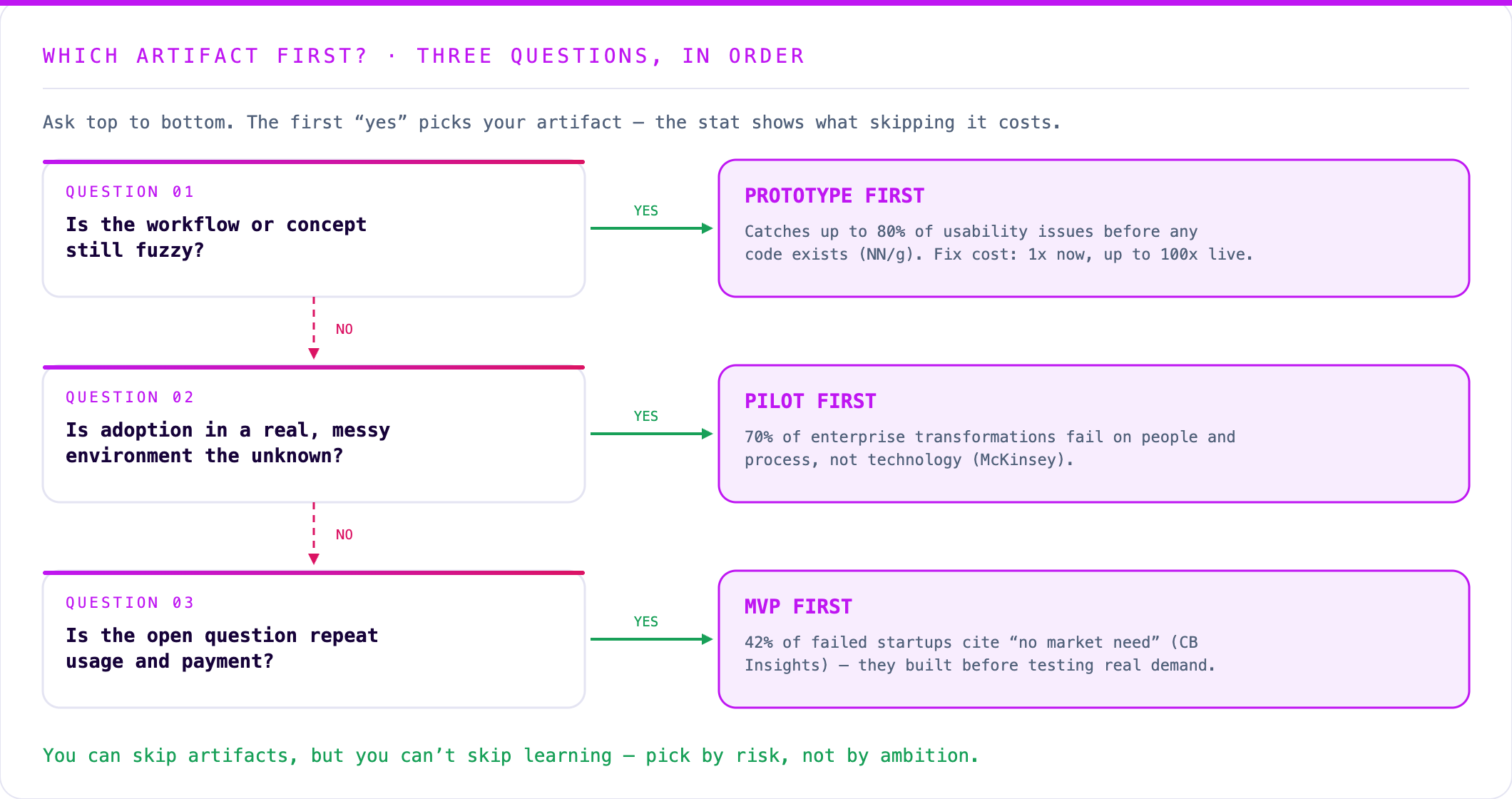
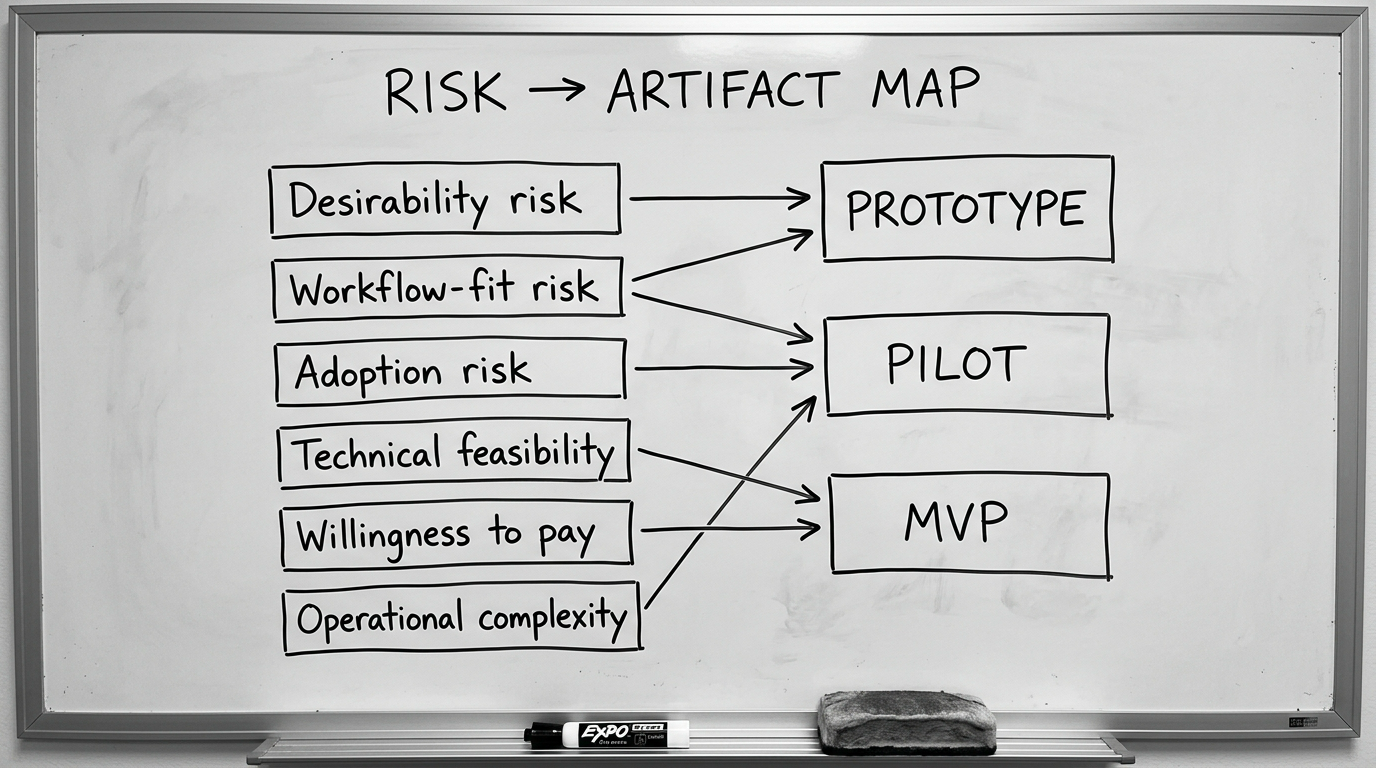
Here’s how to map common risks to the right first artifact:
| Risk type | First artifact | Why |
|---|---|---|
| Desirability risk | Prototype | Test if users understand and want the concept |
| Workflow-fit risk | Prototype → Pilot | Validate the flow, then test it in context |
| Adoption risk | Pilot | Real environment, real stakeholders, real friction |
| Technical feasibility | Narrow MVP | Prove it works, even if ugly |
| Willingness to pay | MVP or commercial pilot | Need real commercial signal |
| Operational complexity / compliance | Pilot | Can’t simulate regulation in a prototype |
Validate it in 2 weeks. A Blueprint session turns this thinking into a tested prototype in front of real users — see how Blueprint & Prototype works.
When to build a prototype first
Build a prototype first when the biggest unknown is desirability or usability.
That usually means one of these is true:
- users struggle to describe what they need
- the workflow is new or still fuzzy
- every stakeholder imagines a different product
- you expect major UX changes after the first few user reactions
- the cost of engineering the wrong flow is high
If your current debate is mostly about screens, roles, steps, or handoffs — you probably need a prototype before anything else.
A good prototype should help you answer:
- Can users complete the core flow without explanation?
- Where do they hesitate or get confused?
- Which steps feel unnecessary or unclear?
- Does the solution feel better than the current workaround?
If those are your real questions, an MVP is overkill.
What research says
The Nielsen Norman Group’s prototyping guidance is blunt about the point: prototypes let teams test interaction and workflow before development locks in the expensive version of a mistake. That’s not a small thing — fixing a design error in prototype is cheap; fixing it in production is not.
When to run a pilot first
Run a pilot first when the biggest unknown is adoption in the real environment.
A product can look great in a prototype and still fail once it hits actual operations. This happens more often than founders expect — McKinsey research notes that 70% of enterprise transformations fail, mostly due to people and process resistance, not technology.
Pilots are especially useful when the solution touches:
- multiple departments
- approval chains
- regulated data or workflows
- manual operational handoffs
- frontline teams with entrenched habits
- enterprise environments with more than one decision-maker
A good pilot should help you answer:
- Will people actually use this in a live setting?
- What breaks operationally?
- Who resists, and why?
- What approvals or controls are needed?
- Does the solution create enough value to justify wider rollout?
If your main risk is real-world execution, a prototype is too abstract and an MVP may be too early.
When to build an MVP first
Build an MVP first when the biggest unknown is repeatable product value.
That usually means the concept is already clear, the workflow is relatively standard, and the main question is whether a narrow working product can earn real usage.
An MVP makes sense when:
- the problem is already well understood
- the value only becomes real when the system actually works
- users can adopt it without heavy organizational change
- you need real usage or payment signals, not just positive interviews
- the main challenge is productizing a focused solution, not imagining it
A good MVP should help you answer:
- Do users come back after first use?
- Will they pay, renew, or expand usage?
- Does the core experience hold up in production?
- Which features actually matter once the product is live?
If you mainly need commercial or retention evidence, go straight to MVP.
The validation sequence
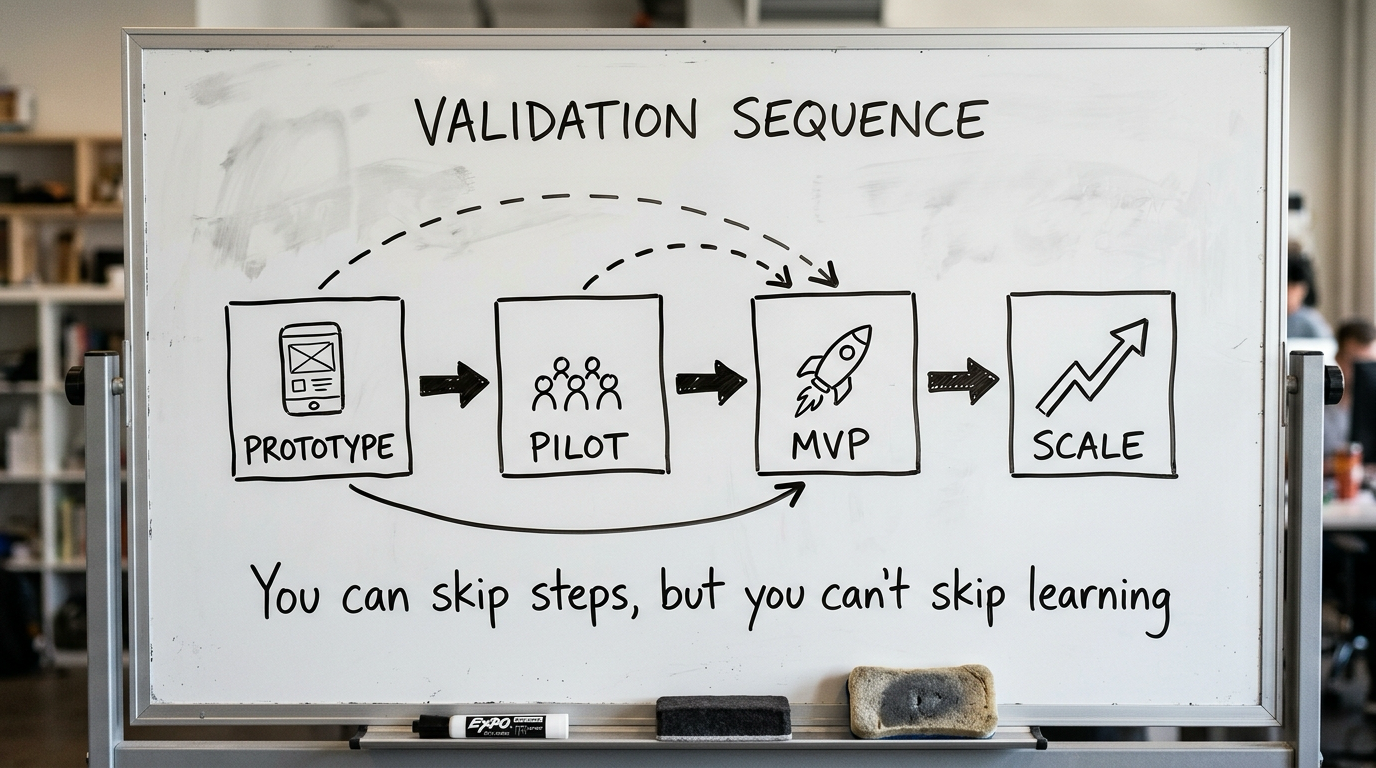
Most products go through a natural sequence — prototype → pilot → MVP → scale — but not always in the same order, and not always completing every step.
The key insight: you can skip steps, but you can’t skip learning. If you jump to MVP without validating the concept, you’re gambling — not building.
Three real examples
In all three cases the first artifact is chosen by the dominant risk — not by how impressive the build sounds.
1. Internal procurement workflow
The pain is obvious. Teams already complain about scattered requests and slow approvals. But nobody agrees on the exact flow.
Best first artifact: Prototype
Why: the main risk is workflow fit, not market demand. The team needs something concrete to react to before code hardens the wrong process.
2. Enterprise AI assistant in a regulated industry
Leadership likes the idea, but legal, compliance, and operations all have concerns. Success depends on trust, controls, and real-world behavior.
Best first artifact: Pilot
Why: a prototype won’t prove operational viability, and a full MVP may be too expensive before approvals are clear.
3. Niche SaaS tool for branch reporting
Managers already use painful spreadsheets. The problem is clear. The real question is whether a focused tool creates repeated usage and enough value to pay for.
Best first artifact: MVP
Why: the workflow is already familiar. The learning only becomes meaningful when the product works end to end.
The mistake founders keep making
The biggest mistake is building the artifact that feels most impressive rather than the one that teaches the most.
That usually looks like this:
- building an MVP before the workflow is clear
- calling a clickable demo “validation”
- running a pilot without defining what success looks like
- treating pilot users as proof of scalable demand
- using engineering effort to answer a question that interviews or prototypes could answer faster
CB Insights found that 42% of failed startups cite “no market need” as their top reason for failure. Not funding. Not competition. Not bad timing. They built something nobody wanted — often because they started building before they understood what to learn.
That’s why we keep pushing teams toward evidence before build, not build before clarity. A good place to start is the 12 discovery questions every founder should ask before building — they expose which risk is actually your biggest. If you haven’t identified the main risk yet, you’re probably choosing the wrong first artifact.
FAQ
What is the difference between a pilot and an MVP?
A pilot tests whether a solution works in a real-world environment with real stakeholders and operational constraints. It can involve manual processes behind the scenes. An MVP is a working product — narrow but fully functional — that tests whether users will repeatedly use and pay for it. Pilots answer “does this work in reality?” MVPs answer “will people use and pay for this?”
Should I always start with a prototype?
No. If your biggest risk is adoption in a complex environment (like a regulated enterprise), start with a pilot. If your biggest risk is whether people will pay for a working product, start with an MVP. Prototype first only when the concept, workflow, or usability is still unclear.
How long should a pilot run?
Long enough to see real behavior patterns — typically 4 to 8 weeks. Anything shorter risks capturing novelty effects rather than genuine adoption. Define success criteria before the pilot starts: what metrics, what thresholds, what decisions you’ll make based on the results.
Can I skip prototype and pilot and go straight to MVP?
Yes — but only if the concept is already clear and the main risk is commercial viability. If you’re uncertain about the workflow, user mental model, or operational fit, skipping to MVP usually means building the wrong thing faster.
What if my pilot fails?
That’s valuable. A failed pilot tells you exactly where the friction is — whether it’s the workflow, the stakeholders, or the value proposition. Document what failed, why, and what assumption it broke. Then decide: pivot the approach, run another pilot with changes, or kill the concept entirely. Failed pilots are cheaper than failed products.
What to do next
If you want a more disciplined way to choose your first artifact, start with our Blueprint methodology or read why 80% of products fail before they launch. And if you want that discipline applied to your idea in two weeks, that’s exactly what Blueprint & Prototype is for. The point is always the same: learn the right thing early.
A prototype, pilot, or MVP isn’t a badge of seriousness. It’s a tool.
The question isn’t which one sounds more advanced.
The question is: what do you need to learn next?
That’s the thing you should build first.
Related posts: 12 Discovery Questions Every Founder Should Ask · The Blueprint Methodology Explained · Why 80% of Products Fail
Two weeks to a real answer
Need help putting this into practice?
Book a Blueprint session and we'll turn the ideas in this article into a tested prototype in front of real users—2 weeks, from $3,000.