What Is an MVP? Build a Small Product That Tests Real Demand
What is an MVP? Compare MVPs, prototypes and pilots, scope one useful workflow, and test repeat usage with a worked example and an honest budget.
 By Aditya S November 2, 2026 Updated November 11, 2026 14 min read
What is an MVP? A minimum viable product is a deliberately limited version of an offering that lets you learn whether a particular customer gets enough value to change their behavior. The useful question is what you need to learn before committing more money. A short feature list alone does not answer it.
I’m Aditya S, Business Development Manager at Synetica, a tech-based business consultancy combining strategy and execution for Dreamers and Growing Businesses. This guide uses Eric Ries’s explanation of MVPs and a fictional ordering service you can inspect. The numbers are teaching assumptions, not Synetica client results or market benchmarks.
You’ll separate an MVP from a prototype and a pilot, define one useful workflow, choose evidence worth collecting, and build a budget around the decision. You’ll also see why a working app with registrations can still leave its central business assumption unanswered.
TL;DR — the whole guide in five lines
- Start with one uncertain customer behavior: “will they order again?” gives a build a purpose.
- Keep the promise complete and the audience narrow: fewer workflows still need dependable delivery.
- Match the experiment to the uncertainty: a prototype, a concierge service and a live product provide different evidence.
- Count repeat use and fulfilled outcomes: registrations alone cannot establish demand.
- Fund the next decision: agree the review date and stop conditions before adding features.
What can an MVP tell you that a signup page cannot?
A signup tells you someone expressed interest; a completed repeat order tests a stronger commitment. Consider a fictional service that helps independent cafés reorder cleaning supplies from one local distributor. The hypothesis is that owners will return weekly because the service makes reordering easier.
Invite 20 eligible café owners for a four-week test. Assume 12 activate by submitting a valid order, 8 receive a fulfilled first order, and 5 of those 8 place another order during the agreed follow-up window. Every count below is invented for this example.
| Fictional cohort event | Count | Calculation and limit |
|---|---|---|
| Invited, eligible owners | 20 | Defined before recruitment |
| Submitted a valid first order | 12 | 12 / 20 = 60% of invited owners |
| Received a fulfilled first order | 8 | 8 / 12 ≈ 67% of submitted first orders |
| Ordered again after fulfillment | 5 | 5 / 8 = 62.5% of fulfilled buyers |
| Repeated as a share of invitations | 5 | 5 / 20 = 25%; a different denominator |
The result contains an operational problem: four submitted orders never reached fulfillment. Ask whether the cause was stock, service coverage, payment, or onboarding before concluding that customers rejected the idea. Also record whether every fulfilled buyer had the same opportunity to reorder.
Five repeat buyers do not establish product-market fit. This small, selected cohort gives you questions and early evidence. Bring one uncertain workflow to Blueprint & Prototype if you cannot yet say what counts as success.
What is an MVP, and what does minimum viable product mean?
An MVP reduces the work needed to learn about customers while preserving the value being tested. It might involve software, a manually delivered service, or a small combination of both. A manual experiment can test demand before you automate; it cannot prove that the future automation performs reliably.
Eric Ries makes the distinction directly in his explanation of an MVP:
“MVP, despite the name, is not about creating minimal products.” — Eric Ries.
I read that as a practical scoping rule: remove work that does not help answer the current question. Keep the work that makes the answer trustworthy. That is my application of the principle, rather than a claim that Ries supplies the thresholds or budgets in this guide.
For the café example, the promise is a dependable replenishment order. Product recommendations and a referral program can wait. Clear availability, an accepted order, fulfillment status and a way to resolve a mistake belong inside the test. Compare the choice with our prototype and pilot guide.
What is the difference between an MVP, prototype and pilot?
Choose the artifact around the uncertainty you need to resolve. These labels describe overlapping tools. They are not a compulsory sequence or a ranking of how serious your business is.
| Tool | Main question | Typical evidence | What it cannot establish alone |
|---|---|---|---|
| Prototype | Can the intended user understand and complete this flow? | Observed tasks and specific confusion | Repeat purchasing in real operations |
| Concierge experiment | Will a customer accept the outcome if people deliver it manually? | Actual requests, fulfillment and commitment | Automated scalability or self-service usability |
| MVP | Will this narrow offering produce the behavior we need to learn about? | Completed use, return behavior, payment where relevant | Broad market fit from a tiny selected group |
| Pilot | Can an agreed service operate in a bounded real setting? | Operational exceptions and hand-off evidence | Demand across every segment |
An MVP can be run as a pilot with one distributor. A prototype may test its ordering flow before that launch. If your demand question can be answered by a concierge service, avoid building a full catalog engine merely to collect the same evidence.
Use the risk-based selection framework when the team disagrees about what should come first.
How do you choose the hypothesis for an MVP?
Write the customer, behavior, time window and decision in one sentence. For example: “For cafés ordering at least weekly, we will test whether a simple reorder flow leads fulfilled buyers to order again within 14 days, then decide whether to continue that segment.”
“People want an easier app” is too broad. It contains no customer boundary, observation window or next decision. Choose owners who already perform the relevant task, and record how you recruited them. A warm introduction from the founder may influence the response.
Before recruiting, define what would make you continue, change the offer or stop. Any threshold you choose is a planning judgment. It becomes useful when the team agrees why it matters and what evidence would contradict it. It does not become a universal startup benchmark.
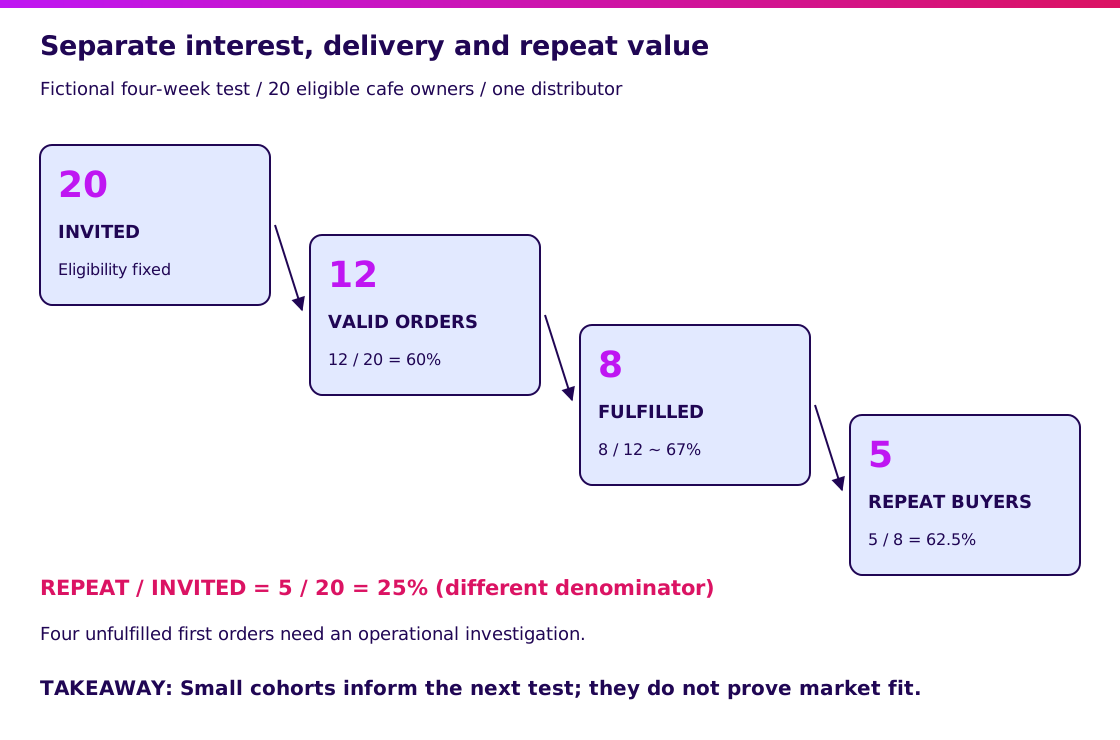
Open the evidence diagram at full size. Use it to separate customer interest from delivery failure before you review the cohort.
Which MVP features should you build first?
Build one complete path from the customer’s request to the promised outcome. In the café fixture, an order that reaches a broken fulfillment queue is not a smaller version of the promise. It is an unfinished promise.
| Include in the first test | Handle manually if workable | Defer until the evidence asks for it |
|---|---|---|
| Known products, units and availability | Supplier stock confirmation | Automated multi-supplier marketplace |
| Accepted order with an order reference | Routing to one distributor | Route optimization for a national fleet |
| Price and payment terms shown clearly | Reconciliation by a named operator | Dynamic credit scoring |
| Fulfillment status and support contact | Exception resolution by the founder | Referral engine and loyalty tiers |
| Event records and usable export | A controlled review spreadsheet | Large analytics suite |
A manual step needs an owner, capacity limit and disclosure where it affects the customer. Record how much effort the team spends. Otherwise, founder attention can disguise a service that loses money on every order.
Scope the smallest useful flow with the person who must deliver it, not only with the person paying for the app.
1. Define the customer promise — owned by the product lead
Make the promise a short checklist that a user and an operator can both recognize.
- Name the eligible customer and service area.
- Choose the recurring task you will support.
- State the promised outcome and response window.
- List the exceptions the team will handle.
- Write the review date and decision owner.
In our fixture, the product lead limits the test to one distributor and 20 café owners. Review question: can a customer explain what happens after submitting an order? I recommend this boundary because a narrow audience makes a failure easier to interpret. Map the promise before drawing screens.
2. Deliver the outcome — owned by the operations lead
Treat the first live workflow as a small service with real obligations.
- Confirm product units and stock before acceptance.
- Save the accepted order and its terms.
- Assign fulfillment and exception owners.
- Record cancellations, delays and refunds accurately.
- Give customers one clear support route.
For a café ordering two cartons, the operator checks that the supplier also uses cartons rather than individual bottles. Review question: can another shift finish the order from the saved record? I recommend explicit hand-offs because a founder fixing every gap personally produces misleading evidence. Review the records in our database guide.
3. Measure the result — owned by the learning lead
Make each event traceable to the behavior the team agreed to test.
- Define activation as a completed action.
- Separate submitted, accepted and fulfilled orders.
- Track repeat behavior over a stated window.
- Link support time and costs to the same cohort.
- Preserve failed attempts rather than deleting them.
In the example, 5 repeat buyers out of 8 fulfilled buyers means 62.5%, while 5 out of 20 invitations means 25%. Review question: would another analyst calculate the same denominator? I recommend a written event dictionary because ambiguous metrics let the team choose a flattering answer. Agree the evidence before the build.
Validate it in 2 weeks. Blueprint & Prototype tests the riskiest assumptions with relevant users and turns the result into agreed scope. The two-week promise concerns prototype validation; it does not guarantee repeat demand or a production launch.
| Review finding | Next decision | Evidence to preserve |
|---|---|---|
| People return and delivery works | Test the next uncertainty with a wider, defined cohort | Repeat window, pricing and recruitment source |
| People request orders but delivery fails | Repair one operational constraint and repeat | Failure reasons and staff effort |
| Delivery works but people do not return | Test the offer, audience or buying cycle | Alternatives used and reasons for leaving |
| Hypothesis contradicted; no credible next test | Stop further spend on this scope | Decision and unused budget |
How do you measure whether an MVP works?
Measure completed value, repeat behavior and the effort required to deliver it. Use the same cohort and observation window when comparing results. A later customer with only two days of exposure should not be judged against someone who had two weeks to reorder.
| Measure | Definition to agree | What to investigate |
|---|---|---|
| Activation | First valid order from an eligible owner | Form confusion or weak intent |
| Fulfillment | Accepted outcome actually delivered | Stock, coverage or operator capacity |
| Repeat use | A second qualifying action within a fixed window | Value, buying cycle and alternatives |
| Commercial commitment | Payment or an explicit paid agreement, where appropriate | Discount dependence and willingness to pay |
| Delivery effort | Staff minutes and variable cost per fulfilled order | Whether the service can support its promise |
Interview both repeat buyers and people who dropped out. Ask what they did instead, which step failed, and what they expected next. An interview explains a behavior; it does not replace the behavior. Keep discounts, reminders and founder assistance visible in the review.
Bring the cohort and its exception log to the next review, rather than a dashboard showing only registrations.
How much does an MVP cost?
Estimate the experiment you need, with an explicit period and operating scope. The following fictional model covers a four-week concierge-assisted ordering test for one distributor and 20 invited cafés. It includes a modest web flow and manual fulfillment coordination. It is not a quotation or a market price survey.
| Assumed line, IDR million | Planning amount |
|---|---|
| Research and experiment design | 6 |
| Ordering flow configuration | 10 |
| Event capture and usable export | 3 |
| Four-week operations allocation | 4 |
| Test tools and hosting | 1 |
| Planned spend | 24 |
| Separate 15% contingency funding | 3.6 |
| Funding envelope | 27.6 |
The arithmetic is 6 + 10 + 3 + 4 + 1 = 24. The reserve is 24 × 15% = 3.6. It is available funding, not guaranteed expenditure. Inventory purchases, delivery charges, payment fees, taxes and a later production build are excluded. State which party pays those costs before recruitment.
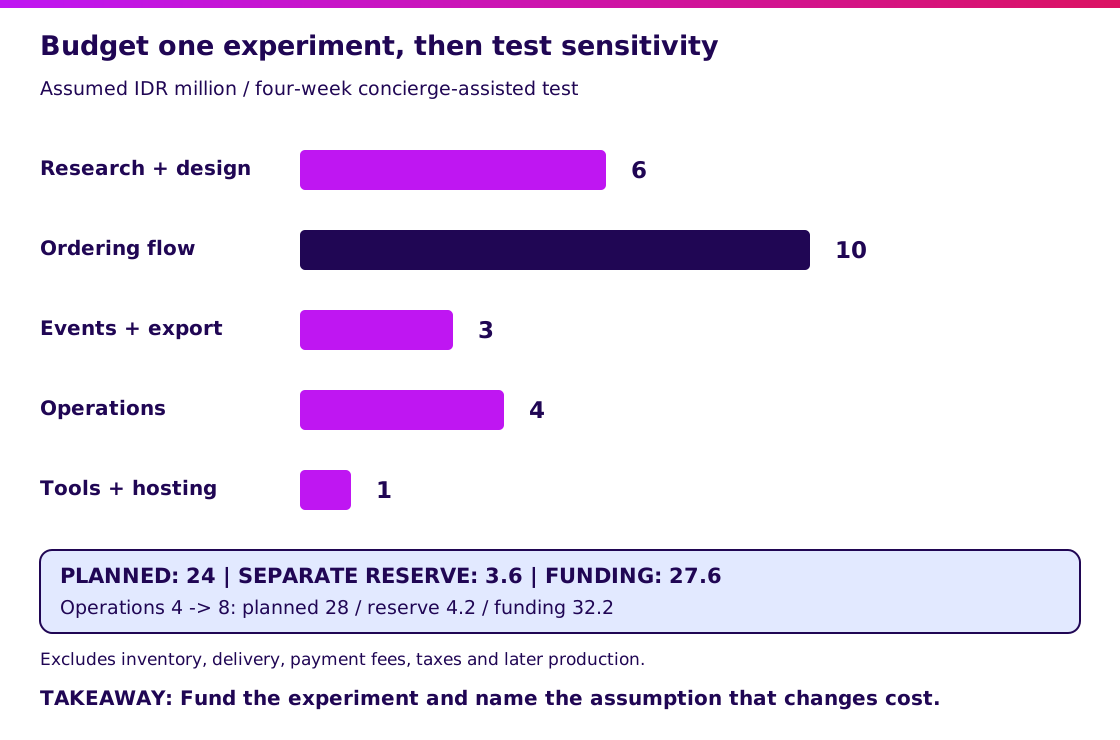
Open the budget diagram at full size. If operations needs 8 million instead of 4, planned spend becomes 28 million and the same 15% reserve becomes 4.2 million. The envelope rises to 32.2 million. That sensitivity matters more than pretending to know a universal MVP price. See the broader application cost model.
How long does MVP development take?
Separate the time needed to build from the time needed to observe customer behavior. A weekly buying cycle requires enough elapsed time to reveal a second purchase. Faster development cannot compress that cycle into a meaningful five-minute usability session.
Our four-week example is an observation window, not a delivery promise. Recruitment, supplier readiness and configuration may happen before it. Record when each buyer first becomes eligible to repeat, and extend observation if the initial window does not cover the behavior you need.
For agreed custom scope, Synetica follows Blueprint & Prototype in 2 weeks, Production Grade Software in 8 weeks, then Launch & Grow on an ongoing monthly retainer. The validation-to-production path is ten weeks. An experiment may inform that path without requiring every stage, and evidence may justify changing scope rather than authorizing production.
Plan production work once the evidence, safety requirements and operating owners are clear.
What mistakes make an MVP produce misleading evidence?
Small scope still needs honest measurement and appropriate safeguards. Do not remove access controls, payment accuracy, a support route or recovery procedures merely because the test is early. Match safeguards to the data and obligations involved.
Three mistakes deserve attention. First, recruiting friends who do not perform the target task. Second, measuring registrations while the hypothesis concerns repeat purchases. Third, treating a manually rescued delivery as evidence that an automated workflow already works.
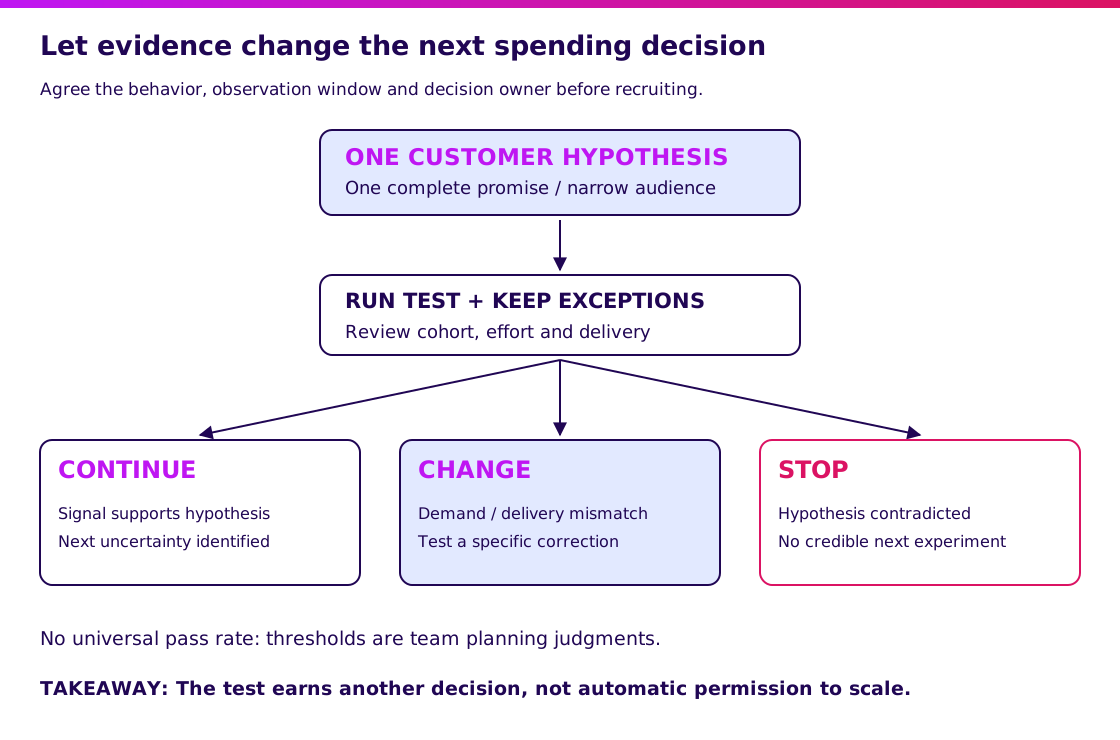
Open the decision diagram at full size. If demand appears but fulfillment fails, investigate operations. If fulfillment works but nobody returns, examine the offer and buying cycle. If the hypothesis is contradicted and there is no credible next experiment, stop the spend. Use the product stop framework to make that discussion concrete. To run the build in short, reviewable cycles, read what agile means in practice. If part of the product can be rented rather than built, see what SaaS is and when to choose it.
What would I tell a founder planning an MVP?
Bring one hypothesis, one user group and one decision to the scoping meeting. I would rather review five traceable customer outcomes than a list of 40 proposed screens. The outcomes tell us where the next build might earn its cost.
For a Growing Business, start with one recurring workflow and the staff who own it. For a Dreamer, test whether the intended customer will make a meaningful commitment before expanding automation. In both cases, make failure interpretable and preserve the evidence.
My next step would be to book a scoping conversation with the hypothesis, the current workaround and the decision you want to make after the test.
FAQ — Understanding MVPs
What is an MVP in simple terms?
An MVP is a deliberately limited offering used to learn about a customer behavior with less work. It must deliver enough value to test the specific hypothesis. A list of unfinished features cannot do that by itself.
What is an example of an MVP?
A reorder service for one distributor and a small group of cafés can be an MVP when customers place real orders and the team tracks fulfillment and repeat use. Manual coordination may be sufficient initially; it does not demonstrate automated scalability.
What is the difference between an MVP and a prototype?
A prototype usually tests understanding or interaction without delivering the whole live outcome. An MVP tests a hypothesis through an offering customers can actually use. They may support the same project at different points.
How much does it cost to build an MVP?
Cost depends on the experiment, integrations, safeguards and operating period. The fictional four-week model here plans IDR 24 million plus a separate IDR 3.6 million reserve. It excludes inventory, delivery, fees, taxes and a later production build.
Does a successful MVP prove product-market fit?
No. A small cohort can provide useful early evidence while leaving acquisition, repeatability, economics and wider demand uncertain. Define the next test from those remaining uncertainties rather than calling registrations proof of fit.
Related Posts
Aditya S
Business Development Manager, Synetica.
Put it into practice
Need help putting this into practice?
We turn the ideas in this article into a prototype tested with real users in 2 weeks (from Rp49jt)—or production-grade software in 8 weeks (from Rp100jt).