App Development Services: Process, Timeline & Deliverables
App development services in Indonesia: what each phase delivers, a ten-week timeline with payments, IDR package ranges and why the cheapest quote costs more.
 By Aditya S November 18, 2026 Updated November 19, 2026 13 min read
App development services (jasa pembuatan aplikasi in Indonesian) should sell you a sequence of deliverables you can open and check, not a block of developer time. Most buyers compare the total on page one. The useful comparison is what you receive at each step, and what the quote quietly leaves out.
I’m Aditya S, Business Development Manager at Synetica, a tech-based business consultancy combining strategy and execution for Dreamers and Growing Businesses. This guide follows one fictional app from brief to launch and prices it two ways, line by line. The figures are teaching assumptions, not Synetica prices, vendor quotes or a market survey.
You’ll get what an app development service includes, the package ranges, a cheap quote against a scoped one, the ten-week process with its deliverables, how to choose a partner, the handover you should hold on launch day, and the red flags.
TL;DR — the whole guide in five lines
- Buy deliverables, not hours: every phase should end in something you can open, test or sign.
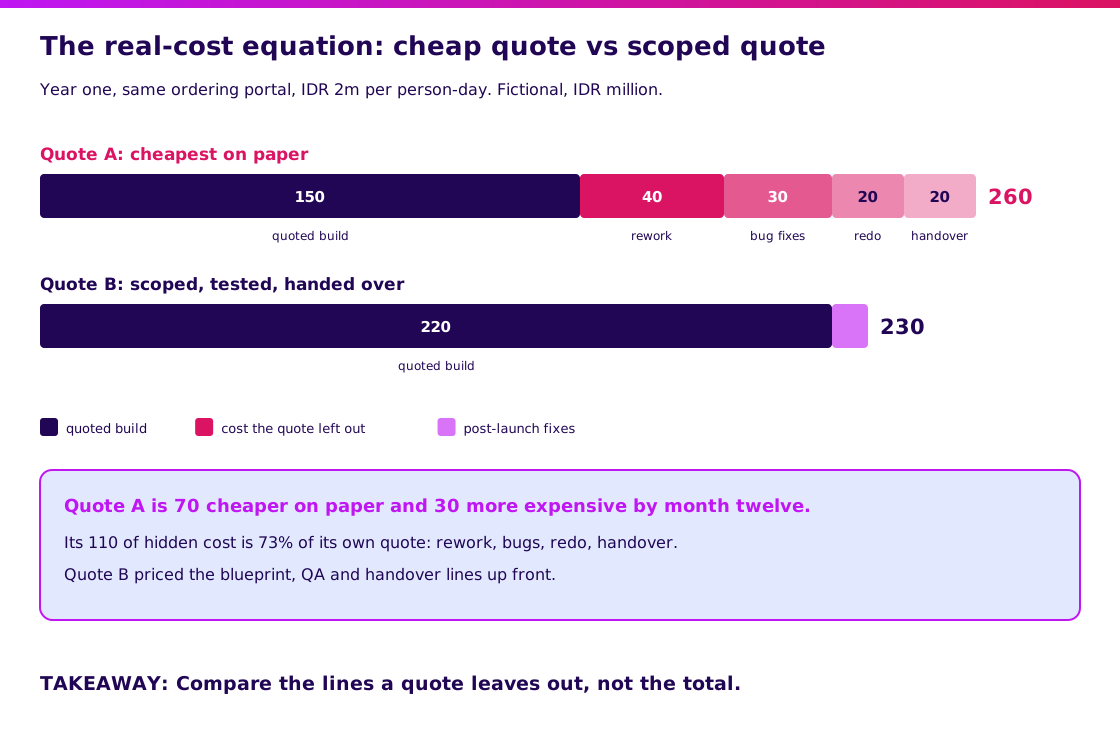
- The cheapest quote is often the most expensive one: in our example a 150 million quote ends year one at 260 million; a 220 million quote ends at 230 million.
- Look for three lines: blueprint, QA and handover. Quotes that skip them move that work to after you have paid.
- Pay against evidence: 30% at signed scope, 40% at a working staging build, 30% at handover.
- The handover is a deliverable: code, accounts and documents in your company’s name, written into the contract.

What is included in app development services?
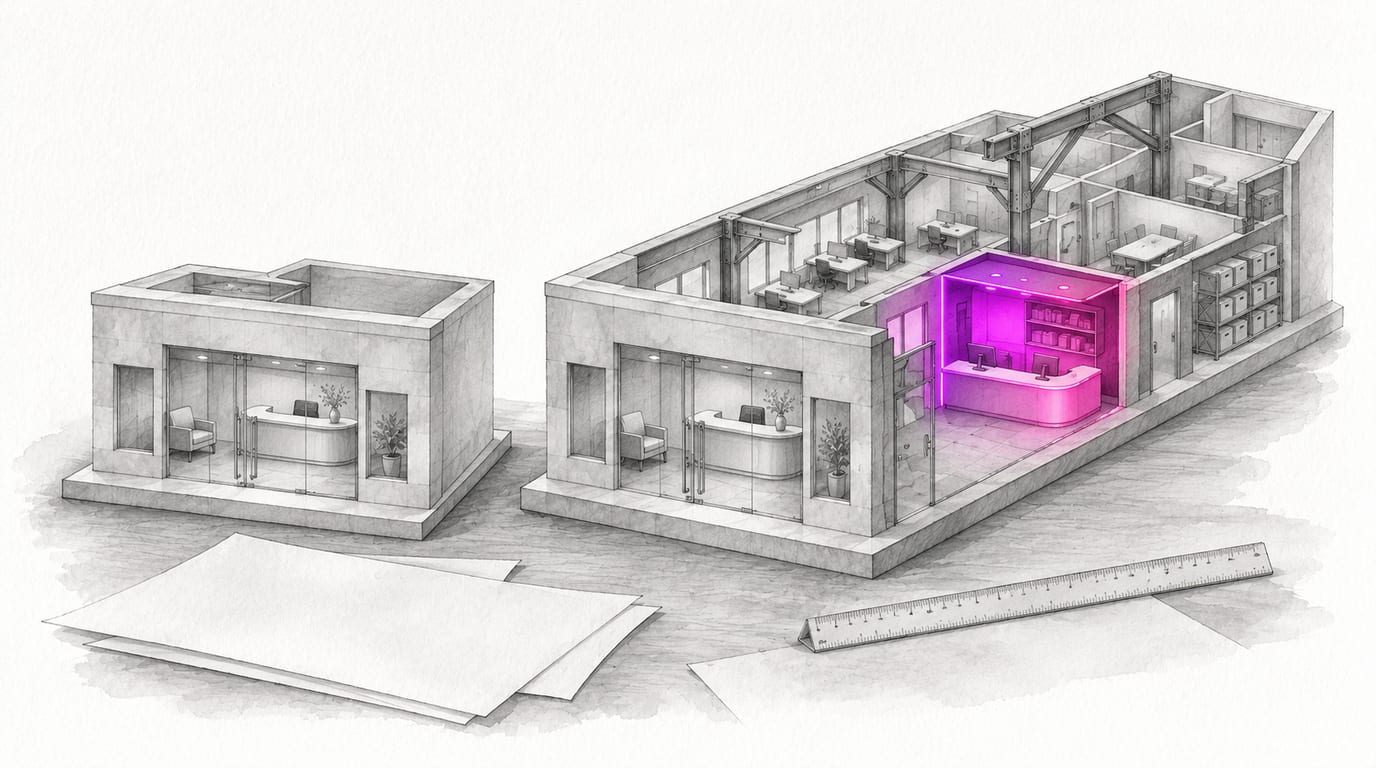
App development services cover seven kinds of work: blueprint, design, front-end, back-end, integration, QA, and release with handover. A quote that names only “design and development” has left at least three of them for you to discover.
| Phase | What you should receive | How you check it |
|---|---|---|
| Blueprint and prototype | Written scope with acceptance criteria, clickable prototype, notes from user tests | You can read every feature and click through the main flow |
| UX and UI design | Screens for every state: empty, loading, error, offline | Each state in the scope has a screen |
| Architecture | Data model and API contract | Another developer could read it and understand the system |
| Build sprints | A staging link updated every two weeks, release notes | You log in and try the new features yourself |
| Integration | Data moving to your accounting, ERP or payment system | A test order appears in the other system |
| QA and security | Test results, fixed bug list, UAT sign-off | Your staff run the agreed scenarios and sign |
| Release and handover | Production release, repository, accounts, runbook, restore test | See the handover checklist below |
The words to watch are “how you check it”. If a phase has no check, you will find out at launch whether it was done.
How much do app development services cost? (Real breakdown)
Plan for IDR 15–40 million for a validation prototype, 60–140 million for a focused internal web app, 180–350 million for an operational application with an integration, and 300–700 million or more for a customer app on Android and iOS.
| Package | Scope | Estimate (IDR) | Timeline | Best for |
|---|---|---|---|---|
| Validation prototype | One risky workflow, clickable, tested with users | 15–40m | 2–4 weeks | Proving the app is worth building |
| Focused internal web app | Few roles, one workflow, basic reports | 60–140m | 6–10 weeks | Moving one manual process into a shared tool |
| Operational application | Multiple roles, approvals, one integration, migration | 180–350m | 10–16 weeks | A Growing Business running daily work on it |
| Customer app, Android + iOS | Both stores, accounts, payments, back-end | 300–700m+ | 4–6 months | A product your customers download |
These are the same planning bands as our application development cost guide, which splits a budget into seven lines. This guide follows the same money through time: what you get for it, and when.
The proof: one ordering portal, two quotes
Same app, same day rate: the 150 million quote ends year one at 260 million, and the 220 million quote ends at 230 million. Our fictional building-materials distributor has six branches and 300 contractor customers. It wants an ordering portal where contractors see their prices, place orders and track deliveries, with orders sent to the accounting system. Both vendors charge IDR 2 million per person-day.
| Line, IDR million | Quote A (cheapest) | Quote B (scoped) |
|---|---|---|
| Blueprint and prototype | not quoted | 20 (10 days) |
| UX and UI design | 20 (10 days) | 24 (12 days) |
| Front-end | 40 (20 days) | 46 (23 days) |
| Back-end and admin | 70 (35 days) | 70 (35 days) |
| Integration with accounting | 20 (10 days) | 20 (10 days) |
| QA and security | not quoted | 30 (15 days) |
| Release and handover | not quoted | 10 (5 days) |
| Quoted total | 150 (75 days) | 220 (110 days) |
| Rework from unclear scope | 40 | — |
| Bug fixing after launch | 30 | 10 |
| Integration redone after go-live | 20 | — |
| Handover rebuilt by a new team | 20 | — |
| Year-one total | 260 | 230 |
Quote A is 70 million cheaper on paper and 30 million more expensive by month twelve. Its hidden 110 million is 73% of its own quote.
None of that hidden cost is a scam. It is the work Quote B priced up front, arriving later at a worse moment. Without a blueprint, the scope is argued during the build. Without a QA line, your staff find the bugs. Without a handover, the next team starts by reading code nobody explained.
Think of it as buying a house with the foundation listed as “optional”. The price looks better until the first rain.
What factors determine the price of app development services?
Integrations, user roles and data migration move the price. Screen count barely does. At our assumed IDR 2 million a day:
| Factor | Typical addition | Why it costs that |
|---|---|---|
| Each integration (ERP, accounting, payment) | 8–15 days, IDR 16–30m | Two systems must agree on every record, including failures |
| Each extra user role | 4–6 days, IDR 8–12m | New screens, access rules and tests |
| Data migration from spreadsheets | 5–10 days, IDR 10–20m | Old data is never as clean as it looks |
| Approval workflows | 4–8 days, IDR 8–16m | Every path, including rejection and delegation, needs testing |
| Mobile apps on top of the web app | 300–700m+ band | A second front-end, store release and device testing |
| Maintenance after launch | monthly | Security updates, small changes and hosting |
To lower the price, cut scope and keep the lines. In Quote B, moving delivery tracking to a second release removes about 8 days, or IDR 16 million, and contractors can still order from day one. Removing QA saves 30 million on paper and, in Quote A, cost 30 million in bug fixes anyway.
Which costs are not optional?
If the app stores customer data, Indonesia’s Personal Data Protection Law (Law No. 27 of 2022) applies, so security testing belongs in the quote, not in a later change request.
If the app ships on Android, maintenance is not optional either. From 31 August 2026, new apps and app updates must target Android 16 (API level 36) to be submitted to Google Play, and the bar moves up roughly once a year. See Google’s target API level requirement.
Validate it in 2 weeks. Before you spend heavily on app development services, Blueprint & Prototype tests your assumptions: a spec, a clickable prototype in front of real users, and a real cost estimate. The two-week promise covers prototype validation; it does not mean the finished app ships in two weeks.
What is the app development process and timeline, from brief to launch?
Quote B takes ten weeks and five deliverables, with three payments tied to things you can open and test. 110 person-days fit into ten weeks because two or three people work in parallel.
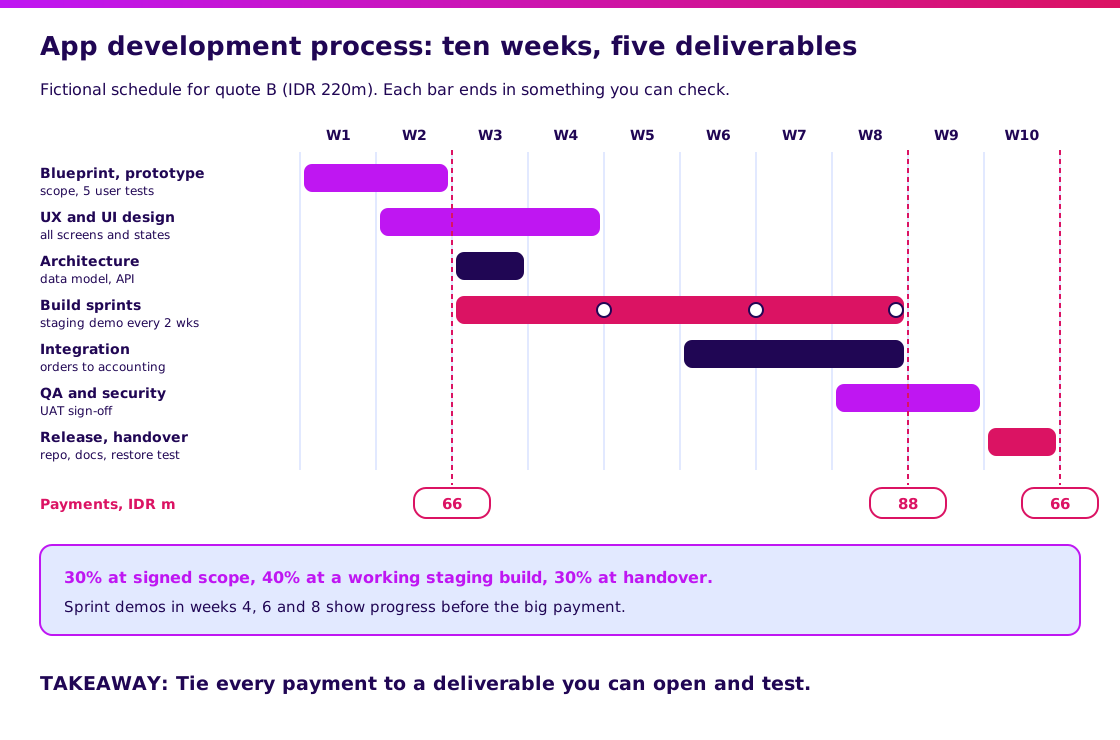
- Weeks 1–2, Blueprint & Prototype. You receive the written scope with acceptance criteria and a clickable prototype tested with five contractors. Pay 30%, IDR 66 million, when you sign the scope.
- Weeks 2–4, design and architecture. You receive every screen and state, plus the data model and API contract.
- Weeks 3–8, build sprints. You receive a staging link with a demo in weeks 4, 6 and 8. Pay 40%, IDR 88 million, when the full flow works on staging.
- Weeks 6–9, integration, QA and UAT. You receive a test order in the accounting system, test results and a signed UAT.
- Week 10, release and handover. You receive the production release and the handover pack. Pay the last 30%, IDR 66 million.
The schedule follows Synetica’s own path: 2 weeks of Blueprint & Prototype, then about 8 weeks of Production Grade Software, then Launch & Grow as a monthly retainer. A larger scope takes longer, up to the 10–16 weeks in the operational band.
Ask to see the staging link before the big payment, not a slide deck about it. Sprint demos are the cheapest way to find a misunderstanding in week 4 instead of week 10.
How do you choose an app development partner (not the cheapest vendor)?
Choose the partner whose model matches who should own delivery. Then compare on deliverables, not day rates.
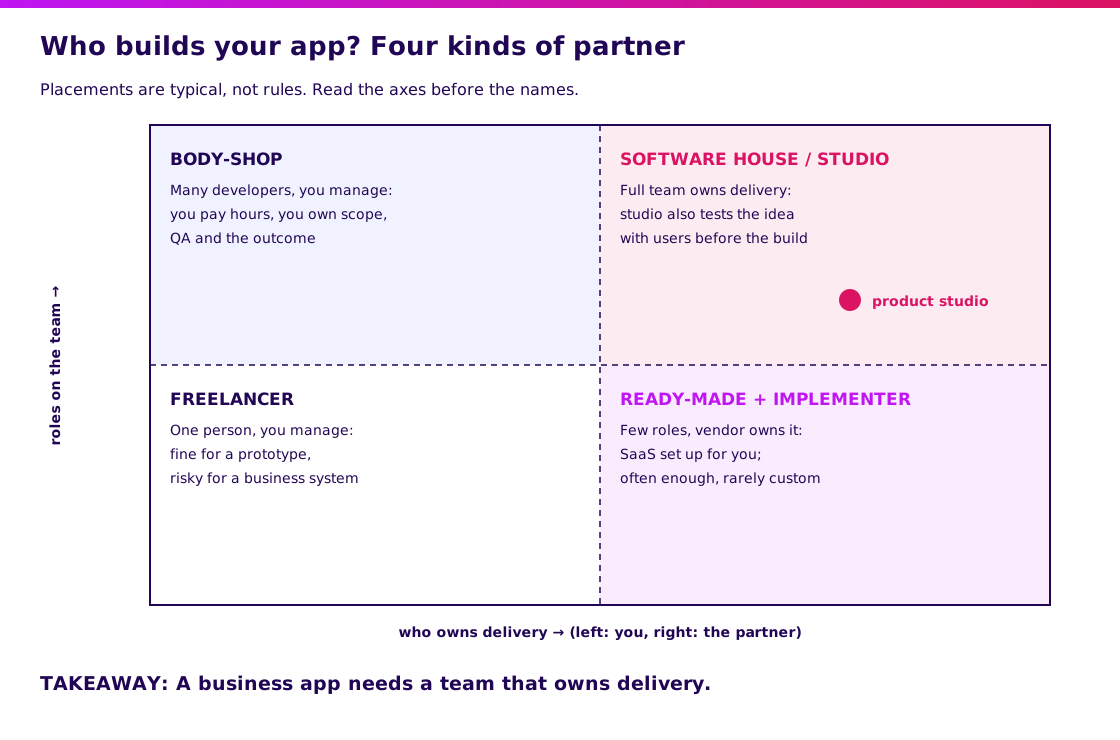
- Freelancer. One person you manage. Good value for a prototype, risky for a system your branches depend on.
- Body-shop. Developers by the hour. You own scope, QA and the outcome, so you need a strong product owner in-house.
- Software house. A full team delivering an agreed scope. Our software house guide gives five checks for picking one.
- Product studio. A full team that also tests the idea with users before the build, so you don’t fund the wrong scope.
- Ready-made software with an implementer. If your process is standard, a SaaS product set up for you is often cheaper than any custom app.
In every meeting, ask for the same four things: person-days per line, an example staging demo, an example handover pack, and the monthly cost after launch. The vendor due diligence checklist goes deeper.
What should you receive at handover?
On launch day you should hold the code, the accounts and the knowledge needed to run the app without the vendor.
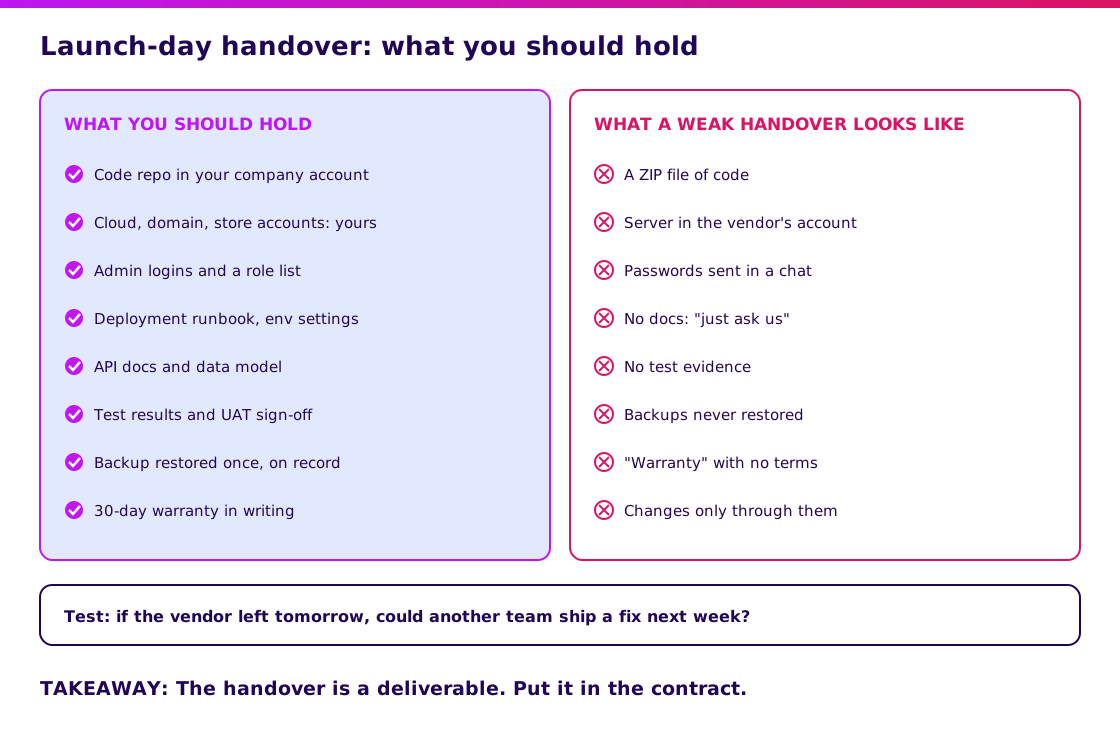
- Code repository in your company’s GitHub or GitLab account, with full history.
- Cloud, domain and app store accounts registered to your company.
- Admin logins and a list of user roles.
- A deployment runbook and environment settings, so another team can release a fix.
- API documentation and the data model.
- Test results and the signed UAT.
- A backup restored at least once, with the date on record.
- A written warranty, such as 30 days of bug fixes, with clear terms.
The test is simple: if the vendor left tomorrow, could another team ship a fix next week? In Quote A, the answer was no, and finding out cost 20 million.
What are the red flags when choosing app development services?
A quote is a warning sign when it hides the work you can’t see, or the owner of what you paid for. Watch for these six:
- No blueprint line. Scope gets settled during the build, at build prices.
- No QA line. Your staff become the testers, after launch.
- One payment of 50% or more up front. Nothing exists yet to check it against.
- No staging link until the end. You see the app for the first time when it is too late to change cheaply.
- Code or servers in the vendor’s account. You rent your own app.
- An operational system at a prototype price. At IDR 2 million a day, 60 million buys 30 days. Quote B needs 110.
What I would do before signing an app development contract
Write the deliverables into the contract first, then negotiate the price. Most disputes come from a payment that was due before anyone agreed what “done” meant.
- Ask every vendor for the same table: phase, deliverable, how you check it, payment.
- Fund the blueprint separately if you are unsure of the scope. It is the cheapest phase to change your mind in.
- Keep the last 30% for the handover, not for the go-live alone.
This advice fits Growing Businesses moving a daily process into software and Dreamers pricing a first product. If your process is standard, try a ready-made application before you commission a custom one.
My next step would be to book a scoping conversation with your workflow, your user roles and the systems the app must connect to.
If the direction is still unclear, use the IT consultant guide. If you need to choose who will deliver the agreed scope, compare in-house, outsourced and integrated app teams.
FAQ — App development services
How much do app development services cost?
As planning ranges, IDR 15–40 million for a validation prototype, 60–140 million for a focused internal web app, 180–350 million for an operational application with an integration, and 300–700 million or more for a customer app on Android and iOS. Real quotes depend on the written scope.
What is the best app development service in Indonesia?
There is no single best one. The best partner for you lists person-days per phase, shows a staging build every two weeks, ties payments to deliverables and hands over code and accounts in your name. Compare vendors on those four, not on the total.
How long does app development take?
About 2–4 weeks for a prototype, 6–10 weeks for a focused web app, 10–16 weeks for an operational application and 4–6 months for a customer app on both stores. Our fictional ordering portal takes ten weeks.
What is the difference between a software house and a freelancer?
A freelancer is one person you manage, which suits a prototype or a small tool. A software house brings design, front-end, back-end and QA roles and owns delivery of the agreed scope, which an operational system with an integration needs.
What does an app development service do?
It turns your process into a written scope and prototype, designs the screens, builds the front-end and back-end, connects the app to your other systems, tests it with your staff, releases it and hands over the code, accounts and documents. Good ones also maintain it after launch.
Related Posts
Aditya S
Business Development Manager, Synetica.
Put it into practice
Need help putting this into practice?
We turn the ideas in this article into a prototype tested with real users in 2 weeks (from Rp49jt)—or production-grade software in 8 weeks (from Rp100jt).