
IT Consultant: When You Need One and How to Choose
Choose an IT consultant with a clear scope, inspectable deliverables and an IDR cost model. Know when advice, configuration or a custom build is the right next step.
 By Aditya S November 7, 2026 Updated November 19, 2026 12 min read
An IT consultant should help you make a technology decision you can explain and check. If your sales team wants a new app while operations wants the existing system fixed, commissioning development immediately leaves the disagreement inside the project.
I’m Aditya S, Business Development Manager at Synetica, a tech-based business consultancy combining strategy and execution for Dreamers and Growing Businesses. This guide uses a fictional distributor and an open calculation, so you can inspect the reasoning without treating a teaching example as a client result.
You’ll get a scope checklist, a comparison of advisory and delivery roles, a worked consulting budget, five supplier checks, and a decision process that can end with buying, building, or changing a workflow.
TL;DR — the whole guide in five lines
- Buy a decision with evidence: a consultant should leave you with options, assumptions, costs and an accountable owner.
- Separate diagnosis from implementation: advice can lead to configuration, a custom build, or no software purchase.
- Compare named deliverables: a day rate alone tells you little about what you will receive.
- Price your own participation: access to users, data and decision-makers determines whether the work can progress.
- Test the handover: another team should be able to act on the recommendation without reconstructing the investigation.

When does an IT consultant help? Start with one measurable problem
Bring a consultant in when the expensive uncertainty is what to change, who must change it, or which option fits. You may already have capable developers. Their constraint could be a contradictory brief rather than missing engineering capacity.
Consider a fictional distributor processing 5,000 orders a month. Staff spend eight minutes per order copying information between systems. A proposed workflow takes two minutes. The difference is 5,000 × six minutes ÷ 60 = 500 hours of monthly capacity.
At an assumed internal cost of IDR 60,000 per hour, that capacity has a nominal value of IDR 30 million. It is not automatically a cash saving. If only 40% could reduce paid overtime, the cash opportunity would be IDR 12 million, conditional on the overtime actually disappearing.
A useful consultant checks the eight-minute baseline, tests the two-minute assumption, and asks whether integration or a simpler form could remove the repeated entry. The app is one possible answer. Measure a representative sample across routine orders, returns and exceptions before extrapolating.
Compare the build-versus-buy decision framework before requesting a development proposal.
What does an IT consultant actually do?
An IT consultant connects a business problem to a practical technology decision and an implementation plan. The scope can include process mapping, architecture review, vendor selection, data readiness, security priorities, or a product blueprint. List which of these you are buying.
| Role | Main question | Inspectable output | Your responsibility |
|---|---|---|---|
| IT consultant | What should change, and why? | Options, evidence, recommendation, roadmap | Own the decision and provide access |
| Software delivery team | How do we implement agreed scope? | Tested software, deployment, handover | Accept scope and verify outcomes |
| Internal IT team | How do we keep operations dependable? | Access controls, support, service records | Set priorities and funding |
| Software implementer | Can a packaged tool cover the workflow? | Configuration, migration, training | Own process rules and adoption |
A company can provide several roles. Ask who performs each role and how a recommendation is reviewed when that company also sells the build. A stated incentive is easier to manage than an invisible one.
For cybersecurity work, NIST’s CSF 2.0 Profiles guidance distinguishes current and target outcomes. That supports a useful consulting habit: describe the starting position and the intended destination. It does not provide a consulting price or certify a supplier.
Define the question in a Blueprint & Prototype engagement if you need a working test alongside the recommendation.
How much does an IT consultant cost in Indonesia?
Calculate effort from deliverables before comparing fees. The following budgets are fictional planning exercises at IDR 2 million per person-day. They are not market averages, Synetica offers, or supplier quotations. A person-day means one person’s working day; it is not necessarily one elapsed calendar day.
| Illustrative scope | Person-days | Assumed fee | Elapsed planning window | Suitable decision |
|---|---|---|---|---|
| Focused review | 6 | IDR 12m | 1–2 weeks | One bounded system question |
| Workflow and options study | 12 | IDR 24m | 2 weeks with shared staffing | Compare configuration, hybrid and custom |
| Multi-system assessment | 20 | IDR 40m | 4 weeks | Dependencies across several owners |
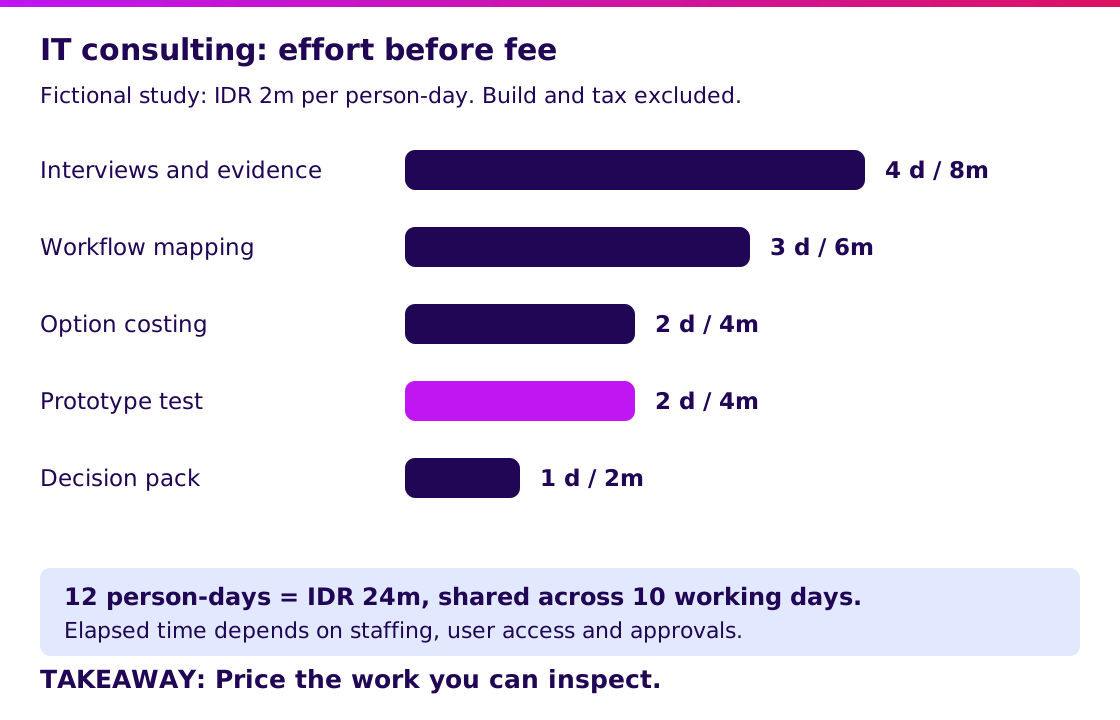
The twelve-day example contains four days of interviews and evidence review, three days of workflow mapping, two days of option costing, two days of a prototype test, and one day preparing the decision pack. At the assumed rate, 12 × IDR 2 million = IDR 24 million.
It assumes a lead and supporting analyst can share effort across ten working days. It excludes implementation, ongoing subscriptions, travel and taxes. Prototype work is a limited test, not production software. Extra systems or unavailable interviewees require a scope or schedule revision.
Ask a supplier to mark inclusions and exclusions next to each output. If the data assessment is omitted, establish who will do it and how it could change the recommendation. Use the software vendor due diligence questions to turn the estimate into a reviewable brief.
How do you compare configuration, hybrid and custom costs fairly?
Keep the business requirement and comparison period constant. For the fictional distributor, assume all options cover the same order workflow, user group, migration sample and acceptance tests. Differences must be written down before comparing totals.
| Planning option | Setup | Monthly software, hosting and support | First year | With the same IDR 24m study |
|---|---|---|---|---|
| Configure packaged software | IDR 12m | IDR 3m | IDR 48m | IDR 72m |
| Packaged core plus integration | IDR 60m | IDR 4m | IDR 108m | IDR 132m |
| Custom workflow | IDR 180m | IDR 5m | IDR 240m | IDR 264m |
Setup includes the assumed migration, testing and onboarding effort. Monthly figures are respectively software 2 + support 1; software 2 + hosting 1 + support 1; and hosting 3 + support 2, in IDR million. All options exclude tax and future feature expansion. These are assumptions to replace with actual quotations.
The cheapest configuration is a credible winner if it passes the workflow test. If it cannot enforce a necessary approval rule, record that failed test instead of inventing future rework to justify custom software. Conversely, a complex preference that users rarely need may be cheaper to change operationally.
Discuss the smallest test with a sample order and the rule your current system cannot handle.
Validate direction in 2 weeks. Blueprint & Prototype combines a decision-ready plan with a working prototype. Use user signal to decide whether production investment is justified; the example fees above are not Synetica pricing.
How do you choose an IT consultant? Five checks with named owners
1. Problem evidence — owned by your operations lead
Request a baseline that survives a second look. It is the measuring tape for the rest of the engagement.
- Observe routine work and exceptions.
- Count the sample and record its dates.
- Separate waiting time from handling time.
- Confirm which manager owns the metric.
For the distributor, examine 30 orders before accepting eight minutes as representative. Ask: “Which order breaks this average?” This is a suggested interview question, not a testimonial. The reason is simple: an average can hide the process that actually needs attention. Prepare the evidence with your team.
2. Options and incentives — owned by the business sponsor
Require at least one credible alternative to the supplier’s preferred solution. This is a fork in the road, not a ceremonial comparison.
- Include configuration and workflow change.
- Name mandatory acceptance tests.
- Show recurring and exit costs.
- Disclose commissions or implementation incentives.
In the example, the IDR 72m configuration path stays on the shortlist until a necessary test rules it out. Ask: “What evidence would make you recommend the cheaper option?” This question makes the reasoning inspectable. Review build versus buy before scoring proposals.
3. Technical reality — owned by the engineering reviewer
Test the uncertain dependency before accepting the architecture. One small connection can act as a load test for the whole recommendation.
- Verify API access and rate limits.
- Inspect a representative data export.
- Check identity and permission boundaries.
- Record failure and recovery behaviour.
Use one anonymised order to test a proposed integration. Ask: “Can another engineer reproduce this result?” The purpose is to expose dependencies while the decision is still cheap to change. Scope production engineering after the test, not before it.
4. Decision pack — owned by the accountable executive
Leave the engagement with a document that allows a yes, no, or staged decision. It should function like a board paper with receipts.
- State the recommendation and rejected options.
- Attach assumptions and cost calculations.
- Prioritise risks and responsible owners.
- Define the next funding gate.
A twelve-day study should produce more than twelve days of meeting notes. Ask: “What can we approve using this pack?” This is why deliverables matter more than a slide count. Define your approval gate before the work begins.
5. Transfer and independence — owned by your future operator
Ask the receiving team to explain the plan back. A useful handover is a bridge another team can cross.
- Deliver editable source documents.
- Transfer approved access through company accounts.
- List unresolved questions and dependencies.
- Run a walkthrough with the delivery owner.
Give a second engineer the integration notes and ask for a small reproducibility check. Ask: “What would stop us using another implementation partner?” The rationale is continuity, even when the original consultant remains involved. Check software house ownership terms alongside the advisory agreement.
What timeline and deliverables should an IT consultant propose?
Use decision gates so that uncertainty controls the next step. In a two-week study, days one and two establish the baseline; days three to five map rules and options; days six to eight test the risky workflow; days nine and ten assemble costs, owners and the recommendation.
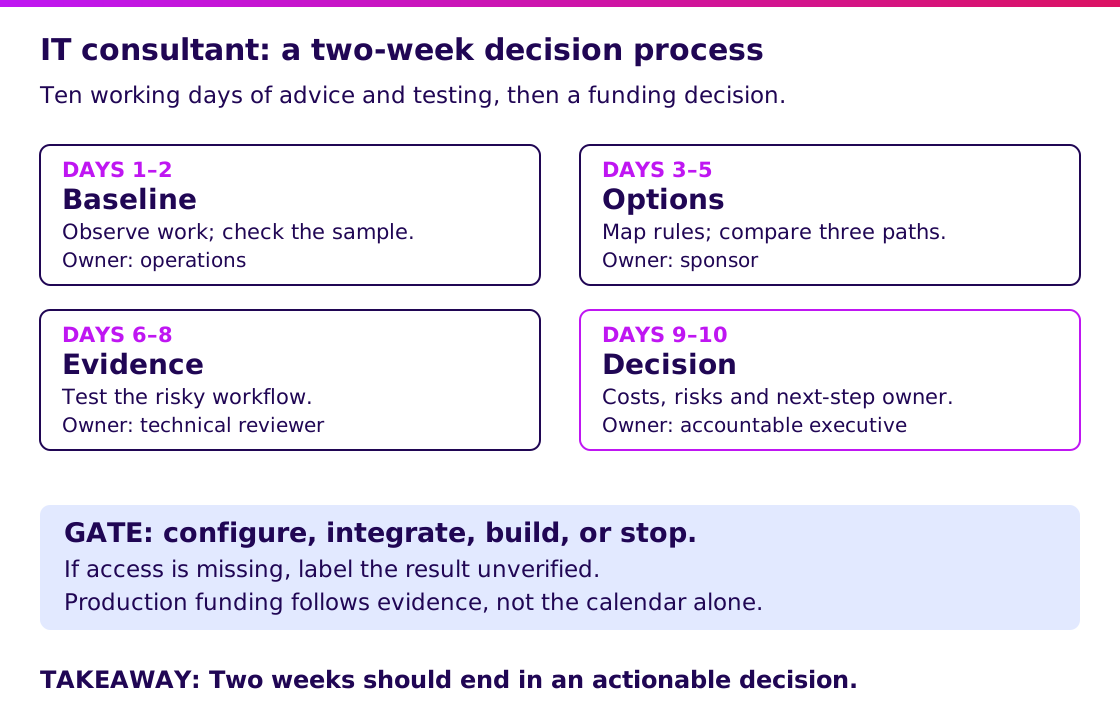
Client interviews and access approvals are dependencies, not background administration. Assign a sponsor, an operations representative and a technical contact before kickoff. If an integration cannot be tested because access is missing, the decision pack should label it unverified rather than quietly convert a guess into a commitment.
At Synetica, Blueprint & Prototype takes two weeks, followed by eight weeks of Production Grade Software for agreed scope, then Launch & Grow as an ongoing monthly retainer. That is a ten-week validation-to-production path. An IT assessment alone does not mean production software will appear in two weeks.
“Working software is the primary measure of progress.” — Kent Beck, Martin Fowler and fellow signatories, Principles behind the Agile Manifesto.
For advisory work, translate that principle into demonstrable evidence: a tested workflow, a reproducible integration, or a decision that can be acted on. Agree the validation gate before extending the engagement.
What warning signs should you watch for?
A recommendation becomes weak when you cannot identify its evidence or owner. Watch for a product selected before interviews, claimed savings with no baseline, unlimited scope at a fixed fee, inaccessible documentation, and a roadmap without an adoption owner.
An honest consultant can say the current system is sufficient, the dataset is not ready, or the business case is too small. Ask for open questions in writing. A recommendation to delay a build can be a useful result if it prevents funding a workflow users will not adopt.
Bring the unclear brief to a consultation instead of turning every uncertainty into a feature request.
What I would do before commissioning advice
Write one decision sentence: “We need to decide whether to ___ by ___ because ___.” Add a baseline, one failed workflow example, and the name of the person who can approve the next step.
Growing Businesses with competing system priorities benefit from this preparation. Dreamers with one untested product assumption may need a smaller prototype engagement. If the scope and acceptance criteria are already clear, a delivery team may be the immediate hire.
My next step would be to review that decision sentence in a consultation. It is enough to start a useful conversation.
FAQ
How much does an IT consultant cost?
Price depends on scope, seniority, access and deliverables. Our fictional twelve-person-day study costs IDR 24m at IDR 2m per day, excluding implementation, subscriptions, travel and tax. Get a written estimate for your own scope.
Who is the best IT consultant in Indonesia?
There is no universal winner. Compare relevant workflow experience, named delivery owners, disclosed incentives, evidence quality and handover terms against your decision.
How long does IT consulting take?
A bounded review can take one or two weeks; a multi-system assessment can take longer. Access, sample quality and approval speed affect elapsed time. Confirm gates and dependencies in the brief.
What is the difference between an IT consultant and a software house?
A consultant helps determine direction and priorities; a software house typically implements scope. A partner can do both. Specify the advisory output and engineering responsibility separately.
What should an IT consultant deliver?
Expect an agreed baseline, options, test evidence, cost assumptions, prioritised risks and an actionable recommendation with owners. Add prototype or architecture outputs explicitly when needed.
Related Posts
Aditya S
Business Development Manager, Synetica.
Put it into practice
Need help putting this into practice?
We turn the ideas in this article into a prototype tested with real users in 2 weeks (from Rp49jt)—or production-grade software in 8 weeks (from Rp100jt).