App Developer: In-house, Outsourced or Product Team?
Choose an app developer by comparing in-house, outsourced and studio teams. Use equal-scope IDR budgets, acceptance tests and ownership checks before you commit.
 By Aditya S November 19, 2026 12 min read
An app developer can be an employee, an external engineer, or part of a team responsible for the whole product. The right choice depends on the work that remains uncertain and who will own the application after launch.
I’m Aditya S, Business Development Manager at Synetica, a tech-based business consultancy combining strategy and execution for Dreamers and Growing Businesses. This guide compares three delivery arrangements using explicit fictional budgets. It is a decision worksheet, not a salary survey or a ranking of agencies.
You’ll compare responsibilities, calculate a year of ownership, inspect a real handover standard, and use five hiring checks to decide which arrangement your company can actually manage.
TL;DR — the whole guide in five lines
- Hire for the missing responsibility: coding capacity, technical leadership and product direction are different gaps.
- Keep scope equal: compare the same workflow, acceptance tests, support window and ownership terms.
- Count the people around the developer: design, QA, delivery decisions and operations still need owners.
- Price the operating year: recruitment, infrastructure and support change the comparison after launch.
- Choose a sustainable arrangement: the cheapest team you cannot direct is an expensive management problem.

How do you compare an app developer fairly?
Start with the work and constraints before comparing team labels. A fictional distributor wants a portal for 200 repeat buyers: authenticated orders, a credit-limit check, order status and one accounting integration. Exclude route planning, a consumer marketplace and a second mobile app from the comparison.
All three arrangements below must deliver the same portal, test it against the same examples and support the same twelve-month ownership window from kickoff. Assume an existing operations manager can act as product owner. If that person is unavailable, the budget and decision should change for every option.
Write five acceptance cases before requesting prices: an approved order, a customer above its credit limit, a repeated submission, a cancelled order, and an integration outage. Give every candidate identical anonymised inputs. A credible comparison measures what happens to those cases rather than how many technology names appear on a slide.
Use the app development process guide to turn the workflow into inspectable deliverables.
What does an app developer do, and what needs a wider team?
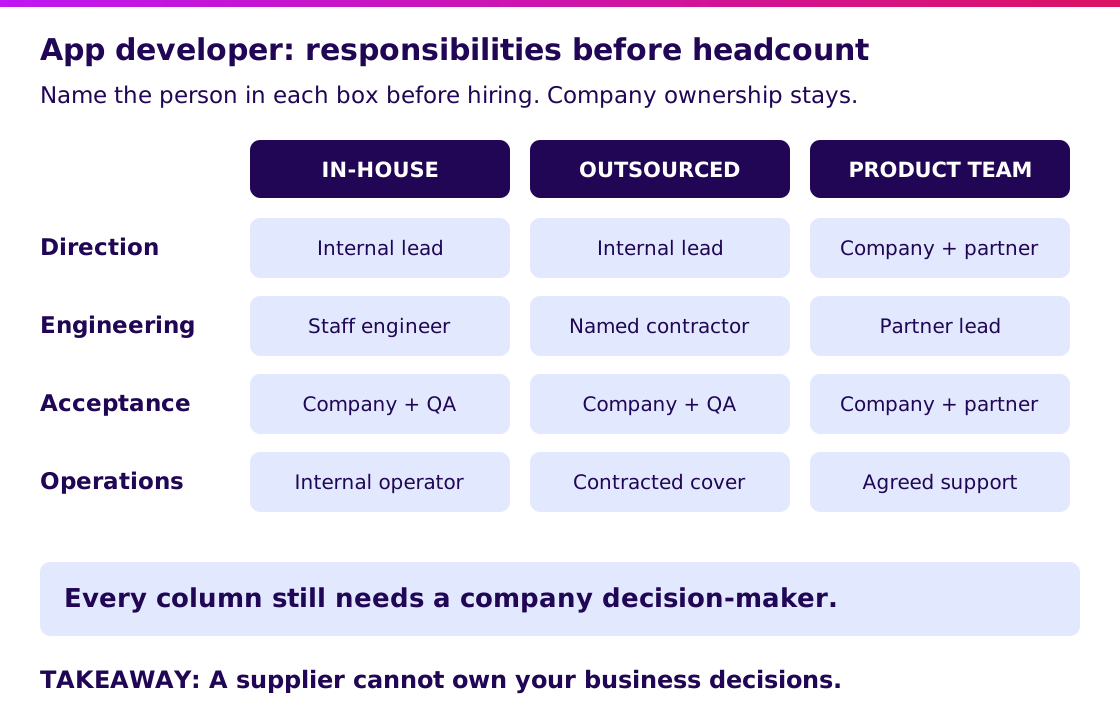
A developer implements software behaviour; a delivery arrangement must also cover the decisions and controls around it. One person may hold several roles, but those responsibilities do not disappear.
| Arrangement | You are buying | What your company must supply | Best fit |
|---|---|---|---|
| In-house developer with supporting roles | Ongoing knowledge and capacity | Hiring, leadership, product ownership, career support | A continuous roadmap with internal management |
| Outsourced development capacity | Contracted engineering effort | Clear priorities, architecture and acceptance decisions | A known backlog with a capable internal lead |
| Integrated product team | Discovery, design and delivery under an agreed scope | Sponsor, user access, business decisions | A bounded product problem needing several disciplines |
“Product studio” is a delivery-market label, not proof of competence. Synetica’s category is tech-based business consultancy: strategy and execution together. Judge any partner by named responsibilities and evidence rather than its preferred description.
For our portal, the product owner sets the credit policy, an engineer implements it, QA checks edge cases, and operations handles rejected orders. Ask candidates to name all four owners. Review the IT consultant guide if the unresolved issue is direction rather than delivery capacity.
How much does an app developer cost over a year?
Compare the full arrangement over the same period, with the same assumptions. The following IDR figures are invented for teaching. They are not salary benchmarks, vendor prices, or a Synetica proposal. Replace each line with a quote or your finance team’s actual employment cost.
| Assumed first-year component, IDR million | In-house | Outsourced capacity | Integrated product team |
|---|---|---|---|
| Engineering or contracted delivery | 384 | 432 | 240 |
| QA, leadership and design outside that line | 216 | 120 | Included in delivery |
| Recruitment or initial handover/setup | 20 | 12 | Included in delivery |
| Post-launch application support | Included in team capacity | Included in contract capacity | 72 |
| Infrastructure, twelve months | 36 | 36 | 36 |
| Total | 656 | 600 | 348 |
What assumptions sit behind each team budget?
The in-house assumption is IDR 32m monthly fully loaded engineering cost plus QA 6m, leadership 8m and design 4m per month. That is 50m × 12 + recruitment 20m + infrastructure 36m = 656m. Fully loaded cost includes assumed employment overhead and equipment; it does not mean take-home salary.
Outsourced capacity is assumed at 36m monthly, with internal leadership/design/acceptance support of 10m monthly: 46m × 12 + setup 12m + infrastructure 36m = 600m. The agreement must say how fixes, leave and availability use that capacity.
The integrated team is a bounded 240m delivery project including discovery, design, engineering, QA and handover, followed by nine months of assumed support at 8m = 72m, plus 36m infrastructure: 348m. Ten weeks of build-and-validation occupy approximately the first three months. Support covers fixes and small agreed changes; it does not fund a year of new features.
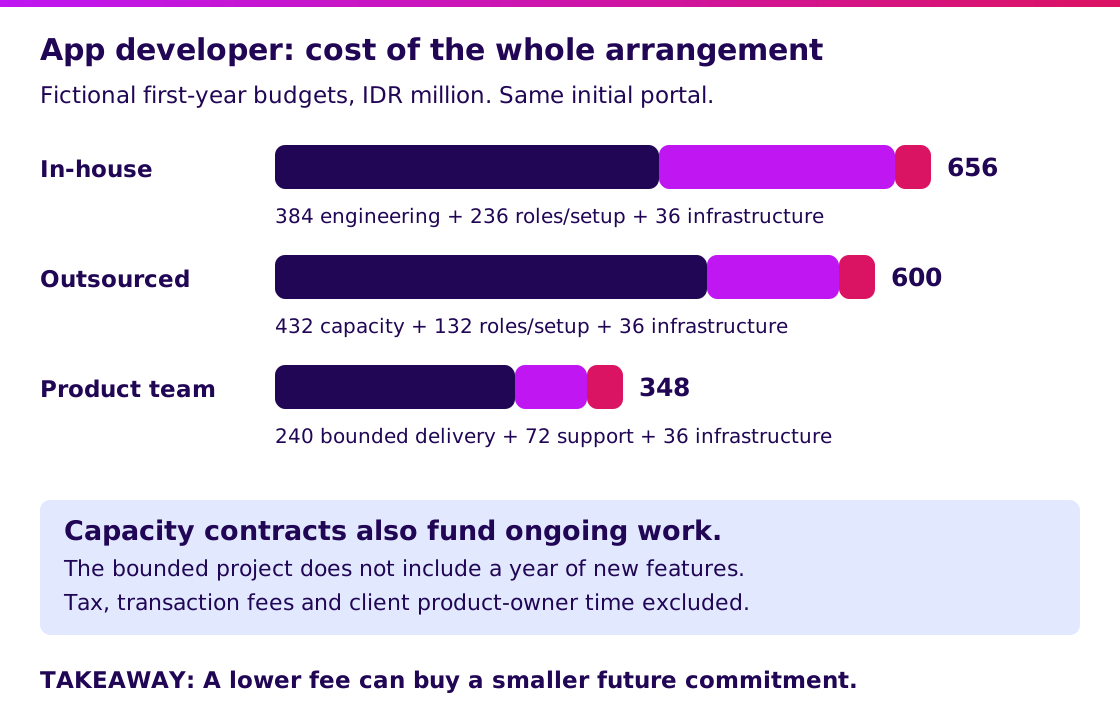
All totals exclude taxes, third-party transaction fees, app-store fees and large new features. Client product-owner time is required across all options and is not priced here. A contingency reserve should be approved separately; it is not planned spend. Get a scoped estimate after filling the missing assumptions.
When is each app developer arrangement the better buy?
The example’s integrated team is cheaper because the roadmap is bounded, not because external teams are inherently more efficient. The annual capacity arrangements provide room for ongoing work that a fixed delivery fee does not include.
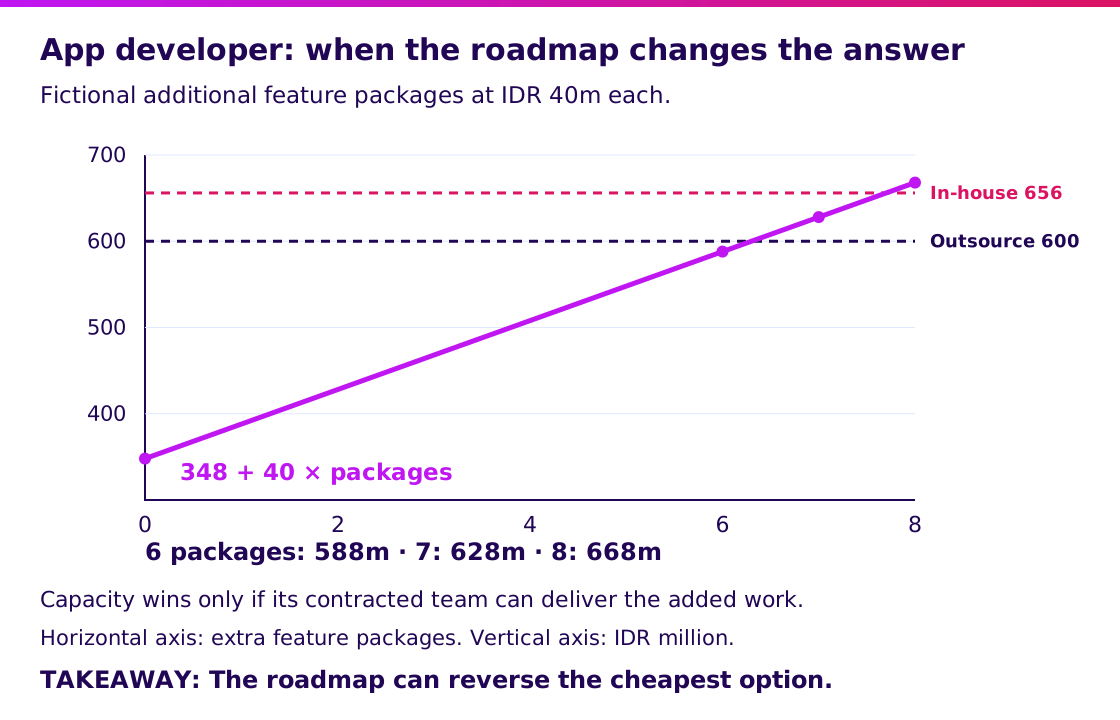
Suppose the company adds eight substantial monthly feature packages after launch. At an assumed IDR 40m per package, the integrated path adds 320m and becomes 668m. It now exceeds the 600m capacity budget, provided the outsourced team can actually deliver that extra workload within its contracted capacity.
The same qualification applies in-house: available hours do not prove delivery throughput. Ask for a capacity plan and evidence from a representative task. At 40m per package, seven packages raise the integrated total to 628m; six raise it to 588m. The comparison turns between six and seven only under these assumptions.
Your next step is to write a twelve-month roadmap and separate committed work from speculative requests. A “cheap” project can be the right choice for a stable workflow and the wrong choice for a product with weekly experiments.
How do you choose an app developer? Five checks before hiring
1. Working example — owned by your product owner
Evaluate one important user journey end to end. This is the test drive, not the showroom tour.
- Provide a representative input.
- Define success and a failure case.
- Ask for a runnable demonstration.
- Record assumptions and outstanding gaps.
For the portal, submit an order above the credit limit and confirm what the customer, sales rep and finance user each see. Ask: “Which part of this workflow remains uncertain?” This is a suggested assessment question, not an attributed testimonial. Define the prototype test before paying for a large build.
2. Engineering quality — owned by your technical reviewer
Inspect how another engineer will maintain the application. A tidy front door says little about the wiring behind it.
- Review one change and its tests.
- Check permissions and error handling.
- Run the setup instructions.
- Inspect the release and recovery process.
Ask a reviewer to start the project from its documentation without the original developer driving the keyboard. For our portal, test how a duplicate submission is handled. The purpose is reproducibility, not a particular framework choice. Review the software house evidence checklist alongside the sample.
“Good programmers write code that humans can understand.” — Martin Fowler, quoted in the publisher’s Refactoring overview.
3. Delivery ownership — owned by your executive sponsor
Name who resolves trade-offs when scope, time and quality conflict. That person is the steering wheel for the engagement.
- Assign the business decision-maker.
- Identify the engineering lead.
- Define acceptance and escalation.
- Agree how changes alter scope or fees.
If accounting access is delayed by five days, ask: “Who decides whether to sequence other work, extend the schedule or remove the dependency?” This exposes a management gap before it becomes an argument about performance. Clarify the delivery brief with the proposed lead present.
4. Capacity and continuity — owned by your operating manager
Check availability during ordinary absences and after release. Continuity is a relay, so inspect the handoff as well as the runner.
- Confirm assigned people and allocation.
- Document cover and escalation hours.
- Separate incidents from feature work.
- Define replacement and notice terms.
For a monthly capacity contract, a named engineer assigned half-time is not a full-time commitment. Ask: “Who handles a production issue when that engineer is away?” The answer should match your operating hours and the fee. Discuss production support expectations before signing.
5. Ownership and exit — owned by your company administrator
Make the company the owner of essential accounts and deliverables. Treat access like the keys to the building.
- Create the repository under your organisation.
- Assign billing and domain ownership.
- Store deployment and recovery instructions.
- Rehearse export and access revocation.
Ask another authorised administrator to locate the latest backup and release procedure. The question is: “Can we keep operating if this relationship ends?” Contract language should support that practical result. Use the vendor due diligence guide to record the evidence.
What should the hiring and delivery timeline look like?
Choose a delivery arrangement before promising a launch date. An employee’s start date depends on recruitment and notice periods. Outsourced availability depends on the actual team, not an agency’s total headcount. A fixed project depends on approved scope and access.
For an already available team and a bounded portal, Synetica’s sequence is two weeks of Blueprint & Prototype, eight weeks of Production Grade Software, then Launch & Grow on an ongoing monthly retainer. That is ten weeks to the agreed production release after kickoff. It excludes an unbounded recruitment period or unresolved procurement approval.
Validate direction in 2 weeks. Blueprint & Prototype tests the risky workflow before you commit to production scope. Use the result to decide the team shape; the illustrative budgets here are not service prices.
The Agile Manifesto principles advocate frequent delivery of working software. Apply that as a useful review habit: inspect runnable work regularly, record decisions and change priorities when evidence changes. It does not guarantee a ten-week timeline or a particular supplier’s capability.
Plan the production phase only after the validation gate identifies what needs to be built.
What warning signs matter when hiring an app developer?
Be cautious when a supplier cannot connect its estimate to scope, capacity and ownership. Relevant warning signs include an unnamed delivery team, a promise to build any feature inside one fixed fee, and a demo that cannot be reproduced outside the presenter’s laptop.
Also question a contract that assigns production incidents to a general chat without response hours or escalation. “Support included” can mean very different things. Get the coverage, exclusions, acceptance window and change process in writing.
For in-house hiring, the equivalent risk is expecting one developer to invent product direction, design, security review and operations without support. A job title cannot create the missing working environment. Review responsibilities with the sponsor before opening the role.
What I would choose for a growing business
For a stable, bounded workflow, compare a complete project against the existing-tool option first. For an ongoing digital product, model the cost of sustained capacity and appoint someone who can direct it.
Growing Businesses often need a hybrid arrangement: internal product ownership with external specialist delivery, then an internal operator who learns during the build. Dreamers may need a smaller validation exercise before they need a permanent engineering hire.
Write the next ninety days of work and the likely following nine months on one page. My next step would be to review that roadmap and ownership map before choosing a hiring route.
FAQ
How much does an app developer cost in Indonesia?
It depends on allocation, seniority, scope and support. Our fictional first-year arrangements cost IDR 656m, 600m and 348m under explicit assumptions. Those figures are examples, not salary or supplier benchmarks.
Is an in-house or outsourced app developer better?
In-house capacity suits an ongoing roadmap with internal management. Outsourcing can suit a known backlog or bounded project. Compare responsibilities, available capacity and continuity against the work you actually need.
How long does an app developer need to build an application?
Scope, access, quality requirements and team availability determine duration. Synetica’s agreed validation-to-production path is two weeks plus eight weeks for bounded scope, followed by ongoing launch and growth work.
What is the difference between a freelancer and a software house?
A freelancer usually supplies an individual’s skills. A software house may supply a wider team and delivery management. Verify actual named roles; either arrangement can still leave product ownership and acceptance with you.
What should an app developer hand over?
Expect source code, company-owned access, setup and deployment instructions, test evidence, data export and backup procedures, and support terms. Verify that another authorised person can use them.
Related Posts
Aditya S
Business Development Manager, Synetica.
Put it into practice
Need help putting this into practice?
We turn the ideas in this article into a prototype tested with real users in 2 weeks (from Rp49jt)—or production-grade software in 8 weeks (from Rp100jt).