Android App Development Services: Native vs Cross-Platform
Android app development services in IDR: package ranges, three quotes for one app (native, cross-platform, two native apps) and how to pick a partner.
 By Aditya S November 17, 2026 Updated November 19, 2026 15 min read
Android app development services (jasa pembuatan aplikasi android in Indonesian) are priced by two decisions you make before any vendor writes code: whether the app ever needs iOS, and how deeply it uses the phone. Native versus cross-platform is the question most buyers ask first. It matters less than those two.
I’m Aditya S, Business Development Manager at Synetica, a tech-based business consultancy combining strategy and execution for Dreamers and Growing Businesses. This guide prices one fictional app three ways, line by line, so you can check every number. The figures are teaching assumptions, not Synetica prices, vendor quotes or a market survey.
You’ll get the package ranges, three quotes for the same app, the factors that move the price, the cost after launch, a ten-week schedule with payments, and the red flags in an Android quote.
TL;DR — the whole guide in five lines
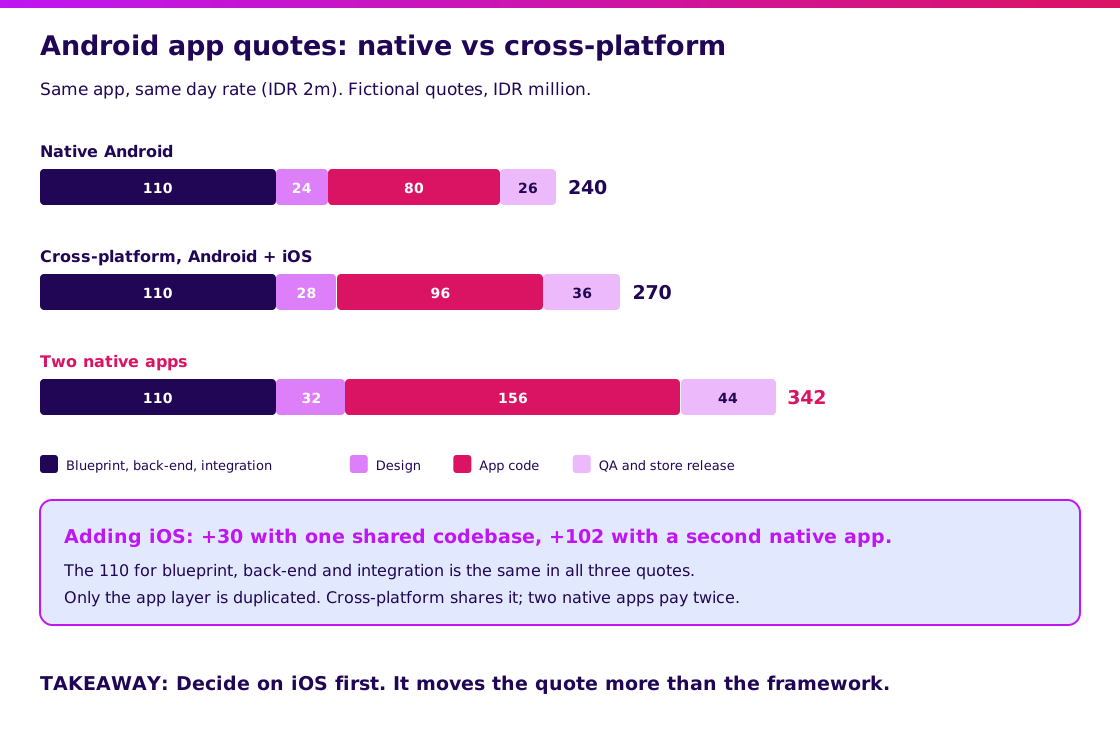
- Decide on iOS before the framework: adding iOS costs +12.5% with one shared codebase and +42.5% with a second native app in our example.
- The back-end is the same in every quote: IDR 110 million of our 240 million native Android quote, or 46%, does not change with the framework.
- Native Android wins when the phone does real work: background GPS, Bluetooth printers, scanners and long offline shifts.
- Budget the yearly Android update: Google Play raises its target API level every year, so an app nobody maintains stops being publishable.
- Pay for installable builds: 30% at signed scope, 40% at a test build on real phones, 30% at go-live.

What is included in Android app development services?
Android app development services cover six kinds of work: blueprint, design, the app itself, the back-end, testing on real devices, and the Play Store release. The app on the phone is usually less than half of the quote.
- Blueprint and prototype. User flows, a written scope and a clickable prototype tested with real users.
- UX and UI design. Screens, offline and error states, and how the app behaves on small and large phones.
- The Android app. Native code in Kotlin, or a shared codebase in Flutter or React Native.
- Back-end and admin dashboard. The database, logins, roles, business rules and the web screens your office team uses.
- Integrations. Sending orders, stock or payments to your ERP, accounting system or payment gateway.
- QA and release. Testing on several phone models and Android versions, then the Google Play listing, signing keys and the release itself.
Ask who owns the Play Console account and the signing key. If the vendor holds them, they hold your app.
Native vs cross-platform: what is the difference?
A native Android app is written only for Android, in Kotlin. A cross-platform app is written once, in Flutter or React Native, and runs on both Android and iOS.
| Native Android (Kotlin) | Cross-platform (Flutter, React Native) | Two native apps (Kotlin + Swift) | |
|---|---|---|---|
| Platforms | Android only | Android and iOS | Android and iOS |
| Codebases to maintain | 1 | 1, plus small platform-specific parts | 2 |
| Device features | Full access, first to get new Android features | Most features through plugins; edge cases need native code | Full access on both |
| Cost in our example | IDR 240m | IDR 270m (+12.5%) | IDR 342m (+42.5%) |
| Best for | Staff apps on company Android phones, heavy device use | Customer apps on both stores with standard features | Large consumer apps with deep device use on both |
If your app will only ever run on Android, the framework choice barely moves the price. A Flutter app for Android only costs about the same as a native one. The choice then comes down to device depth and to which stack your team can keep maintaining.
For the wider stack decision, including when a web app is enough, see our guide to choosing a tech stack.
How much do Android app development services cost?
Plan for IDR 15–40 million for a validation prototype, 80–180 million for a simple Android app, 180–350 million for a business app with a back-end, and 300–700 million or more for a consumer app on both stores.
| Package | Scope | Estimate (IDR) | Timeline | Best for |
|---|---|---|---|---|
| Validation prototype | Clickable Android prototype of one risky flow, user sessions | 15–40m | 2–4 weeks | Proving the app is worth building |
| Simple Android app | Few screens, login, uses an existing or simple back-end | 80–180m | 6–10 weeks | One internal task moved onto phones |
| Business Android app | Back-end, admin dashboard, offline work, one integration | 180–350m | 10–16 weeks | Field teams, operations, staff apps |
| Consumer app, Android + iOS | Both stores, accounts, payments, analytics, release work | 300–700m+ | 4–6 months | A product your customers download |
These are the same planning bands as our application development cost guide, narrowed to Android. That guide splits any app budget into seven lines. This one compares three ways to build the same app.
How much does one Android app cost, native vs cross-platform? (Real breakdown)
Same app, same day rate: native Android costs IDR 240 million, cross-platform for both stores 270 million, and two native apps 342 million. Here is the proof, using one fictional snack distributor with 40 field salespeople and a rate of IDR 2 million per person-day.
The app lets a salesperson check in at a store with GPS, take a shelf photo, enter an order offline and sync it to the company’s accounting system when a signal returns. The office team manages routes, prices and targets in a web dashboard.
| Line, IDR million | A. Native Android | B. Cross-platform, Android + iOS | C. Two native apps |
|---|---|---|---|
| Blueprint and prototype | 20 (10 days) | 20 (10 days) | 20 (10 days) |
| Back-end and admin dashboard | 70 (35 days) | 70 (35 days) | 70 (35 days) |
| Integration with accounting | 20 (10 days) | 20 (10 days) | 20 (10 days) |
| UX and UI design | 24 (12 days) | 28 (14 days) | 32 (16 days) |
| App code | 80 (40 days) | 96 (48 days) | 156 (78 days) |
| QA on devices, store release | 26 (13 days) | 36 (18 days) | 44 (22 days) |
| Total | 240 (120 days) | 270 (135 days) | 342 (171 days) |
Where does the difference come from?
The first IDR 110 million is identical in all three quotes, because the back-end does not care what the phone runs. That is 46% of the native Android quote.
Only the app layer changes. Cross-platform adds 2 days of design, 8 days of app code for iOS-specific parts and 5 days of extra testing, so iOS costs IDR 30 million more. Two native apps build the app layer twice (4 + 38 + 9 extra days), so iOS costs IDR 102 million more.
Think of it as one kitchen with two serving windows, against two kitchens. The food (the back-end) costs the same. The question is how many windows you need and how many kitchens you are willing to run.
For our distributor, all 40 salespeople carry company Android phones. iOS adds cost and no users, so quote A wins.
Native Android or cross-platform: which one should you choose?
Choose native Android when the app is Android-only and the phone does real work. Choose cross-platform when you need both stores and the features are standard.
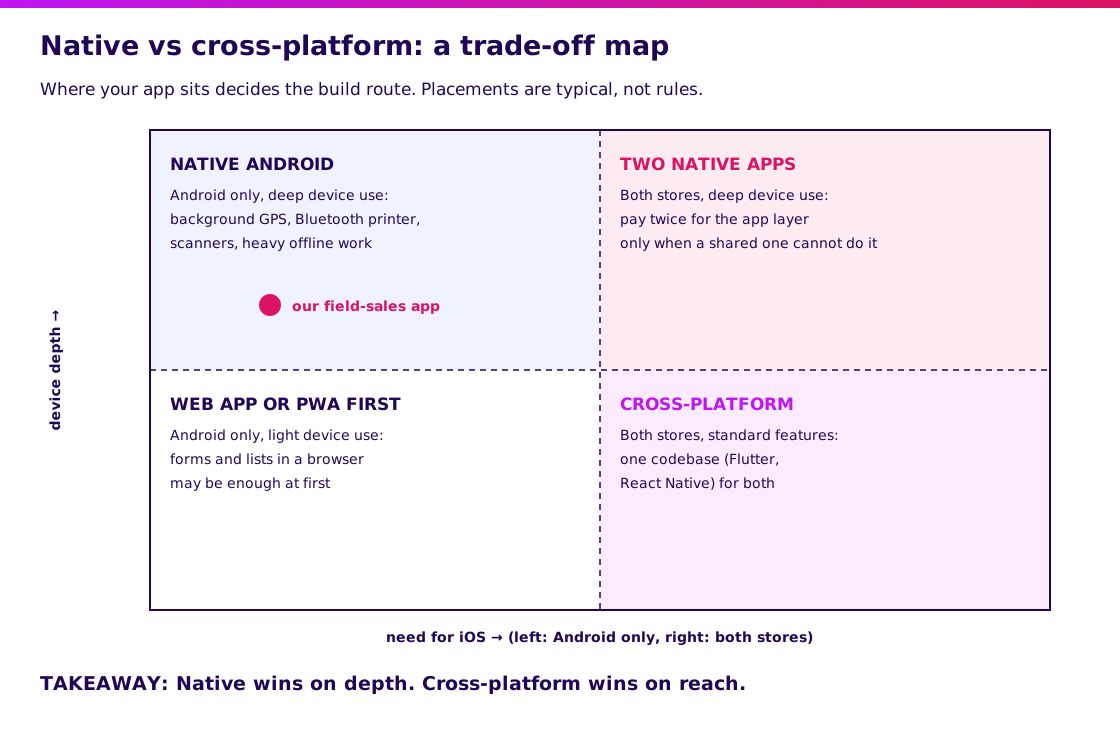
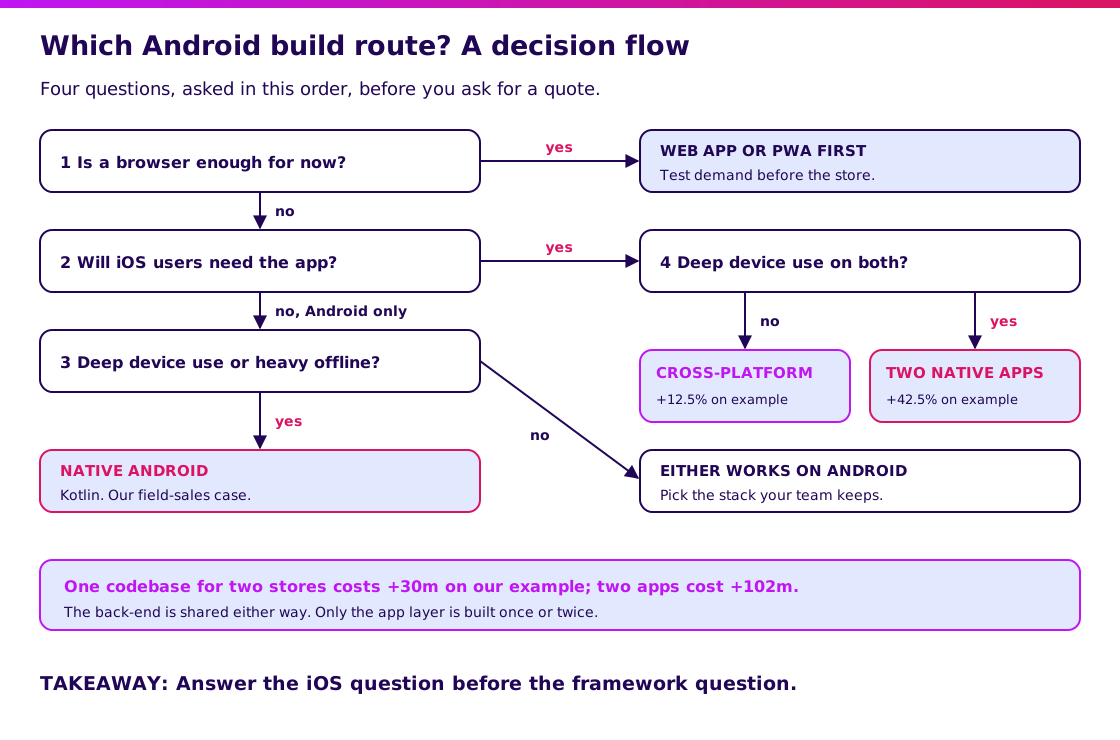
Four questions place you on the map, in this order:
- Is a browser enough for now? Forms, lists and approvals often work as a web app or PWA. Test demand there before paying for a store release.
- Will iOS users need the app? Customers usually do. Staff on company phones usually do not.
- Does the app use the phone deeply? Background location, Bluetooth printers, barcode scanners, the camera all day or long offline shifts favour native.
- If you need both stores, is the deep use on both? Only then is a second native app worth +42.5%.
If you are not sure the app is needed at all, test the riskiest flow first. Our MVP guide shows how to test one flow with a small first version.
Validate it in 2 weeks. Before you spend heavily on Android app development, Blueprint & Prototype tests your assumptions: a spec, a clickable prototype in front of real users, and a real cost estimate. The two-week promise covers prototype validation; it does not mean the finished app ships in two weeks.
What factors determine the price of an Android app?
Device work, offline sync and integrations move the price. Extra screens barely do. At our assumed IDR 2 million a day, these are typical additions:
| Factor | Typical addition | Why it costs that |
|---|---|---|
| Offline mode with sync | 8–12 days, IDR 16–24m | Two copies of the data must agree, including conflicts |
| Background GPS tracking | 5–8 days, IDR 10–16m | Battery limits and Android permission rules on every version |
| Bluetooth printer or scanner | 4–8 days, IDR 8–16m | Each device model behaves slightly differently |
| Payment gateway | 5–8 days, IDR 10–16m | Failed, pending and refunded payments all need handling |
| Each extra user role | 4–6 days, IDR 8–12m | New screens, access rules and tests |
| Integration with ERP or accounting | 8–15 days, IDR 16–30m | Two systems must agree on every record |
To lower the price, cut scope and keep the day rate. In quote A, moving shelf photos to a second release removes about 5 days, or IDR 10 million, and the salespeople still take orders from day one. A cheaper rate on the same vague scope only moves the cost to later.
If the app stores customer data, Indonesia’s Personal Data Protection Law (Law No. 27 of 2022) also applies, so security testing belongs in the quote.
What does an Android app cost after launch?
In our example the native Android app costs IDR 4 million a month to run, the cross-platform app 5 million, and two native apps 6.5 million. The more codebases you keep, the more you pay every month.
| Three-year component, IDR million | A. Native Android | B. Cross-platform | C. Two native apps |
|---|---|---|---|
| Build fee | 240 | 270 | 342 |
| Hosting and services (1.5 a month) | 54 | 54 | 54 |
| Maintenance and OS updates | 90 (2.5 a month) | 126 (3.5 a month) | 180 (5 a month) |
| Three-year total | 384 | 450 | 576 |
Maintenance is not optional on Android, because Google Play keeps raising the bar. From 31 August 2026, new apps and app updates must target Android 16 (API level 36) to be submitted, and existing apps must target at least Android 15 (API level 35) to stay available to new users. See Google’s target API level requirement.
That requirement moves up roughly once a year. An app nobody updates cannot ship its next bug fix. Ask every vendor for the monthly figure in writing, next to the build fee.
Store fees are small but real: a one-time Google Play developer registration, and a yearly Apple Developer Program membership if you add iOS. Register both accounts in your company’s name.
How do you choose an Android app development partner?
Give every vendor the same written brief, then compare the lines that do not show on the phone. A quote that is one number for “app” cannot be compared with anything.
- Ask for person-days per line. Blueprint, design, app, back-end, integration, QA and release.
- Ask which phones they test on. Name the models and Android versions. Your field team’s phones should be on the list.
- Ask how offline sync handles conflicts. Two salespeople editing one order is the test.
- Confirm ownership. Source code, Play Console account, signing key and back-end hosting in your name.
- Get the monthly cost. Including the yearly Android target update.
A freelancer suits a prototype, an agency suits a fixed brief, and a product studio suits an app whose value is still unproven. Our software house guide gives five checks for the partner itself, and the vendor due diligence checklist goes deeper.
What is the process and timeline, from brief to launch?
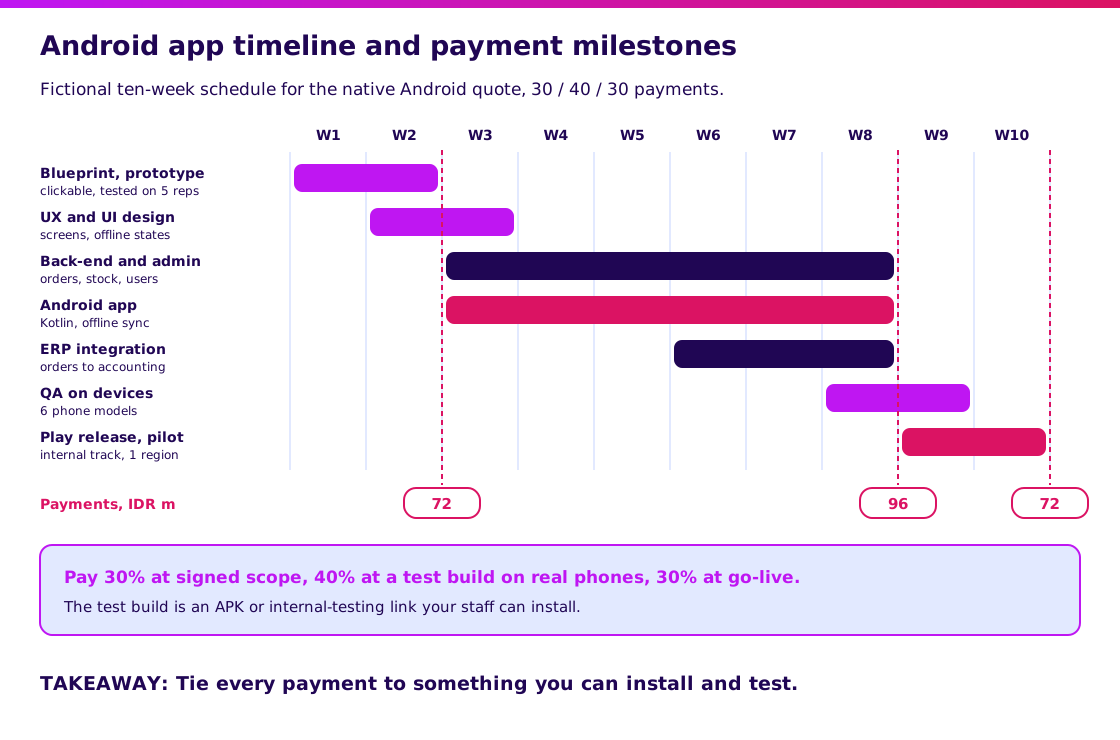
Our native Android app takes ten weeks, with three payments tied to something your staff can install and test.
| Milestone | What you receive | Payment |
|---|---|---|
| Scope signed, 30% | Clickable prototype tested with five salespeople, fixed scope | IDR 72m, week 2 |
| Test build, 40% | An installable build on real phones, connected to the back-end | IDR 96m, week 8 |
| Go-live, 30% | Play Store release, a one-region pilot, access and documentation | IDR 72m, week 10 |
The schedule follows Synetica’s own path: 2 weeks of Blueprint & Prototype, then about 8 weeks of Production Grade Software. A consumer app on both stores takes longer, up to the 4–6 months in the range above.
Release to a pilot group first. Google Play’s internal and closed testing tracks let 10 salespeople use the app for two weeks before all 40 depend on it. For what you should receive at each phase, and the handover pack at the end, see our app development services guide.
What are the red flags when choosing Android app development services?
A quote is a warning sign when it hides the back-end, the devices or the owner. Watch for these six:
- “Android and iOS for the price of one.” Our example adds 30 million for one shared codebase. If iOS is free, something else was cut.
- No back-end line. The app has to send its data somewhere. Someone is paying for that.
- No list of test devices. Bugs become your salespeople’s job to find.
- The Play Console account in the vendor’s name. Moving it later is slow, and the signing key may never move.
- No monthly figure. The yearly Android update arrives as a surprise.
- A business app at a simple-app price. At IDR 2 million a day, 80 million buys 40 days. Quote A needs 120.
What I would do before approving an Android app budget
Answer the iOS question first, then the device question, then ask for the lines. Most budget surprises come from choosing a framework before choosing an audience.
- Staff on company Android phones: build native Android. iOS adds cost and no users.
- Customers on both stores, standard features: build cross-platform. You pay 12.5% more, not 42.5%.
- Unsure anyone will use it: prototype the riskiest flow before you pay for the back-end.
This advice fits Growing Businesses putting a field team on phones and Dreamers pricing a first app. If your users only need to fill in a form, a web app may be enough for the first year.
My next step would be to book a scoping conversation with your answers to the four questions and the phones your users carry.
FAQ — Android app development services
How much do Android app development services cost?
As planning ranges, IDR 15–40 million for a validation prototype, 80–180 million for a simple Android app, 180–350 million for a business app with a back-end and 300–700 million or more for a consumer app on Android and iOS. Real quotes depend on the written scope.
What is the best Android app development service in Indonesia?
There is no single best one. The best partner for you shows person-days per line, names its test devices, puts the code and Play Console account in your name and gives you a monthly maintenance figure. Compare vendors on those four, not on the total.
How long does Android app development take?
About 2–4 weeks for a prototype, 6–10 weeks for a simple app, 10–16 weeks for a business app with a back-end and 4–6 months for a consumer app on both stores. Our fictional field-sales app takes ten weeks.
What is the difference between a software house and a freelancer?
A freelancer is one person, which suits a prototype or a small app. A software house brings design, back-end, Android and testing roles, which a business app with an integration needs, and keeps working when one person leaves.
What does an Android app development service do?
It plans the app, designs the screens, writes the Android app and its back-end, connects it to your other systems, tests it on real phones and releases it on Google Play. Good ones also maintain it after launch.
Related Posts
Aditya S
Business Development Manager, Synetica.
Put it into practice
Need help putting this into practice?
We turn the ideas in this article into a prototype tested with real users in 2 weeks (from Rp49jt)—or production-grade software in 8 weeks (from Rp100jt).