Guide
Outsource Software Development: Guide for CTOs
You’ve got a product roadmap that’s 18 months deep, a hiring pipeline that moves like molasses, and a board that wants results by Q3. Sound familiar?
Most CTOs don’t outsource software development because they want to. They outsource because the alternative—waiting six months to hire a full team—kills the window of opportunity. The average time to hire a senior developer in Australia is 68 days. Multiply that by a team of five, add onboarding, and you’re looking at half a year before anyone writes meaningful code.
The question isn’t whether outsourcing works. It’s whether you can make it work for you—without sacrificing quality, security, or your sanity. This guide gives you the decision framework, the cost data, and the red flags to watch for.
What is Software Development Outsourcing?
Software development outsourcing is contracting an external team or company to build, maintain, or extend your software—instead of (or alongside) an in-house engineering team.
It’s not new. IBM outsourced its PC operating system to a tiny company called Microsoft in 1980. That worked out reasonably well for one of the parties involved.
What is new is the maturity of the model. Modern outsourcing isn’t “throw a spec over the wall and pray.” The best partnerships look like embedded teams with shared tooling, daily standups, and joint ownership of outcomes.
Three main flavours:
- Offshore — Partner is in a different region (e.g., Australia to Southeast Asia). Biggest cost savings, requires timezone management.
- Nearshore — Similar timezone, different country (e.g., US to Latin America). Balanced cost and overlap.
- Onshore — Same country, different city. Minimal friction, premium pricing.
When to Outsource vs Hire In-House
This is the real decision. Not “should I outsource?” but “what should I outsource?”
Outsource When:
- Speed matters more than long-term headcount. You need a team in weeks, not months.
- The project has a clear scope and end date. MVP builds, platform migrations, legacy rewrites.
- You need skills you don’t have and won’t need permanently. Mobile dev, DevOps, AI/ML—specialised skills for a defined period.
- Your core team is at capacity and the work isn’t core IP. Don’t burn out your best people on commodity features.
Keep In-House When:
- The work IS your competitive advantage. Your core algorithm, your proprietary data pipeline, your secret sauce.
- You need deep institutional knowledge that takes years to build. Domain experts who understand your customers’ edge cases.
- Security and compliance are extreme. Defence, certain healthcare, regulated financial services with strict data residency.
The sweet spot: outsource the building, keep the thinking in-house. Your CTO sets architecture. Your product manager owns requirements. The external team executes with precision.
Outsourcing Models: Pick the Right One
Not all outsourcing is the same. The model you choose matters more than the country you choose. Here’s what actually works—and when.
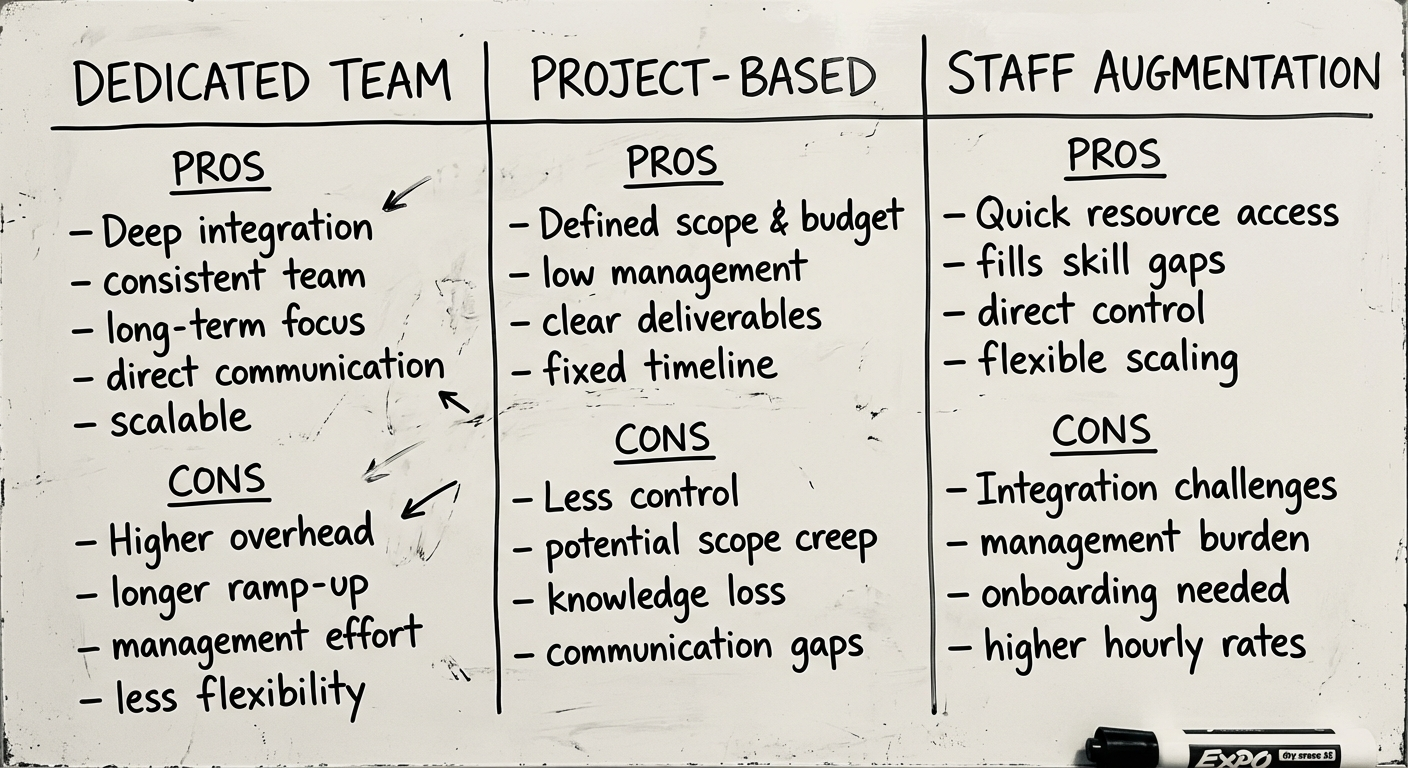
1. Dedicated Team
What it is: A full team (developers, QA, PM, designer) allocated exclusively to your project. They work your hours, use your tools, attend your standups.
Best for: Long-term product development (6+ months). Ongoing platforms that need continuous iteration.
Pros: Feels like an in-house team. Knowledge accumulates. Team stability. Cons: Higher monthly commitment. You manage priorities.
Typical cost (AU market): $15,000–$35,000/month for a 3-5 person team from Southeast Asia.
2. Project-Based
What it is: Fixed scope, fixed price, fixed timeline. You define what you want, the partner delivers it.
Best for: MVPs, proof of concepts, well-defined internal tools. Projects with clear requirements and a defined end state.
Pros: Predictable cost. Clear accountability. Defined deliverable. Cons: Change requests cost extra. Less flexibility mid-flight.
Typical cost: $30,000–$150,000 depending on complexity.
3. Staff Augmentation
What it is: Individual developers or specialists embedded into your existing team. They report to your tech lead.
Best for: Filling skill gaps. Scaling up for a sprint. Getting a senior specialist (e.g., DevOps engineer) without a full-time hire.
Pros: Maximum control. Integrates with existing processes. Cons: You manage them directly. Onboarding overhead.
Typical cost: $4,000–$12,000/month per developer, depending on seniority and location.
Which Model Should You Choose?
| Scenario | Recommended Model |
|---|---|
| Building an MVP from scratch | Project-Based |
| Ongoing product with regular releases | Dedicated Team |
| Need 2 React devs for 3 months | Staff Augmentation |
| Legacy system migration | Project-Based or Dedicated |
| Scaling for a funding milestone | Dedicated Team |
How to Evaluate an Outsourcing Partner
The technical assessment is only 30% of the decision. Culture fit, communication cadence, and process maturity matter more than whether they use React or Vue.
Here’s a framework we recommend:
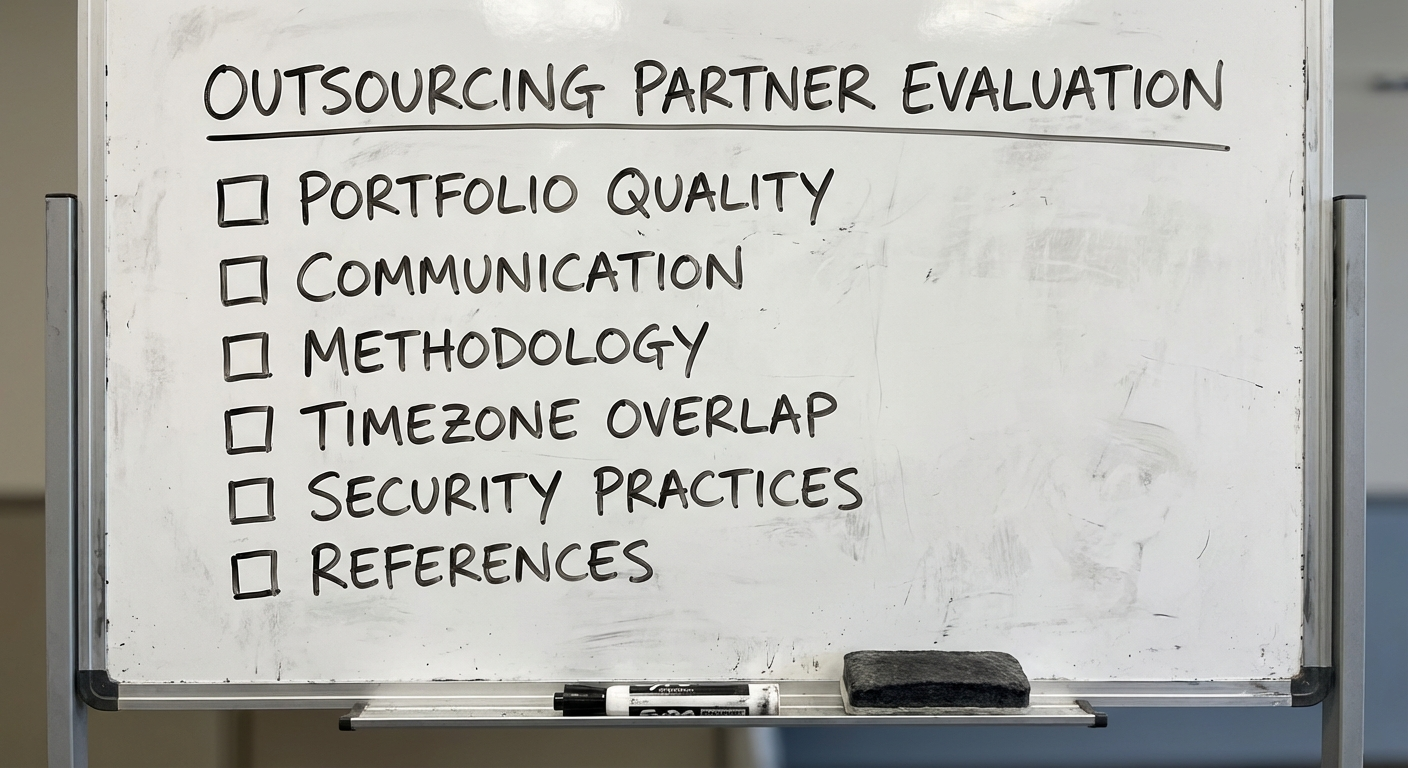
1. Process Over Portfolio
A beautiful portfolio means they finished something. It doesn’t tell you what the journey was like. Ask instead:
- “Walk me through your last project that went wrong. What happened?”
- “How do you handle scope changes mid-sprint?”
- “What does your first two weeks look like after signing?”
Partners who have a structured onboarding process (a “Blueprint” phase) are significantly more likely to deliver well. Ad hoc kickoffs are a red flag.
2. Communication Culture
- Do they default to async-first with clear documentation? Or do they need a call for every decision?
- What’s their response time for critical issues?
- Can you talk directly to the developers, or is everything filtered through a project manager?
3. Technical Due Diligence
- Ask for a code sample or architecture review of a past project (anonymised).
- Check their testing practices. No automated tests = no quality guarantee.
- Evaluate their DevOps maturity. CI/CD pipelines should be standard, not an upgrade.
4. References That Matter
Don’t just ask for references. Ask for references from clients who had problems. Every long project hits rough patches. The question is how the partner handled them.
Red Flags: When to Walk Away
Fifteen years of building with distributed teams teaches you to spot problems early. Here are the signals that should make you pause:
🚩 “We can build anything.” — Specialists outperform generalists. If they claim expertise in everything, they’re experts in nothing.
🚩 No discovery phase. They jump straight to quoting without understanding your business. A partner who quotes without deep discovery is either reckless or desperate. Neither is good.
🚩 Opaque pricing. If you can’t see what you’re paying for—hourly breakdowns, team composition, infrastructure costs—you’ll get surprised. And not the good kind.
🚩 100% outsourced management. If the PM, architect, AND developers are all outsourced, who owns the product vision? Someone on your side needs to steer.
🚩 No IP transfer clause. If the contract doesn’t explicitly state that you own the code, the architecture docs, and the deployment pipeline—don’t sign.
🚩 Developer churn. Ask about team retention rates. If their average developer tenure is under a year, you’ll spend more time onboarding replacements than building product.
Synetica’s Approach: Blueprint-First
We do things differently. Before writing a single line of code, every engagement starts with a Blueprint—a 2-4 week deep dive that produces:
- Architecture document — System design, tech stack decisions, integration points
- Detailed scope — Feature breakdown with effort estimates (not guesses)
- Risk register — What could go wrong and how we’ll handle it
- Prototype/wireframes — Visual proof of concept before committing to full build
The Blueprint is a paid engagement. It’s not a free proposal designed to win work. It’s genuine engineering thinking that becomes your asset—even if you don’t proceed with us.
Why? Because building without a plan is how projects fail. And we’re allergic to failed projects.
We also don’t do AI-generated filler code or “vibe coding”. Every line is intentional, reviewed, and tested. AI assists our developers; it doesn’t replace them.
Our model: you own the strategy, we execute the build. Full transparency on hours, decisions, and trade-offs. No black boxes.
Cost Comparison: Australia vs Southeast Asia vs Eastern Europe
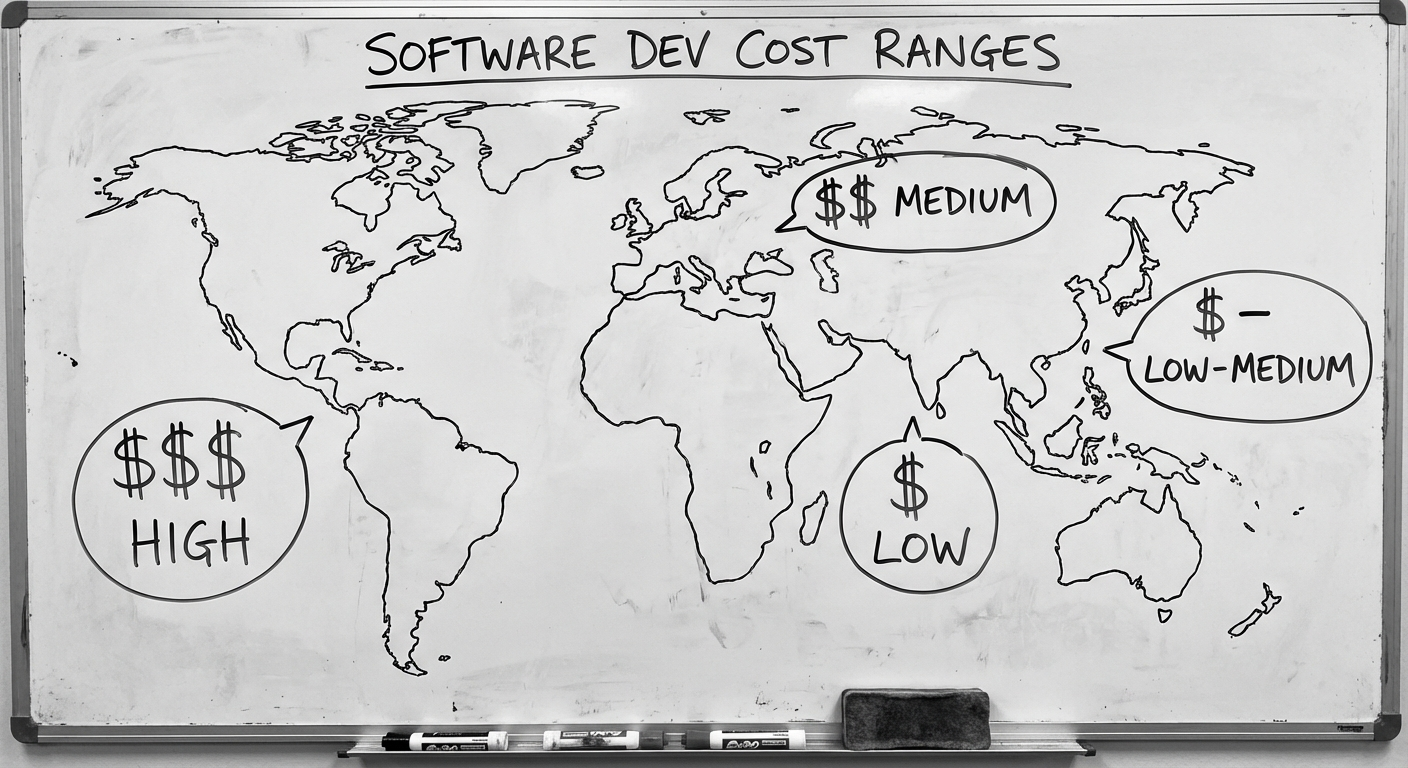
Let’s talk numbers. These are 2026 market rates for mid-to-senior full-stack developers, based on our data and industry benchmarks.
| Region | Hourly Rate (AUD) | Monthly (Full-time) | Quality Notes |
|---|---|---|---|
| Australia | $150–$250/hr | $25,000–$42,000 | Top talent, same timezone, premium price |
| Southeast Asia (Vietnam, Philippines, Indonesia) | $35–$75/hr | $5,800–$12,500 | Strong talent pool, 1-3hr timezone overlap with AEST |
| Eastern Europe (Ukraine, Poland, Romania) | $50–$100/hr | $8,300–$16,600 | Excellent engineering culture, limited timezone overlap |
| India | $25–$60/hr | $4,200–$10,000 | Massive talent pool, variable quality, requires careful vetting |
The Real Cost Equation
Hourly rate ≠ total cost. Factor in:
- Management overhead — 10-20% of your CTO/lead’s time for coordination
- Communication friction — Timezone gaps add 1-2 days to feedback loops
- Ramp-up time — 2-4 weeks before a new team is productive
- Quality assurance — Budget for code reviews and testing
- Turnover risk — Replacement and re-onboarding costs
A $40/hr developer who needs constant supervision costs more than a $70/hr developer who ships autonomously. Optimise for output, not rate cards.
For most Australian companies, Southeast Asia offers the best value-to-risk ratio. Strong technical education systems, growing English proficiency, and manageable timezone overlap (1-3 hours with AEST).
Making the Decision: A Simple Framework
Still unsure? Run through this checklist:
- Do you need a team in less than 8 weeks? → Outsource.
- Is the project scope well-defined with a clear end state? → Project-based outsourcing.
- Do you need ongoing development for 6+ months? → Dedicated team.
- Is this your core IP? → Keep architecture in-house, consider outsourcing execution.
- Is your budget under $25K/month for a full team? → Look at Southeast Asia or Eastern Europe.
Next Steps
If you’re evaluating outsourcing partners, start with the Blueprint. It’s the lowest-risk way to test a partnership before committing to a full engagement.
Here’s what happens when you reach out:
- We have a 30-minute call to understand your situation
- We propose a Blueprint scope (2-4 weeks, fixed price)
- You get a complete technical plan—architecture, scope, timeline, risks
- You decide whether to proceed with us, another partner, or in-house
No lock-in. No pressure. Just engineering clarity.
Need help putting this into practice?
Book a Blueprint session and we'll turn the ideas in this article into your next validated release.
Book a Discovery Call