Guide
Company Finance Application: Real-Time Dashboards
A company finance application should tell you whether next Friday’s payments are safe. A dashboard that shows yesterday’s revenue beautifully, while hiding overdue collections and restricted cash, cannot answer that question.
At Synetica, our starting point is the decision a user needs to make. For finance leaders, I would start with a payment decision and trace every number back to its source before discussing charts. The worked example below is illustrative, not a client result.
This guide covers the definition, a cash visibility test, essential modules, buy versus custom options, vendor checks, an explicit cost model, and a staged rollout. You can use it to brief finance, operations, and your software partner together.
TL;DR — the whole guide in five lines
- Start with usable cash: bank balance alone ignores restrictions and upcoming commitments.
- Define real-time per decision: a current chart can still contain an old bank feed.
- Keep the ledger authoritative: use a dashboard to explain records, with drill-down to evidence.
- Buy standard workflows first: build only the integration or approval gap that survives testing.
- Pilot one payment cycle: stale feeds, duplicates, and access failures matter more than chart colours.

How can a finance dashboard change a payment decision?
Reproduce one decision with explicit inputs before accepting a vendor’s demo. Here is a worked receipt you can rebuild in a spreadsheet. All figures are illustrative IDR millions for one entity over the next seven days.
| Cash input | Amount | Evidence to request |
|---|---|---|
| Reconciled opening bank balance | 900 | Bank statement and reconciliation |
| Restricted cash included in that balance | −150 | Restriction register |
| Receipts expected within seven days | +300 | Invoice-level collection assumptions |
| Approved supplier payments | −500 | Payment run and due dates |
| Payroll due in the same period | −280 | Approved payroll total |
| Projected usable closing cash | 270 | 900 − 150 + 300 − 500 − 280 |
Management sets a cash floor of IDR 200m. The base case leaves IDR 70m of headroom.
If IDR 120m of expected receipts slips into the following week, closing cash falls to IDR 150m: IDR 50m below the floor. Revenue growth will not solve a payment timing problem on its own.
Do not add the restricted amount back later, and do not count the same supplier bill in both the payment run and a separate commitments list. Those two mistakes can make identical charts tell opposite stories.
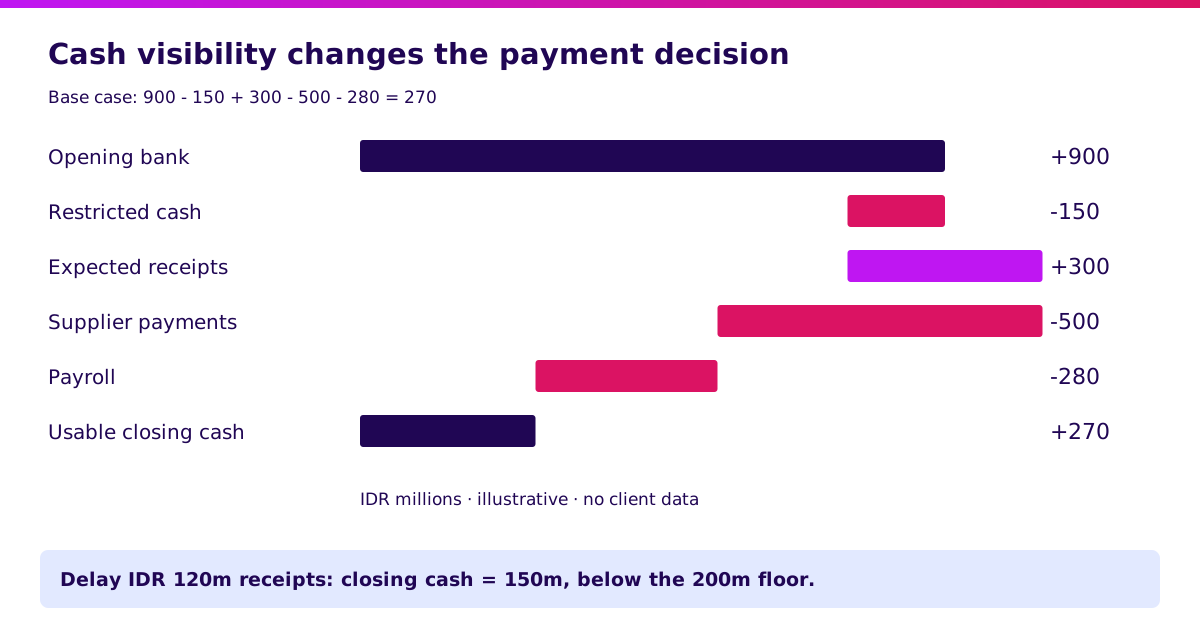
I would ask the vendor to reproduce both scenarios and open the underlying invoices. That is a stronger receipt than a claim about faster decisions. Map your decision and data dependencies before choosing a dashboard.
What is a company finance application?
A company finance application connects financial records, cash planning, spending controls, and management reporting so you can decide what to collect, pay, defer, or investigate. It may be an accounting suite, an ERP finance module, or a reporting layer over existing systems.
Think of it as an instrument panel: each dial needs a calibrated sensor. Adding dials does not repair a disconnected sensor.
- Record transactions in the authoritative accounting system.
- Reconcile bank activity against recorded cash.
- Plan collections and approved payments by date.
- Compare budgets with actuals and commitments.
- Assign exceptions to an accountable person.
Accounting records explain what happened; finance planning adds what could happen next. If posting rules are your main gap, start with our accounting application and ERP integration guide. This article focuses on the management decision above those records.
Company finance application: SaaS, custom, or hybrid?
Choose the smallest architecture that can reproduce your payment decision reliably. The budgets below are planning assumptions for the example later, not vendor price benchmarks. Durations are illustrative scopes, excluding procurement and bank onboarding.
| Option | Initial setup/build assumption | Pilot window | Flexibility | Best fit |
|---|---|---|---|---|
| Ready-made SaaS | IDR 24m | 2–4 weeks | Standard reports and approvals | One entity, supported feeds |
| Hybrid: existing ledger + reporting layer | IDR 75m | 4–8 weeks | Custom mapping and views | Reliable ledger, disconnected sources |
| Custom finance workflow layer | IDR 190m | 8–12 weeks | Specific controls and orchestration | Proven workflow gap across systems |
Initial cost excludes recurring licences and support. Custom here means a layer around a standard ledger, not rebuilding accounting rules from scratch.
If your existing suite passes the acceptance checks, configuring it is a sensible result.
The broader ledger decision belongs in accounting software: build vs buy. Bring your actual payment case to both evaluations so you do not buy overlapping products.
Which company finance application features matter most?
Give every module an owner, an acceptance example, and a next action. The following four modules use the same evaluation pattern; the role identifies who should validate it, not an interviewed customer.
1. Cash position and forecast — owned by treasury
This is your fuel gauge: it shows whether cash arrives before obligations fall due.
What it helps you do
- Separate available cash from restricted balances.
- Place receipts and payments into dated buckets.
- Change collection assumptions without changing actuals.
- Explain a cash shortfall by source transaction.
Walkthrough: use the IDR 900m opening balance above. Move the IDR 120m receipt by seven days and verify that the current week’s closing cash moves from IDR 270m to IDR 150m. Keep the forecast assumption separate from the posted receipt.
Why this design: treasury owns timing assumptions because invoice due dates alone do not prove when customers will pay. Oracle NetSuite’s financial controller checklist includes short-term cash forecasting and receivables/payables review; this test makes those connected responsibilities visible.
Use the payment scenario as your prototype brief.
2. Receivables and collection queues — owned by credit control
This is a collection worklist, turning an ageing total into someone’s next call.
What it helps you do
- Group unpaid invoices by agreed due date.
- Assign follow-up to a named owner.
- Record disputes separately from overdue balances.
- Trace settlements to invoices and bank evidence.
Walkthrough: place three invoices worth IDR 40m each in the collection queue. Mark one disputed and move its expected collection date. The unpaid balance stays IDR 120m; the forecast for this week drops by IDR 40m. A disputed invoice has not disappeared.
Why this design: credit control needs a worklist with reasons and dates, while management needs the resulting cash impact. A single red ageing total serves neither role particularly well.
Check the invoice and settlement integration boundary.
3. Payables and spending approval — owned by the controller
This is a gate before money leaves, with a record of who opened it.
What it helps you do
- Match bills to purchase and receipt evidence.
- Separate requested, approved, and released payments.
- Detect duplicate supplier invoice references.
- Enforce approval thresholds and delegation periods.
Walkthrough: submit a second copy of an IDR 25m supplier bill. The application should flag it for review, preserve the original record, and avoid increasing the approved payment total. Test a substitute approver and an expired delegation too.
Why this design: approval authority belongs to finance policy, not a dashboard developer’s default setting. Report access must not automatically grant payment release rights.
Define approval controls before production development.
4. Budget and management reporting — owned by FP&A
This is a shared measuring stick, keeping departments from presenting different versions of the same margin.
What it helps you do
- Compare actual spend with the approved budget version.
- Show commitments separately from posted expenses.
- Explain variances by department and period.
- Distinguish provisional results from closed accounts.
Walkthrough: a department has IDR 100m budget, IDR 65m posted expenses, and IDR 20m unfulfilled purchase commitments. Show IDR 35m remaining against actuals and IDR 15m after commitments. Label both measures; do not silently merge them.
Why this design: a shared metric definition prevents a meeting about performance from becoming an argument about arithmetic. FP&A approves the definition and the controller verifies ledger reconciliation.
Include metric definitions in your Blueprint & Prototype scope.
“I would test one payment decision all the way back to its source before approving the dashboard scope.” — Ganis Atmawarin, editorial recommendation for this guide.
What does real-time mean for a finance dashboard?
Define source freshness, refresh completion, and accounting status separately. A page refreshed at 10:00 can still show a bank export from yesterday. A live operational margin can still exclude unposted adjustments.
Microsoft’s Power BI refresh documentation distinguishes source data refresh from visual refresh, and describes different behaviour for Import and DirectQuery models. Refreshing the display is therefore not evidence that every source is current.
For your application, write a freshness agreement per feed. Example acceptance targets: bank data by 09:00 each working day; invoice updates within 60 minutes; approvals visible within five minutes.
These are proposed business requirements, not promises about any vendor or bank.
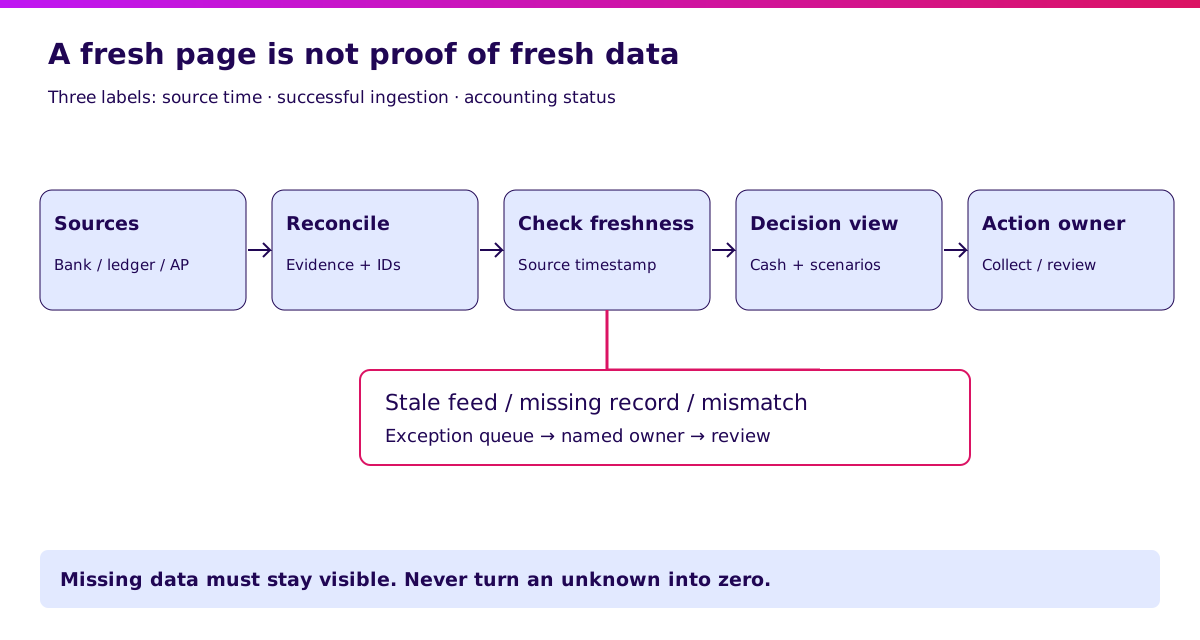
Show the source’s latest available timestamp, last successful ingestion, and unresolved exception count. When a feed misses its target, display a stale-data notice and require review before the affected payment decision.
Never replace missing data with zero.
Validate it in 2 weeks. Synetica’s Blueprint & Prototype maps one finance decision, tests the workflow with users, and defines integration scope before a larger build commitment.
When is ready-made software enough, and when should you build?
Buy when standard controls fit; consider custom when a measurable gap survives a realistic pilot. Supported bank feeds, one ledger, and standard department reporting usually favour configuration.
Hybrid becomes useful when you already trust the ledger but need a common view across entities or old operational systems. Keep ingestion read-only at first.
A reporting connector should not silently gain the ability to post journals or initiate payments.
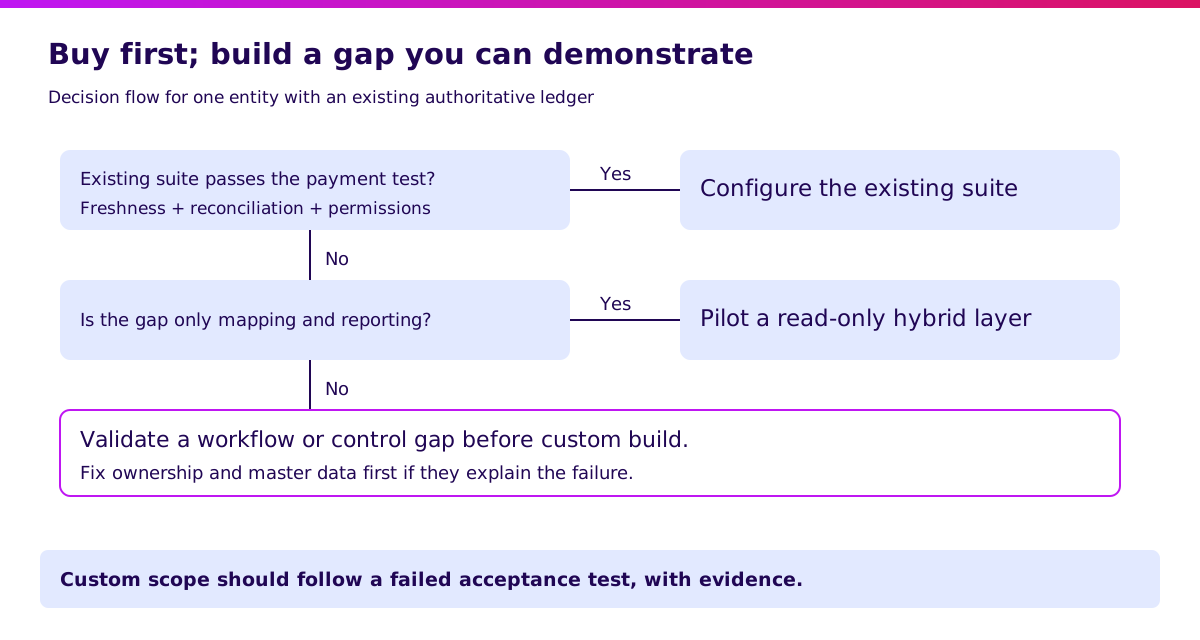
A custom workflow layer can make sense when approval routing, reconciliation exceptions, or multi-system handoffs remain expensive. Quantify handling time and incident frequency first.
If the problem is unclear ownership or inconsistent master data, new software inherits it.
Discuss the smallest validated production scope after the pilot identifies the gap.
How do you evaluate a finance application vendor?
Use your records and failure cases in the demo. Ask the vendor to demonstrate these eight checks, keeping the evidence with your procurement decision.
- Reconcile opening cash to bank evidence, including restricted balances.
- Replay an ingestion batch without duplicating invoices or payments.
- Stop a feed and show the stale-data warning and accountable owner.
- Drill from a cash forecast line to its invoice and assumption history.
- Test user permissions across entities, exports, and approval actions.
- Change a metric definition and retain its prior version.
- Export records, attachments, audit history, and mapping documentation.
- Demonstrate backup recovery and explain support ownership for failed connectors.
Record pass, fail, workaround, and additional cost for each check. Reject a workaround that depends on an undocumented spreadsheet only one employee understands.
For hosting, security, support, and exit terms, use our software vendor due diligence checklist.
How much does a company finance application cost in Indonesia?
Compare first-year total cost with a conservative, measurable benefit. The following hypothetical budget assumes one entity, five finance users, an existing ledger, and limited integrations. It is not a quote or a market price survey.
| First-year component, IDR millions | SaaS | Hybrid | Custom layer |
|---|---|---|---|
| Configuration or build | 24 | 75 | 190 |
| Annual licences | 18 | 24 | 24 |
| Data preparation and migration | 8 | 15 | 20 |
| Support and monitoring | 6 | 18 | 30 |
| Contingency | 9 | 18 | 36 |
| First-year total | 65 | 150 | 300 |
Assume report preparation currently takes 40 hours a month and the pilot reduces it to 16. At an assumed loaded labour cost of IDR 100,000/hour, capacity released is 24 × 100,000 × 12 = IDR 28.8m a year.
That is capacity value, not guaranteed payroll savings.
This narrow benefit alone does not cover any option’s first-year cost. A larger investment needs additional evidenced benefits, such as lower handling effort or a documented control requirement.
Do not count earlier customer payments as profit or assume every freed hour becomes cash savings.
Request a separate recurring-cost schedule, including licence growth, connector maintenance, and support. Then validate the business case with your own volumes.
How do you implement a company finance application in stages?
Expand after a reconciled payment cycle, with a rollback path. Your rollout schedule depends on data access, bank arrangements, and sign-off capacity.
Start with two weeks of Blueprint & Prototype: name the decision owner, map sources, define metrics, and test a prototype with finance users. Gate: the team agrees on the payment scenario and acceptance evidence.
Next, configure the chosen suite or build the validated gap. For a suitable custom scope, Synetica’s Production Grade Software phase is eight weeks after the two-week prototype phase.
Gate: permissions, replay handling, alerts, and reconciliations pass. Vendor setup timelines may differ.
Run a parallel payment cycle with the current process before cutover. Require every difference to be explained, an exception owner to be assigned, and rollback to be rehearsed.
Do not let a launch date override unreconciled cash.
After release, review feed failures, forecast accuracy, and user adoption. Launch & Grow is an ongoing monthly retainer for analytics and iteration where needed; bank or vendor lead times can extend the overall project calendar. Review the delivery approach.
What I would do before approving a finance dashboard
Bring one payment run, one bank reconciliation, and one overdue invoice list to the first workshop. Those records reveal more than an extensive feature wishlist.
For Growing Businesses, I would prioritise cash timing and accountable exceptions. For a Dreamer with a single uncomplicated ledger, an existing accounting application’s standard reports may be enough.
Start with the smallest useful decision and earn the next integration.
Your next step: book a Blueprint & Prototype conversation with that payment scenario.
FAQ
What is a company finance application?
It connects financial records, planning, controls, and reporting to support collection, payment, and spending decisions. It can be a ready-made suite or a layer over an existing ledger.
Which company finance application is best?
Choose one that passes your reconciliation, freshness, access, and scenario tests. There is no universal winner across different banks, entities, and approval policies.
How much does a company finance application cost?
This guide models first-year budgets of IDR 65m for SaaS, IDR 150m for hybrid, and IDR 300m for a custom layer. These are explicit planning examples; obtain quotes against your scope.
Can a finance application be custom-built?
Yes. Start with a validated workflow or integration gap and preserve a standard authoritative ledger where possible.
Include monitoring, audit history, and ongoing ownership in the build scope.
Does a real-time dashboard replace month-end closing?
No. Operational data may be provisional.
Month-end adjustments, reconciliations, and approval still determine closed accounts; label the dashboard accordingly.
Related Posts
Two weeks to a real answer
Need help putting this into practice?
Book a Blueprint session and we'll turn the ideas in this article into a tested prototype in front of real users—2 weeks, from $3,000.