Guide
Accounting Software: Build vs Buy for SMEs and Enterprises
Accounting software should do one thing before anything else: give you a month-end number you trust, in days, not weeks. If your finance team still re-keys invoices and chases bank lines in spreadsheets, the software is not the problem. The workflow around it is.
We have spent more than 15 years delivering business systems for Indonesian companies. Accounting is the module where “buy a package” is right more often than anywhere else, and where a custom build is quietly wrong more often than most vendors will admit.
This guide covers what accounting software is, buy vs hybrid vs custom, the capabilities that matter, an illustrative month-end close model, ten vendor tests, costs, and rollout. If accounting is one slice of a wider system, our ERP software guide shows where it sits.
TL;DR — the whole guide in five lines:
- Buy first. A standard SaaS accounting app passes the real-close test for most SMEs. Do not build what you can configure.
- Test with your own month-end, not the vendor’s demo company. The close is where the days, and the errors, hide.
- Hybrid wins when the gap is one rule or one integration, such as multi-entity consolidation or revenue recognition. Keep the ledger standard; customise the edge.
- In our illustrative 120-staff model, a connected close avoids about IDR 198 million a year. First-year cost: IDR 25–90 million for SaaS, IDR 150–400 million hybrid, IDR 500 million–1.5 billion custom.
- Roll out in stages. Opening balances, a parallel close, then cut-over. Never big-bang a ledger.
What Is Accounting Software?
Accounting software records every financial transaction in a ledger, reconciles it, and produces the reports and tax data your business needs. It replaces spreadsheets and paper vouchers with one set of books that others can audit.
A useful accounting system does five jobs:
- Record sales, purchases, payments, and adjustments against a chart of accounts.
- Reconcile bank lines, receivables, and payables.
- Report profit and loss, balance sheet, and cash flow, by entity, branch, or project.
- Support tax work: VAT and withholding data, invoice exports, and a clean audit trail.
- Control who can post, approve, and close a period.
If you also run stock or retail, accounting must link to those systems. See our guide on inventory integration with accounting and POS.
Accounting Software Options: SaaS vs Hybrid vs Custom
Buy SaaS unless a rule you cannot configure costs more than the build.
| Factor | SaaS accounting | Hybrid | Custom |
|---|---|---|---|
| First-year cost (120 staff, 5 finance users) | IDR 25–90m | IDR 150–400m | IDR 500m–1.5bn |
| Time to live | 1–2 months | 3–5 months | 6–10 months |
| Flexibility | Vendor settings and add-ons | SaaS ledger + custom rules or integrations | Fully yours |
| Best for | Standard SME, one or few entities | Multi-entity, special billing, heavy integrations | Accounting is part of your product |
SaaS wins for most growing businesses. Indonesian and global vendors already ship invoicing, bank feeds, and tax exports. Hybrid wins when one rule or integration does not fit. Custom wins only when the ledger itself is your edge, which is rare.
Next: Which Accounting Software Capabilities Matter?.
Which Accounting Software Capabilities Matter?
Capabilities matter when they shorten the close or remove re-keying. Six do most of the work.
1. Bank reconciliation that matches itself
Import bank lines, auto-match by amount and reference, and queue only the exceptions.
2. Invoicing, AR, and AP in one ledger
Issue invoices, record vendor bills, and age both. No second spreadsheet for “what we really owe”.
3. Tax-ready data
Keep VAT and withholding fields on every transaction, and export in the formats your tax filing needs. Confirm current formats with your tax adviser; they change.
4. Multi-entity and multi-currency
Post to the right company, convert at the right rate, and consolidate without copy-paste.
5. Approvals and period lock
Require approval before posting large entries. Lock a closed period so numbers do not move after review.
6. Integrations and audit trail
Connect sales, POS, inventory, and payroll through an API, and log every change by user and time. Indonesian tax rules require bookkeeping records to be retained for years; check the current requirement under the tax procedure law with your adviser.
How Much Does a Slow Month-End Close Cost?
The business case is days of finance time, rework, and late-payment penalties.
This model is illustrative, not client data. Replace each input with your own month.
Imagine a 120-person company with 5 finance users, about 1,500 transactions a month, and a blended finance cost of IDR 55,000 an hour:
- Slow close. Manual matching and re-keying stretch the close to 12 working days. A connected close takes 6. The extra 6 days × 5 people × 8 hours = 240 hours = IDR 13.20 million/month.
- Entry errors. 3% of 1,500 transactions (45) need 1.5 hours of rework: 67.5 hours = IDR 3.71 million/month.
- Late bills. 12 vendor bills a month slip past due, at an illustrative IDR 400,000 each in penalties and lost early-payment discounts: IDR 4.80 million/month.
- Tax preparation. 30 hours of reconciliation at IDR 80,000: IDR 2.40 million/month.
Total: IDR 24.11 million/month.
With connected software, close extra days fall to 2 (80 hours, IDR 4.40 million), errors fall to 1% (15 entries, IDR 1.24 million), late bills fall to 3 (IDR 1.20 million), and tax prep falls to 10 hours (IDR 0.80 million). New cost: IDR 7.64 million/month.
That avoids IDR 16.48 million/month, or about IDR 198 million/year.
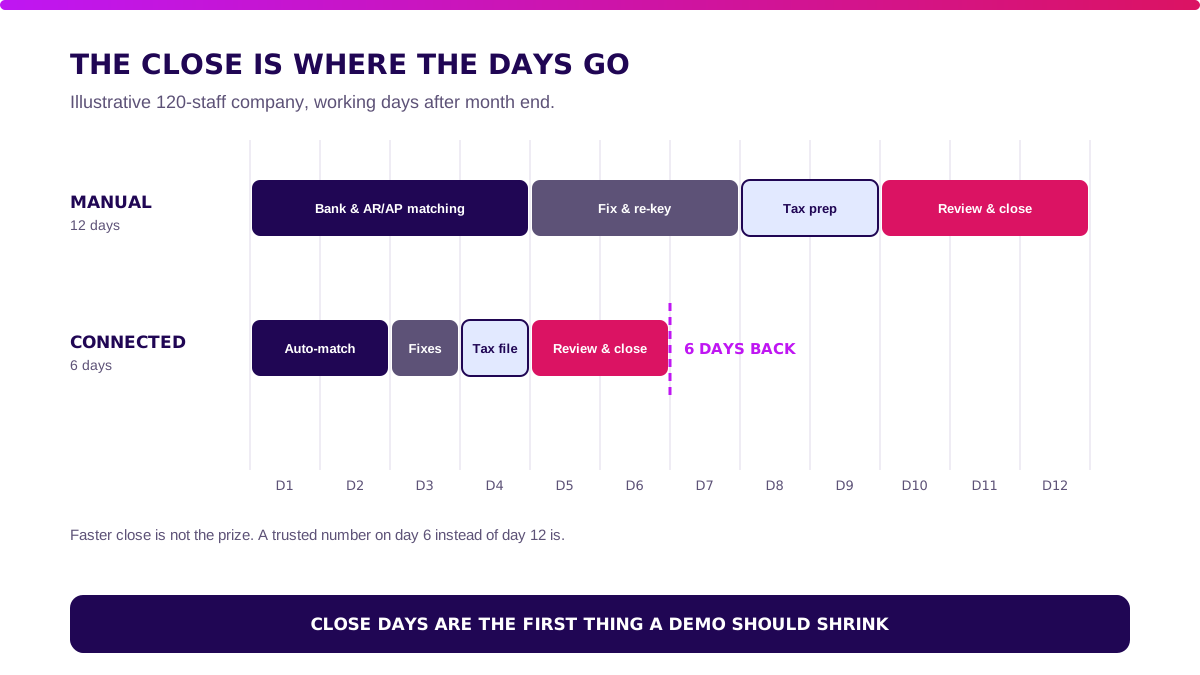
Builder’s note: I ask every vendor to close one of our messy months in the demo, not theirs. If the close does not shrink, the feature list does not matter.
Next: When Is Off-the-Shelf Accounting Software Enough?.
When Is Off-the-Shelf Accounting Software Enough?
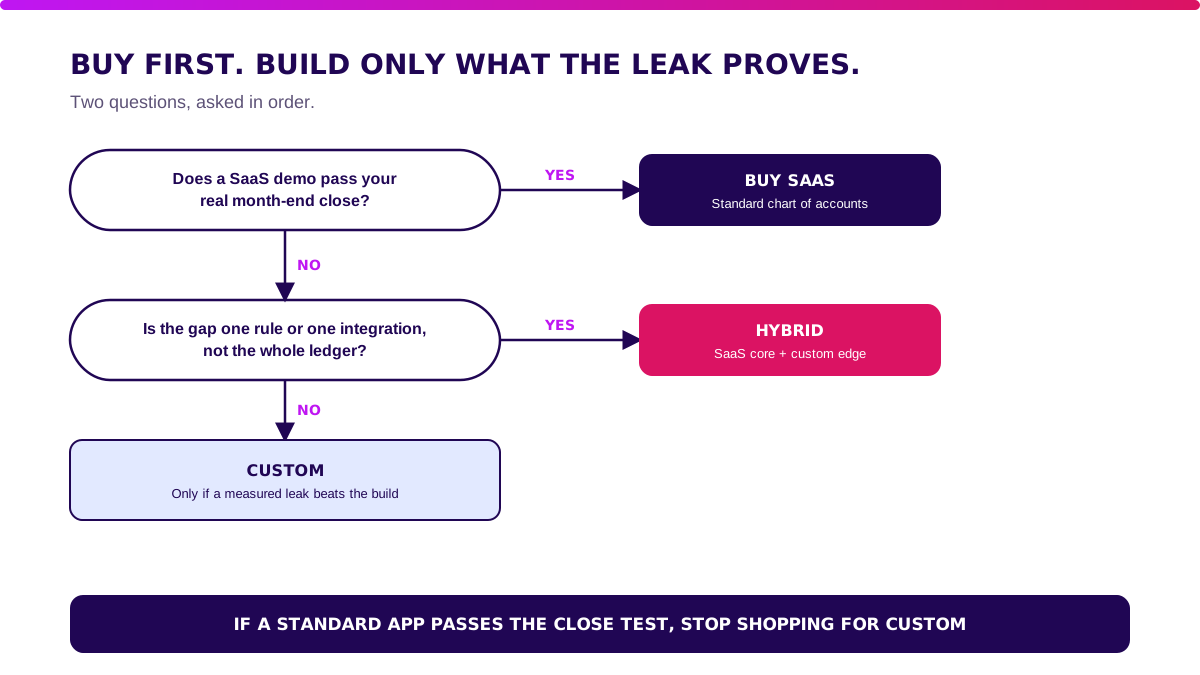
Stay off-the-shelf when a SaaS trial passes your own close. One entity, standard invoicing, and normal tax data are configuration, not custom work.
Go hybrid when the gap is narrow: consolidating several entities, usage-based or milestone billing, or a link to an internal system SaaS cannot reach. Build custom only when the leak you measured is larger than the build, or when accounting is what you sell.
Validate it in 2 weeks. Before you spend on accounting software, Blueprint & Prototype measures your close, prototypes the riskiest flow, and returns real cost numbers plus a buy, hybrid, or build recommendation.
How to Choose Accounting Software: 10 Vendor Tests
A demo company always closes cleanly. These tests use your month.
- Import three months of your bank statements and check the auto-match rate.
- Post your ten messiest transactions, including a part-payment and a foreign-currency bill.
- Run your real chart of accounts and cost centres, not the default.
- Issue an invoice and a credit note with your tax fields, then export the data.
- Close a period, then try to edit it as a normal user.
- Require approval on an entry above an amount you choose.
- Run a consolidated report across two entities.
- Pull sales or POS data in through the API.
- Restore a backup, and export every record in an open format.
- Open the audit log and trace one entry from user to change.
If the vendor passes, continue with software vendor due diligence for hosting, security, SLA, and exit terms.
How Much Does Accounting Software Cost in Indonesia?
First-year cost includes subscription or build, migration, integration, and support. The per-user fee is one line.
These are illustrative ranges for 120 staff and 5 finance users, not vendor quotes:
| First-year component | SaaS | Hybrid | Custom |
|---|---|---|---|
| Subscription or build | IDR 12–40m | IDR 12–40m | IDR 350m–1bn |
| Setup and data migration | IDR 8–30m | IDR 15–40m | IDR 40–120m |
| Custom edge and integration | IDR 0–10m | IDR 100–250m | IDR 60–250m |
| Support and contingency | IDR 5–10m | IDR 23–70m | IDR 50–130m |
| Illustrative total | IDR 25–90m | IDR 150–400m | IDR 500m–1.5bn |
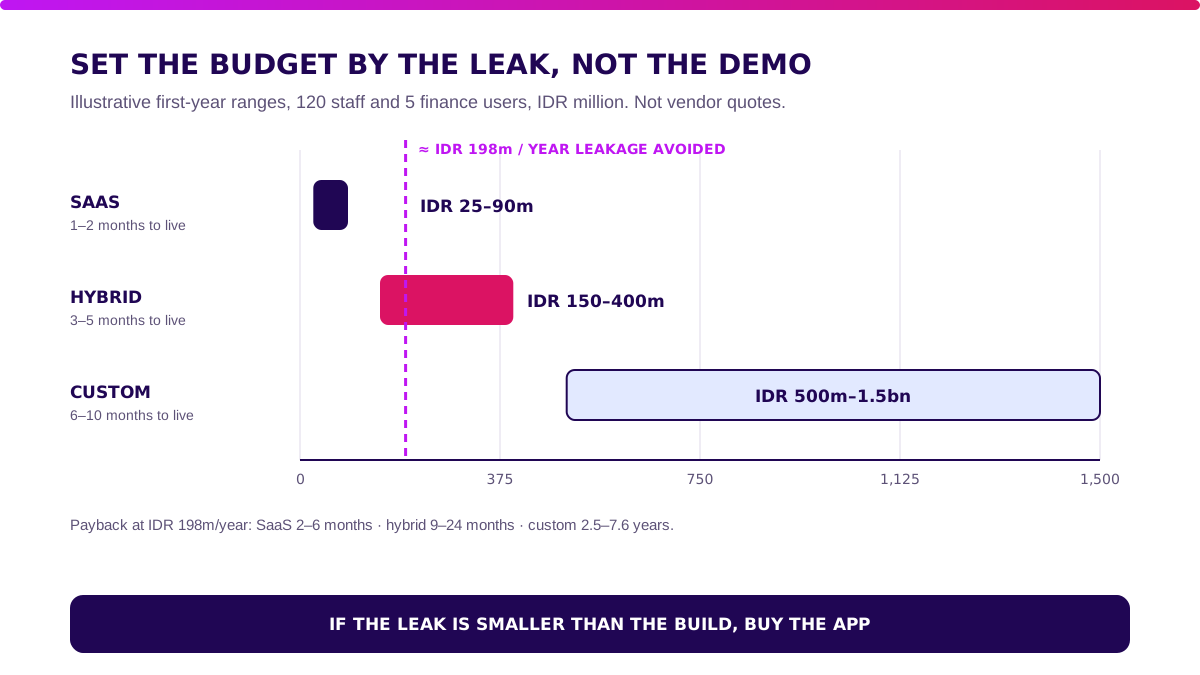
At IDR 198 million a year of avoided leakage, SaaS pays back in about 2–6 months, hybrid in 9–24 months, and custom in 2.5–7.6 years.
Next: How to Implement Accounting Software Without a Big-Bang Failure.
How to Implement Accounting Software Without a Big-Bang Failure
Load opening balances, run one parallel close, then cut over.
Step 1 — baseline and chart of accounts (weeks 1–2)
Time your current close. Clean the chart of accounts.
Gate: finance signs the baseline.
Step 2 — migrate and pilot (weeks 3–6)
Load opening balances and open items for one entity. Post a month of real transactions.
Gate: trial balance matches the old books.
Step 3 — parallel close (weeks 7–10)
Close one month in both systems. Gate: every difference explained.
Step 4 — cut over and add entities (weeks 11–14)
Switch off the old books per entity and lock the old periods. If you validated a custom edge, Production Grade Software turns it into secure, observable, maintainable software.
What I Would Do Before Buying Accounting Software
- Time your own close. Without a baseline, you cannot judge any demo.
- Trial two SaaS tools with real data. Ten tests, one afternoon each.
- Write down the one rule SaaS cannot hold. If you cannot, you do not need custom.
- Plan the integrations. Sales, POS, inventory, and payroll feed the ledger; the ledger is only as good as its feeds.
- Never big-bang. Run a parallel close.
Trial two SaaS tools on your own last quarter. If one closes in half the days, buy it and stop there.
Next: FAQ About Accounting Software.
FAQ About Accounting Software
What is accounting software?
Accounting software records financial transactions in a ledger, reconciles them, and produces reports and tax data, replacing spreadsheets and paper vouchers.
What is the best accounting software in Indonesia?
The one that passes your own month-end close: your chart of accounts, your bank statements, your tax fields. Test two with real data before deciding.
How much does accounting software cost?
In this article’s illustrative model for 120 staff and 5 finance users: IDR 25–90 million for SaaS, IDR 150–400 million for hybrid, and IDR 500 million–1.5 billion for custom in the first year.
Can accounting software be custom-built?
Yes, but rarely wise. Add a custom edge to a SaaS ledger when one rule or integration does not fit.
Build the whole ledger only when accounting is your product.
Accounting software vs a ready-made app: which is better?
Ready-made wins when it passes your close test, which is most of the time. Custom wins only when a measured leak is larger than the cost to build.
Related Posts
Two weeks to a real answer
Need help putting this into practice?
Book a Blueprint session and we'll turn the ideas in this article into a tested prototype in front of real users—2 weeks, from $3,000.