Technology Strategy
ERP Vendors in Indonesia: How to Evaluate Before Signing
Choosing an ERP vendor in Indonesia is not a contest for the cleanest demo. It is a decision about who will influence your workflows, data, and pace of change for several years.
The problem is that most proposals look similar before implementation starts. They all promise integrated, scalable, secure, and easy to use. The difference appears when master data is messy, approvals contain exceptions, an API fails, or users return to spreadsheets.
This guide turns a sales presentation into an evidence-based decision. We will cover vendor types, evidence to request, a weighted scorecard, three-year cost, contract terms, and the pilot to run before signing.
TL;DR — the whole guide in five lines:
- Choose against one real workflow, not a module list or a slide full of client logos.
- Escalate the evidence: demo, documents, sandbox, reference call, then a pilot with pass/fail metrics.
- Score the same seven areas for every vendor so the first polished presentation does not set the decision.
- Model three-year cost, including integration, change, support, and exit—not only licence fees.
- Put data export, SLA, acceptance criteria, and transition support in the contract before your leverage disappears.
Proof first: an ERP demo is not an ERP implementation
Strong vendors are comfortable moving the discussion from features to constraints. They can show how an invalid order is handled, who fixes master data, what happens when an API times out, and how finance closes a period when transactions arrive late.
Before comparing vendors, choose one important value stream—such as order-to-cash or procure-to-pay. Provide a normal scenario and three real exceptions. Ask every vendor to run the same scenarios. You are then comparing their ability to handle reality, not their ability to stage a demo.
The NIST SP 1326 due diligence guide frames due diligence as systematic research into a supplier and product before acquisition. For ERP, provenance, resilience, cyber practices, and dependencies must be visible.
What is an ERP vendor?
An ERP vendor is a company that provides, implements, or operates a system connecting data and workflows across business functions. It may be the product owner, implementation partner, system integrator, or a custom team building the core and integration layer.
One project can involve several parties. Do not stop at the brand on the proposal. Ask who configures the system, migrates data, builds integrations, holds production access, and provides support after go-live.
ERP vendor types in Indonesia: a quick comparison
| Path | Main strength | Main risk | Best fit |
|---|---|---|---|
| Local product + implementer | Local support and Indonesian operating context | Capability varies between partners | Mostly standard workflows and a fast rollout |
| Regional/global product + partner | Mature modules, governance, broad ecosystem | Licences, configuration, and change can be expensive | Multi-entity organisations with formal controls |
| Custom ERP / hybrid partner | Unique workflows and integrations can be designed precisely | Requires product ownership and engineering discipline | Core processes genuinely differentiate the business |
| Best-of-breed integrator | Each function can use the strongest specialist tool | Data model and integration ownership become more complex | Teams ready to govern a modular architecture |
No category always wins. If finance, payroll, and procurement are standard, packaged software is usually faster. If pricing, allocation, routing, or customer workflow creates the advantage, a hybrid or custom path may make more sense.
How to evaluate ERP vendors: raise the level of evidence
Do not award a high score because an answer sounds confident. Ask for evidence that becomes increasingly expensive to fake.
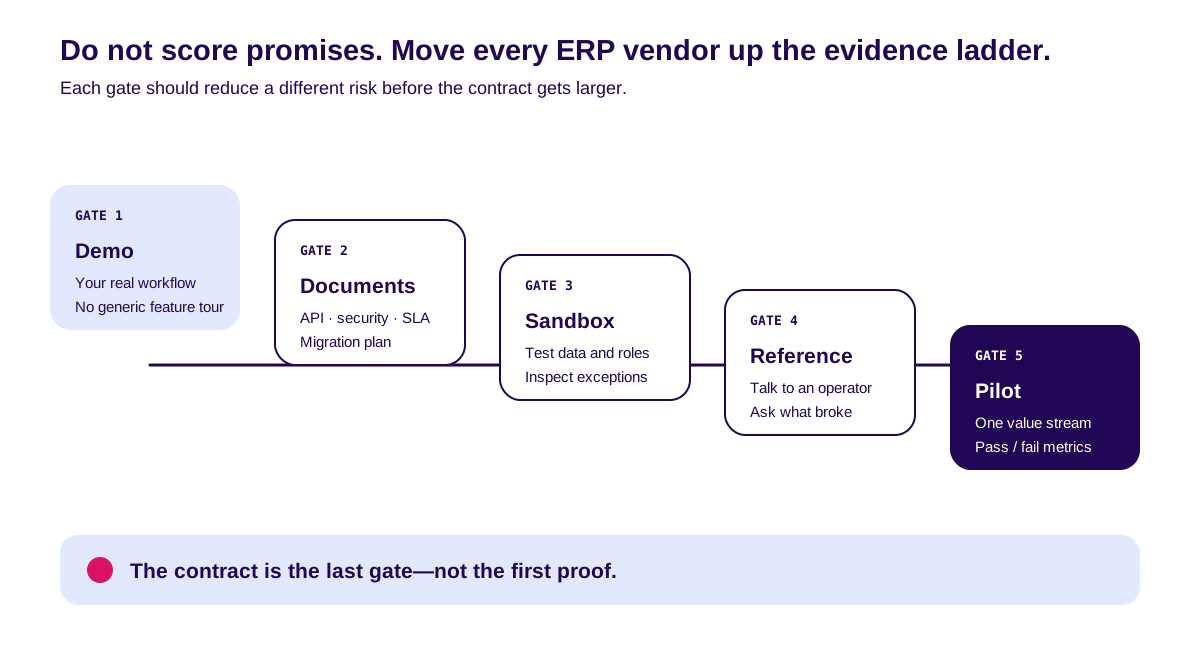
- Demo: run your workflow and exceptions, not a generic product tour.
- Documents: review architecture, APIs, data model, security practices, SLA, and migration plan.
- Sandbox: load realistic sample data, roles, approvals, and exceptions.
- Reference: speak with a client operator, not only an executive sponsor or procurement team.
- Pilot: test one value stream against baseline and acceptance metrics.
If a vendor refuses to move from demo to evidence, mark the risk. Do not let an assumption become a contract.
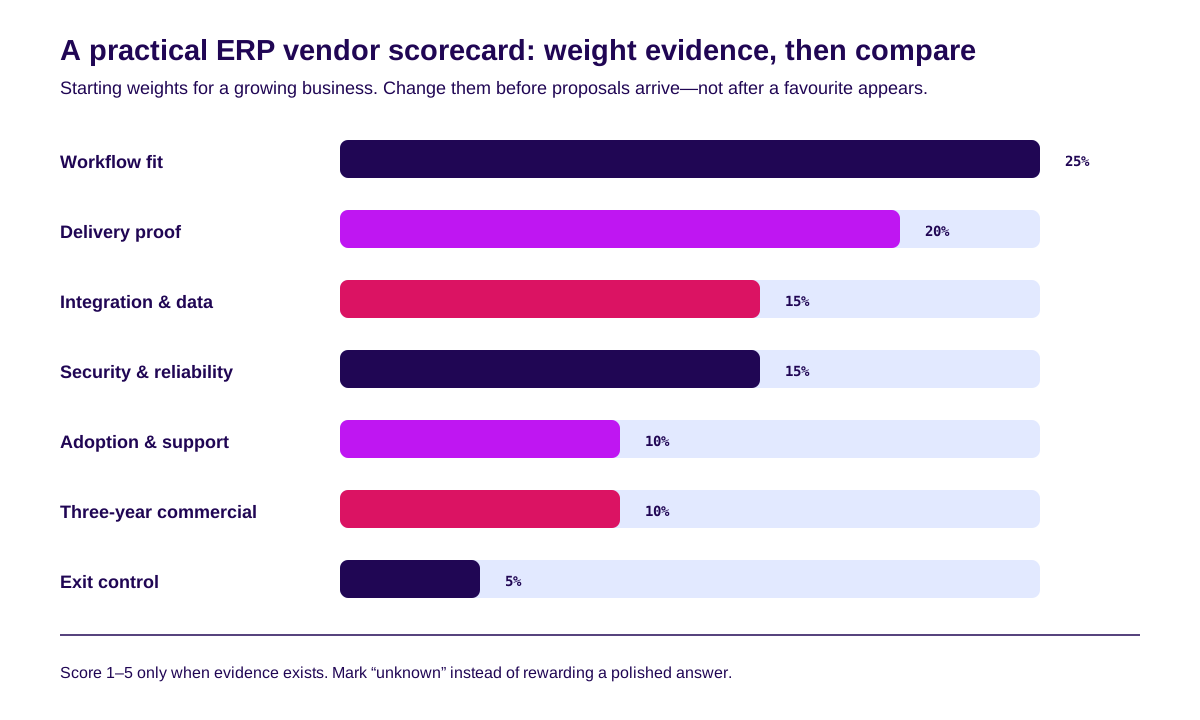
Seven areas for an ERP vendor scorecard
Use the same format for every candidate: what to verify, evidence to request, and the red flag. The scorecard below is a starting point. Change the weights before opening proposals.
1. Workflow fit
Verify: how many steps work out of the box, are configurable, need integration, or require custom code?
Request: a marked-up process map, exception demo, and a list of customisations the vendor recommends you do not build.
Red flag: every request receives a “yes” without an impact on upgrades, support, or timeline.
2. Delivery proof
Verify: who works after signature, how dependencies are managed, and what completes each phase?
Request: the named implementation lead, work breakdown, example RAID log, reference call, and acceptance gates.
Red flag: you only meet sales; the delivery plan is still one timeline without accountable owners.
3. Integration and data
Verify: sources of truth, canonical IDs, API limits, retries, reconciliation, migration, and data-quality ownership.
Request: API documentation, sample payloads, data mapping, error paths, volume tests, plus cutover and rollback plans.
Red flag: integration is called “easy” while the sandbox, documentation, or monitoring is unavailable. Read the ERP integration guide before fixing the scope.
4. Security and reliability
Verify: access control, audit logs, encryption, backup, incident notification, vulnerability management, and recovery targets.
Request: security policy, relevant audit evidence, architecture review, penetration-test summary, incident process, RTO, and RPO.
Red flag: the vendor offers only a badge or the word “secure”. OWASP ASVS provides verifiable security requirements that can be used during procurement and written into contracts.
5. Adoption and support
Verify: who changes SOPs, trains admins, helps users, and measures usage after go-live?
Request: role-based training, support channels, response times, escalation paths, and an adoption dashboard.
Red flag: the project ends at system go-live with no owner for workflow completion or manual workarounds.
6. Three-year commercial model
Verify: setup, user, module, storage, environment, API, support, change-request, and annual increase costs.
Request: invoice models for three usage scenarios, rate cards, implementation assumptions, and excluded items.
Red flag: the opening price is low but API access, sandbox, reports, or required support sits in an extra tier.
7. Exit control
Verify: export format and frequency, termination fees, deletion, and transition support.
Request: a sample export, data dictionary, deletion certificate, exit timeline, and ownership of custom code or configuration.
Red flag: the data “belongs to the customer” but can only be exported through an unbounded paid professional service.
How much does an ERP vendor cost in Indonesia?
There is no honest single number without user count, modules, entities, migration, integrations, and support model. A useful proposal separates the following five cost layers.
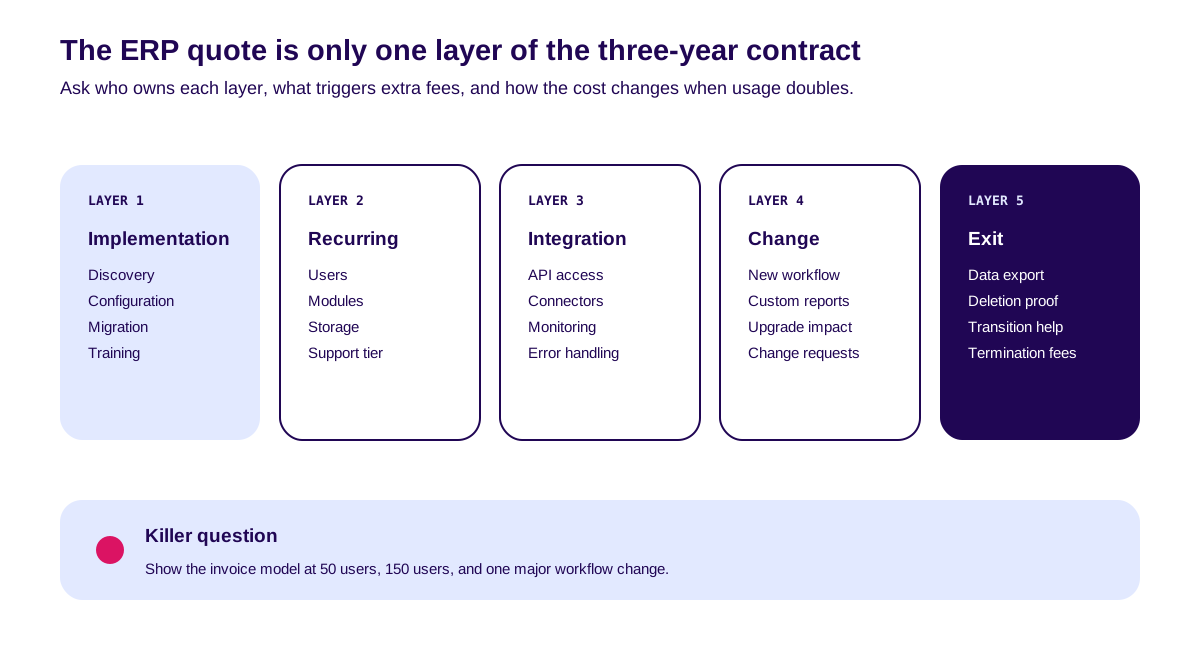
| Cost layer | Question the vendor must answer |
|---|---|
| Implementation | Fixed scope or time-and-material? Who pays for data cleansing and rework? |
| Recurring | Does price change by user, module, transaction, storage, or entity? |
| Integration | Are APIs, connectors, monitoring, and endpoint changes included? |
| Change | What is the rate card and lead time for a new workflow or report? |
| Exit | What does export, transition, and verified deletion cost? |
Ask for conservative, expected, and growth scenarios. If the vendor gives only one total, finance cannot see the cost drivers and operations cannot see which changes become expensive.
Validate it in 2 weeks. Before an ERP contract locks in a large commitment, Blueprint & Prototype maps the workflow, tests exceptions, and makes the implementation numbers more real — see how Blueprint & Prototype works.
What must be written before signing?
At minimum, the contract and statement of work must define:
- Outcome and acceptance criteria: what must work for a phase to be complete.
- Scope and dependencies: including data, integration, testing, and decision ownership.
- Service levels: severity, response, restore target, maintenance windows, and escalation.
- Security: access, audit, incident notification, testing, and subprocessors.
- Commercial guardrails: rate cards, price escalation, change requests, and exclusions.
- Data and IP: ownership, export format, retention, deletion, and rights to custom work.
- Exit: transition assistance, timeline, fees, and handover artefacts.
Legal review still matters. But legal cannot repair acceptance criteria that the business and technical teams never defined.
What we would recommend before choosing an ERP vendor
- Shortlist no more than three vendors. More candidates add presentations, not necessarily decision quality.
- Test the riskiest workflow. Do not choose the easiest process simply to make the pilot look successful.
- Score product and partner separately. A strong product can fail with a weak implementer; a strong partner cannot erase every product limit.
- Use “unknown” when evidence is missing. Honest uncertainty is better than a high number based on assumptions.
- Sign after the pilot and exit path are clear. Your best leverage exists before the contract, not after a difficult go-live.
The best ERP vendor is not the one that says yes fastest. It is the one that makes constraints visible, provides evidence, and helps you make a decision that still works three years from now.
FAQ
What is an ERP vendor?
An ERP vendor provides the product or implementation services for an ERP system. It may be a software owner, implementation partner, system integrator, or custom/hybrid partner.
How do you choose the best ERP vendor?
Start with one real workflow, use the same scorecard, request documents and sandbox access, run reference calls, and pilot before the full contract. “Best” means best fit for your outcomes and constraints.
How much does an ERP vendor cost in Indonesia?
Cost depends on users, modules, entities, migration, integrations, support, and customisation. Compare three-year total cost and growth scenarios, not only setup or the first month of licences.
Can ERP be custom built?
Yes. Standard processes such as finance or payroll are often more efficient on packaged products. Custom investment is more defensible for workflows that materially change margin, speed, or service.
Is a local or global ERP vendor better?
Local vendors often lead on local context and support; global vendors on module depth and governance. The right choice depends on workflow fit, partner quality, integration, total cost, and exit control.
Related Posts
Two weeks to a real answer
Need help putting this into practice?
Book a Blueprint session and we'll turn the ideas in this article into a tested prototype in front of real users—2 weeks, from $3,000.