Auto Repair Shop Software: Service, Parts and Invoices
Choose auto repair shop software with tests for approvals, spare parts and invoices. Compare ready-made and custom options with a labeled first-year budget.
 By Aditya S October 27, 2026 Updated November 11, 2026 16 min read
Auto repair shop software should connect the work a customer approved, the spare parts a mechanic used, and the invoice your cashier collects. If those three records disagree, a tidy dashboard will not explain the missing part or the disputed charge. This guide gives you a testable buying process for an Indonesian workshop.
I’m Aditya S, Business Development Manager at Synetica, a tech-based business consultancy combining strategy and execution for Dreamers and Growing Businesses. I use supplier documentation, an attributed shop-owner quote, and fictional examples you can replay. I am not claiming results from a Synetica workshop client or ranking products I have tested.
You’ll follow one repair order, compare features by operating model, assign four controls, and use ten acceptance tests before buying. Then we’ll compare a ready-made package, a small integration and a custom core on the same first-year scope.
TL;DR — the whole guide in five lines
- Approve each estimate version: additional work needs a new approval record before it enters the bill.
- Separate reserved and consumed stock: a part waiting for a mechanic still exists on your shelf.
- Keep completion and payment separate: finishing a repair does not settle the customer’s balance.
- Buy a package that passes your exceptions: custom development needs a specific business case.
- Reconcile before activating one workshop: open jobs, physical parts and outstanding balances need named owners.
What problems should auto repair shop software solve?
Start the demo with one repair order whose arithmetic you can check. My test fixture is fictional: B-104 has an oil-change labor charge of IDR 100,000, two sealed one-liter oil bottles at IDR 75,000 each, and one filter at IDR 50,000. These are assumed test prices, not Indonesian market rates or a service recommendation.
The customer approves estimate v1 for IDR 300,000 and pays IDR 100,000 as a deposit. A later proposed filter upgrade costs IDR 80,000 instead of IDR 50,000. The customer declines it. The approved total therefore stays IDR 300,000, with IDR 200,000 outstanding.
| Event in B-104 | Work and parts record | Money record, IDR |
|---|---|---|
| Approve estimate v1 | Labor 100,000; oil 150,000; filter 50,000 | Approved total 300,000 |
| Receive deposit | No work completion implied | Paid 100,000; due 200,000 |
| Decline proposed v2 | Original filter remains approved | Total stays 300,000 |
| Issue approved parts | Two oil bottles and one original filter | Balance unchanged |
| Complete and collect | Record final checks and vehicle handover | Collect 200,000; due zero |
For the original filter SKU, assume ten units on hand. Reserving one leaves ten on hand and nine available. Issuing that unit for use leaves nine on hand and zero reserved. Reprinting the invoice must not deduct another unit.
These are acceptance criteria I recommend, not a claim that every package uses the same stock states. Map your actual hand-offs in Blueprint & Prototype before requesting a supplier demo.
What is auto repair shop software?
Auto repair shop software links a vehicle’s repair order to estimates, authorized work, parts, service history and payment. Indonesian workshops often call the repair order a Work Order or Perintah Kerja Bengkel (PKB). It is the job’s shared folder, rather than just a sale at the counter.
KasGo’s published Work Order guide describes a record connecting customer, vehicle, mechanic, services, spare parts and job status. It also describes moving completed work to the cashier. That is evidence of a documented workflow, not independent verification of the product or every exception below.
A general cashier package can handle a completed sale. Workshop operations also need to remember what was proposed, what was declined, what is waiting for a part and who can release the vehicle. Our cashier app guide covers the transaction controls that still matter here.
If you sell spare parts over the counter as well, distinguish that sale from stock issued to a repair order. Otherwise, the same part can appear to leave the workshop twice. Use the stock tests below to check both routes.
Which workshop software features matter at each scale?
Choose features around operational hand-offs, not the number of screens offered. A single workshop handling fleet credit accounts may have more complex billing than several cash-only outlets.
| Operating model | Minimum capability to demonstrate | Signal to expand scope |
|---|---|---|
| One motorcycle or car workshop | PKB, vehicle history, estimate approval, parts, invoice, export | Staff cannot explain work or stock differences |
| Workshop plus spare-parts counter | Above, plus separate retail sales, units, returns and stock counts | One SKU is deducted through two sales routes |
| Fleet or business accounts | Above, plus customer credit rules, invoice cycle and receivables | Completed jobs disappear inside unpaid balances |
| Multiple workshops or central store | Above, plus branch permissions and matched stock transfers | Dispatch and receipt cannot be reconciled |
Ask for a searchable internal vehicle ID as well as registration details. A plate number can change; it should not be the only link to service history. Record the identifiers appropriate to your work and restrict access to customer contact details and photos.
For each shortlisted feature, write one observable result. “Has inventory” is vague. “Returning an unused filter restores the correct SKU at the correct location once” is something your storekeeper can test. Prepare the demo with your inventory owner.
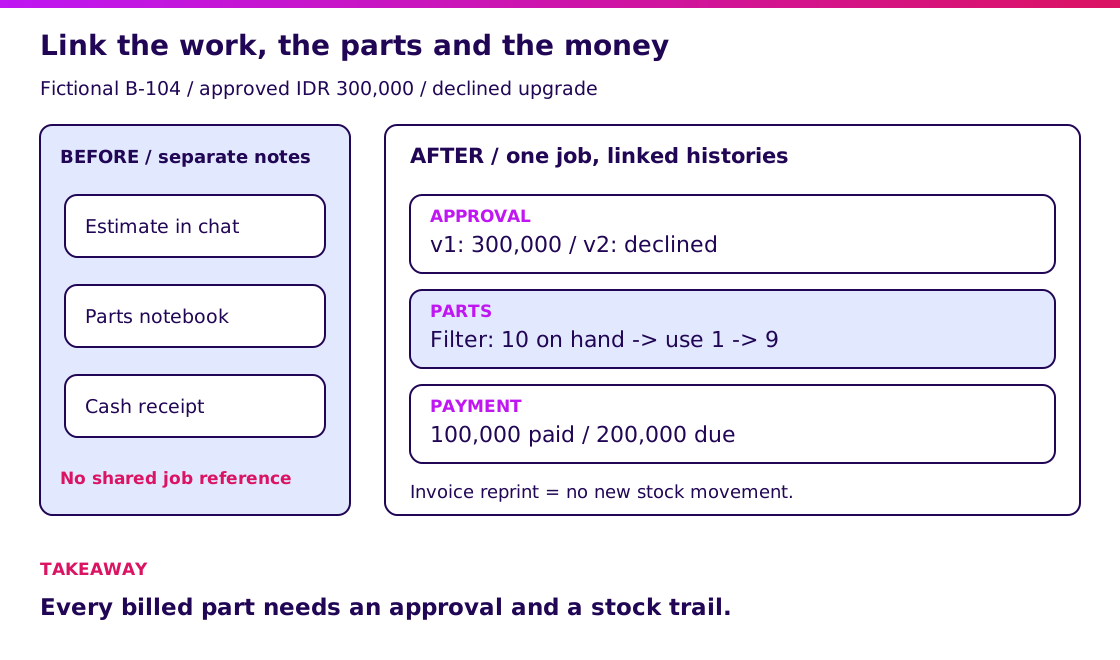
Open the workflow diagram at full size.
What controls should workshop management software include?
Assign an owner to each hand-off so an exception has somewhere to go. The roles below are responsibilities to allocate, not invented client interviewees. In a small workshop one person may hold several roles; still require review of sensitive adjustments.
1. Estimates and approval — owned by the service advisor
Make the estimate a versioned agreement that follows the vehicle through the bay.
- Record the complaint, vehicle, mileage and intake condition.
- Separate proposed work from customer-approved work.
- Show labor, parts, quantities and any agreed fees before approval.
- Preserve the approver, time, channel and estimate version.
- Route additional work back for approval.
In B-104, v2 proposes a more expensive filter. Declining it must leave the original IDR 300,000 approval intact. A later edit cannot quietly convert that decision into consent for IDR 330,000. Agree how staff record phone approvals and attach the relevant evidence.
Demo question: can you show v1 and the declined v2 after the invoice is printed?
I recommend this because the cashier needs the customer’s agreement, not a mechanic’s memory of a conversation. Bring one estimate revision to a scoping discussion.
2. Spare parts and returns — owned by the storekeeper
Treat a reservation as a name on a shelf, and consumption as a physical movement off it.
- Track SKU, location and purchase versus sale units.
- Distinguish reserved, issued, returned and available quantities.
- Link a part issue to the actual repair order.
- Approve substitutions before fitting and billing them.
- Record stock adjustments with reasons and an accountable user.
B-104 reserves one of ten filters, then consumes it. If an unused part comes back, record a linked return once after checking its condition. A used or damaged part belongs in the appropriate non-saleable location or disposition process, not automatically in available stock.
Demo question: does printing or reopening B-104 change stock a second time?
This structure makes stock differences explainable. Bulk oil also needs an explicit liters-to-purchase-unit conversion; our fixture deliberately uses sealed bottles. Use the stock movement checklist with your own units.
3. Mechanic work and quality checks — owned by the workshop lead
Use the repair order as a relay baton carrying the next action between shifts.
- Assign each approved job to a mechanic or team.
- Separate waiting for approval, waiting for parts and active work.
- Record completion evidence appropriate to the service.
- Require the agreed final check before release.
- Link a repeat visit to the original job without deleting its history.
A mechanic completing the oil change does not mean a vehicle waiting for another approved task is ready for collection. Define which roles may close the whole repair order. Keep technical work records factual; the software should support qualified staff and your workshop’s service procedures.
Demo question: can a second shift identify the remaining task without calling the first?
I recommend distinct job states because a single “in progress” label hides the reason a bay is blocked. Include a shift handover in the pilot.
4. Invoices and collection — owned by the finance lead
Keep the invoice as a bridge between completed, authorized work and the money actually received.
- Carry approved line items into the bill without retyping them.
- Apply deposits once and show the remaining balance.
- Restrict discounts, refunds and credit-note approvals.
- Reconcile each payment channel against its settlement evidence.
- Export invoices and payments with references back to the job.
B-104 has IDR 100,000 paid and IDR 200,000 due. A repeated payment notification cannot create a second deposit. For a fleet customer, an authorized credit arrangement may permit vehicle handover before payment; the receivable must remain visible with its due date.
Demo question: can finance explain every difference between the invoice total and collected cash?
I recommend separate job, vehicle-release and payment states because they answer different questions. Scope accounting hand-offs before development.
Why does customer approval deserve its own workflow?
An approval record gives the next staff member the context behind the charge. In Tekmetric’s supplier-published SJ Automotive story, Chicago shop owner Tomi Oliva says:
“I really love the ease of communication and authorization.” — Tomi Oliva, owner of SJ Automotive, quoted by Tekmetric.
This is a vendor-selected customer testimonial, not independent research or a Synetica client result. I use it to illustrate an operator’s stated priority. I do not import the story’s revenue claims into your business case or assume the product supports Indonesian integrations.
For your demo, ask the service advisor to send a revised estimate, record a declined line, and show what the cashier sees afterward. The useful evidence is a saved version and decision, not a message that merely says “sent.”
Validate it in 2 weeks. Blueprint & Prototype maps your risky hand-offs and tests a working prototype with relevant users before you approve production scope. Bring one disputed invoice or unexplained stock movement.
Should you buy ready-made workshop software or build custom?
Start with a package when it passes your must-have tests and lets you take your data out. Custom development earns its cost when a recurring workflow gap has a measurable consequence that configuration cannot address.
| Approach | Good fit | Evidence to request | Main trade-off |
|---|---|---|---|
| Ready-made package | Standard repairs, stock and customer billing | Replay your exceptions and export full job history | Fit is constrained by supplier rules |
| Package plus integration | Core workflow fits; one accounting or fleet hand-off does not | Supported API, retry behavior and clear data ownership | Two suppliers may share responsibility |
| Custom core | Distinct fleet rules, cross-branch approvals or other valuable gaps remain | Prototype, acceptance criteria and operating owner | You fund maintenance and future changes |
For a hybrid system, write down which system owns parts, invoice numbering and payment status. A stock issue must have one authority. An integration failure needs a visible queue and a retry that does not repeat the business action.
Do not choose custom simply because you have three branches or want your logo on a login screen. Count the exceptions, estimate their cost, and compare that with the additional spend. Read our build-versus-buy framework before committing.
How do you test workshop software before buying?
Run the same ten tests in every demo and keep the exported evidence. Use a sandbox with fictional customers. These are recommended acceptance tests, not assertions that a particular supplier passes or fails them.
| Test | Required observable result |
|---|---|
| 1. Revise and decline an estimate | Original approval survives; declined extras do not enter the bill |
| 2. Reserve the last available filter | A second job cannot silently consume the same availability |
| 3. Issue, then return an unused part | Correct SKU and location; linked movements occur once |
| 4. Request a substitute part | Price and approval changes are visible before use |
| 5. Reprint and reopen an invoice | No additional stock deduction or duplicate invoice |
| 6. Repeat a payment notification | One payment record and the correct outstanding balance |
| 7. Reopen a repeat-service visit | Original work remains; new work and charging policy are explicit |
| 8. Interrupt the connection mid-save | Clear saved/unsaved state; retry creates no duplicate job |
| 9. Try a restricted adjustment | Unauthorized user is blocked; allowed adjustment has history |
| 10. Export and reconcile B-104 | Approvals, parts, invoice and payments retain matching IDs |
Agree which failures block adoption. Unexplained stock loss, a charge for declined work, and duplicated money records should stop the purchase until resolved. A cosmetic report change may be scheduled separately.
Ask the supplier to demonstrate backup recovery and explain access after cancellation, export scope and retention. An export button alone does not prove you can reconstruct your jobs. Bring the resulting evidence to a vendor review.
How much does workshop software cost in the first year?
Compare the same operating scope over twelve months, including implementation. The model below is fictional planning arithmetic, not vendor prices, a market survey or a Synetica offer. Scope: one workshop, PKB and approvals, parts, invoicing, reporting, and one accounting hand-off.
| Assumed cost, IDR million | Package | Hybrid | Custom core |
|---|---|---|---|
| Discovery and configuration | 4 | 7 | 12 |
| Custom development or integration | 0 | 24 | 96 |
| Twelve-month subscription | 6 | 6 | 0 |
| Additional hosting | 0 | 3 | 6 |
| Migration and staff training | 3 | 4 | 8 |
| Additional support | 3 | 6 | 12 |
| Planned first-year spend | 16 | 50 | 134 |
| Separate 15% reserve | 2.4 | 7.5 | 20.1 |
| Funding envelope | 18.4 | 57.5 | 154.1 |
The assumed subscription is IDR 500,000/month, or IDR 6 million/year. “Additional” means beyond what the subscription includes: remove overlapping support or hosting when comparing actual quotes. Reserve is held funding, not an invoice or guaranteed expenditure.
The model excludes taxes, devices, scanners, printers, payment fees, message usage and future features. Ask suppliers to itemize these. No hardware purchase is necessary merely because it appears in a sample demo.
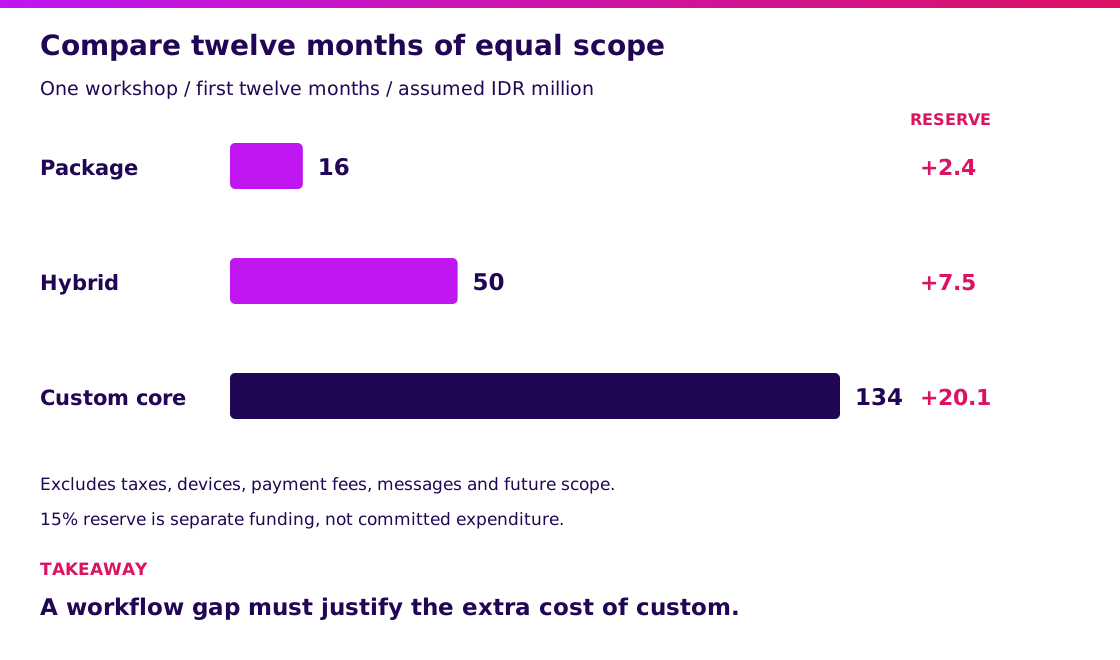
Open the budget diagram at full size.
How do you check whether the cost is justified?
Use recoverable operating value and verified margin, with assumptions visible. Suppose staff save an assumed 30 minutes a day across 26 days: 13 hours/month. At an assumed IDR 40,000/hour, that is IDR 520,000 of released capacity, not automatic cash savings.
Against the model’s IDR 500,000 subscription, only IDR 20,000 remains before setup and other costs. If the subscription doubles, yearly planned package spend rises from IDR 16 million to IDR 22 million. Time value alone would no longer cover the subscription.
A more persuasive business case may include measured stock differences or billable work currently missed. Measure a baseline first and avoid counting the same benefit twice. Extra bookings are valuable only if demand, bays and staff capacity exist. Review the wider application cost drivers with those constraints in view.
How do you roll out workshop software?
Activate one workshop only after open jobs, stock and money reconcile. Software installation is one task; deciding which records become authoritative is the harder one.
Use four evidence gates. First, map service codes, units, approval rules and owners. Second, replay the ten tests with the service advisor, mechanic, storekeeper and cashier. Third, reconcile counted stock, deposits and open jobs against opening records. Fourth, activate one workshop and review its first shift close.
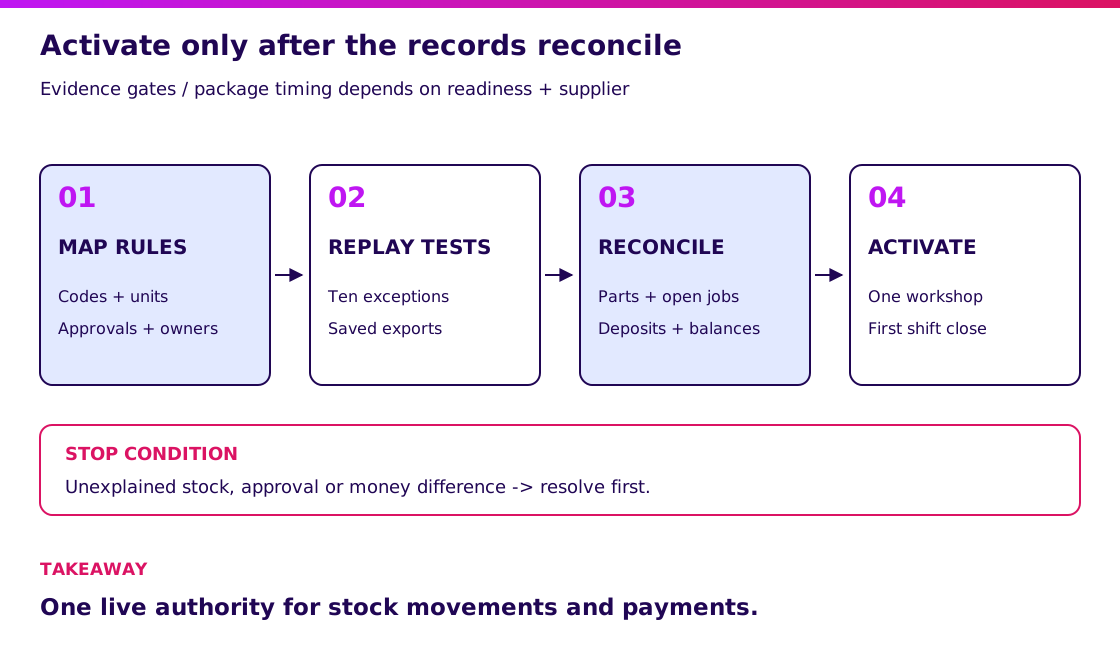
Open the rollout diagram at full size.
Choose a cutover time and one system for live stock movements and payments. You can compare read-only reports during the pilot, but avoid deducting the same part in two live ledgers. Name the person who can pause activation and the procedure for recovering unfinished transactions.
For agreed custom scope, Synetica’s 2B2G path is Blueprint & Prototype in 2 weeks, followed by Production Grade Software in 8 weeks, then Launch & Grow on an ongoing monthly retainer. That is ten weeks through prototype validation and production build. Package setup depends on supplier capability and your readiness; it does not inherit this custom-delivery schedule.
Plan the production work after the prototype establishes the scope and acceptance criteria.
What would I advise a workshop owner to do first?
Bring one difficult repair order to a demo before buying a bigger feature list. Choose a job with a revised estimate, a returned part and a deposit. Ask your next shift to explain it using only the saved records.
- For one workshop: buy the smallest package that passes the critical tests and exports usable history.
- For fleet or multi-workshop operations: prove credit rules, stock ownership and handovers before adding automation.
- For custom scope: name the gap, its operating cost and the person responsible for the new workflow.
My next step would be to book a scoping conversation with that repair order and its unanswered questions.
FAQ — Choosing workshop software
What is auto repair shop software used for?
It connects vehicle intake, estimates, approval, mechanic work, parts, invoices and payments. The central record is the repair order or PKB. A useful implementation lets staff trace a billed part back to the approved work and its stock movement.
What features should workshop software include?
Start with versioned estimates, vehicle history, job ownership, spare-parts movements, deposits, invoices, role permissions and export. Add fleet billing or branch transfers when your workflow needs them. Test exceptions such as declined extras and returned parts before adding reminders or dashboards.
How much does workshop software cost?
Get current quotes for your scope. This article’s fictional first-year model totals IDR 16 million for a package, IDR 50 million for hybrid and IDR 134 million for a custom core, before separate reserves and listed exclusions. These are calculations, not market prices.
Is free workshop software enough?
It can be enough for a limited workflow if its current terms, user limits and export cover your needs. Check whether approvals, stock history, backups and support are included. A free tier that forces staff to maintain critical records elsewhere may create additional work.
Can workshop software be customized?
Yes, through supported configuration, integrations or a custom build. First test whether an existing product meets the critical workflow. Custom scope needs clear data ownership, maintenance funding and acceptance tests; branch count alone does not justify it.
Related Posts
Aditya S
Business Development Manager, Synetica.
Put it into practice
Need help putting this into practice?
We turn the ideas in this article into a prototype tested with real users in 2 weeks (from Rp49jt)—or production-grade software in 8 weeks (from Rp100jt).