Hotel PMS: 6 Controls for Small and Mid-Size Properties
Choose a hotel PMS that connects bookings, room readiness, and payments. Compare six controls, vendor tests, and an illustrative Indonesian hotel budget.
 By Aditya S October 20, 2026 Updated November 11, 2026 16 min read
A hotel PMS should help you sell the right room, prepare it for arrival, and reconcile the money afterward. For a small or mid-size Indonesian property, the buying decision starts with those hand-offs. A long feature list is less useful than a reservation your next shift can trust.
I’m Aditya S, Business Development Manager at Synetica, a tech-based business consultancy combining strategy and execution. This is a software evaluation guide, not a report from a Synetica hotel engagement. I use inspectable vendor documentation and a clearly labeled operating simulation; I do not claim measured hotel savings or a vendor price survey.
You’ll get a worked inventory example, six controls with accountable owners, a packaged-versus-custom decision, a budget model, and ten demo tests. If you manage leases and monthly tenants instead of nightly stays, start with our property management system guide.
TL;DR — the whole guide in five lines
- Buy the booking-to-cash workflow first: room availability, housekeeping readiness, and settlement must agree.
- A channel manager reduces distribution risk: it does not guarantee that simultaneous last-room bookings cannot happen.
- Test six controls with named owners: reservations, distribution, housekeeping, folios, payments, and daily reporting.
- Prefer a packaged PMS when it passes your tests: add a narrow integration before funding a replacement platform.
- Budget the full first year: setup, subscriptions, training, integrations, support, and a separately held reserve.
What problems should a hotel PMS solve first?
The first proof is a room count you can reproduce. Consider this synthetic one-night fixture for a 24-room hotel. These are invented test inputs, not occupancy data from a real property.
| Inventory event for the same stay date | Rooms remaining to sell |
|---|---|
| Physical rooms | 24 |
| Two rooms blocked for maintenance | 22 |
| Eighteen confirmed room-nights already committed | 4 |
| One new direct booking consumes one room-night | 3 |
| One existing one-room booking is canceled | 4 |
All bookings in this fixture are for one night, with no group allotments or temporary holds. A cancellation releases inventory only under the property’s configured rule. Maintenance blocks stay separate from reservations; you cannot recover a broken shower by changing a booking status.
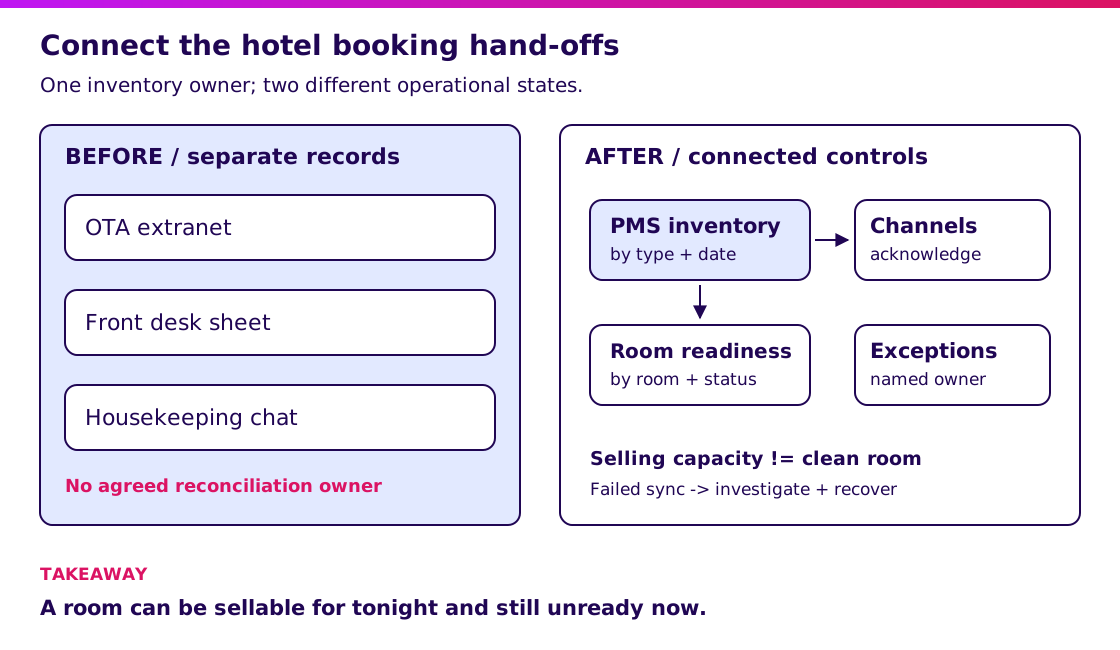
Three available room-nights also do not prove three clean rooms are ready now. Availability is a selling constraint by date and room type; readiness is a physical room condition. A guest arriving early can still need to wait even when the calendar has capacity.
My evaluation question is simple: can the receptionist replay those events and explain every change? Save reservation IDs, timestamps, and the before/after count. Use that fixture in your vendor evaluation, rather than accepting a tour of a preloaded dashboard.
What is a hotel PMS, and how is it different from a channel manager?
A hotel PMS, or property management system, manages reservations, room assignments, guest stays, housekeeping status, folios, and operating reports. A folio is the guest’s running record of charges and payments. A booking engine takes direct online reservations; a channel manager exchanges availability, rates, and bookings with connected sales channels.
Choose the complete operating connection, even if different vendors supply its parts. Ask which system owns the room count, which publishes it, and where failed updates become visible. “Integrated” needs an operational explanation.
Which features matter at each property size?
These are planning profiles, not industry thresholds. A 12-room resort with restaurant packages can be more complex than a 60-room limited-service hotel.
| Need | Small single property | Mid-size property | Multiple properties |
|---|---|---|---|
| Reservations | Shared calendar, deposit, cancellations | Groups, room moves, rate restrictions | Property-specific inventory and access |
| Distribution | Exact OTA and direct-channel coverage | Mapping, update logs, failed-sync alerts | Central visibility with local control |
| Housekeeping | Dirty, cleaned, inspected, blocked | Assignment and supervisor release | Separate teams and maintenance queues |
| Money | Folio, receipts, payment matching | Split bills, POS charges, refunds | Entity-level settlement and consolidation |
| Reporting | Arrivals, departures, daily close | Source mix and settlement exceptions | Consistent definitions across properties |
If your use case is room nights, keep it distinct from a rental portfolio’s lease ledger. Use the property management guide for that comparison, then return to the six hotel controls below.
Which hotel PMS features need an accountable owner?
A module earns its place when a shift owner can demonstrate the control. The following six checks use the same sequence: owner, purpose, actions, a walkthrough, a demo question, rationale, and a next step. The questions are evaluation prompts, not attributed quotations.
1. Reservations — owned by the front office lead
Keep one booking history from creation to departure. Your front office lead should be able to:
- Record source, stay dates, room type, rate, and deposit terms.
- Apply expiry rules to provisional holds.
- Move rooms without losing the original booking reference.
- Trace cancellations and overrides to a staff account.
Walkthrough: enter a two-night stay, move the second night to another room, then cancel only that night. Verify the remaining charge and released inventory for each date. A booking total alone cannot prove that both dates are correct.
Demo question: “Can the evening shift see who changed the stay and why?” History matters because a guest’s agreement can outlive the employee who recorded it. Put this walkthrough in your acceptance-test brief.
2. Distribution — owned by the reservations manager
Make update failures visible before they become arrival problems. Your reservations manager should be able to:
- Map each physical room type to its channel listing.
- Publish rates and restrictions through supported connections.
- Inspect booking imports and availability acknowledgments.
- Escalate a failed update with an owner and recovery procedure.
Walkthrough: start with four sellable rooms in the earlier fixture. Enter one direct booking and verify that the count becomes three on each supported test channel. Retry the same imported reservation and check that it does not consume inventory twice.
Demo question: “What happens when the final room is booked on two channels?” Cloudbeds’ overbooking support guidance identifies mapping errors, simultaneous bookings, and update timing as risks. That documentation supports a recovery plan, not a promise of zero overbooking. Add a last-room policy and escalation owner to your demo brief.
3. Housekeeping — owned by the housekeeping supervisor
Release a clean room through an explicit hand-off. Your supervisor should be able to:
- Separate dirty, cleaned, inspected, and maintenance-blocked states.
- Assign work without exposing unnecessary guest information.
- Require a release step where your operating policy needs inspection.
- Notify the front desk when the room becomes assignable.
Walkthrough: a guest checks out of room 204 at 11:00. Mark it dirty, then cleaned, then inspected. Ask the receptionist to assign an early arrival before the final release; confirm the system follows the property’s policy, including logged supervisor overrides.
Demo question: “Who can release a blocked room?” A room can be vacant while still unsafe or unready. That distinction stops a calendar color from becoming the only control. Define the permitted transitions in your Blueprint & Prototype.
4. Folios and extras — owned by the duty manager
Every guest charge needs an origin and a correction trail. Your duty manager should be able to:
- Post accommodation and approved extras to the correct stay.
- Split guest and company charges where needed.
- Reverse mistakes with an explanation and permission check.
- Export charge detail without erasing adjustments.
Walkthrough: post an illustrative IDR 120,000 restaurant charge to the wrong room. Reverse it, repost to the correct folio, and show both actions in history. The total stays correct without pretending the mistake never happened.
Demo question: “Can I trace this charge back to its source?” If you already have restaurant software, test the actual connector and its failure queue. A checkbox labeled POS integration does not demonstrate posting behavior. Compare that boundary with the restaurant software guide.
5. Payments and refunds — owned by the finance lead
A paid booking and a bank settlement are different events. Your finance lead should be able to:
- Distinguish guest deposits from final charges.
- Match receipts to provider references and bank settlements.
- Track refund approval, execution, and remaining balances.
- Reconcile commissions, fees, and delayed payouts separately.
Walkthrough: use a test folio with IDR 900,000 in charges and an IDR 300,000 deposit. The guest balance is IDR 600,000 before additional payments. A duplicate payment notification must not apply another IDR 300,000. A provider fee belongs in reconciliation, not in an invented guest payment.
Demo question: “Which amount is still owed, and by whom?” Keeping those balances distinct prevents staff from treating a reservation marked paid as proof that the hotel received its payout. Scope reconciliation explicitly in your production integration brief.
6. Daily close and reporting — owned by the general manager
Use reports that can be traced to stays and settlements. Your general manager should be able to:
- Review arrivals, departures, unresolved balances, and exceptions.
- Define business date and the treatment of late postings.
- Drill into occupancy and revenue calculations.
- Export property-specific records for accounting and exit.
Walkthrough: reconcile the synthetic 24-room fixture to its reservation and block records. Then compare posted guest charges with settled funds. Those figures serve different purposes; they need an explained bridge, not forced equality.
Demo question: “Can another staff member rebuild yesterday’s total?” A reproducible report is more useful than a chart with an unexplained denominator. Save a sample daily-close pack with your vendor scorecard.
Should you buy a hotel app or build a custom PMS?
Start with packaged software that passes the operating tests. Custom ownership does not automatically improve distribution access, staff adoption, or support coverage. Those capabilities still need suppliers, maintenance, and a working team.
A useful human perspective comes from a vendor-published story about White Goose Hotel in Bali:
“Each department is able to access it for their specific needs.” — Noura Ben Salah, General Manager, White Goose Hotel, in the Cloudbeds customer story.
This is a supplier-selected testimonial, not independent comparative research or a Synetica result. It highlights a testable requirement: each department needs appropriate access. It does not prove that this supplier fits your property.
| Approach | Choose it when | Validate before approval |
|---|---|---|
| Packaged PMS | Core booking, housekeeping, and finance flows fit | Exact plan, channels, exports, support hours |
| PMS plus narrow integration | Core fits; one reporting or settlement gap remains | API access, failure handling, connector ownership |
| Custom PMS | Repeated critical failures remain after evaluating credible packages | Distribution access, support staffing, migration and lifecycle cost |
For most standard small-property workflows, my starting recommendation is a package. If one missing finance export creates the problem, cost that connector before replacing the room calendar. For a multi-property group, permissions and entity boundaries can justify a wider integration project.
Validate it in 2 weeks. Use Blueprint & Prototype to test the riskiest hotel workflow, compare viable packages, and define only the integration or build scope the evidence supports.
How much should you budget for hotel software?
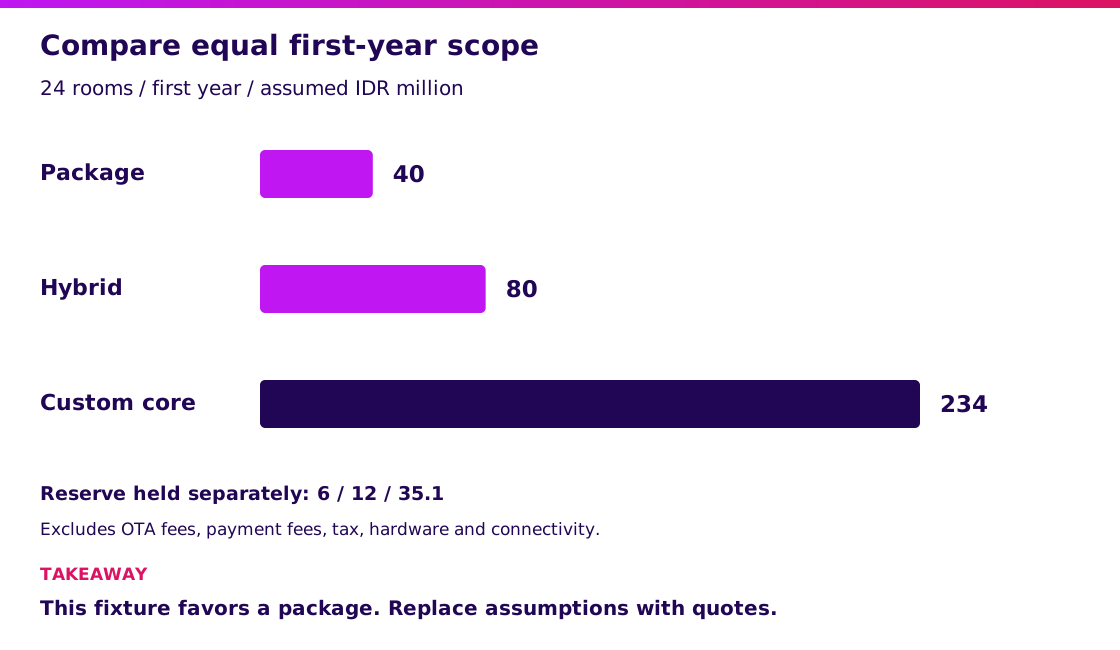
Compare the same property, channels, and twelve-month period. The following is a fictional procurement worksheet for a 24-room hotel. Every amount is an assumption in IDR millions, not a market benchmark, vendor quote, or Synetica offer.
| First-year component | Package configuration | Package + connector | Custom core |
|---|---|---|---|
| Workflow discovery and acceptance design | 6 | 10 | 18 |
| Setup or core build | 4 | 4 | 120 |
| PMS subscription, assumed 1.5/month | 18 | 18 | 0 |
| Connector or distribution integration work | 0 | 30 | 48 |
| Migration, staff training, rehearsal | 6 | 8 | 18 |
| Incremental support or hosting allocation | 6 | 10 | 30 |
| Planned first-year spend | 40 | 80 | 234 |
| Separate contingency reserve, assumed 15% | 6 | 12 | 35.1 |
| Funding envelope if reserve is held | 46 | 92 | 269.1 |
The custom column assumes subscription-free core software, but distribution work does not guarantee partner approval or eliminate external channel-service fees. All columns exclude OTA commissions, payment transaction fees, taxes, hardware, connectivity, and new feature requests. Add dated supplier amounts for those before making a purchase decision; existing vendor support and incremental implementation support must not be double-counted.
At an assumed IDR 3 million monthly subscription instead of IDR 1.5 million, package spend rises by IDR 18 million to IDR 58 million. Hybrid becomes IDR 98 million. Custom remains more expensive in this first-year fixture, even under that subscription change.
How do you test whether the spending pays back?
Suppose staff currently spend 90 minutes daily re-entering bookings and matching receipts. At an assumed loaded cost of IDR 40,000/hour across 30 days, that is 1.5 × 40,000 × 30 = IDR 1.8 million of staff capacity per month. If the workflow removes half that effort, the capacity value is IDR 900,000, not the whole IDR 1.8 million.
That is not a cash saving unless payroll or paid overtime actually falls. It also does not cover the fictional IDR 1.5 million monthly subscription alone. You would need separately evidenced benefits or a lower cost to justify the decision. Do not count hypothetical additional bookings as guaranteed revenue.
Record your actual baseline for seven days, then use the same method in a trial. Bring those observations to a software cost discussion before approving a build budget.
How do you test hotel software before signing?
Make the supplier run your exceptions on a test property. Use synthetic guest details and test payments. Ask for recordings, logs, and export files, not access to another customer’s data.
| Test | Pass evidence |
|---|---|
| Direct booking changes remaining inventory | Reservation ID and before/after counts |
| Channel retry delivers the same reservation twice | One booking, one inventory deduction |
| Cancellation after a date change | Correct release on the revised dates |
| Two channels attempt the final room | Documented residual risk, alert and recovery owner |
| Dirty or blocked room is assigned | Policy enforced or authorized override logged |
| Restaurant charge is corrected | Source, reversal and corrected folio visible |
| Deposit notification is repeated | One payment applied to the folio |
| Refund is approved but not yet settled | Separate statuses and remaining balance |
| Internet connection fails during a shift | Agreed fallback, reconciliation and recovery demonstrated |
| Contract ends | Usable export of bookings, folios, payments and history |
Use a written score: pass, fail, or requires configuration. Record the responsible person, delivery date, extra cost, and retest for every gap. A critical failure cannot be averaged away by five attractive dashboards.
For connectivity, test what staff can actually do during an outage. A cached arrivals list is not proof of offline booking capability. Keep a controlled fallback record and reconcile it after recovery to avoid entering the same booking twice. Attach results to your vendor due-diligence checklist.
How long does hotel PMS implementation take?
Release by operating evidence, not by the training calendar alone. For a package rollout, agree a supplier-specific schedule after checking data quality, channel activation, and staff coverage. The stages below are gates, not a universal duration promise.
| Gate | Owner | Evidence required to proceed |
|---|---|---|
| Map inventory and policies | Front office lead | Room types, blocks, dates, deposits and cancellation rules signed off |
| Rehearse with synthetic data | Department leads | Ten demo tests passed or formally resolved |
| Reconcile migration | Finance + reservations | Future bookings, deposits and open balances match source records |
| Activate controlled live use | General manager | One authoritative booking record; channels deliberately switched |
| Observe a full close cycle | Duty manager + finance | Arrivals, housekeeping, folios and settlement exceptions reviewed |
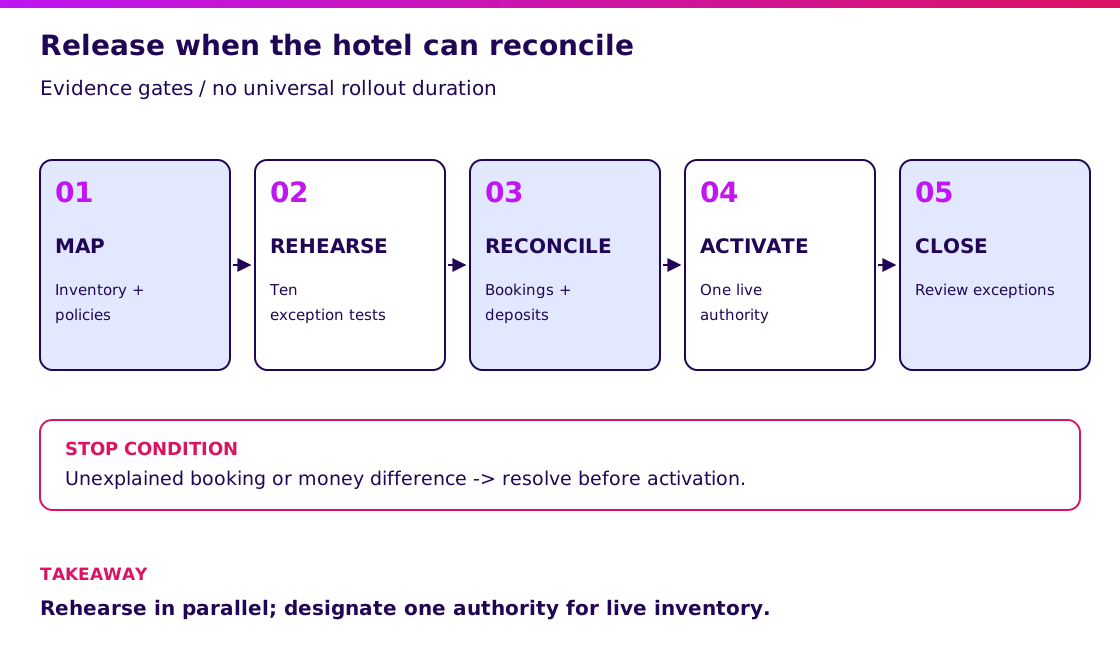
A rehearsal can run beside the old system. Live booking entry should have one designated authority at a time, with a cutover procedure that prevents both systems publishing conflicting inventory. Keep read-only source exports for investigation and agree a rollback trigger before activation.
For validated custom scope, Synetica’s path is Blueprint & Prototype (2 weeks), then Production Grade Software (8 weeks): ten weeks from validation through the agreed production release. It is not a promise to recreate every hotel platform in ten weeks. Distribution certification and third-party approvals need their own confirmed dependencies. Launch & Grow is an ongoing monthly retainer for launch, measurement, and iteration. Define those boundaries in the build scope.
What would I recommend to a small hotel owner?
Bring one troublesome stay to a demo before bringing a feature wish list. Include its booking source, date changes, room readiness, deposit, extra charges, and settlement. Replace guest details with synthetic data, then ask the staff who handle those events to run it.
For a standard independent property, I would shortlist packaged systems first. For Growing Businesses with several properties, I would investigate cross-property reporting and finance boundaries before approving a custom core. Dreamers opening their first property need a manageable daily workflow before a sophisticated revenue dashboard.
Choose the smallest scope that passes the critical tests and has an owner after go-live. If the gaps still point to integration or custom software, bring your workflow to Synetica for a concrete next-step assessment.
FAQ
What is a hotel PMS?
A hotel PMS manages daily accommodation operations, including reservations, room assignments, housekeeping status, guest folios, and reporting. Check whether channel distribution, direct booking, and payment services are included or separately connected.
Which hotel software features matter most for a small property?
Start with a shared reservation calendar, controlled room availability, housekeeping readiness, deposits, folios, settlement matching, and usable exports. Add modules when your staff can identify the operating problem they solve.
How much does hotel software cost in Indonesia?
Get a dated quote for your room count, channels, users, migration, and support. This guide’s IDR 40 million package and IDR 80 million hybrid first-year totals are fictional planning examples, not verified market prices.
Is free hotel software enough?
A free option can be evaluated with the same tests. Verify channel coverage, export access, backups, support, and transaction charges. A zero subscription does not remove the cost of staff work, configuration, or recovery.
Can a hotel PMS be customized?
Sometimes configuration or a supported integration is enough. Confirm API access, partner permissions, failure recovery, and maintenance ownership before paying for development. Replace the core only when critical requirements justify its lifecycle cost.
Related Posts
Aditya S
Business Development Manager, Synetica.
Put it into practice
Need help putting this into practice?
We turn the ideas in this article into a prototype tested with real users in 2 weeks (from Rp49jt)—or production-grade software in 8 weeks (from Rp100jt).