
Savings & Loan Cooperative App: Features & Compliance
Aplikasi koperasi simpan pinjam explained: what it does, features by size, ready-made vs custom, compliance checks, cost and a 12-week rollout.
 By Aditya S October 22, 2026 Updated November 11, 2026 9 min read

An aplikasi koperasi simpan pinjam (savings and loan cooperative application) is the software a koperasi uses to keep member savings, loans, installments, and the annual profit share in one ledger. This guide is for koperasi managers, boards, and the staff who currently reconcile member balances from notebooks and spreadsheets.
I’m Aditya S, Business Development Manager at Synetica, a tech-based business consultancy. We have not run a koperasi and this article does not claim a cooperative client. The figures below are planning simulations built on stated assumptions, not measurements and not a quote. Replace them with your own numbers.
You’ll get a definition, the problems the software solves, features by size, a compliance checklist, a ready-made versus custom decision, cost and timing, and a rollout plan. If you are still deciding whether to buy or build at all, start with our build vs buy guide.
TL;DR — the whole guide in five lines
- A koperasi app is one ledger that member savings, loans, and the year-end profit share all read from, not a notebook per teller.
- Month-end close is the real test: if balances still need manual fixing before the books are signed, the system is not doing its job.
- Ready-made is usually right for a standard koperasi; go custom only where your products or rules are genuinely different.
- Regulatory and reporting duties must be verified with the authorities, not taken from a vendor’s brochure or from this article.
- Budget for year one: in our simulation IDR 161m to build becomes IDR 227m.
What is a savings and loan cooperative application (aplikasi koperasi simpan pinjam)?
A koperasi simpan pinjam application is software that records every member’s savings, loans, installments, and fees in one ledger, and produces the statements and reports the cooperative owes its members. The member record is the core; deposits, loan schedules, and accounting hang off it.
A simple example: a teller records a monthly savings deposit and a loan installment once, the loan balance and interest update, the member sees the new balance, and the month-end report pulls the same numbers without anyone retyping them.
What problems does a koperasi app solve?
It removes the retyping and the balance disputes between tellers, the finance officer, and members. These are the pain points that usually justify the project:
- Savings tracked in individual notebooks, so a member’s true balance depends on whose book you open.
- Interest and installment schedules calculated by hand, so one rate change means re-checking every active loan.
- Arrears noticed late, because nobody has a single list of who is overdue and by how long.
- Member statements prepared on request, so each question costs a staff member an afternoon.
- The annual profit share (SHU) computed in a rush before the annual member meeting (RAT).
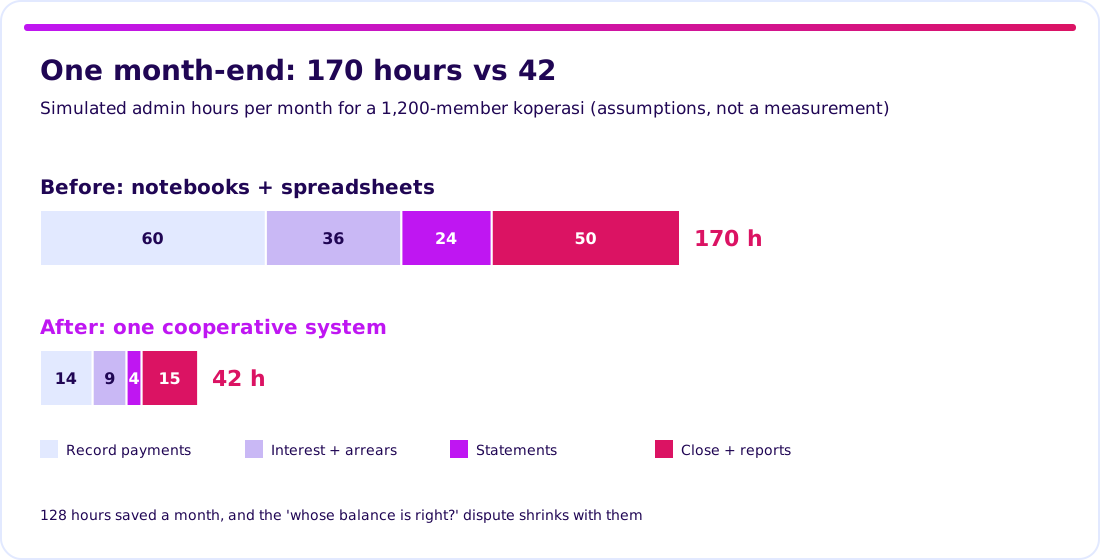
Take a simulation for a 1,200-member koperasi. Recording savings and payments takes 60 hours a month, interest and arrears calculation 36, member statements 24, and month-end close plus reports 50, which is 170 hours of admin. With one system the same month might be 14, 9, 4, and 15, or 42 hours. The saving is 128 hours, about 16 working days of one person. Every figure is an assumption; time your own last month-end and replace them.
Start the build-or-buy decision from the build vs buy guide.
Which features does a koperasi simpan pinjam app need?
Start with member records, savings, and loans with installments; add accounting, arrears follow-up, and the member portal in later waves. This table is a planning aid, not a standard.
| Feature | Small koperasi (under 300 members) | Mid-size (300 to 3,000) | Large or multi-branch |
|---|---|---|---|
| Member records | Core | Core | Core, shared across branches |
| Savings (principal, mandatory, voluntary) | Core | Core | Core, with product rules |
| Loans, interest and installment schedules | Basic | Core | Core, with approval workflow |
| Arrears and collection follow-up | Basic | Core | Core, with aging reports |
| Accounting and financial statements | Verify | Core | Core, with audit trail |
| Annual profit share (SHU) calculation | Basic | Core | Core |
| Member portal or statements by message | Optional | Core | Core |
| Role-based access | Basic | Core | Core, with approvals |
Do not buy every row on day one. Verbs matter more than modules: can a teller record a deposit in seconds, can the finance officer trace any balance back to its transactions, can you export your data in a readable file?
Run the vendor checks before you shortlist.
What compliance checks does a koperasi app need?
Treat compliance as a list to verify with the responsible authorities, not as a feature the vendor ticks for you. Rules for savings and loan cooperatives, their supervision, and their reporting have changed in recent years and may differ by cooperative type and size. This article does not restate them, and nothing here is legal advice.
| Area to confirm | Question to ask | Evidence to keep |
|---|---|---|
| Legal status and supervision | Which regulator or ministry office supervises our koperasi, and what does it require? | Written confirmation from that office |
| Reporting | Which reports, in which format and schedule, must we submit? | Sample export accepted by the recipient |
| Annual member meeting (RAT) | Which figures must the system produce, and who signs them? | Report pack matching your bylaws |
| Member data | What does the personal data protection law require for member and borrower data? | Access log and retention rule |
| Bylaws | Does the software enforce our own rules for savings, loans, and SHU? | Test cases from your bylaws |
Ask a lawyer or the cooperative’s supervisor to confirm the current requirements before go-live. Keep real member data out of demos and screenshots.
Validate it in 2 weeks. Before you commit a koperasi system budget, we test your riskiest workflow through Blueprint & Prototype: a specification, a prototype your tellers and board can try, and cost numbers from the real scope.
Is a ready-made or custom koperasi app better?
Buy ready-made if it covers your products, bylaws, and reports; build custom only where your cooperative model is genuinely different. For most standard savings and loan cooperatives, ready-made is the right answer, and we will say so.
| Option | Strength | Risk to check | Best for |
|---|---|---|---|
| Ready-made (subscription) | Fast start, tested report formats | Fixed loan and SHU logic, data lock-in, per-member pricing as you grow | Standard small or mid-size koperasi |
| Ready-made + extension | Keeps the proven core | Who owns the integration, upgrade conflicts | One or two real gaps |
| Custom, in phases | Fits unusual products or a federation | Larger scope, you own maintenance and security | Multi-branch group, unusual products, or a product plan |
A free koperasi app can be enough for a very small cooperative, but check who maintains it, how security updates reach you, and whether member data can leave. You are holding other people’s money records, so treat security and backups as part of the price.
How should you test a koperasi app before you trust it?
Specify your calculation rules and data ownership separately from the screens. A smooth demo is one piece of evidence, not proof that your real month-end will work.
| Check | Acceptance exercise | Evidence to keep |
|---|---|---|
| Interest and installments | Load three real loan types and compare schedules to your hand calculation | Matches to the rupiah |
| Balances | Pick ten members and trace each balance back to its transactions | Every balance reconciles |
| SHU | Run your bylaw formula on last year’s data | Same result as the approved figures |
| Access | Log in as teller, finance officer, and board and try to edit a closed month | Closed months stay locked |
| Exit | Export all members, savings, and loans | Readable file and field definitions |
How much does a koperasi app cost, and how long does it take?
Cost depends on scope, the number of loan and savings products, and how much history you import, so there is no single price. The chart shows one illustrative scenario for one 1,200-member koperasi. It is a planning example, not a market average and not a Synetica quote.
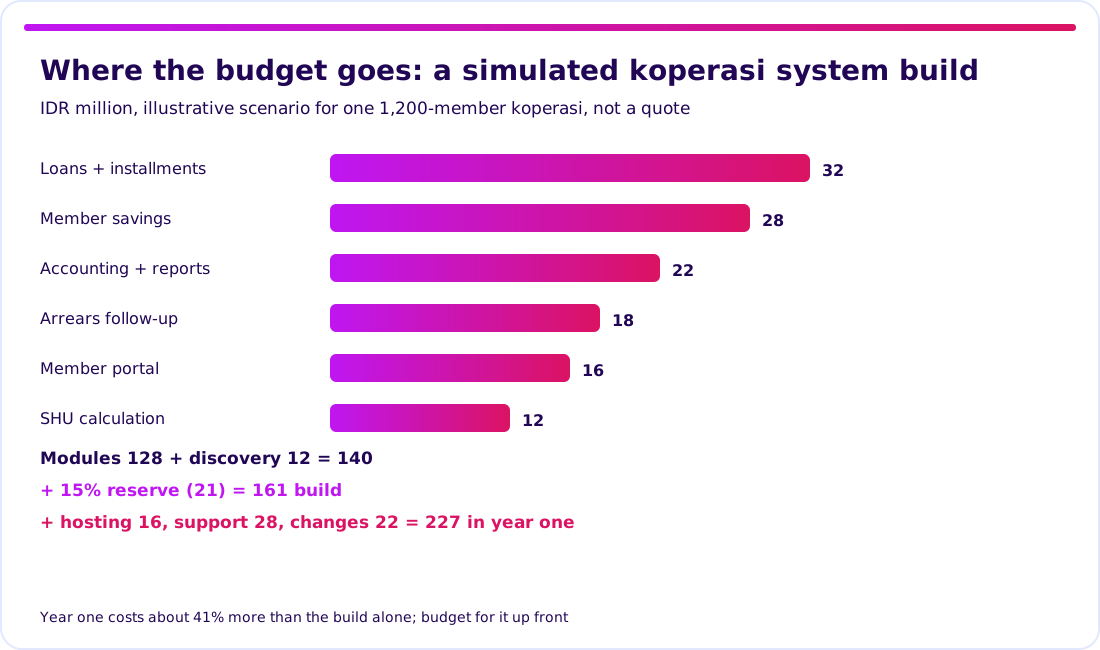
The arithmetic: modules 128 + discovery 12 = 140; a 15% reserve adds 21, so the build is IDR 161m. Hosting 16, support 28, and post-release changes 22 bring year one to IDR 227m, about 41% above the build alone. Discovery is under 8% of the build and the cheapest place to find a wrong assumption.
Synetica’s path is a two-week Blueprint & Prototype, eight weeks of Production Grade Software for validated scope, then monthly Launch & Grow. See also the app development cost breakdown and how the production phase works.
How do you roll out a koperasi app without breaking the books?
Roll out in gates: pilot with one member group, dry-run a month-end, import balances, then run in parallel before the switch. Move the remaining members only after the agreed evidence is complete, and plan the switch right after a month-end close, never in the weeks before the annual member meeting.
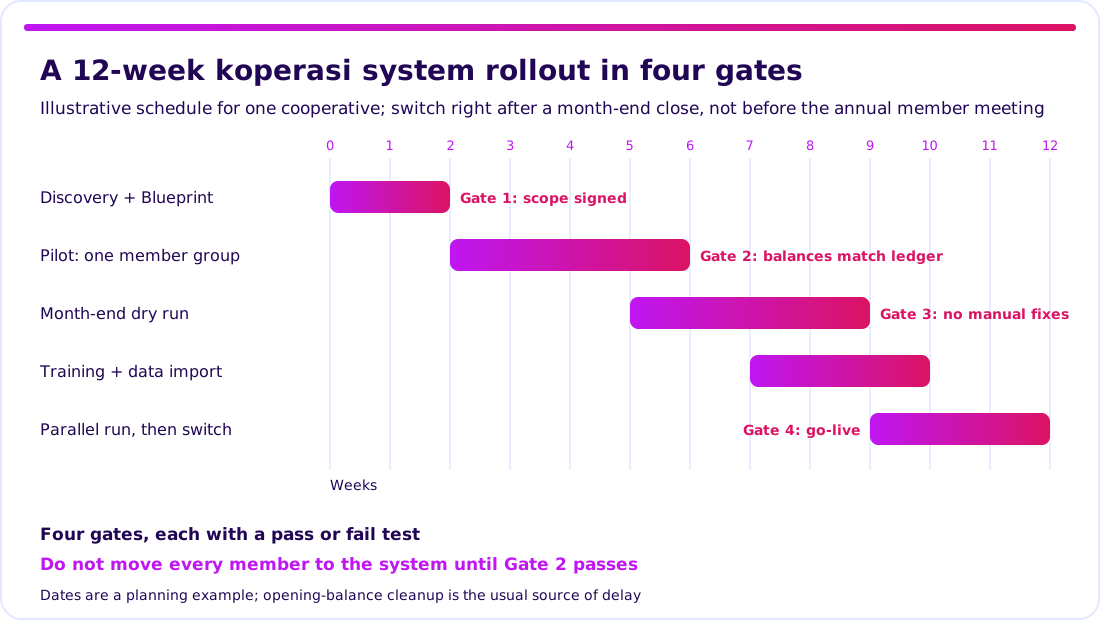
- Gate 1, scope signed: one koperasi, one owner, a written list of what is out of scope.
- Gate 2, pilot passes: one member group’s savings and loans run for several weeks and match the old ledger.
- Gate 3, month-end accepted: a dry-run close produces the reports with no manual corrections.
- Gate 4, go-live: a parallel run shows matching balances, then the notebooks stop on an agreed day.
The twelve weeks are a planning example. Opening-balance cleanup is the usual source of delay, so keep a fallback date.
Plan the rollout with a Blueprint first.
What I’d do before choosing
I would time one ordinary month-end, then pilot two shortlisted systems with one member group each. That comparison beats any feature checklist.
For Growing Businesses running a cooperative or a member-based lender, prioritise balance reconciliation, bylaw-rule tests, data export, and year-one cost. For Dreamers planning a lending product, first check which regulated activity it falls under and whether an existing system already solves the problem.
Next step: bring your riskiest koperasi workflow to Blueprint & Prototype.
FAQ — aplikasi koperasi simpan pinjam
What is an aplikasi koperasi simpan pinjam?
Software that keeps member savings, loans, installments, and fees in one ledger, so tellers, the finance officer, and members see the same balances.
What features does a koperasi simpan pinjam app have?
Usually member records, savings, loans with interest and installment schedules, arrears follow-up, accounting, SHU calculation, and a member portal or statements. The right set depends on size.
How much does a koperasi simpan pinjam app cost?
It depends on scope and products. Our simulation for one 1,200-member koperasi is IDR 161m to build and IDR 227m in year one; it is a scenario, not a market price or a quote.
Is there a free koperasi simpan pinjam app?
There are free options for very small cooperatives. Check support, security updates, backups, and whether you can export your member data.
Can a koperasi simpan pinjam app be customised?
Yes, but customise only where your products or bylaws differ from standard. Validate the workflow with your tellers and board first, then build in phases.
Related Posts
Aditya S
Business Development Manager, Synetica.
Put it into practice
Need help putting this into practice?
We turn the ideas in this article into a prototype tested with real users in 2 weeks (from Rp49jt)—or production-grade software in 8 weeks (from Rp100jt).