Laundry Software: Order Tracking and Membership Guide
Choose laundry software for orders, garment tracking and membership. Use demo tests, a first-year budget and rollout gates before buying or building.
 By Aditya S October 27, 2026 Updated November 11, 2026 16 min read
Laundry software should tell your next shift whose clothes you hold, where they are, what you promised, and what remains unpaid. For an Indonesian laundry business, those answers matter more than an attractive customer app. This guide starts with a test order you can reproduce, rather than a ranking of vendors I have not tested.
I’m Aditya S, Business Development Manager at Synetica, a tech-based business consultancy combining strategy and execution for Dreamers and Growing Businesses. I use published supplier evidence and explicitly fictional operating examples here. This is a purchasing framework, not a report of results from a Synetica laundry client.
You’ll get a worked order receipt, features by operating scale, four controls with accountable owners, ten supplier tests, and a first-year budget. The decision is whether an existing package can run your workflow, whether it needs a small integration, or whether custom development earns its cost.
TL;DR — the whole guide in five lines
- Track the order and its separate bundles: washing, packing, payment and collection are different states.
- Keep membership balances in a ledger: money credit, kilogram packages and loyalty points need distinct rules.
- Buy a package when it passes your exception tests: branch count alone does not justify a custom platform.
- Compare twelve months of equal scope: subscriptions, setup, migration, training and support all belong in the budget.
- Activate one outlet after reconciliation: prove garment custody and money balances before extending the rollout.
What problems should laundry software solve first?
A credible demo follows one order through both its clothing and its money. Use this fictional fixture: order L-104 contains 5 kg of wash-and-fold at an assumed IDR 8,000/kg, plus two shirts requiring separate pressing at IDR 10,000 each. These are test rates, not a survey of Indonesian laundry prices.
The total is IDR 60,000. The customer pays a deposit of IDR 20,000. The wash-and-fold bundle is ready first; the two shirts remain in pressing. Your system must preserve that distinction even if both services share one receipt.
| Test event | Physical record | Money record |
|---|---|---|
| Receive L-104 | One parent order, two labeled service bundles | Charges 40,000 + 20,000 = 60,000 |
| Receive deposit | Both bundles still in your custody | Paid 20,000; due 40,000 |
| Finish first bundle | Wash-and-fold ready; shirts still in process | Due remains 40,000 |
| Release first bundle | Customer receives only that bundle | Record any additional payment separately |
| Complete final collection | Both bundles released, with recipient and time | If customer pays 40,000, due becomes zero |
This fixture does not count kilograms as pieces. Piece-level custody requires an actual item count and tags; a weighed bag alone cannot prove that a particular shirt was received.
Ask the supplier to replay the fixture live and export its history. If you need help defining your own edge cases, map the workflow in Blueprint & Prototype.
What is laundry software?
Laundry software connects order intake, processing, collection and payment records. It can cover kilogram laundry, per-item services, pickup and delivery, or a central processing plant. Your required scope depends on how garments move through your business.
An ordinary cashier app records a sale. A laundry workflow also needs custody over time: intake today, separate processing tomorrow, and collection later. Our cashier app guide explains the transaction controls worth carrying into that workflow.
For inspectable market evidence, CleanCloud’s published feature list includes garment tracking, rack locations, split tickets, subscriptions and loyalty points. Those are supplier claims about its own product. They establish useful demo topics; they do not prove local payment support, a particular plan’s inclusions, or fitness for your outlet.
The controls below are my recommended acceptance criteria. Have each shortlisted supplier demonstrate them with your own rates, staff roles and collection rules.
Which laundry software features matter at each business size?
Choose features by the hand-offs you operate, rather than by outlet count alone. One busy outlet using an external processing plant may need stronger custody tracking than three outlets that wash everything locally.
| Operating model | Minimum capability to test | Expansion trigger |
|---|---|---|
| One outlet, local processing | Intake receipt, service rates, due time, tags, status, payments, export | Staff cannot locate bundles or reconcile a shift |
| Outlet with pickup and delivery | Above, plus booking windows, driver custody and failed-delivery handling | Delivery promises depend on private staff chats |
| Multiple outlets, central plant | Above, plus transfer manifests, branch permissions and receiving checks | Items cross locations without a matched handover |
| Recurring household or business accounts | Above, plus package ledger or agreed invoice cycle | Unclear remaining entitlement or disputed balances |
Before requesting a demo, write the receiving outlet, processing location, collection location and money owner for one representative order. Keep the required list short enough that a cashier can rehearse it during a quiet shift.
Use the demo checklist below to turn those requirements into observable results.
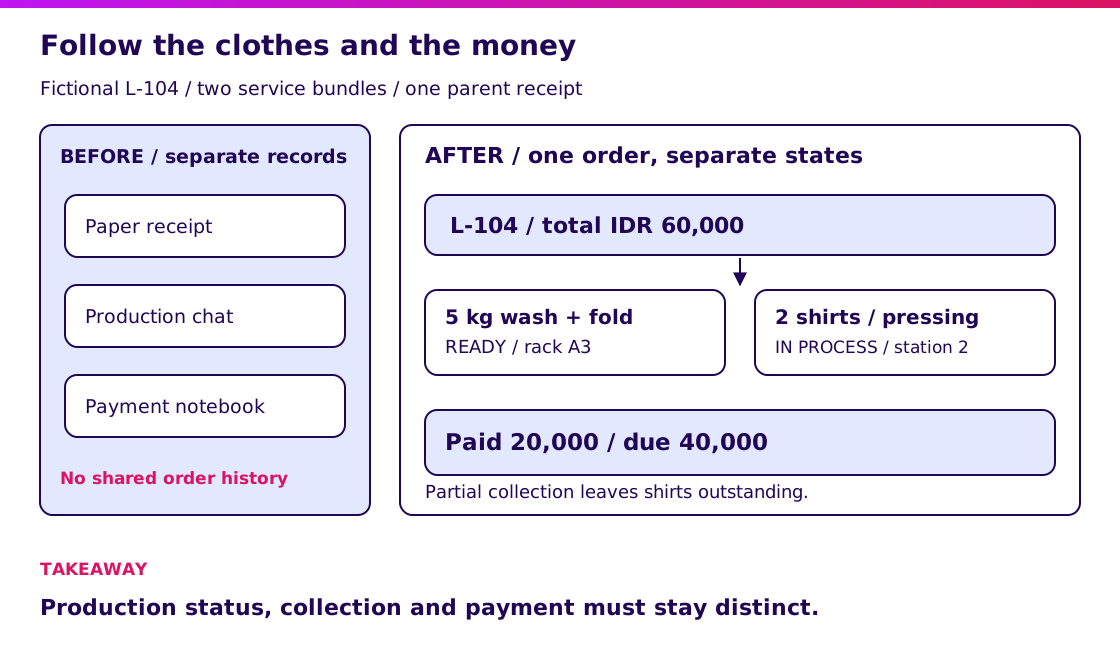
Open the workflow diagram at full size.
What controls should laundry software include?
Give each control an operational owner who can explain a mismatch. The roles below are responsibilities to assign, not people quoted as clients. A small outlet may give one person several roles, while keeping approvals separate where practical.
1. Intake and pricing — owned by the counter lead
Treat the intake receipt as the agreement that follows the clothes through the shop.
- Record the customer, service, measured quantity and promised collection time.
- Apply minimum charges and rounding rules visibly.
- Tag each service bundle, or each item where item tracking is required.
- Capture exceptions such as existing damage with restricted photo access.
- Require a reason and approval for a price change.
For L-104, the counter lead records 5 kg of wash-and-fold and two shirts as separate service lines. A later reweigh must retain the original quantity, the correction and who approved the new charge. Silently changing the receipt makes customer disputes harder to resolve.
Demo question: can a cashier change the price after a deposit without leaving history?
I recommend this structure because the next shift needs the original promise as well as the current amount. Bring one real intake policy to a scoping discussion.
2. Processing and collection — owned by the production lead
Give every bundle a location and a next action, like a claim tag attached to a moving object.
- Record processing stages without overwriting the previous event.
- Assign a rack or holding location when work is ready.
- Match dispatch and receipt when sending bundles to another location.
- Route rewash or damage issues into an exception queue.
- Record partial collection with the actual recipient and remaining bundles.
In L-104, releasing the 5 kg bundle leaves two shirts outstanding. The order cannot become fully collected merely because one bundle passed the counter. A rewash should reopen production work while preserving the customer’s original due time and any revised promise.
Demo question: can the next shift locate the shirts without asking the previous cashier?
This keeps the handover attached to the order instead of somebody’s memory. Use the partial-collection test before approving a supplier.
3. Membership and payments — owned by the finance lead
Keep the customer’s entitlement as a ledger whose entries explain the balance.
- Separate cash credit, kilogram allowances and loyalty points.
- Define eligible services, expiry and any overage charge before selling a package.
- Record every debit, top-up and reversal against its originating transaction.
- Prevent a repeated payment notification from crediting the balance twice.
- Restrict manual adjustments and reconcile them at shift close.
Suppose a fictional member buys a 20 kg allowance and uses 5 kg. Their remaining entitlement is 15 kg. Two pressed shirts do not consume kilograms unless your package explicitly includes a conversion rule. Avoid quietly combining incompatible units.
Demo question: what happens to the allowance if staff cancel and recreate the same order?
I recommend a reversal linked to the original use, followed by one new deduction. That makes the arithmetic inspectable. Check the membership examples below with your finance owner.
4. Notifications and delivery — owned by the outlet supervisor
Send customer messages from operational events, so each notification describes work actually completed.
- Notify only when the relevant bundle reaches its agreed ready state.
- Record delivery failure and give staff a retry action.
- Show what remains outstanding when an order is partly ready.
- Assign pickup and delivery windows that staff can fulfill.
- Record driver handover and failed delivery without marking collection complete.
For L-104, a message saying “your laundry is ready” would be misleading while the shirts remain unfinished. Use a partial-ready message, or wait until the whole order is ready, according to your published service policy.
Demo question: can a failed message leave a visible task instead of silently disappearing?
This matters because an accurate status has little value if staff communicate a different promise. Include messaging and delivery boundaries in your requirements.
How should laundry membership balances work?
A membership is a set of rules and ledger entries; a discount badge is insufficient. Start by deciding what the customer actually buys. The examples below are fictional acceptance fixtures, with no expiry or promotional bonus unless stated.
| Membership type | Example transaction | Expected balance |
|---|---|---|
| Prepaid money | Credit IDR 200,000; pay a 60,000 order | IDR 140,000 remaining |
| Kilogram allowance | Buy 20 kg; redeem 5 kg for an eligible service | 15 kg remaining; other services billed separately |
| Loyalty points | Earn 10 points; reverse the original earning transaction | Zero points from that transaction |
| Refund/reversal | Cancel the 60,000 prepaid-money charge | Restore 60,000 once, with a linked reversal |
Ask who may authorize refunds, whether an expired allowance can be extended, and how unused balances are exported when changing software. Confirm accounting treatment with your accountant. This guide does not prescribe revenue recognition or payment-service obligations.
For communication context, Charles Measley, owner of Fluff & Fold Laundry, described the earlier problem in a supplier-published CleanCloud interview:
“Communication was often delayed.” — Charles Measley, owner, Fluff & Fold Laundry.
This is a vendor-selected testimonial, not independent research or a Synetica client quote. My takeaway is narrower than a vendor recommendation: make the current promise and balance understandable to both staff and customers.
Validate it in 2 weeks. Blueprint & Prototype maps the risky workflow and tests a working prototype with users before you approve production scope.
Should you buy laundry software or build a custom application?
Start with a package that passes your tests; fund custom work for a demonstrated gap. A branded app can wait while you prove intake, custody, settlement and export.
Buy when your services, package rules, branch permissions and reporting fit a supported configuration. Choose a hybrid when the core works but a specific local payment or accounting connection is missing. Confirm that the supplier permits and supports the integration before budgeting it.
Custom becomes a candidate when a commercially important workflow cannot be configured or integrated reliably: for example, a central plant allocating contract work across franchise operators with different settlement rules. First measure the actual workaround cost. “We plan to expand” is not enough evidence on its own.
Ask suppliers to export orders, service lines, status history, payments and membership balances. Check identifiers and links, not just whether a download button exists. An incomplete export can make switching expensive even when the monthly subscription is modest.
Use the same decision discipline as the hotel PMS guide: test the operational hand-offs before buying a longer feature list. If custom scope survives that comparison, review Production Grade Software delivery.
How do you test laundry software before buying?
Ask for saved evidence from exception tests, rather than a rehearsed tour of screens. Use fictional customer data in the demo. Your counter, production and finance owners should sign off on the same fixture.
| Test | Required result | Evidence to retain |
|---|---|---|
| Mixed-service order | Two service bundles keep one parent reference | Receipt and status history |
| Weight correction | Original quantity and revised charge remain traceable | Actor, reason and approval |
| Partial collection | Uncollected shirts stay outstanding | Recipient, time and remaining bundle |
| Rewash | Work reopens without erasing the earlier promise | Exception record and new due time |
| Membership cancellation | Entitlement restored exactly once | Linked reversal and balance |
| Repeated payment notification | One payment, one balance update | Provider reference and duplicate outcome |
| Failed ready message | Failure visible; retry does not alter production | Message log and retry result |
| Branch transfer mismatch | Receiving staff flag the missing bundle | Dispatch/receipt manifest |
| Connection interruption | Supported fallback preserves unique receipts | Recovery and reconciliation record |
| Exit export | Orders, money and membership can be matched | Usable sample export with stable IDs |
For the connection test, ask whether intake truly works offline, which actions are blocked, and how conflicts recover. Do not assume a browser-based app provides offline operation. If it does not, rehearse a numbered paper fallback and controlled re-entry.
Score each result as pass, workaround or fail. Record the owner, extra labor and cost of every workaround. Use those gaps as the scope for Blueprint & Prototype.
How much does laundry software cost in the first year?
Compare complete operating scope over twelve months and hold contingency separately. This fictional one-outlet model covers intake, bundle tracking, membership, reporting and one payment connection. All amounts are IDR million. These are planning assumptions, not vendor quotes or Synetica offers.
| Planned cost, first twelve months | Package | Hybrid | Custom core |
|---|---|---|---|
| Discovery and configuration/specification | 3 | 6 | 10 |
| Initial custom development | 0 | 18 | 80 |
| Subscription, assumed 0.3/month | 3.6 | 3.6 | 0 |
| Hosting and monitoring for custom components | 0 | 2.4 | 6 |
| Migration and staff training | 2 | 3 | 6 |
| Support and maintenance | 2.4 | 6 | 12 |
| Planned spend | 11 | 39 | 114 |
| Separate reserve, 15% of planned spend | 1.65 | 5.85 | 17.1 |
| Funding envelope | 12.65 | 44.85 | 131.1 |
The package subscription assumes hosted infrastructure is included. Support lines cover additional help only; remove overlap with subscription or implementation support. Hybrid development assumes a narrow connector, while custom covers a new core. Confirm equivalent acceptance tests even though the delivery approaches differ.
Excluded: tax, printers, tags, scanners, connectivity, payment transaction fees, messaging usage, delivery operations and future features. Add supplier-specific charges before choosing. The model contains no assumed sales uplift.
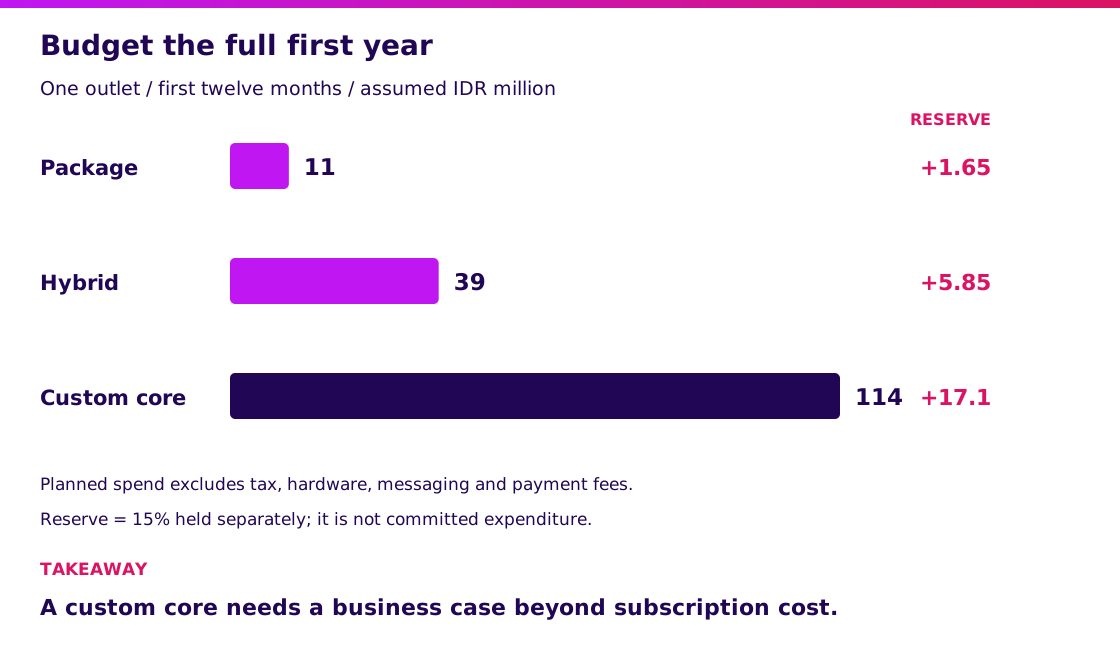
Open the budget chart at full size.
Which assumption changes the budget decision?
At an assumed subscription of IDR 600,000/month instead of 300,000, the package and hybrid each add IDR 3.6m/year. Their planned spend becomes 14.6m and 42.6m. That change alone does not make the 114m custom scenario cheaper.
Suppose staff save an assumed 30 minutes/day over 26 days at IDR 30,000/hour. That frees 13 hours, valued at IDR 390,000/month. It is available capacity, not automatic cash savings. A 300,000 subscription leaves just 90,000 of modeled monthly value before other running costs; at 600,000, time value alone falls short.
Measure handling time and errors at your outlet before using either assumption. For a wider model, read the application development cost guide.
How long does a laundry software rollout take?
Release on evidence that clothes and balances reconcile, rather than on a calendar date alone. A packaged rollout depends on configuration, migration quality, hardware and staff readiness. Agree its timeline with the supplier after testing those dependencies.
For a validated custom scope, Synetica’s 2B2G path is Blueprint & Prototype (2 weeks), then Production Grade Software (8 weeks), followed by Launch & Grow on an ongoing monthly retainer. The two-week promise refers to prototype validation; the validation-to-production path is ten weeks for agreed scope. A package configuration does not automatically require that custom-build schedule.
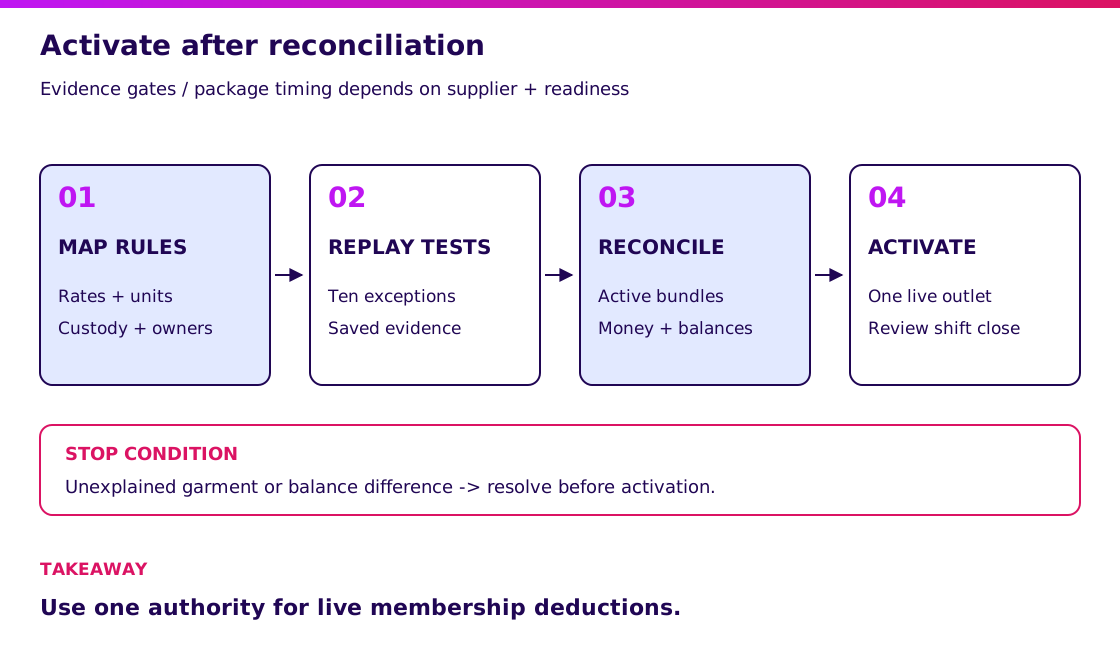
Open the rollout gates at full size.
Name one owner for each gate. Reconcile active orders, physical bundles, unpaid invoices and opening membership balances before activation. Avoid two independent live membership ledgers: parallel testing should compare copies, with one designated authority for real deductions.
Set a stop condition for any unexplained garment or balance difference. Agree a fallback owner and a review of the first completed shift. Include those gates in your implementation scope.
What would I prioritize for your laundry business?
I would prove one mixed-service order and one membership reversal before buying a customer app. Those two tests expose whether your team can trust the record when work diverges from the happy path.
For one outlet, buy the smallest supported package that passes. For a growing network, map custody and settlement between locations before adding features. Preserve the option to export your data and change suppliers later.
Your next step: bring one anonymized order and your package rules to a scoping conversation.
FAQ — Laundry software
What is laundry software?
Laundry software manages intake, service charges, bundle or garment status, collection and payments. Pickup, delivery, membership and branch transfers extend that core when your operating model needs them.
Which laundry software features are essential?
Start with accurate receipts, tags, due times, status history, partial collection, payment reconciliation and usable exports. Add package balances and transfer manifests when you sell memberships or move work between locations.
How much does laundry software cost?
Request a twelve-month quote for your tested scope. This guide’s fictional package scenario totals IDR 11m in planned spend, plus a separately held reserve of 1.65m. It is a budgeting example, not a market price.
Is free laundry software enough for one outlet?
It may be, if its supported features pass your order, balance, export and recovery tests. Verify limits on users, orders, history, support and data access. Free access does not remove migration or staff-training work.
Can laundry software be customized for membership and branches?
Yes, through supported configuration, an integration or custom development. Test package units, cancellation reversals, location permissions and settlement rules first. Fund the smallest change that resolves a material operating gap.
Related Posts
Aditya S
Business Development Manager, Synetica.
Put it into practice
Need help putting this into practice?
We turn the ideas in this article into a prototype tested with real users in 2 weeks (from Rp49jt)—or production-grade software in 8 weeks (from Rp100jt).