How to Create a Website: A Guide for Business Owners
How to create a website for your business in seven steps: validate first, compare no-code, custom and product studio, and see realistic cost and time.
 By Aditya S November 15, 2026 Updated November 19, 2026 13 min read
How to create a website (cara membuat website in Indonesian) is a seven-step job, and the first step happens before you open any website builder: decide the one thing the site must do and test whether anyone wants it. Most guides start at “choose a template”, which is how business owners end up with a handsome site that brings no enquiries.
I’m Aditya S, Business Development Manager at Synetica, a tech-based business consultancy combining strategy and execution for Dreamers and Growing Businesses. This guide uses a fictional furniture workshop with 12 staff so you can check every number. The figures are teaching assumptions, not Synetica client results, vendor prices or industry benchmarks.
You’ll get the seven steps, a cheap way to validate before you build, a comparison of no-code, custom and product studio, a one-page blueprint, realistic cost and time, and the mistakes that sink website projects.
TL;DR — the whole guide in five lines
- Validate before you build: run one page with a WhatsApp button for 14 days and count the chats against a target you set in advance.
- Start with no-code for a simple site: a website builder is enough for a company profile under about ten pages, and you can make it yourself.
- Count your own hours: in our example the do-it-yourself site costs IDR 9.9 million in cash and IDR 26.7 million once the owner’s 112 hours are priced.
- Hire when you can name the extra orders: a hired site costs IDR 44.7 million more in our example, which is 15 extra orders over three years.
- Plan around content: writing and photos take 16 of the 40 hours, and building takes 10.
What are the steps to create a website?
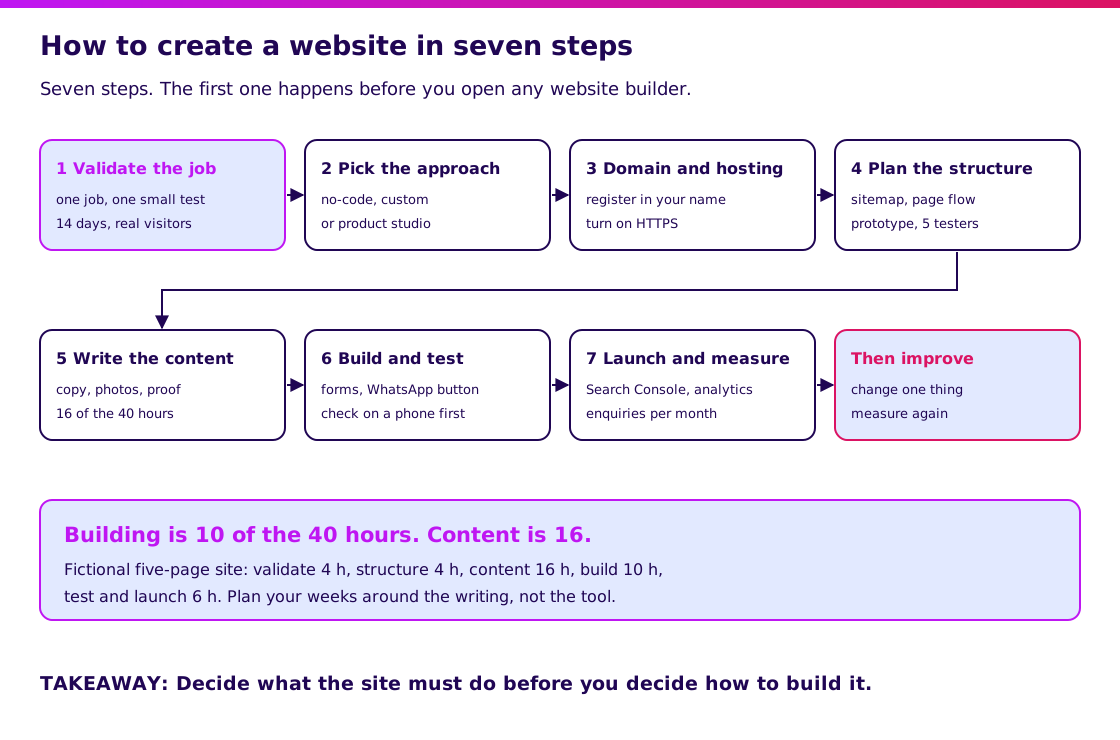
To create a website, validate the idea, choose an approach, register a domain, plan the structure, write the content, build and test, then launch and measure. Here is the short version of each step.
- Validate the job. Write the one thing the site must do, such as “bring furniture enquiries”, and test it with a single page.
- Pick the approach. Choose between a no-code builder, a custom build and a product studio.
- Register domain and hosting. Use your own name and email, never the vendor’s, and turn on HTTPS.
- Plan the structure. Draw the sitemap, the route a visitor takes to an enquiry, and a rough prototype.
- Write the content. Prepare copy, photos, prices and proof such as past projects.
- Build and test. Assemble the pages, connect the form and WhatsApp button, and test on a phone.
- Launch and measure. Submit the site to Google Search Console, then count enquiries each month.
After step 7 you improve one thing at a time and measure again. A website is a shop you keep tidy, and step 7 is the opening day.
How do you validate before you create a website?
Name one job for the site, run the smallest test that could prove it, and decide the target before you look at the result. Think of it as tasting the soup before you cook for a hundred guests.
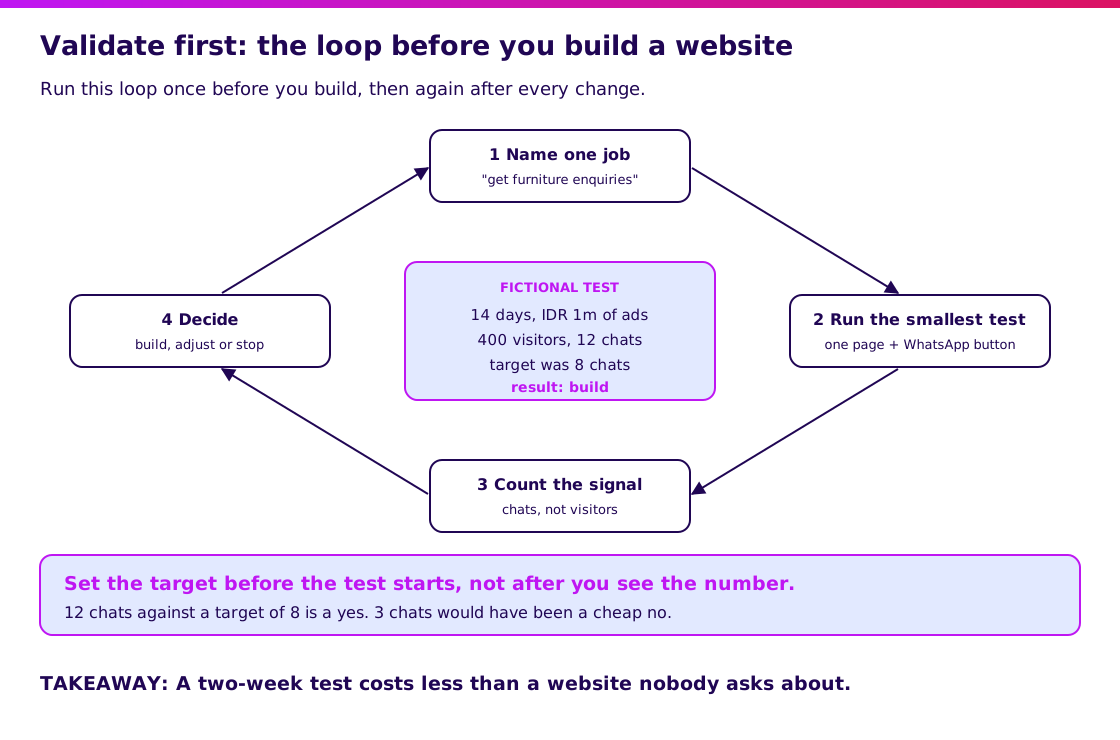
Our fictional workshop sells custom furniture. Its owner believed a website would bring orders from outside the city. Before building anything, the owner ran this test:
| Test item | Assumption |
|---|---|
| What was built | One page: three photos, a price range, a WhatsApp button |
| Duration | 14 days |
| Ad spend | IDR 1 million |
| Target, set in advance | 8 WhatsApp chats |
| Result | 400 visitors, 12 chats, 2 orders |
| Cost per chat | 1,000,000 / 12 = about IDR 83,000 |
Twelve chats against a target of eight is a yes. Three chats would have been a no that cost IDR 1 million and two weeks, far less than a finished site nobody asks about.
Count chats and orders, not visitors. Visitors show that the advert works. Chats show that the offer works.
If your idea is a web application with logins and payments, a single page will not prove enough. In that case test a clickable prototype, as our MVP guide explains.
Which approach should you choose: no-code, custom or product studio?
Choose no-code for a simple site you will edit yourself, custom when the site must win leads with a stable brief, and a product studio when the site is a business process.
| No-code builder | Custom build (freelancer or agency) | Product studio | |
|---|---|---|---|
| Cost | About IDR 2–5 million a year, plus your hours | IDR 8–25 million for a template site, 35–90 million for a custom design | IDR 49 million for a two-week Blueprint & Prototype, then a build priced from the tested scope |
| Time | 2–6 weeks, part time | 2–8 weeks | 2 weeks to validate, then about 8 weeks to build |
| Control | You edit everything, within the builder’s limits; moving out later is hard | Any design; changes go through the developer unless you get a CMS | Scope is fixed by a prototype users have tested; you own the code |
| Best for | A company profile, catalogue or landing page under about ten pages | A site the business relies on for leads | Login, payments, integrations, or a goal nobody has proven yet |
The cost ranges are planning assumptions that match our website development services guide, which covers how to compare vendor quotes. Always ask for a written quote.
For a first business website, no-code is usually the right start. You learn what customers ask for, and that knowledge makes any later custom build cheaper.
How do you plan the blueprint: spec, flow and prototype?
Write a one-page spec, draw the route from landing to enquiry, and test a rough prototype with five customers before you build. A blueprint for a five-page site fits on one sheet:
| Blueprint item | Fictional workshop’s answer |
|---|---|
| The one job | Bring enquiries for custom furniture from outside the city |
| Who it is for | Homeowners and cafe owners ordering made-to-measure pieces |
| Pages | Home, Products, Past projects, How to order, Contact |
| Main route | Advert or search → Products → Past projects → WhatsApp |
| Proof to show | 12 project photos, 3 customer quotes, a price range |
| Number to measure | WhatsApp chats per month |
| Who updates it | The owner’s admin, once a week |
The prototype can be paper sketches or a draft in the builder. Hand it to five customers, ask them to “find the price of a dining table and ask about it”, and watch where they get stuck. Fix those spots before you write the full content.
Good structure is mostly good UI/UX: the visitor should never wonder what to click next.
Validate it in 2 weeks. Before you spend heavily on creating a website or web application, Blueprint & Prototype tests your assumptions: a spec, a clickable prototype in front of real users, and a real cost estimate. The two-week promise covers prototype validation; it does not mean the finished site ships in two weeks.
How do you register a domain and build the pages?
Register the domain in your own name, write the content before you touch the design, and build for the phone first. These three habits prevent the most expensive problems.
- Domain. Pick a short name that matches your brand. A
.co.iddomain requires company documents;.comand.idare simpler to register. - Ownership. The domain, hosting and builder accounts should use an email you control. If a vendor registers them, get the logins in writing.
- Content. Write for the customer’s question, not your company history. Lead with what you sell, for whom, and at what price range.
- Photos. Real photos of your work beat stock images. Compress them so the page loads fast.
- Phone first. Most visitors arrive on a phone, so check every page there before the desktop.
- Speed. Google’s Core Web Vitals treat a largest contentful paint of 2.5 seconds or less as good. See Google’s Core Web Vitals guidance.
For search basics such as page titles, descriptions and a sitemap, follow Google’s SEO Starter Guide. You do not need an SEO agency for a five-page site. You need clear titles and pages that answer real questions.
How much does it cost to create a website?
In our example a do-it-yourself site costs IDR 26.7 million over three years once the owner’s hours are counted, and a hired site costs IDR 71.4 million. The cash figure for the do-it-yourself route, IDR 9.9 million, hides most of its cost.
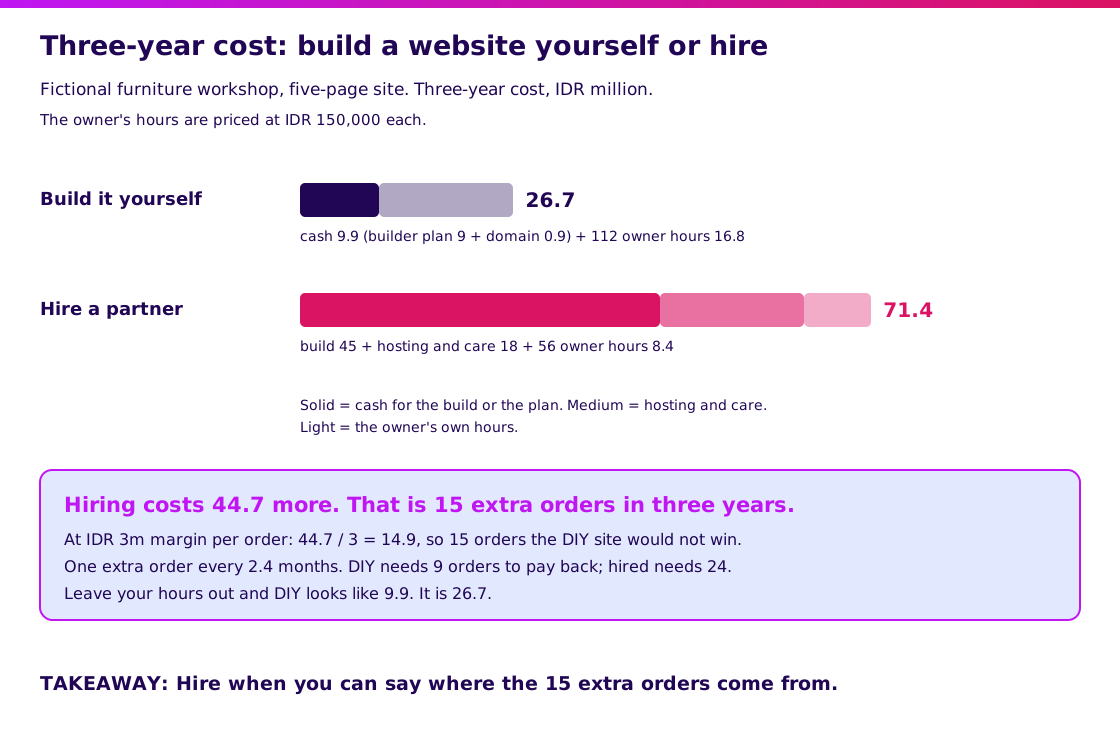
| Three-year component, IDR million | Build it yourself | Hire a partner |
|---|---|---|
| Builder plan (0.25 a month) or build fee | 9.0 | 45.0 |
| Domain, hosting and care | 0.9 | 18.0 |
| Owner’s hours at IDR 150,000 | 16.8 (112 h) | 8.4 (56 h) |
| Three-year total | 26.7 | 71.4 |
The owner’s hours are 40 to build plus 2 a month to maintain for the do-it-yourself site, and 20 for the brief and reviews plus 1 a month for the hired site.
Hiring costs IDR 44.7 million more, so it must win 15 more orders than the site you could make yourself. At a margin of IDR 3 million per order, 44.7 / 3 = 14.9. That is one extra order every 2.4 months for three years.
If you can say where those orders come from, such as better design, search traffic or faster loading, hire. If you cannot, build it yourself first and let the enquiries tell you.
How long does it take to create a website?
A five-page site built by a busy owner takes about six part-time weeks, or 40 hours. Promises of “a website in one day” describe a draft with placeholder text.
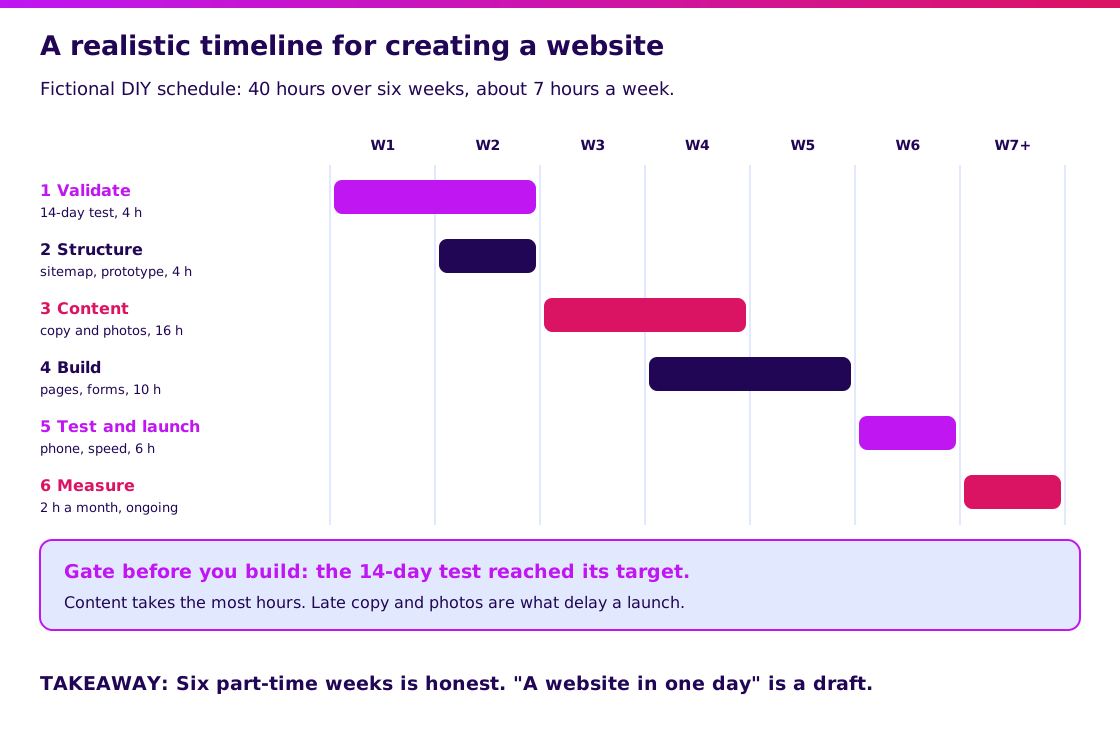
| Step | Hours | Weeks |
|---|---|---|
| Validate with a 14-day test | 4 | 1–2 |
| Structure and prototype | 4 | 2 |
| Content: copy and photos | 16 | 3–4 |
| Build pages and forms | 10 | 4–5 |
| Test and launch | 6 | 6 |
| Total | 40 | 6 |
Content is 16 of the 40 hours, or 40%. Late copy and missing photos delay more launches than any technical problem, whether you build the site yourself or hire.
A hired custom site typically takes 6–8 weeks, and a web application takes longer. Synetica’s own path is 2 weeks of Blueprint & Prototype and about 8 weeks of Production Grade Software.
What mistakes make a website project fail?
Website projects fail when nobody decided what the site was for, so nobody can tell whether it worked. The same pattern shows up in software, as our product validation guide describes. Watch for these six mistakes:
- No single job. A site that must “build the brand, sell, recruit and inform” does none of them well.
- Design before content. A template filled later with rushed text reads like one.
- The vendor owns the domain. If the relationship ends, your address goes with it.
- No way to update. A site you cannot edit is out of date within a month.
- Desktop only. A page that is hard to use on a phone loses most of its visitors.
- Nothing measured. Without analytics and a monthly count of enquiries, every change is a guess.
Each one has a cheap fix at the start and an expensive fix after launch.
What would I tell a business owner creating a first website?
Spend your first two weeks on the test, not the template. A page, a WhatsApp button and a target tell you more than any amount of planning.
- Simple site, under ten pages: build it yourself with a no-code builder and keep the accounts in your name.
- The site must bring leads and you can name the extra orders: hire, with a written brief and a CMS you can edit.
- Login, payments or integrations: validate the riskiest flow with a prototype before paying for a build.
This advice fits owners of Growing Businesses who want enquiries from the site, and Dreamers testing a first idea. If you only need an address on the internet, a free business profile on Google may be enough for now.
My next step would be to book a scoping conversation with your one-line job for the site, your 14-day test result and the pages you think you need.
FAQ — How to create a website
Can I create a website myself?
Yes. A no-code website builder lets a business owner make a company profile or landing page without code. In our example it takes about 40 hours over six weeks, and most of that time goes into content.
How much does it cost to create a website?
In our fictional example a do-it-yourself site costs IDR 9.9 million in cash over three years, or IDR 26.7 million with the owner’s hours, and a hired custom site costs IDR 71.4 million. Real quotes depend on scope.
How do I create a website as a beginner?
Start with one job for the site, test it with a single page for 14 days, then use a website builder template. Write the content first, check every page on a phone and submit the site to Google Search Console.
Should I use no-code or custom?
Use no-code for a simple site under about ten pages that you will edit yourself. Go custom when the site must win leads with a specific design, and use a product studio when it needs login, payments or integrations.
How long does it take to create a website?
About six part-time weeks for a five-page do-it-yourself site in our example, 6–8 weeks for a hired custom site, and longer for a web application with logins and payments.
Related Posts
Aditya S
Business Development Manager, Synetica.
Put it into practice
Need help putting this into practice?
We turn the ideas in this article into a prototype tested with real users in 2 weeks (from Rp49jt)—or production-grade software in 8 weeks (from Rp100jt).