Electronic Medical Records: Duties & Implementation 2026
Electronic medical records (rekam medis elektronik) explained for clinic and hospital owners: duties to verify, features by size, SATUSEHAT, cost and rollout.
 By Aditya S October 19, 2026 Updated November 11, 2026 10 min read
Electronic medical records, known in Indonesia as rekam medis elektronik (RME), are the digital version of a patient’s chart: history, diagnosis, treatment, prescriptions, and results in one record. This guide is for owners and managers of clinics and hospitals who must decide what the duty to go electronic means in practice and how to implement it without disrupting patient flow.
I’m Aditya S, Business Development Manager at Synetica, a tech-based business consultancy. I am not a clinician or a regulator, and Synetica does not claim an EMR client in this article. The figures below are planning simulations, not measurements. Treat the compliance section as a list of questions to confirm with Kemenkes and your legal adviser.
You’ll get a definition, the problems an EMR solves, essential features by facility size, a compliance checklist, a ready-made versus custom decision, cost and timing, and a rollout plan. Running a clinic? Pair this with the clinic app guide.
TL;DR — the whole guide in five lines
- An EMR is one patient record that every role reads and writes, not a scanned copy of the paper folder.
- The duty to go electronic is real, but the details differ by facility type, so verify the current regulation text yourself.
- Prove SATUSEHAT readiness with test data, not with a brochure that says “compliant”.
- Pilot with one doctor before you widen, and migrate old data in a separate, planned step.
- Budget for year one: in our simulation IDR 69m to build becomes IDR 109m.
What migration evidence is available beyond a vendor promise?
Start with a documented implementation lesson, then test your own records. Mediakom Kemenkes, November 2024, page 25 reports Cicendo’s prioritisation of active patient records during digitisation.
We did it in stages.
— Hartono, Cicendo operational services director; translated from Kami lakukan bertahap. in Mediakom.
This is independent reporting about another institution, not a Synetica case study. I would use a staged sample to test whether record meaning survives migration, instead of treating a successful file upload as acceptance.
| Migration check | Evidence to retain | Stop condition |
|---|---|---|
| Patient identity | Source-to-target matching list | Duplicate or ambiguous match |
| Visit history | Dates and record provenance | Missing or reordered visits |
| Medication history | Clinician-reviewed sample | Changed meaning or units |
| Access | Role-based test results | An unauthorised role can read |
These are proposed checks. A clinician must approve clinical meaning; an IT migration report cannot do that alone. Map the complete clinic workflow before choosing the sample.
What are electronic medical records?
Electronic medical records are a digital patient chart that stores each visit’s history, diagnosis, treatment, and orders, and makes them available to authorised staff. Unlike a scanned PDF, the data is structured: a diagnosis is a field you can search, report on, and send to another system.
A simple example: a returning patient is registered, the doctor opens last month’s notes in one click, records a diagnosis and a prescription, and the pharmacy reads the same order. Nobody retypes, and the record shows who changed what and when.
Compare the surrounding workflow before expanding scope.
What problems do electronic medical records solve?
They remove time lost to finding, rewriting, and reconciling paper, and they give you data you can report from. These are the pain points that usually justify the project:
- History is slow to find, because folders are filed by hand and a returning patient waits.
- Handwriting and abbreviations create ambiguity between doctor, nurse, and pharmacy.
- The same facts are written several times: registration, note, prescription, bill.
- Nobody can see who changed a record, which is a patient-safety and a liability gap.
- Reports are rebuilt manually for the owner, the payer, and the health office.
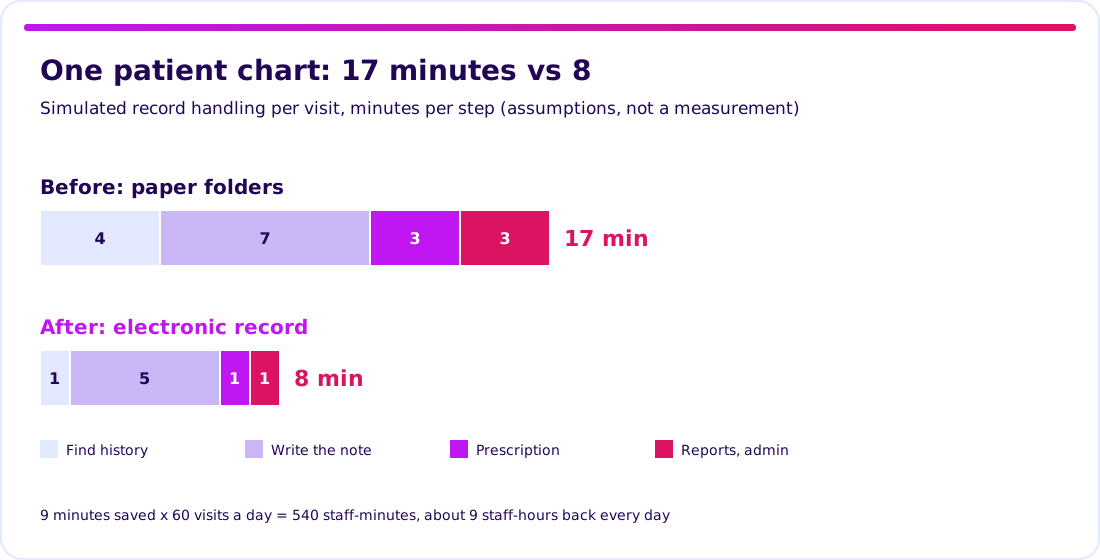
Take a simulation for one visit: 4 minutes to find history, 7 to write the note, 3 for the prescription, and 3 for reports and admin is 17 minutes of record handling. With an EMR the same visit might be 1, 5, 1, and 1, or 8 minutes. At 60 visits a day, 9 minutes saved is 540 staff-minutes, about 9 staff-hours back every day. Every figure is an assumption; time your own team for a week and replace them.
Compare the surrounding workflow before expanding scope.
Which EMR features are essential?
Start with the record, access control, and orders; add integrations in later waves. This table is a planning aid, not a standard.
| Feature | Small clinic | Mid-size clinic | Multi-branch group or hospital |
|---|---|---|---|
| Patient master record | Core | Core | Core, shared patient ID |
| Visit notes and templates | Core | Core | Core, specialty templates |
| Access roles and audit log | Core | Core | Core, per-branch rules |
| E-prescription and orders | Basic | Core | Core, linked to pharmacy and lab |
| SATUSEHAT integration | Verify | Verify | Verify |
| Data migration from paper | Optional | Planned wave | Planned waves |
| Reports and export | Basic | Core | Consolidated |
Do not buy every row on day one. Verbs matter more than modules: can a doctor find history in one click, can a nurse record vitals without leaving the chart, can the owner export the data in a readable format?
Compare the surrounding workflow before expanding scope.
What do you need to verify about EMR duties and compliance?
Specify access, retention, and registration separately from the screen design. A successful upload is one piece of technical evidence, not a certificate that every legal duty has been met.
The official Permenkes 24/2022 text provides concrete anchors: Article 9(3) addresses electronic-system operator registration; Article 39 sets a minimum electronic-record storage period of 25 years from the last patient visit. That corrects the vague assumption that electronic retention is simply a vendor-selected period. A backup is not a complete retention or retrieval policy.
| Control | Proposed acceptance exercise | Evidence |
|---|---|---|
| Retention | Retrieve an archived synthetic visit | Searchable record and attachments |
| Correction | Amend a test entry using an authorised role | Previous value, actor, reason, time |
| Confidentiality | Try access with an unrelated role | Denied access and recorded event |
| Exit | Export a representative sample | Readable files and field definitions |
Use the SATUSEHAT registration guide to distinguish the RME system’s status from the facility’s onboarding. Ask the clinical owner to approve record meaning and the IT owner to retain the integration result. Keep real patient data out of public demos and articles.
For JKN services, have the facility’s BPJS liaison confirm the required scope and tests directly. Use the hospital information-system guide for the surrounding pharmacy, laboratory, and billing hand-offs.
Ready-made vs custom EMR: which fits you?
Buy ready-made if it covers your workflow and passes the SATUSEHAT test; build custom only where your process is genuinely different. For most clinics, ready-made is the right answer, and we will say so.
| Option | Strength | Risk to check | Best for |
|---|---|---|---|
| Ready-made (subscription) | Fast start, proven templates | Fixed workflows, data lock-in | Standard general practice |
| Ready-made + extension | Keeps the proven core | Who owns the integration, upgrade conflicts | One or two real gaps |
| Custom, in phases | Fits a unique workflow | Larger scope, needs a decision owner | Specialty, multi-branch, or product plans |
For the wider logic, read the build vs buy guide and run the vendor due diligence checklist on every shortlist.
Validate it in 2 weeks. Before you commit an EMR budget, we test your riskiest clinical workflow through Blueprint & Prototype: a specification, a prototype your doctors and nurses can try, and cost numbers from the real scope.
How much does an EMR cost, and how long does implementation take?
Cost depends on scope, the number of integrations, and how much paper history you migrate, so there is no single price. The chart shows one illustrative scenario for one clinic. It is a planning example, not a market average and not a Synetica quote.
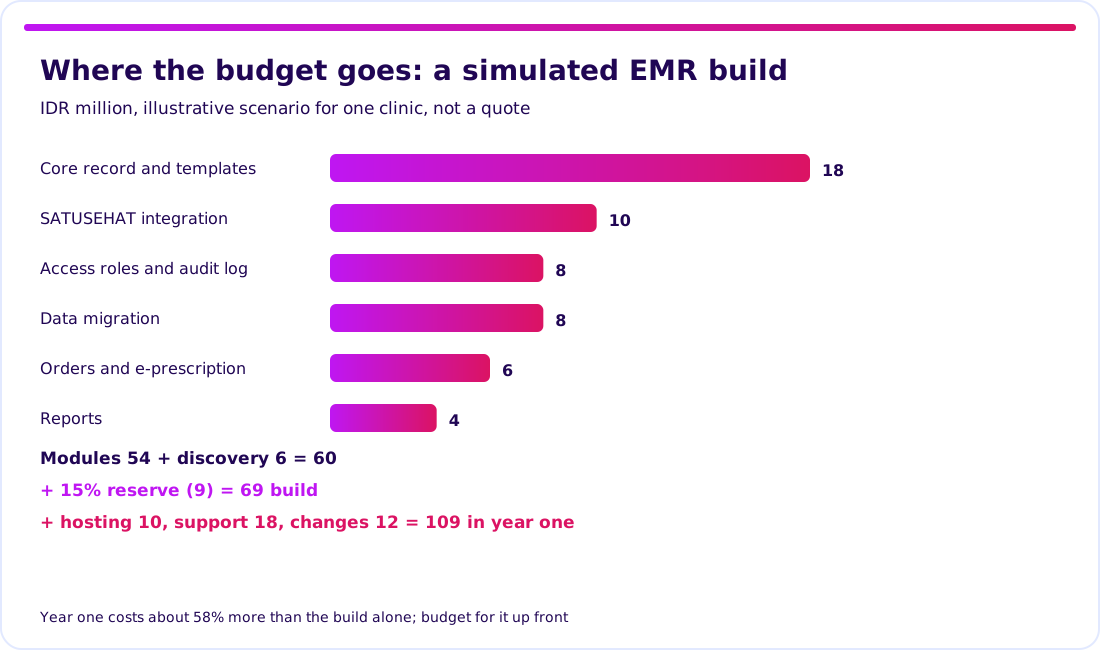
The arithmetic: modules 54 + discovery 6 = 60; a 15% reserve adds 9, so the build is IDR 69m. Hosting 10, support 18, and post-release changes 12 bring year one to IDR 109m, about 58% above the build alone. Discovery is under 9% of the build and the cheapest place to find a wrong assumption.
Synetica’s path is a two-week Blueprint & Prototype, eight weeks of Production Grade Software for validated scope, then monthly Launch & Grow. See also the app development cost breakdown and how the production phase works.
How do you implement an EMR without disrupting patients?
Implement in gates: pilot with one doctor, test integrations, migrate data, then run in parallel before the switch. Expand only after the agreed evidence is complete.
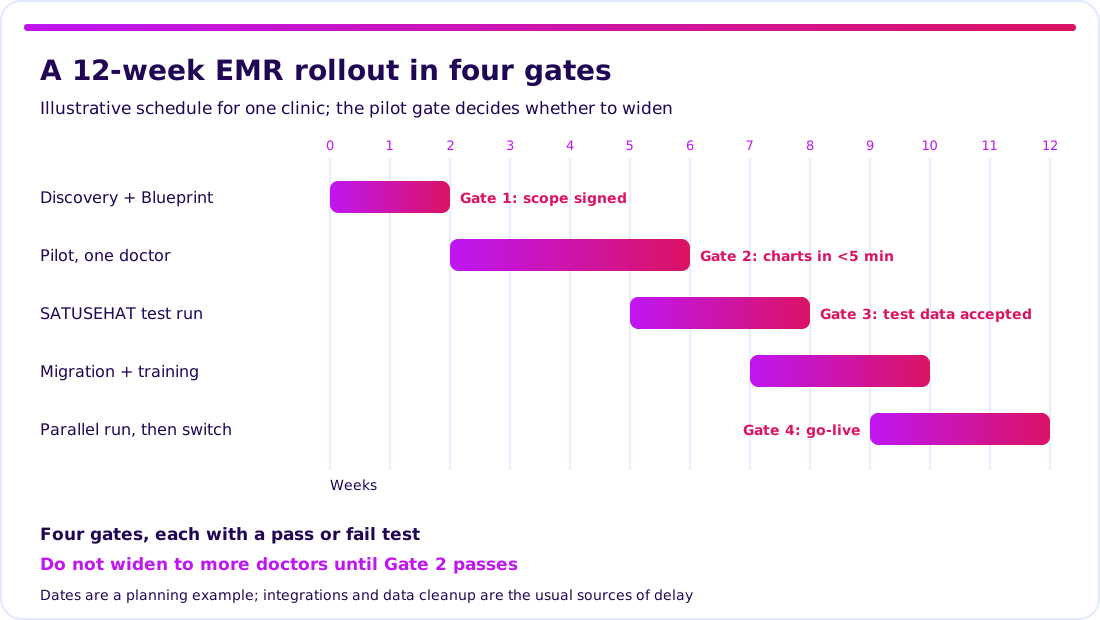
- Gate 1, scope signed: one workflow, one owner, a written list of what is out of scope.
- Gate 2, pilot passes: one doctor completes a typical chart in five minutes or less for a week.
- Gate 3, integration accepted: SATUSEHAT test data is sent and the response is reviewed.
- Gate 4, go-live: a parallel run shows matching records, then paper stops on an agreed day.
The twelve weeks are a planning example. Migration and integration are the usual sources of delay, so keep a fallback date.
Compare the surrounding workflow before expanding scope.
What I’d do before choosing
I would time one ordinary clinic day, then pilot with one doctor on two shortlisted systems. That comparison beats any feature checklist.
For Growing Businesses running clinics or small hospitals, prioritise compliance proof, data export, and year-one cost. For Dreamers planning a health product, first check whether an existing EMR already solves the problem and where your product would only add friction.
Next step: bring your riskiest clinical workflow to Blueprint & Prototype.
FAQ — electronic medical records
What is an electronic medical record?
A digital patient chart that stores history, diagnosis, treatment, and orders in structured form, so authorised staff can read, update, and report on it.
What features does an EMR have?
Usually a patient master record, visit notes and templates, access roles with an audit log, e-prescriptions and orders, reporting, and SATUSEHAT integration. The right set depends on size.
How much does an EMR cost?
It depends on scope and integrations. Our simulation for one clinic is IDR 69m to build and IDR 109m in year one; it is a scenario, not a market price or a quote.
Is there a free EMR?
There are free and open-source options. Check support, security updates, SATUSEHAT readiness, and who maintains any customisation.
Can an EMR be customised for my workflow?
Yes, but customise only where your workflow differs from standard. Validate the workflow with clinicians first, then build in phases.
Related Posts
Aditya S
Business Development Manager, Synetica.
Put it into practice
Need help putting this into practice?
We turn the ideas in this article into a prototype tested with real users in 2 weeks (from Rp49jt)—or production-grade software in 8 weeks (from Rp100jt).