Hospital Information System: Modules & SATUSEHAT 2026
Hospital information system guide: how one visit's data flows, which modules go live first, and a SATUSEHAT and BPJS checklist to run before you pick a vendor.
 By Aditya S October 17, 2026 Updated November 11, 2026 9 min read
A hospital information system (in Indonesian, sistem informasi rumah sakit) is software that records one patient visit from registration to bill, then moves that data between units and to external systems such as BPJS and SATUSEHAT. This guide answers one question: which modules you need, and what compliance proof to ask for before you choose.
I’m Aditya S, Business Development Manager at Synetica, a tech-based business consultancy. I am not a clinician or a regulator, and Synetica does not claim a hospital client in this article. The numbers below are planning simulations, not measurements. For legal duties, use this article as a question list and confirm with Kemenkes and your legal adviser.
You’ll get a definition, the problems it solves, must-have features by size, a compliance verification list, a buy-or-build decision, and cost and timing. For the bigger picture and a budget simulation, read the SIMRS guide too.
TL;DR — the whole guide in five lines
- A hospital information system is one record per visit, not a set of apps waiting on each other.
- Start with low-complexity, high-impact modules: registration and outpatient records first, integrations after.
- Prove compliance with a demo in a test environment, not with logos on a vendor brochure.
- Buy ready-made if your workflows are standard; build custom only where your hospital differs.
- Start with a 2-week Blueprint to test one patient journey before you sign a large contract.
What does a documented hospital implementation actually show?
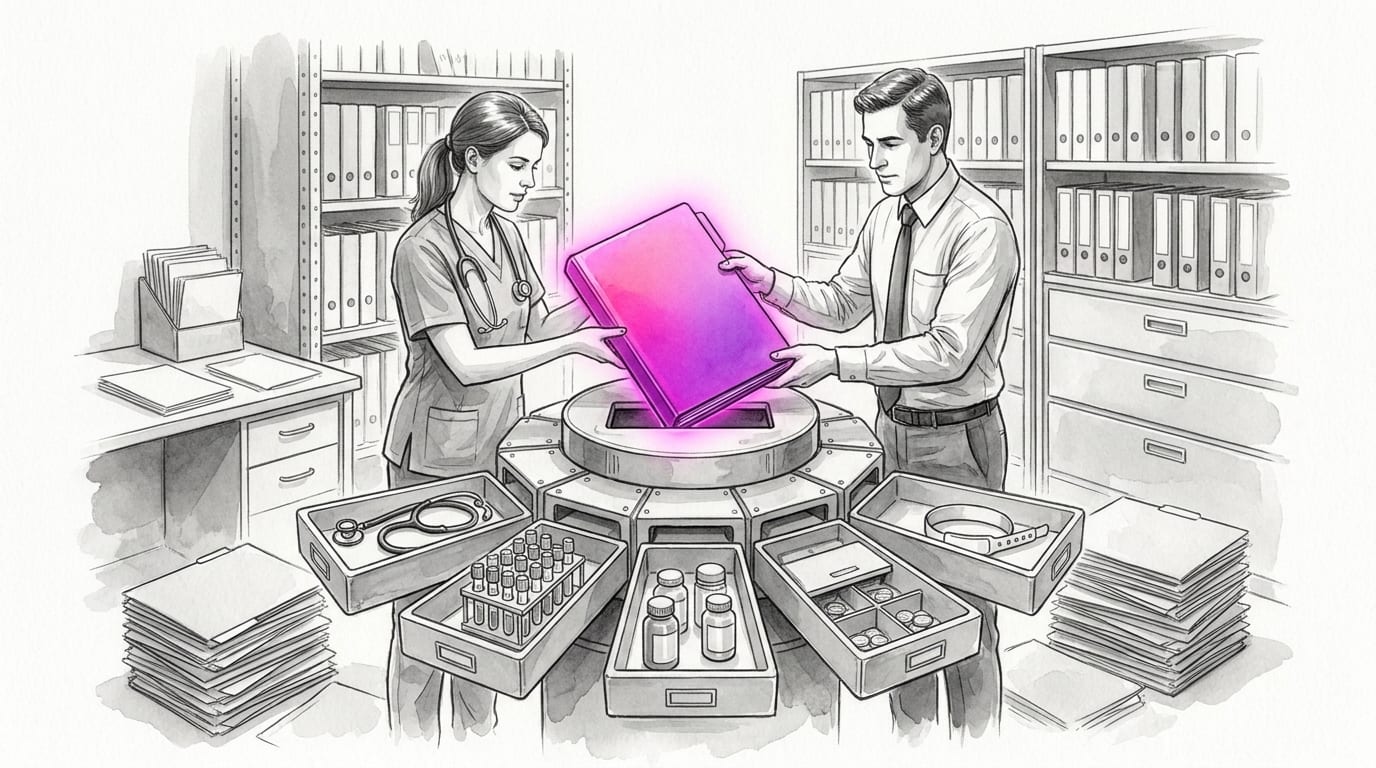
A hospital’s migration experience is stronger evidence than an invented savings claim. Kemenkes’ Mediakom report, November 2024, page 25 describes Cicendo prioritising active patient records during digitisation.
We did it in stages.
— Hartono, Cicendo operational services director; translated from Kami lakukan bertahap. in Mediakom.
That is another institution’s reported experience, not a Synetica project. My recommendation is to turn it into an acceptance exercise: select an active-record sample, reconcile it, and make one unit sign off before expanding.
| Handoff | Evidence I would request | Proposed owner |
|---|---|---|
| Registration to doctor | Same patient and visit identifiers | Registration lead |
| Doctor to pharmacy | Prescription linked to that visit | Pharmacy lead |
| Lab to doctor | Result linked to the correct order | Lab lead |
| Services to cashier | Bill reconciles with recorded services | Finance lead |
This is an editorial checklist, not measured performance. Use the SIMRS pillar to connect these checks to rollout scope and budget.
What is a hospital information system?
A hospital information system stores patient, service, and financial data in one record that every authorised unit can read. In Indonesia it is often shortened to SIMRS; the short version is in the SIMRS guide.
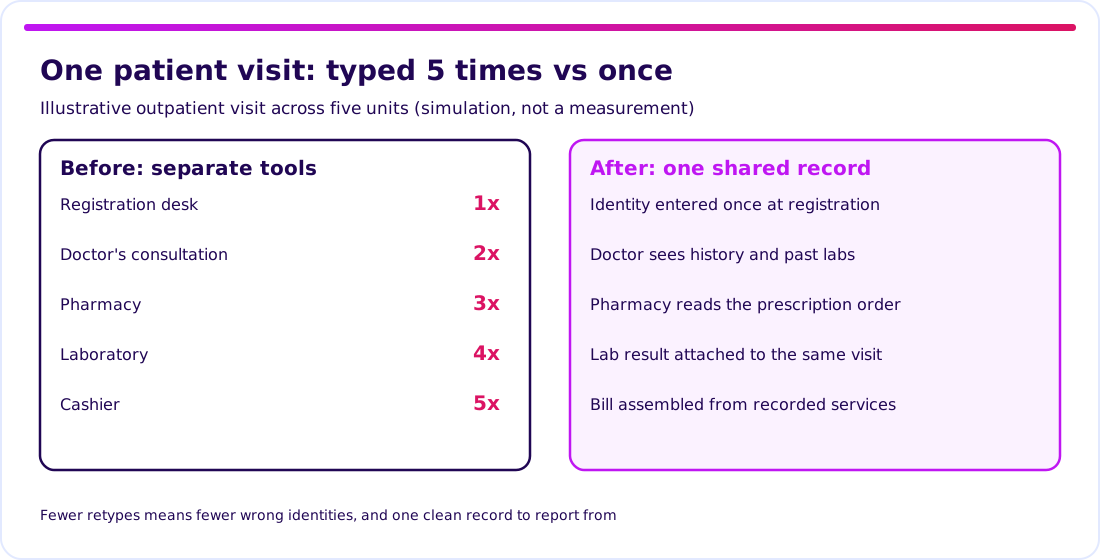
A simple example: a patient registers, sees a doctor, gets a prescription, has a lab test, then pays. In a good system, all five steps add rows to the same record instead of creating five records.
What problems does a hospital information system solve?
It removes the retyping and hand-offs that slow patients down and hide errors. These are the pain points that usually justify the project:
- Identity is retyped at registration, pharmacy, lab, and cashier, so typos spread.
- Doctors cannot see history, so old lab results are phoned in or ordered again.
- Bills arrive late because services are logged on paper and totalled at discharge.
- Reports are assembled by hand from several spreadsheets every month-end.
Take a simple simulation: 200 outpatient visits a day, identity typed 5 times without a shared record (1,000 entries) versus once with one (200 entries). The gap is 800 entries × 30 seconds = 24,000 seconds, about 6.7 staff-hours a day. The 200 visits and 30 seconds are assumptions; replace them with what you observe in your hospital.
Compare the surrounding workflow before expanding scope.
Which hospital information system features are essential?
Match modules to your size, then add only what units will use in the first six months. This table is a planning aid, not a standard.
| Module | Large clinic | Mid-size hospital | Multi-site group |
|---|---|---|---|
| Registration and queue | Core | Core | Core, shared patient ID |
| Outpatient medical record | Core | Core | Core, templates per site |
| Pharmacy and stock | Basic | Core | Core, central purchasing |
| Lab and radiology orders | Optional | Core | Core |
| Inpatient and beds | Not needed | Core | Core, inter-site transfer |
| Billing and cashier | Core | Core | Consolidated |
| BPJS bridging | If serving JKN | If serving JKN | If serving JKN |
| SATUSEHAT integration | Verify | Verify | Verify |
Go-live order matters too. The diagram below is our judgment, not survey data: modules at the top left give high impact with light integration, so they build staff trust first.
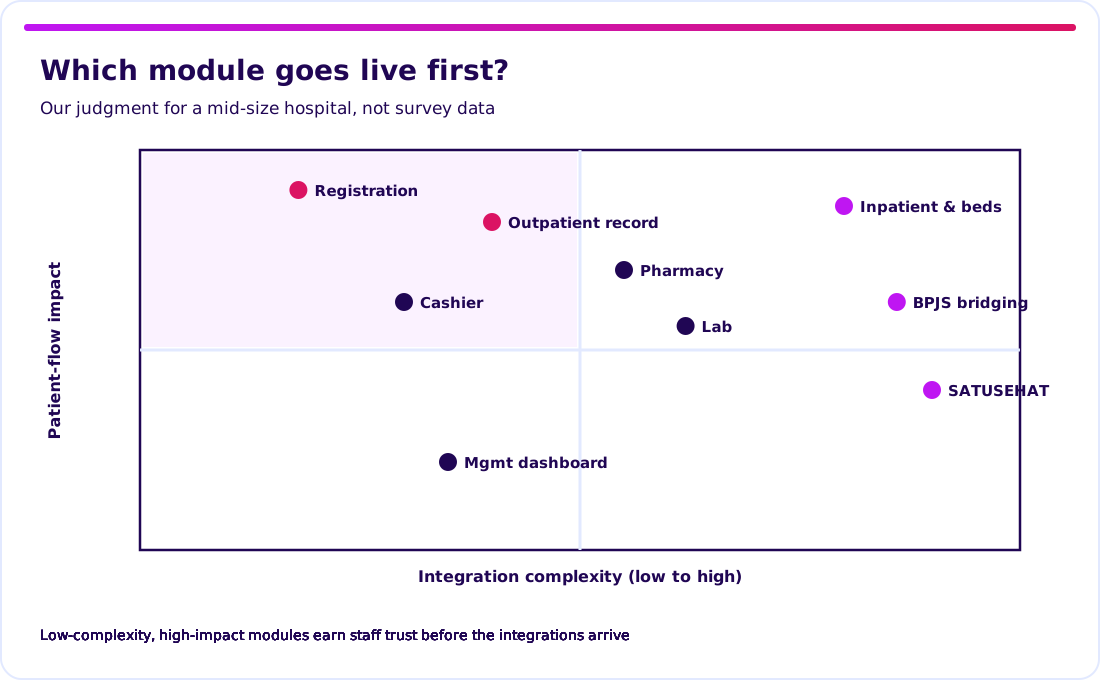
Compare the surrounding workflow before expanding scope.
How do you check SATUSEHAT, BPJS, and patient-data compliance?
Turn each requirement into a named document and a witnessed test. Technical demonstrations support procurement decisions; legal duties also require organisational policies and review.
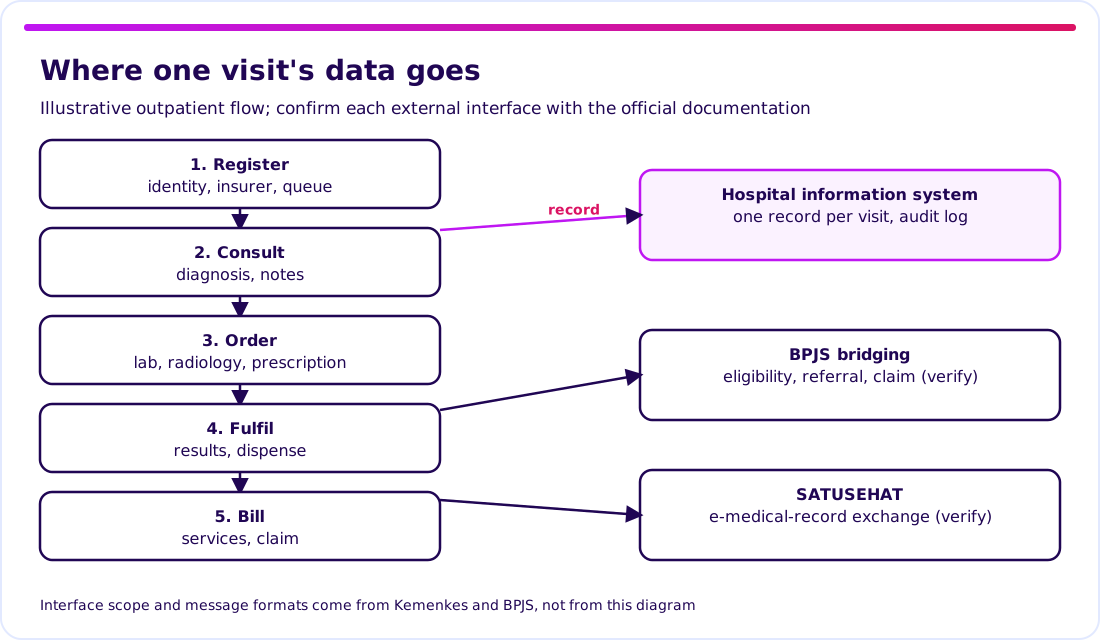
In Permenkes 24/2022, Articles 29–30, record security and access rights are explicit requirements. For procurement, translate them into separate view, input, and correction permissions. My acceptance exercise: a cashier can process charges but cannot alter a clinical note; an authorised correction remains attributable. These are proposed tests, not statutory interface designs.
| Review area | Proposed test | Evidence retained |
|---|---|---|
| Access boundaries | Try a clinical edit using a cashier role | Role matrix and denied-action result |
| Traceability | Correct an authorised test entry | Actor, time, and change history |
| Integration failure | Submit a deliberately invalid test record | Failure response and repair owner |
| Recovery | Restore a copy into an isolated environment | Reconciled sample and recovery duration |
The official SATUSEHAT FHIR transaction-log guide describes resource, status, response code, time, and transaction identifiers. Ask for those details against the visit being demonstrated. Label sandbox evidence as sandbox; retain production evidence only through an authorised facility account.
Keep BPJS tests in their own row with the hospital liaison responsible for confirming service coverage and access. A green SATUSEHAT response is not a BPJS claim approval. Bring this evidence matrix to vendor due diligence.
Ready-made vs custom hospital information system: which fits you?
Buy ready-made if it covers your workflows; build custom only where your process differs. A ready-made system is often the right answer, and we will say so.
| Option | Strength | Risk to check | Best for |
|---|---|---|---|
| Ready-made | Fast start, proven modules | Fixed workflows, vendor dependence | Standard processes |
| Ready-made + extension | Keeps the proven core | Integration ownership, upgrade conflicts | A few specific gaps |
| Custom, in phases | Fits a unique process | Larger scope, needs a decision owner | Differentiating workflows |
For the wider logic, read the build vs buy guide and run the vendor due diligence checklist on every shortlist.
Validate it in 2 weeks. Before you lock a hospital information system budget, we test the riskiest patient journey through Blueprint & Prototype: a specification, a prototype your staff can try, and cost numbers from the real scope.
How much does a hospital information system cost, and how long does it take?
Cost is set by scope, number of integrations, and legacy data migration, so there is no single price. The full simulation for a 120-bed hospital is in the SIMRS guide: an IDR 460m build and IDR 618m in year one, including a 15% risk reserve. That is a planning scenario, not a market average and not a Synetica quote.
Synetica’s own path is a two-week Blueprint & Prototype, eight weeks of Production Grade Software for validated scope, then monthly Launch & Grow. A full hospital rollout can run past the first release, so plan one unit per wave. See also the app development cost breakdown and how the production phase works.
What should a vendor demo prove before you sign?
A demo is useful only if it follows one synthetic patient from registration to bill, in a test environment, with your staff watching. Give the vendor this script a week ahead and score each step pass or fail:
- Register a new patient and a returning one, and show that the returning patient’s history appears without retyping.
- Record a consultation and a prescription, then show the pharmacy screen reading the same order.
- Order a lab test and attach the result to the same visit, visible to the doctor.
- Produce the bill from recorded services and correct one wrong line, with the change visible in the audit log.
- Send test data to SATUSEHAT and, if you serve JKN patients, run a BPJS bridging check, and show the response, including one deliberate error.
- Export a patient’s data in a readable format, to prove you are not locked in.
Treat any step the vendor cannot show live as unproven, whatever the slide says. Two or more failures on steps 1 to 4 mean the core workflow is not ready, and integrations will not fix that.
Use the vendor checklist to record acceptance evidence.
What I’d do before choosing
I would pick one unit with a visible delay and test one patient journey end to end. That yields a more useful comparison than a feature checklist.
For Growing Businesses running a hospital or clinic group, prioritise compliance proof, data handover, and year-one cost. For Dreamers planning a health product, first check whether an existing system already solves the problem.
Next step: bring your riskiest patient journey to Blueprint & Prototype.
FAQ — hospital information system
What is a hospital information system?
A system that keeps patient, service, and financial data in one record used by registration, doctors, pharmacy, lab, and cashier. In Indonesia it is often called SIMRS.
What features does a hospital information system have?
Usually registration and queue, medical records, pharmacy and stock, lab and radiology, inpatient care, billing, and reporting. The right set depends on size.
How much does a hospital information system cost?
It depends on scope and integrations. Our simulation for a 120-bed hospital is in the SIMRS guide; it is a scenario, not a market price or a quote.
Is there a free hospital information system?
There are free and open-source options. Check support, security updates, SATUSEHAT and BPJS readiness, and who maintains the customisations.
Can a hospital information system be customised?
Yes, but customise only where your process differs from standard. Validate that workflow with users first, then build in phases.
Related Posts
Aditya S
Business Development Manager, Synetica.
Put it into practice
Need help putting this into practice?
We turn the ideas in this article into a prototype tested with real users in 2 weeks (from Rp49jt)—or production-grade software in 8 weeks (from Rp100jt).