What Is Scrum? Framework, Roles and How It Works in Practice
What is Scrum? Learn the roles, events and artifacts, what a two-week Sprint costs your team, and when Scrum is the wrong choice for your software project.
 By Aditya S November 8, 2026 Updated November 11, 2026 13 min read

What is Scrum? Scrum is a lightweight framework for building a product in fixed-length cycles called Sprints, where a small team ships a working piece of software each cycle and shows it to the people who will use it. It is one way of practicing agile, with specific roles, meetings and rules. It is not a guarantee of speed, and it is not the same thing as agile itself.
I’m Aditya S, Business Development Manager at Synetica, a tech-based business consultancy combining strategy and execution for Dreamers and Growing Businesses. This guide explains Scrum through a fictional six-person team and a two-week Sprint you can check line by line. The numbers are teaching assumptions, not Synetica client results or industry benchmarks.
You’ll learn what Scrum is, who does what, what the events cost in team time, how a Sprint runs, where Scrum goes wrong, and what to ask a vendor who says “we use Scrum.”
TL;DR — the whole guide in five lines
- Scrum is a loop, not a meeting schedule: plan a small goal, build it, show it to users, then change the plan.
- It has three accountabilities: one Product Owner, one Scrum Master and the Developers, in a team of ten or fewer.
- It costs real time: in our example, the events take 12.5% of a two-week Sprint, so the review must earn it.
- Scrum needs one decision-maker: a Product Owner without authority turns every Sprint into a negotiation.
- Ask to see the last Sprint Review: if there was no working software and no user, you are buying short waterfalls.
What is Scrum, and where does it come from?
Scrum is a framework in which a small team delivers a working Increment of a product every Sprint and adapts its plan based on what it learns. The rules are published in the Scrum Guide, written by Ken Schwaber and Jeff Sutherland and updated in 2020. A Sprint lasts one month or less, and the guide describes the whole framework in a few pages.
“Scrum is a lightweight framework that helps people, teams and organizations generate value through adaptive solutions for complex problems.” — Ken Schwaber and Jeff Sutherland, The Scrum Guide (2020)
Think of a restaurant kitchen running a tasting menu. Every course is small, plated and served before the next is cooked, and the chef changes the next dish based on how the table reacts. A kitchen that cooked the whole banquet and carried it out at the end could produce the same food, but nobody would find out the soup was too salty until it was too late.
How is Scrum different from agile, Kanban and a sprint?
Scrum is one framework inside the wider agile family, and the terms are easy to mix up. It is also one answer to a broader question. If you want the bigger picture of why iteration exists at all, start with our guide to what agile is and when it fits. If you are choosing among delivery approaches overall, the software development life cycle guide puts Scrum next to the alternatives.
| Term | What it is | Example |
|---|---|---|
| Agile | A set of values about feedback and adapting to change | “We show working software to users often.” |
| Scrum | A framework for practicing agile with Sprints and defined roles | Two-week Sprints, a Sprint Review, a Retrospective |
| Sprint | A fixed-length cycle of one month or less | Two weeks that end in a working Increment |
| Product Backlog | An ordered list of what the product might need | “Offline mode” ranked above “reporting screen” |
| Increment | Working software that meets the team’s Definition of Done | A technician can complete a job on a phone |
| Kanban | A flow method that limits work in progress, with no fixed Sprints | A board where “In progress” holds three cards at most |
Scrum is a framework, not a methodology that tells you everything. It leaves engineering practices, tools and estimating techniques to the team.
Decide what the first Sprint should prove with our MVP guide.
Why does Scrum matter for your business?
Scrum matters because it forces a decision about what to build next, on a fixed rhythm, with real feedback. Without a rhythm, projects drift: scope grows quietly and the first honest look at the product happens near the end.
Consider a fictional repair-company scheduling app. A team of six has 12 weeks, which is six two-week Sprints. In a plan-first approach, users would first see the product at release. With Scrum, a real technician sees a working slice after week 2 and tells the team that jobs happen in basements with no signal.
That is the business case: not “Scrum is faster,” but “wrong assumptions surface while changing them is still cheap.” It is also the reason a Growing Business replacing a manual process benefits most: the staff who will live with the system can react every two weeks. For the user-facing side of those reviews, our UI/UX guide shows how to test flows early.
The cost is discipline. Scrum asks one person to rank work, asks the team to finish things rather than start many, and asks stakeholders to show up to reviews. If your organization cannot provide that, the vocabulary will arrive and the benefit will not.
Bring your riskiest assumption to a scoping conversation.
What are the roles in Scrum?
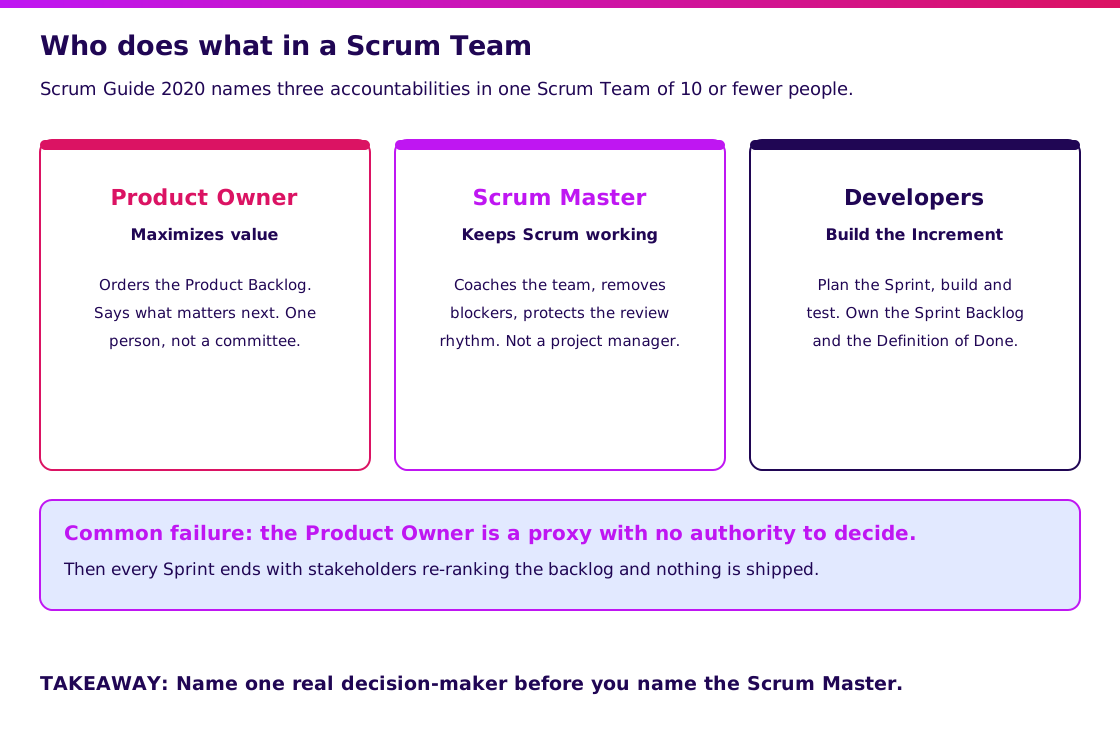
A Scrum Team has three accountabilities: one Product Owner, one Scrum Master and the Developers. The 2020 guide says the whole team is typically ten or fewer people, small enough to stay nimble and large enough to finish meaningful work in a Sprint. The guide calls them accountabilities rather than job titles, so one person may hold one while having a different title in the company.
| Accountability | Owns | Does not own |
|---|---|---|
| Product Owner | What the product should do next, and the order of the Product Backlog | How the team builds it |
| Scrum Master | The team’s effective use of Scrum, and removing blockers | The team’s output, or people management |
| Developers | The Sprint plan and the quality of the Increment | The ranking of the backlog |
The Product Owner is where most failures start. This must be one person with authority to decide, not a committee and not a messenger who must “check with the boss.” If five stakeholders rank the backlog differently, each Sprint ends in debate rather than software.
The Scrum Master is also commonly misread. It is a coaching and facilitation accountability, not a project manager who assigns tasks. In a small team the same person sometimes covers it part-time, though combining it with Product Owner usually weakens both.
Check how a vendor structures a team with our software house guide.
How does Scrum work, step by step?
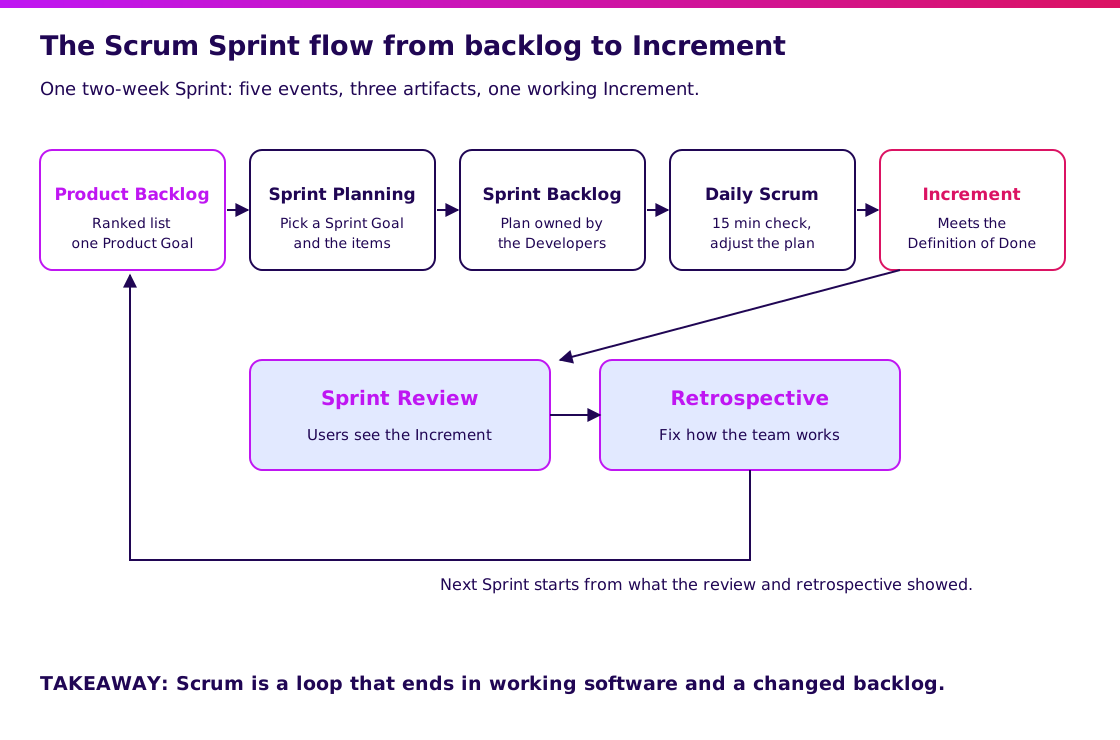
Scrum runs on five events inside a Sprint, producing three artifacts. Each event has a purpose, and the guide sets a maximum length for each, which is shorter for shorter Sprints.
- Sprint Planning: the team picks a Sprint Goal and the items it believes it can finish. The guide’s maximum is eight hours for a one-month Sprint.
- Daily Scrum: a 15-minute check among the Developers on progress toward the Sprint Goal, so the plan can change that day.
- Build and test: work happens throughout the Sprint, and an item only counts when it meets the Definition of Done.
- Sprint Review: the team shows the Increment to stakeholders and users and collects reactions. The maximum is four hours for a one-month Sprint.
- Sprint Retrospective: the team looks at how it worked and picks improvements. The maximum is three hours for a one-month Sprint.
The three artifacts match: the Product Backlog (ordered work for the product, with a Product Goal), the Sprint Backlog (the Sprint Goal, the chosen items and a plan) and the Increment (the usable result, checked against the Definition of Done).
In the repair-company example, sprint 1’s goal is narrow: a technician can open a job and mark it complete on a phone. The review is the point. A real technician tries it, and “works without signal” moves to the top of the Product Backlog before sprint 2 starts.
See how Synetica runs the 8-week build stage.
What does Scrum cost in team time?
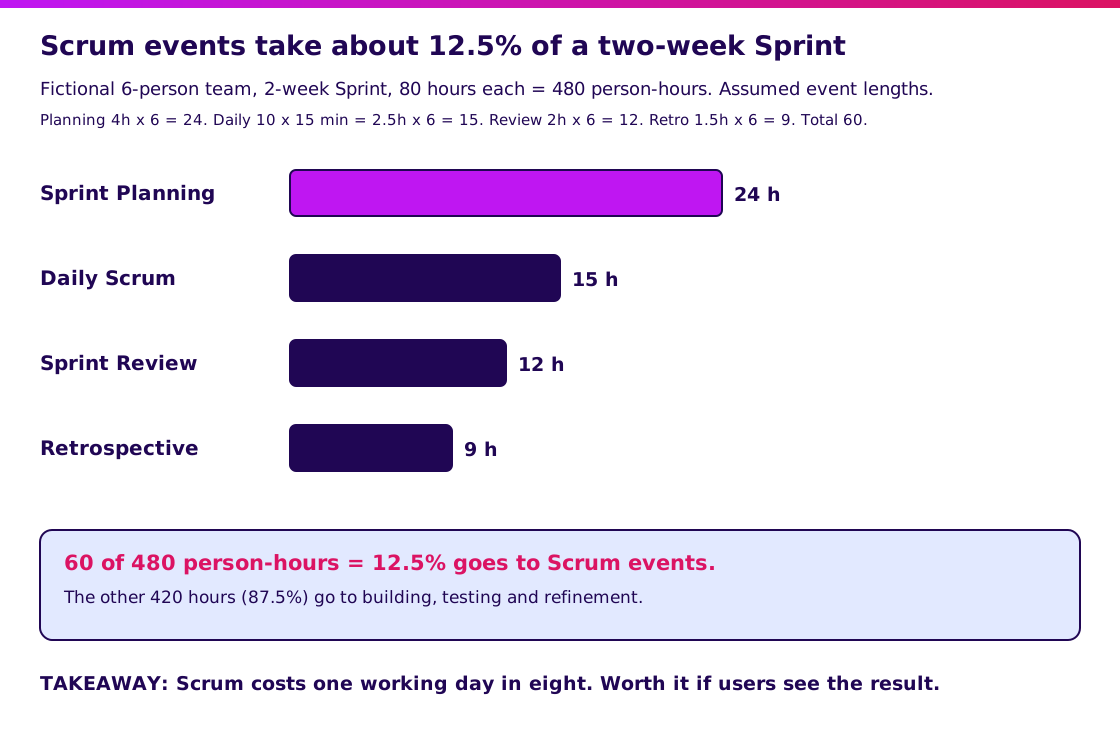
Scrum events are not free; in our example they take 12.5% of every Sprint, so each must earn its slot. Here is the arithmetic for a fictional six-person team on a two-week Sprint, with each person at 80 hours.
| Event | Assumed length per person | × 6 people | Person-hours |
|---|---|---|---|
| Sprint Planning | 4 hours | 6 | 24 |
| Daily Scrum | 10 × 15 min = 2.5 hours | 6 | 15 |
| Sprint Review | 2 hours | 6 | 12 |
| Retrospective | 1.5 hours | 6 | 9 |
| Total | 10 hours | 60 |
The team has 6 × 80 = 480 person-hours, so 60 ÷ 480 = 12.5%, or about one working day in eight. The remaining 420 hours cover building, testing, backlog refinement and everything else. These event lengths are assumptions: a real team may spend less, and the Product Owner often does not attend every Daily Scrum.
The point is not that 12.5% is too much. It is that meeting time grows quietly. A Retrospective that never changes anything, or a Review with no real users, is overhead with no return. Track which improvements each Retrospective produced; if the answer is none for three Sprints, change the format.
Validate it in 2 weeks. Blueprint & Prototype puts a working prototype in front of real users and turns what you learn into agreed scope and a cost estimate. The two-week promise covers prototype validation; it does not guarantee a production launch.
At Synetica, Blueprint & Prototype takes 2 weeks, Production Grade Software takes 8 weeks, and Launch & Grow runs as an ongoing monthly retainer. The two-week stage is where scope decisions are made, so the build starts from evidence rather than assumption.
What does Scrum look like in a real project?
A healthy Scrum project is recognizable by what you can inspect, not by what the team calls its meetings. Using the repair-company example, here is what you would see after Sprints 1, 3 and 6.
| After Sprint | What users see | What changed in the backlog |
|---|---|---|
| 1 (week 2) | A technician can open and complete a job | Offline use moves to the top |
| 3 (week 6) | Jobs sync after the technician regains signal | A planned reporting screen is deferred |
| 6 (week 12) | Scheduling, offline work and completion reports | Release candidate approved by the dispatch lead |
This is a generic illustration, not a Synetica client result. Scope at week 12 is not the scope on day one, and that is Scrum working, provided the sponsor knew scope would move and agreed the total budget upfront.
Compare that with a project that shows slides each Sprint. A real review needs working software, someone who will use it and a visible change to the backlog afterward. Ask to attend one before you sign.
Bring your rough scope and the assumptions you are least sure about.
When is Scrum a poor fit?
Scrum fits work where you cannot be sure what users need and fits poorly where scope is fixed by contract, law or a continuous stream of requests.
| Situation | Scrum fit | Why |
|---|---|---|
| New product, unproven demand | Strong | Each Sprint tests an assumption |
| Internal tool replacing a spreadsheet | Strong | Staff react every two weeks and shape the workflow |
| Support and maintenance request stream | Weak | Work arrives continuously; Kanban usually fits better |
| Fixed price and fixed scope contract | Poor | Scrum flexes scope; the contract forbids it |
| Tiny one-off task like a landing page | Weak | Little uncertainty, so the ceremony outweighs the benefit |
Scrum also assumes the team can actually release something usable every Sprint. If deployment takes three weeks, the Increment cannot be shown, and the first fix is engineering, not process.
What mistakes do teams make with Scrum?
The most common mistake is adopting the vocabulary without the feedback. Stand-ups and story points do not help if users never see the software.
- Skipping the Sprint Review. Sprints become internal deadlines and nobody outside the team reacts.
- Treating the Product Backlog as a promise. It is an ordered list that should change after each review.
- A Product Owner with no authority. The team waits for approvals while stakeholders re-rank the work.
- A Scrum Master acting as project manager. Assigning tasks removes the team’s ownership of the plan.
- Changing the Sprint Goal mid-Sprint. If it keeps changing, the Sprint is too long or the goal is too vague.
- Never stopping. Sprints are a way to learn that a product is not working. Agree stopping conditions upfront.
Scrum also does not remove the need for documentation. Teams still record decisions, data definitions and how the system runs. They write what is useful, not everything possible.
What would I tell a founder deciding whether to use Scrum?
Bring your biggest unknown, one real decision-maker and a total budget. If you can name an assumption that would change the product when proven wrong, Scrum will probably pay for itself. If you cannot, you may need a clear specification more than a Sprint rhythm.
For a Growing Business replacing a manual process, put the staff who do the work into every review. For a Dreamer testing an idea, keep the first Sprints small and measure what users actually do. In both cases, ask any vendor to show you their last Sprint Review before you commit.
My next step would be to book a scoping conversation with your riskiest assumption, your budget range and the person who will decide between Sprints.
FAQ — Understanding Scrum
What is Scrum in simple terms?
Scrum is a framework for building a product in short, fixed-length cycles called Sprints. After each Sprint, the team shows working software to users and adjusts the plan based on their reaction.
What are the roles in Scrum?
A Scrum Team has a Product Owner, a Scrum Master and Developers. The Product Owner decides what matters next, the Scrum Master helps the team use Scrum well, and the Developers build and test the Increment.
What is the difference between Scrum and agile?
Agile is a set of values about feedback and adapting to change. Scrum is one specific framework for practicing it, with Sprints, defined accountabilities and events. A team can be agile without using Scrum, for example by running Kanban.
How long is a Scrum Sprint?
A Sprint is one month or less, and many software teams choose one or two weeks. Shorter Sprints give more feedback points but add more event overhead, so pick the length that matches how fast your users can react.
Does Scrum work with a fixed-price contract?
Rarely well. Scrum flexes scope, while a fixed price with fixed scope does not allow it. A more workable arrangement is a fixed budget and Sprint rhythm, with scope adjusted inside it after each review.
Related Posts
Aditya S
Business Development Manager, Synetica.
Put it into practice
Need help putting this into practice?
We turn the ideas in this article into a prototype tested with real users in 2 weeks (from Rp49jt)—or production-grade software in 8 weeks (from Rp100jt).