Distributor Software: Sales, Stock and Receivables Flow
Choose distributor software with tests for orders, partial stock and credit invoices. Compare ready-made and custom options with a labeled first-year budget.
 By Aditya S October 30, 2026 Updated November 11, 2026 16 min read
Distributor software has one job that spreadsheets rarely survive: connect what a salesperson promised, what the warehouse could actually ship, and what the customer still owes. When those three live in different files, you ship stock you do not have, invoice for goods that never left, and chase receivables nobody can age. This guide gives you a testable buying process for an Indonesian distributor.
I’m Aditya S, Business Development Manager at Synetica, a tech-based business consultancy combining strategy and execution for Dreamers and Growing Businesses. Everything below uses fictional fixtures you can replay in a demo. I am not citing Synetica distribution clients, ranking products I have tested, or giving legal or tax advice.
You’ll follow one sales order through partial stock, invoice and part-payment, compare features by distributor size, assign four controls, and run ten acceptance tests. Then we’ll compare a ready-made package, a small integration and a custom core on the same first-year scope.
TL;DR — the whole guide in five lines
- Check stock and credit before an order is confirmed: an order that cannot ship or cannot be collected is a liability, not a sale.
- Invoice what shipped, not what was ordered: the difference becomes a visible backorder.
- Age every invoice against its terms: a receivable without a due date cannot be collected on purpose.
- Buy a package that survives your exceptions: custom development needs a measurable gap, not a wish list.
- Confirm tax and invoice rules with your adviser: software records documents; it does not decide your obligations.
What problems should distributor software solve?
Start the demo with one order whose arithmetic you can check. My fixture is fictional: customer Toko Makmur orders on SO-701 from a canvasser in the field. The order is 40 cartons of item A at an assumed IDR 120,000 and 20 cartons of item B at an assumed IDR 90,000. That is IDR 4,800,000 plus IDR 1,800,000, or IDR 6,600,000.
The warehouse holds 40 cartons of A but only 15 of B. So 5 cartons of B, worth IDR 450,000, become a backorder. The invoice covers what shipped: IDR 4,800,000 plus 15 × 90,000 = IDR 1,350,000, which is IDR 6,150,000. Ordered 6,600,000 equals invoiced 6,150,000 plus backorder 450,000, with nothing unexplained.
The customer pays IDR 3,000,000 on delivery on 14-day terms. That leaves IDR 3,150,000 open on the invoice. These are test numbers, not market prices or a product recommendation.
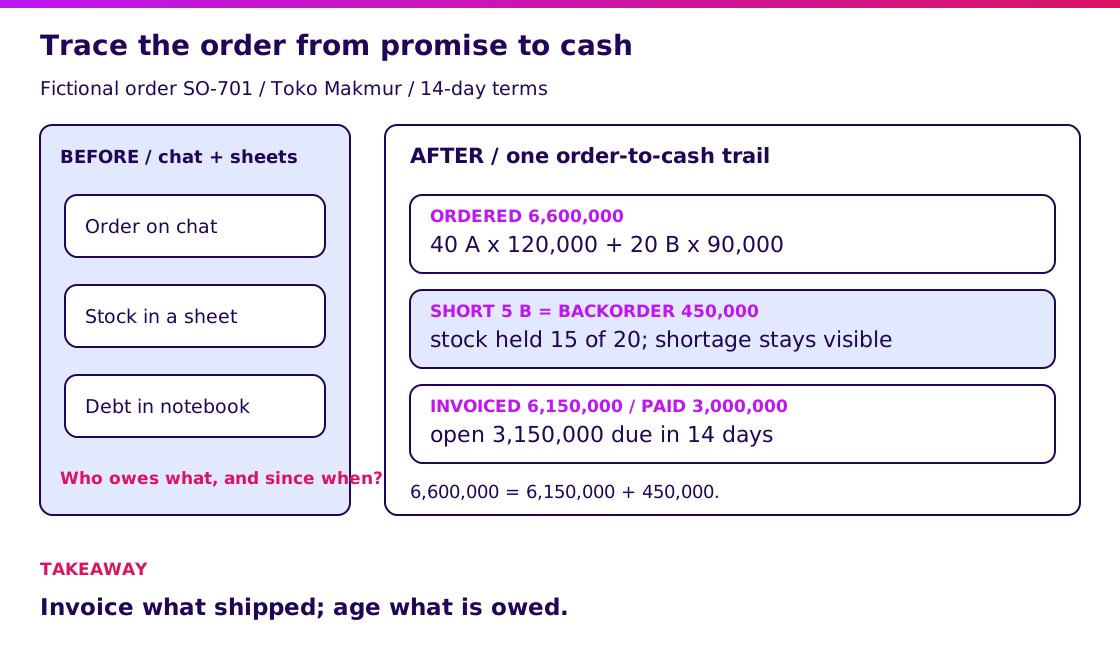
Open the order diagram at full size.
What happens to the shortage and the unpaid balance?
Follow both leftovers. The shortage must stay visible as a backorder until it ships or is cancelled. The unpaid IDR 3,150,000 must carry a due date and an owner. Neither may disappear into a note on a chat thread.
| Event | Order / stock record | Money record |
|---|---|---|
| Confirm SO-701 | Credit and stock checked first | Exposure: existing open balance + 6,600,000 |
| Allocate stock | A 40 of 40; B 15 of 20 | Backorder 5 cartons = 450,000 |
| Ship and invoice | Delivery note for what left | Invoice 6,150,000, due in 14 days |
| Collect on delivery | Delivered | Payment 3,000,000 applied |
| Month-end | Backorder shipped or cancelled | 3,150,000 aged by due date |
These are acceptance criteria I recommend, not a claim that every package models partial shipment the same way. Map your real order-to-cash hand-offs in Blueprint & Prototype before you ask a supplier for a demo.
What is distributor software?
Distributor software records how an order becomes stock movement, an invoice and a collected payment, with an owner at each step. In Indonesia you will hear aplikasi distributor, software distribusi or distribution management system (DMS). It covers sales orders, price lists and promotions, stock by warehouse and batch, delivery, invoicing and receivables.
It overlaps with neighbours. Our stock management guide covers movement and counts in depth. Our logistics software guide covers the delivery leg. Distributor software sits where the sale, the stock and the debt meet.
Decide early which system owns the order, which owns stock and which owns the ledger. Those boundaries cause more rework than any missing screen.
Which distributor software features matter at each scale?
Choose features around hand-offs, not the number of screens offered. A distributor with one warehouse and three canvassers does not need what a multi-branch network needs, but both need an honest trail from order to cash.
| Operating model | Minimum capability to demonstrate | Signal to expand scope |
|---|---|---|
| One warehouse, a few canvassers | Sales order, stock check, delivery note, invoice, open-balance list | You cannot say what a customer owes without asking |
| One warehouse, many outlets | Above, plus price lists, promotions, credit limits and aging | Overdue balances surprise you at month-end |
| Several branches | Above, plus transfers between branches and per-branch stock | Stock is right in total but wrong per branch |
| Multiple principals or marketplaces | Above, plus principal targets, claims and channel orders | Claims and discounts cannot be reconciled |
For each shortlisted feature, write one observable result. “Has credit control” is vague. “An order that would exceed the customer’s limit is held for approval” is something your sales manager can test. Prepare the demo with your warehouse lead and finance owner.
What controls should distributor management software include?
Assign an owner to each hand-off so an exception has somewhere to go. The roles below are responsibilities to allocate, not invented interviewees. In a small distributor one person may hold several roles; still require review of sensitive adjustments.
1. Orders and credit — owned by the sales manager
Treat the order as a promise you have checked, not a wish.
- Capture the order with price list and promotion applied.
- Check customer credit limit and overdue balance before confirmation.
- Show stock availability to the salesperson at order time.
- Hold an over-limit order for a named approver.
- Record the reason for every manual discount.
In the fixture, assume a credit limit of IDR 12,000,000 and an existing open balance of IDR 5,000,000. SO-701 adds 6,600,000, reaching 11,600,000, inside the limit. Demo question: can you show an order held because it would breach the limit, and who released it?
I recommend this because bad debt often starts as a confirmed order nobody checked. Bring one late-paying customer to a scoping discussion.
2. Stock and delivery — owned by the warehouse lead
Treat allocation as a reservation that the invoice must follow.
- Reserve stock per order line at confirmation.
- Create a backorder automatically for any shortage.
- Pick by batch or expiry where the goods require it.
- Issue a delivery note for exactly what leaves.
- Record returns against the original invoice.
In the fixture, line B reserves 15 of 20 and a backorder of 5 stays open. Demo question: can you show every open backorder with its customer and age without a spreadsheet?
3. Invoicing and pricing — owned by the finance admin
Invoice from the delivery, not from the order.
- Generate the invoice from the delivery note.
- Lock prices once the invoice is issued.
- Apply promotions and discounts by rule, not by hand.
- Issue credit notes for returns, linked to the invoice.
- Keep tax and invoice documents as your adviser requires.
If anyone can edit an issued invoice, the ledger is only as honest as the loosest user. Demo question: can you show who changed the price on invoice INV-701, and when?
4. Receivables and collection — owned by the finance lead
Keep the due date attached to every balance.
- Age each invoice by its own terms: current, 1–14, 15–30 and over 30 days late.
- Apply partial payments to named invoices once.
- Assign each overdue customer to a collector.
- Block new orders for customers beyond a set overdue age.
- Restrict write-offs and manual overrides.
Demo question: can finance explain the exact composition of a customer’s open balance, invoice by invoice?
I recommend separate order, stock and cash states because they answer different questions. Scope the finance hand-off before development.
Validate it in 2 weeks. Blueprint & Prototype maps your risky hand-offs and tests a working prototype with relevant users before you approve production scope. Bring one backorder and one overdue customer.
What should you check about tax and invoice rules?
Treat tax and invoice requirements as a checklist to verify, not a feature list to trust. Tax invoices, e-invoicing formats, stamp duty thresholds, product-specific rules and personal-data protection are governed by rules that change. I have not verified current specifics for this article, so I state none.
| Topic | Question to put to the supplier | Who confirms it |
|---|---|---|
| Tax invoice documents | Which documents are issued, numbered and archived, and by which system? | Your tax adviser |
| Product-specific rules | Can restricted or regulated goods be flagged? | The authority and your adviser |
| Customer personal data | Who can see customer details, and is access logged? | Your data-protection owner |
| Accounting hand-off | What is exported, how often, and who reconciles it? | Your accountant |
A supplier saying “compliant” is a claim, not evidence. Ask what the software records, what it exports and which duties remain with your staff. This needs human verification against current official sources before you rely on it.
Assign a reviewer to each required document in your scope.
Should you buy ready-made distributor software or build custom?
Start with a package when it passes your must-have tests and lets you take your data out. Custom development earns its cost when a recurring workflow gap has a measurable consequence that configuration cannot address.
| Approach | Good fit | Evidence to request | Main trade-off |
|---|---|---|---|
| Ready-made package | Standard order-to-cash and stock | Replay your exceptions and export full history | Fit is constrained by supplier rules |
| Package plus integration | Core fits; one accounting, e-commerce or principal hand-off does not | Supported API, retry behavior and clear data ownership | Two suppliers may share responsibility |
| Custom core | Distinct pricing, promotion or multi-principal rules remain | Prototype, acceptance criteria and operating owner | You fund maintenance and future changes |
For a hybrid system, write down which system owns stock, invoices and receivables. An integration failure needs a visible queue and a retry that does not repeat the business action, such as invoicing the same delivery twice.
Do not choose custom because you have several branches or want your logo on the order form. Count the exceptions, estimate their cost and compare that with the extra spend. Read our build-versus-buy framework before committing.
How do you test distributor software before buying?
Run the same ten tests in every demo and keep the exported evidence. Use a sandbox with fictional customers. These are recommended acceptance tests, not assertions that a particular supplier passes or fails them.
| Test | Required observable result |
|---|---|
| 1. Enter SO-701 with a stock shortage | Backorder of 5 cartons created; order not blocked silently |
| 2. Order beyond the credit limit | Held for approval; approver recorded |
| 3. Ship and invoice | Invoice equals shipped quantity × price (6,150,000) |
| 4. Edit an issued invoice | Blocked, or allowed only with a recorded approval |
| 5. Apply a 3,000,000 part-payment | Balance 3,150,000 on that invoice, with due date |
| 6. Apply the same payment twice | Second entry rejected or flagged |
| 7. Return 2 cartons of A | Credit note linked to the invoice; stock updated |
| 8. Lose the connection mid-order | Clear saved or unsaved state; retry creates no duplicate |
| 9. Run the aging report | Each balance sits in the right bucket by its own terms |
| 10. Export and reconcile SO-701 | Order, delivery, invoice and payment keep matching IDs |
Agree which failures block adoption. A stock-less confirmed order, an issued invoice changed without a record and duplicated payments should stop the purchase until resolved. A cosmetic report change can be scheduled separately.
Ask the supplier to demonstrate backup recovery and explain access after cancellation, export scope and retention. An export button alone does not prove you can reconstruct your history. Bring the evidence to a vendor review.
How much does distributor software cost in the first year?
Compare the same operating scope over twelve months, including implementation. The model below is fictional planning arithmetic, not vendor prices, a market survey or a Synetica offer. Scope: one warehouse, five canvassers, sales orders, stock, invoicing, receivables and one accounting hand-off.
| Assumed cost, IDR million | Package | Hybrid | Custom core |
|---|---|---|---|
| Discovery and configuration | 5 | 10 | 18 |
| Custom development or integration | 0 | 35 | 140 |
| Twelve-month subscription | 18 | 18 | 0 |
| Additional hosting | 0 | 4 | 9 |
| Migration and staff training | 6 | 7 | 10 |
| Additional support | 4 | 8 | 16 |
| Planned first-year spend | 33 | 82 | 193 |
| Separate 15% reserve | 4.95 | 12.3 | 28.95 |
| Funding envelope | 37.95 | 94.3 | 221.95 |
The assumed subscription is IDR 1,500,000/month, or IDR 18 million/year. “Additional” means beyond what the subscription includes; remove overlapping support or hosting when comparing real quotes. The reserve is held funding, not an invoice.
The model excludes taxes, handheld devices, message fees and future features. Ask suppliers to itemize these.
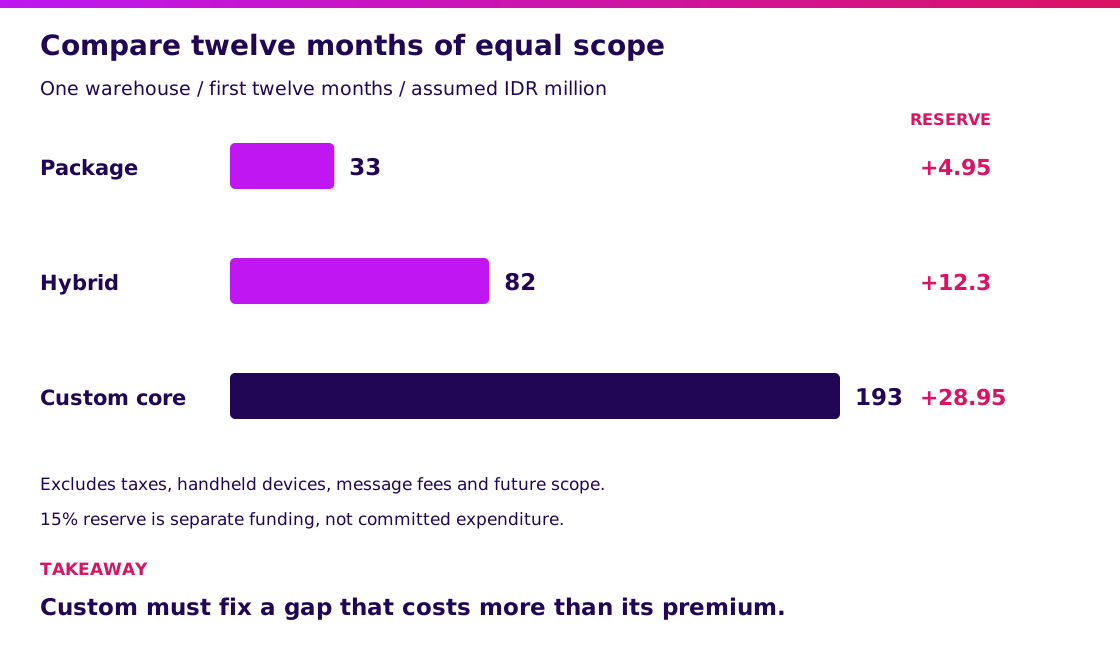
Open the budget diagram at full size.
How do you check whether the cost is justified?
Use recoverable operating value and verified cash release, with assumptions visible. Suppose admin and finance staff save an assumed 10 hours a week on order entry and receivable follow-up: 40 hours a month. At an assumed IDR 35,000/hour that is IDR 1,400,000 of released capacity, which is below the IDR 1,500,000 subscription. Capacity alone does not justify this purchase, and it is not cash unless you redeploy it.
The second lever is collection speed. Suppose credit sales of an assumed IDR 600 million a month, or IDR 20 million a day. If aging and collector assignment cut average collection time by 3 days, that releases about IDR 60 million of working capital once. It is a one-time cash release, not profit. Measure your own baseline first and avoid counting one benefit twice. Review the wider application cost drivers with those constraints in view.
How do you roll out distributor software?
Activate one warehouse or one sales team only after open orders, stock and balances reconcile. Installing software is one task; deciding which records become authoritative is the harder one.
Use four evidence gates. First, map price lists, credit rules, backorder rules and owners. Second, replay the ten tests with a canvasser, the warehouse lead and finance. Third, reconcile opening stock, open orders and customer balances against your current records. Fourth, activate one warehouse or team and review its first month-end close.
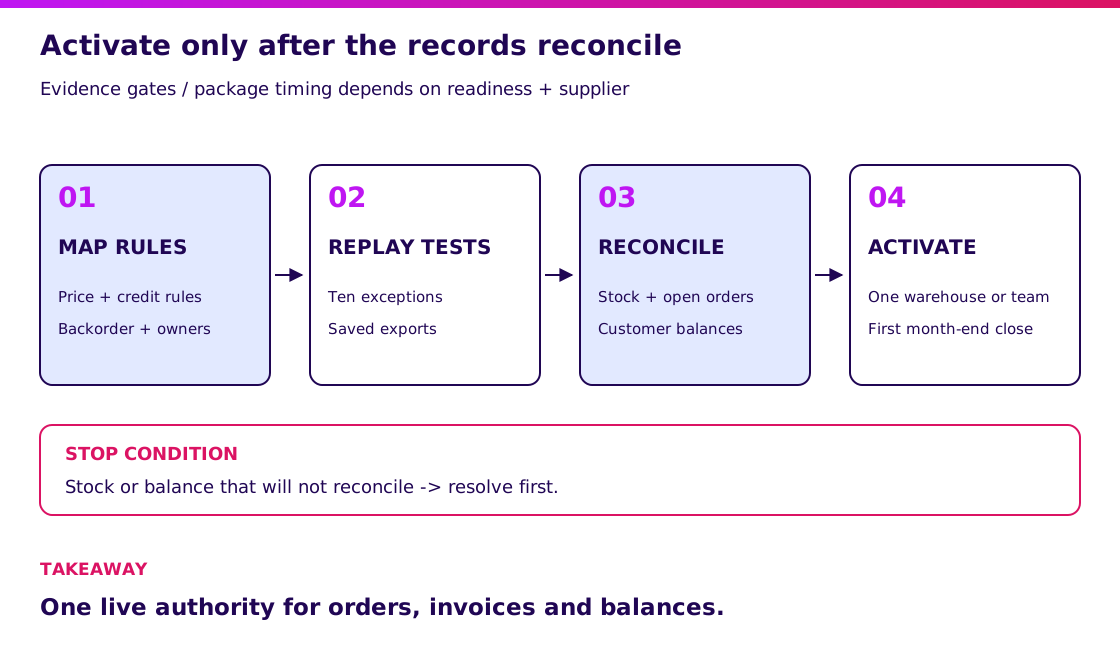
Open the rollout diagram at full size.
Choose a cutover date and one system for live orders and balances. Compare read-only reports during the pilot, but never let two systems both issue invoices for the same delivery. Name the person who can pause activation and the procedure for recovering unfinished orders.
For agreed custom scope, Synetica’s 2B2G path is Blueprint & Prototype in 2 weeks, then Production Grade Software in 8 weeks, then Launch & Grow on an ongoing monthly retainer. That is ten weeks through prototype validation and production build. Package setup depends on supplier capability and your readiness; it does not inherit this schedule.
Plan the production work after the prototype establishes scope and acceptance criteria.
What does an external traceability source actually support?
A connected order trail helps you ask where a product went. In a 2014 GS1 announcement about an EU expert-group report, Maija Laurila, then head of the European Commission’s Product and Service Safety unit, noted:
“ensuring traceability has become more challenging” — Maija Laurila, excerpt from the announcement.
The report concerned non-food consumer-product traceability. It supports the importance of identifiable products and connected records, not our fictional cost model, Indonesian tax compliance or a forecast of your savings. For a distributor, my recommended test is to find every shipment of one product and explain each return using its original order reference. Replay that trace in your own stock workflow.
What would I advise a distributor to do first?
Bring one awkward order to a demo before buying a longer feature list. Choose an order with a stock shortage, a part-payment and a customer near their credit limit. Ask your next demo to explain each using only the saved records.
- For one warehouse and a few canvassers: buy the smallest package that passes the critical tests and exports usable history.
- For several branches or principals: prove ownership of stock, invoices and balances before adding automation.
- For custom scope: name the gap, its operating cost and the person responsible for the new workflow.
My next step would be to book a scoping conversation with that order’s records and its unanswered questions.
FAQ — Choosing distributor software
What is distributor software used for?
It records sales orders, stock allocation, deliveries, invoices and customer receivables. A useful implementation lets staff trace any invoice back to its order and delivery, and any open balance to its due date.
What features should distributor software include?
Start with sales orders, stock availability, backorders, delivery notes, invoicing from delivery, credit limits, receivable aging, role permissions and export. Add promotions, principal claims or branch transfers when your workflow needs them.
How much does distributor software cost?
Get current quotes for your scope. This article’s fictional first-year model totals IDR 33 million for a package, IDR 82 million for hybrid and IDR 193 million for a custom core, before separate reserves and listed exclusions. These are calculations, not market prices.
Is free distributor software enough?
It can be enough for a limited workflow if its current terms, user limits and export cover your needs. Check whether backorders, credit limits, aging, backups and support are included. A free tier that pushes receivables into a spreadsheet may create more work.
Can distributor software be customized?
Yes, through supported configuration, integrations or a custom build. First test whether an existing product meets the critical workflow. Custom scope needs clear data ownership, maintenance funding and acceptance tests; branch count alone does not justify it.
Related Posts
Aditya S
Business Development Manager, Synetica.
Put it into practice
Need help putting this into practice?
We turn the ideas in this article into a prototype tested with real users in 2 weeks (from Rp49jt)—or production-grade software in 8 weeks (from Rp100jt).