Logistics Software: TMS, Tracking and Proof of Delivery
Choose logistics software with tests for manifests, tracking and COD cash. Compare ready-made and custom TMS options with a labeled first-year budget.
 By Aditya S October 29, 2026 Updated November 11, 2026 16 min read
Logistics software should answer three questions without a phone call: where is this parcel, who received it, and has the cash from that delivery reached the office? If the status, the proof and the money live in different places, a delivery report will not explain the complaint at your counter. This guide gives you a testable buying process for an Indonesian expedition or delivery operation.
I’m Aditya S, Business Development Manager at Synetica, a tech-based business consultancy combining strategy and execution for Dreamers and Growing Businesses. Everything below uses fictional fixtures you can replay in a demo. I am not citing Synetica logistics clients, ranking products I have tested, or giving legal or tax advice.
You’ll follow one manifest of ten parcels, compare features by operation size, assign four controls, and run ten acceptance tests. Then we’ll compare a ready-made package, a small integration and a custom core on the same first-year scope.
TL;DR — the whole guide in five lines
- Give every parcel a coded status until it is closed: “out for delivery” is not an ending.
- Save proof of delivery with the status change: a photo or signature that lives elsewhere will not settle a dispute.
- Reconcile cash-on-delivery (COD) per manifest: each rupiah collected must point to a parcel.
- Buy a package that survives your exceptions: custom development needs a measurable gap, not a wish list.
- Confirm transport and data rules with the authority and your adviser: software records duties; it does not discharge them.
What problems should logistics software solve?
Start the demo with one manifest whose arithmetic you can check. My fixture is fictional: manifest M-501 puts 10 parcels on one van. At the end of the route, 8 are delivered with proof saved, and 2 are marked failed with a reason code. Two of the delivered parcels are COD, for an assumed IDR 250,000 and IDR 100,000. A third COD parcel of IDR 180,000 was one of the failed attempts, so no money was collected for it.
The close-out arithmetic is simple. Loaded 10 equals delivered 8 plus failed 2, with nothing unaccounted for. Cash to hand in is IDR 250,000 plus IDR 100,000, which is IDR 350,000. If the driver hands in IDR 330,000, you have a difference with a name on it. These are test numbers, not market rates or a product recommendation.
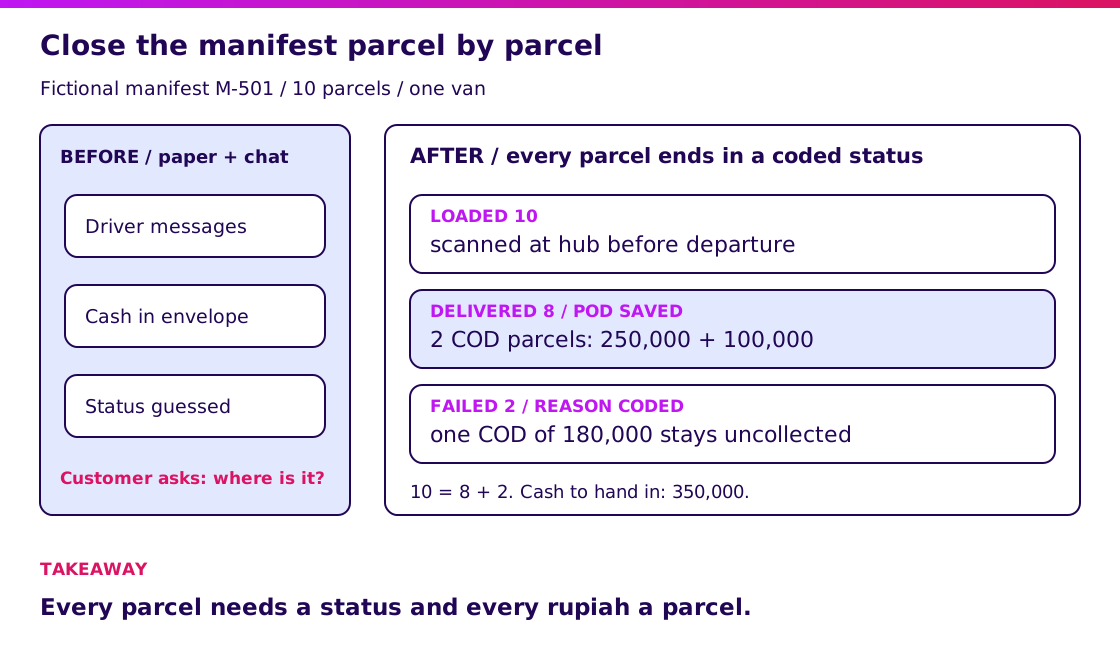
Open the manifest diagram at full size.
What happens to the failed parcels?
Now follow what happens to the two failed parcels. Each carries a reason code, such as recipient absent or address not found, and returns to the hub or is scheduled for a reattempt. Neither may quietly disappear back into the pile.
| Event | Parcel record | Money / proof record |
|---|---|---|
| Scan 10 parcels onto M-501 | Status: out for delivery | No cash yet |
| Deliver 8 parcels | Status: delivered, time and place | Proof saved per parcel |
| Collect on 2 COD parcels | Delivered | Cash due 250,000 + 100,000 |
| Fail 2 parcels | Failed, reason coded | One COD of 180,000 stays open |
| Close manifest | 10 = 8 + 2 | Cash handed in must equal 350,000 |
These are acceptance criteria I recommend, not a claim that every package models failed attempts the same way. Map your real hand-offs in Blueprint & Prototype before you ask a supplier for a demo.
What is logistics software?
Logistics software records how goods are planned, moved, tracked and proven delivered, with a status and an owner at each step. In Indonesia you will hear software logistik, software ekspedisi or TMS, short for transport management system. A TMS focuses on the movement: orders, routes, vehicles, drivers, tracking and proof of delivery.
It overlaps with two neighbours. Our warehouse management system guide covers what happens inside the building, such as picking and putaway. Our supply chain management guide works one level above, across suppliers and customers. Logistics software sits between them, at the dock door and on the road.
Decide early which system owns the order, which owns the parcel status and which owns the invoice. Those boundaries cause more rework than any missing screen.
Which logistics software features matter at each scale?
Choose features around operational hand-offs, not the number of screens offered. A courier running one van does not need what a multi-hub network needs, but both need an honest status trail.
| Operating model | Minimum capability to demonstrate | Signal to expand scope |
|---|---|---|
| One small fleet or van | Manifest, coded statuses, proof of delivery, COD close-out, export | You cannot tell which parcels are still out |
| One hub with several routes | Above, plus route assignment, driver app and customer tracking link | Customers phone to ask where parcels are |
| Hub-to-hub network | Above, plus linehaul legs, transfer scans and reconciliation between hubs | Parcels vanish between two hubs |
| Third-party carriers or marketplace volume | Above, plus carrier booking, rate rules and invoice checks | Freight invoices and deliveries do not match |
For each shortlisted feature, write one observable result. “Has tracking” is vague. “A failed attempt shows its reason and the next planned action to the customer” is something your dispatcher can test. Prepare the demo with your dispatcher and your inventory owner.
What controls should logistics management software include?
Assign an owner to each hand-off so an exception has somewhere to go. The roles below are responsibilities to allocate, not invented interviewees. In a small operation one person may hold several roles; still require review of sensitive adjustments.
1. Dispatch and manifests — owned by the dispatcher
Treat the manifest as the promise of what left the hub.
- Scan each parcel onto a manifest before departure.
- Assign vehicle and driver, with a visible capacity check.
- Block departure of a parcel that is missing a destination.
- Record route changes with a reason.
- Show loaded, delivered, failed and open counts at any moment.
In the fixture, M-501 shows 10 loaded and cannot be closed while any parcel is still out. Demo question: can you show every open parcel on a closed route without a spreadsheet export?
I recommend this because a delivery problem is usually a counting problem first. Bring one disputed manifest to a scoping discussion.
2. Tracking and status — owned by the operations lead
Treat the status as a controlled vocabulary, not free text.
- Define a short set of statuses and reason codes.
- Timestamp every change with the user or device.
- Show customers a status they can understand.
- Restrict who can reopen or override a final status.
- Keep an audit trail of every correction.
If anyone can type “delivered”, the report is only as honest as the loosest user. Demo question: can you show who changed parcel P-07 from failed to delivered, and when?
3. Proof and exceptions — owned by the customer service lead
Make proof part of the status change, not a later upload.
- Capture a signature, photo or receiver name at delivery.
- Require a reason code for every failed attempt.
- Schedule a reattempt or return and show it to the customer.
- Link a claim to the original manifest and parcel.
- Keep proof retrievable for as long as your own rules require.
A dispute that starts with “I never received it” should end with a saved record, or an honest admission that none exists. Use the stock movement checklist for parcels that wait in a hub.
4. COD and billing — owned by the finance lead
Keep the parcel as the bridge between the delivery and the money.
- Show each COD amount on the driver’s manifest.
- Match cash handed in against the manifest, not against a daily total.
- Apply partial remittances once.
- Restrict write-offs, refunds and manual overrides.
- Export deliveries and collections with parcel references.
Demo question: can finance explain every difference between the COD due and the cash received for a closed manifest?
I recommend separate delivery, proof and cash states because they answer different questions. Scope the finance hand-off before development.
Validate it in 2 weeks. Blueprint & Prototype maps your risky hand-offs and tests a working prototype with relevant users before you approve production scope. Bring one disputed COD or one parcel that nobody can find.
What should you check before choosing logistics software for compliance?
Treat regulation as a checklist to verify, not a feature list to trust. Vehicle and cargo documents, driver rules, handling of regulated goods, tax documents, personal-data protection and the electronic documents your customers require are governed by rules that change. I have not verified current specifics for this article, so I state none.
| Topic | Question to put to the supplier | Who confirms it |
|---|---|---|
| Vehicle and cargo documents | Which documents are generated or stored, and who signs them? | Your compliance adviser and the authority |
| Regulated or restricted goods | Can the system flag and block them? | The authority and your operations lead |
| Personal data | Who can see recipient names, phones and addresses, and is access logged? | Your data-protection owner |
| Tax and invoice documents | Which documents are issued, and by which system? | Your tax adviser |
| Customer and partner integrations | Which connections are required, and who maintains them? | The partner and the supplier |
A supplier saying “compliant” is a claim, not evidence. Ask what the software records, what it exports and which duties remain with your staff. This needs human verification against current official sources before you rely on it.
Assign a reviewer to each required document in your scope.
Should you buy ready-made logistics software or build custom?
Start with a package when it passes your must-have tests and lets you take your data out. Custom development earns its cost when a recurring workflow gap has a measurable consequence that configuration cannot address.
| Approach | Good fit | Evidence to request | Main trade-off |
|---|---|---|---|
| Ready-made package | Standard manifests, tracking and COD | Replay your exceptions and export full history | Fit is constrained by supplier rules |
| Package plus integration | Core fits; one accounting, marketplace or carrier hand-off does not | Supported API, retry behavior and clear data ownership | Two suppliers may share responsibility |
| Custom core | Distinct routing, pricing or multi-party rules remain | Prototype, acceptance criteria and operating owner | You fund maintenance and future changes |
For a hybrid system, write down which system owns parcel status, tracking numbers and cash status. A parcel status needs one authority. An integration failure needs a visible queue and a retry that does not repeat the business action, such as marking a parcel delivered twice.
Do not choose custom because you have several hubs or want your logo on the tracking page. Count the exceptions, estimate their cost and compare that with the extra spend. Read our build-versus-buy framework before committing.
How do you test logistics software before buying?
Run the same ten tests in every demo and keep the exported evidence. Use a sandbox with fictional parcels. These are recommended acceptance tests, not assertions that a particular supplier passes or fails them.
| Test | Required observable result |
|---|---|
| 1. Load a manifest of ten parcels | Counts match; each parcel has one open status |
| 2. Deliver with proof | Status, time and proof saved together |
| 3. Fail an attempt | Reason code required; next action visible |
| 4. Try to edit a final status | Blocked, or allowed only with a recorded approval |
| 5. Scan a parcel onto two manifests | Second scan rejected or flagged |
| 6. Close with a COD difference | Difference shown against the manifest and driver |
| 7. Repeat a status update | One status record; no duplicate event |
| 8. Lose the connection mid-delivery | Clear saved or unsaved state; retry creates no duplicate |
| 9. Try a restricted override | Unauthorized user blocked; allowed override has history |
| 10. Export and reconcile M-501 | Parcels, proof and cash keep matching IDs |
Agree which failures block adoption. An unaccounted parcel, a final status changed without a record and duplicated cash entries should stop the purchase until resolved. A cosmetic report change can be scheduled separately.
Ask the supplier to demonstrate backup recovery and explain access after cancellation, export scope and retention. An export button alone does not prove you can reconstruct your history. Bring the evidence to a vendor review.
How much does logistics software cost in the first year?
Compare the same operating scope over twelve months, including implementation. The model below is fictional planning arithmetic, not vendor prices, a market survey or a Synetica offer. Scope: one hub, manifests, coded tracking, proof of delivery, COD close-out, reporting and one accounting hand-off.
| Assumed cost, IDR million | Package | Hybrid | Custom core |
|---|---|---|---|
| Discovery and configuration | 5 | 10 | 18 |
| Custom development or integration | 0 | 35 | 130 |
| Twelve-month subscription | 14.4 | 14.4 | 0 |
| Additional hosting | 0 | 4 | 9 |
| Migration and staff training | 5 | 6 | 10 |
| Additional support | 4 | 8 | 15 |
| Planned first-year spend | 28.4 | 77.4 | 182 |
| Separate 15% reserve | 4.26 | 11.61 | 27.3 |
| Funding envelope | 32.66 | 89.01 | 209.3 |
The assumed subscription is IDR 1,200,000/month, or IDR 14.4 million/year. “Additional” means beyond what the subscription includes; remove overlapping support or hosting when comparing real quotes. The reserve is held funding, not an invoice.
The model excludes taxes, vehicles, handheld devices, SMS or WhatsApp message fees and future features. Ask suppliers to itemize these.
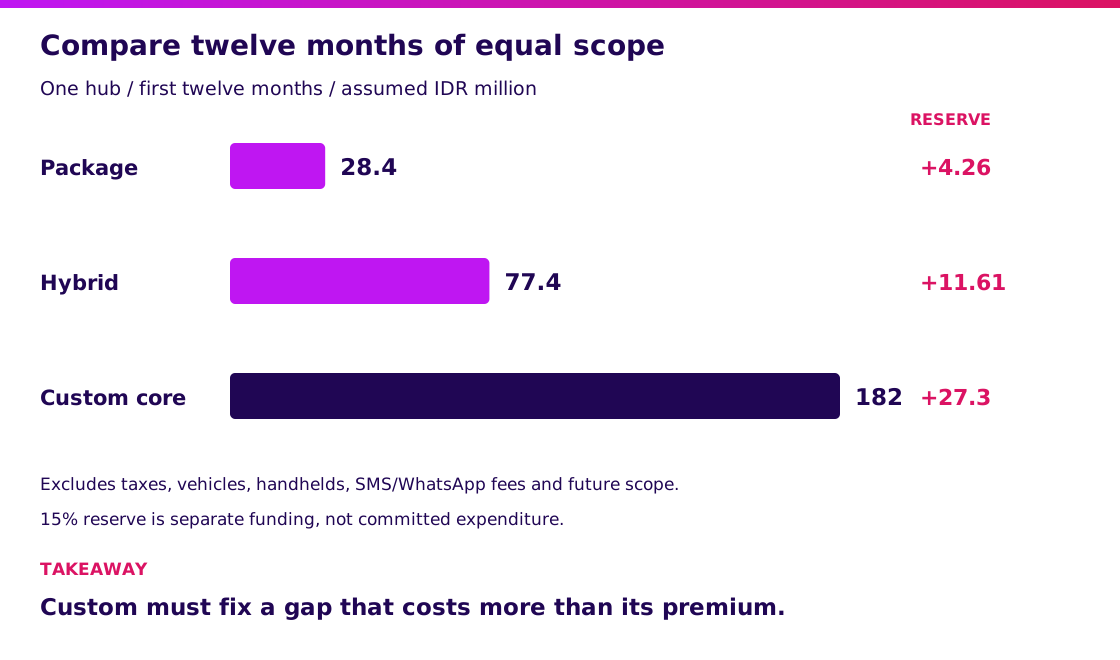
Open the budget diagram at full size.
How do you check whether the cost is justified?
Use recoverable operating value and verified loss reduction, with assumptions visible. Suppose dispatch and finance staff save an assumed 2 hours a day across 26 days: 52 hours a month. At an assumed IDR 35,000/hour that is IDR 1,820,000 of released capacity against the IDR 1,200,000 subscription. That capacity is not automatic cash savings unless you redeploy it.
Failed deliveries are a second lever. Suppose 300 parcels a month and 6% fail the first attempt, which is 18 parcels. At an assumed IDR 25,000 per reattempt, that is IDR 450,000 a month. If reason codes and customer notices cut it by 30%, you recover IDR 135,000, a small amount you should not oversell. Measure your own baseline first and avoid counting one benefit twice. Review the wider application cost drivers with those constraints in view.
How do you roll out logistics software?
Activate one hub or one route only after open parcels and cash reconcile. Installing software is one task; deciding which records become authoritative is the harder one.
Use four evidence gates. First, map statuses, reason codes, COD rules and owners. Second, replay the ten tests with the dispatcher, a driver, customer service and finance. Third, reconcile open parcels, expected cash and customer tracking links against your opening records. Fourth, activate one hub or route and review its first manifest close.
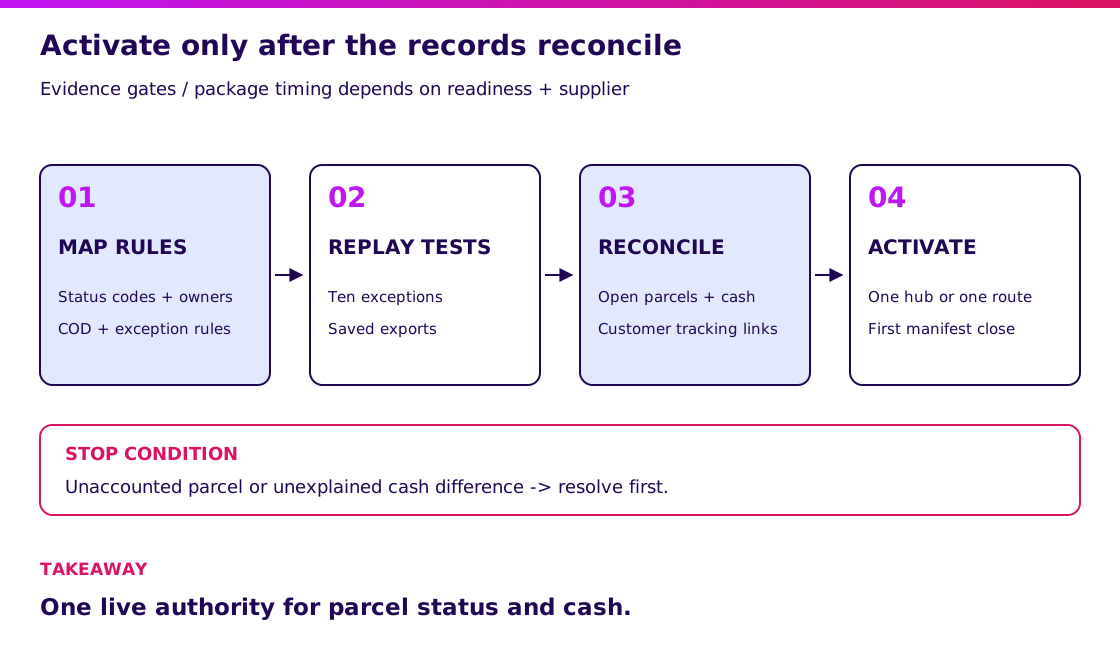
Open the rollout diagram at full size.
Choose a cutover time and one system for live statuses and cash. Compare read-only reports during the pilot, but never let two systems both mark the same parcel delivered. Name the person who can pause activation and the procedure for recovering unfinished manifests.
For agreed custom scope, Synetica’s 2B2G path is Blueprint & Prototype in 2 weeks, then Production Grade Software in 8 weeks, then Launch & Grow on an ongoing monthly retainer. That is ten weeks through prototype validation and production build. Package setup depends on supplier capability and your readiness; it does not inherit this schedule.
Plan the production work after the prototype establishes scope and acceptance criteria.
Why should a delivery demo include a failure?
Test a lost connection as part of the normal operating demo. Werner Vogels titles one lesson in his 2016 AWS engineering retrospective:
“Expect the unexpected.” — Werner Vogels.
The essay concerns software reliability, not courier performance. My application is to interrupt a status upload, reconnect, and check that the saved proof and COD records stay attached to one parcel. It does not establish an Indonesian transport rule or a guaranteed delivery rate. Replay the exception with the dispatcher.
What would I advise a logistics operator to do first?
Bring one awkward day to a demo before buying a longer feature list. Choose a manifest with a COD parcel, a failed attempt and a customer who disputes receipt. Ask your next shift to explain each using only the saved records.
- For one van or hub: buy the smallest package that passes the critical tests and exports usable history.
- For a network or marketplace volume: prove ownership of status, proof and cash before adding automation.
- For custom scope: name the gap, its operating cost and the person responsible for the new workflow.
My next step would be to book a scoping conversation with that day’s records and its unanswered questions.
FAQ — Choosing logistics software
What is logistics software used for?
It records orders, manifests, routes, parcel statuses, proof of delivery and, where relevant, cash collected. A useful implementation lets staff trace any parcel to its manifest, its last status and its proof.
What features should logistics software include?
Start with manifests, coded statuses and reason codes, proof of delivery, customer tracking, COD reconciliation, role permissions and export. Add route optimization, linehaul transfers or carrier invoicing when your workflow needs them.
How much does logistics software cost?
Get current quotes for your scope. This article’s fictional first-year model totals IDR 28.4 million for a package, IDR 77.4 million for hybrid and IDR 182 million for a custom core, before separate reserves and listed exclusions. These are calculations, not market prices.
Is free logistics software enough?
It can be enough for a limited workflow if its current terms, user limits and export cover your needs. Check whether proof of delivery, COD reconciliation, backups and support are included. A free tier that pushes critical records into a spreadsheet may create more work.
Can logistics software be customized?
Yes, through supported configuration, integrations or a custom build. First test whether an existing product meets the critical workflow. Custom scope needs clear data ownership, maintenance funding and acceptance tests; hub count alone does not justify it.
Related Posts
Aditya S
Business Development Manager, Synetica.
Put it into practice
Need help putting this into practice?
We turn the ideas in this article into a prototype tested with real users in 2 weeks (from Rp49jt)—or production-grade software in 8 weeks (from Rp100jt).