Learning Management System: Guide for Companies & Campuses
What is a learning management system? Compare ready-made, hybrid and custom LMS options, essential features, three-year cost, a vendor checklist and phased rollout.
 By Aditya S November 10, 2026 Updated November 11, 2026 10 min read

A learning management system (LMS) is software that delivers training or courses online, tracks who completed what, and reports the results. If you run onboarding for 300 staff or courses for 3,000 students, it is the difference between chasing spreadsheets and reading one completion report.
I’m Aditya S, Business Development Manager at Synetica, a tech-based business consultancy combining strategy and execution for Dreamers and Growing Businesses. This guide uses a fictional 300-person company so you can check every number. The figures are teaching assumptions, not Synetica client results, vendor prices or industry benchmarks.
You’ll learn what an LMS does, how ready-made, hybrid and custom options compare, which features matter, when buying is enough, how to check a vendor, what it costs and how to roll it out in phases.
TL;DR — the whole guide in five lines
- An LMS is a training record, not a video library: its value is knowing who finished, who passed and who is overdue.
- Most companies should buy first: a ready-made LMS covers standard onboarding and compliance training in weeks.
- Learner count flips the cost: in our example, ready-made is cheapest below about 230 learners; above that, an open-source hybrid wins.
- Build custom only when learning is the product: paid courses, unique certification rules or deep HR integration justify it.
- Launch one course to one team first: prove completion rates before you migrate the whole catalogue.
What is a learning management system?
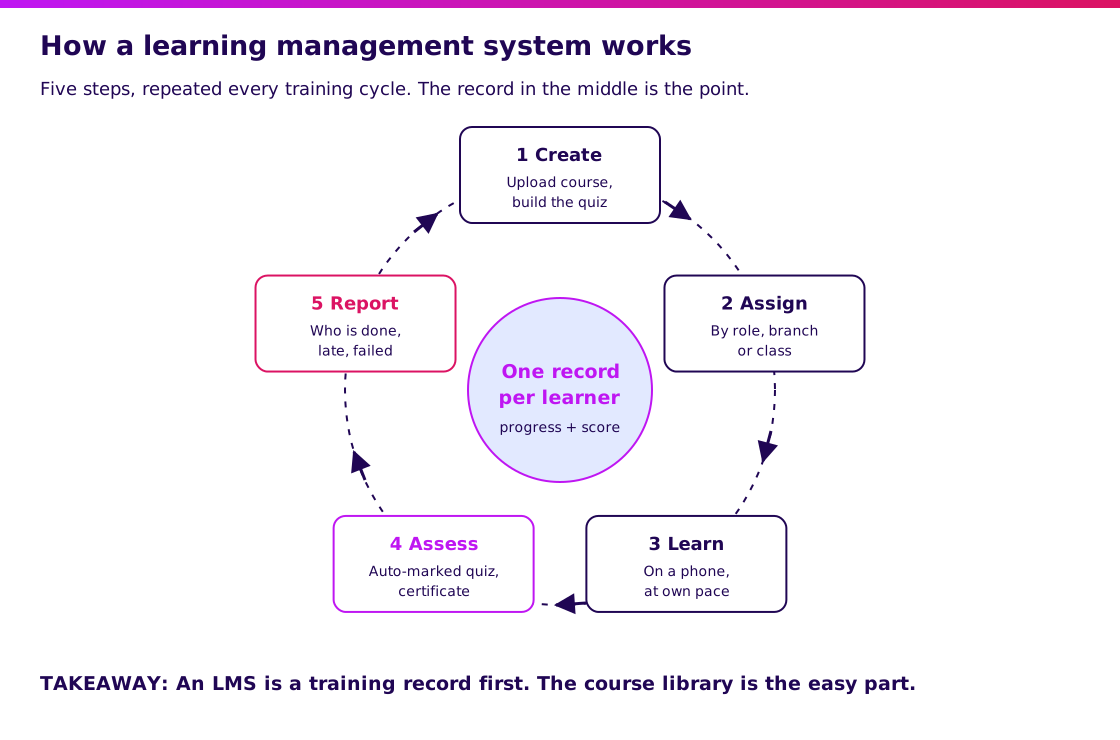
A learning management system is the platform that holds your courses, assigns them to the right people, and keeps a record of every learner’s progress and score. Think of it as a school’s register, timetable and exam office in one place, open 24 hours.
Its core functions are:
- Host learning content: videos, documents, slides, quizzes and live-class links.
- Assign courses by role, department, branch or class, with deadlines.
- Track progress, time spent, completion and quiz scores per learner.
- Assess with quizzes, assignments and certificates that expire and renew.
- Report to HR, managers or lecturers: who is done, who is late, who failed.
Many LMS platforms import course packages built to SCORM, the e-learning packaging standard maintained by the ADL Initiative. That matters because it lets you move content between platforms instead of rebuilding it.
In a company, the LMS usually sits next to HR. On a campus, it sits next to the academic system that holds enrolment and grades. See how an academic information system handles that side.
How much admin does a learning management system save? A worked example
The first payback of an LMS is admin time, not better learning. Here is a fictional 300-person company running four mandatory training cycles a year (safety, compliance, product, onboarding).
| Task per training cycle | Spreadsheet and email | With an LMS |
|---|---|---|
| Send invites and materials | 4 hours | 1 hour |
| Chase people who have not finished | 12 hours | 2 hours (automatic reminders) |
| Collect and mark quizzes | 10 hours | 0 hours (auto-marked) |
| Compile the completion report | 6 hours | 0.5 hours |
| Total per cycle | 32 hours | 3.5 hours |
Over four cycles, that is 128 hours against 14 hours, or 114 hours saved a year, close to three working weeks of one HR person. Time your own last training cycle and replace these numbers before you trust them.
The second payback is evidence. When an auditor or client asks “has everyone done the safety training?”, you answer with a report, not a promise.
Learning management system: ready-made vs custom vs hybrid
Ready-made is fastest to start; a hybrid on an open-source core is cheapest at scale; custom costs most and only pays when learning is your product. Here is how they compare on our fictional 300-learner company.
| Ready-made (SaaS) | Hybrid (open-source core + custom modules) | Custom build | |
|---|---|---|---|
| Upfront cost | IDR 10m setup | IDR 120m setup and customisation | IDR 450m build |
| Running cost | IDR 35,000 per active learner per month | IDR 60m a year hosting and maintenance | IDR 90m a year |
| Time to start | 1 to 3 weeks | 6 to 10 weeks | 10 to 16 weeks |
| Flexibility | Low: the vendor’s workflow | Medium to high | High |
| Best for | Standard onboarding and compliance, small teams | Many learners, local hosting, some unique rules | Paid courses, academies, learning as the product |
Three-year cost at 300 learners: ready-made is 10 + 300 × 0.035 × 36 = IDR 388 million. Hybrid is 120 + 3 × 60 = IDR 300 million. Custom is 450 + 3 × 90 = IDR 720 million.
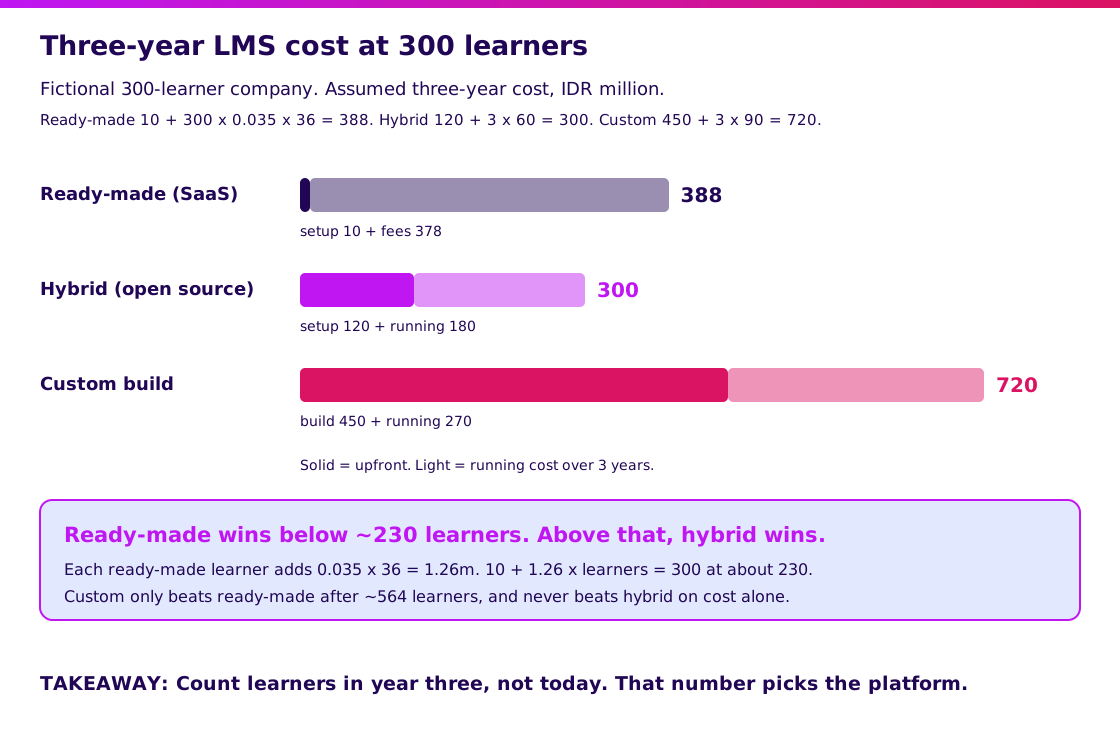
Each extra learner adds 0.035 × 36 = IDR 1.26 million to the ready-made bill over three years. Ready-made stays cheaper than the hybrid until 10 + 1.26 × learners passes 300, at about 230 learners. It stays cheaper than custom until about 564 learners.
That is why campuses rarely pay per-user prices at full scale. At 5,000 students, our assumed rate would be 10 + 5,000 × 1.26 = IDR 6.3 billion over three years. Campuses usually negotiate institution-wide pricing or run an open-source platform. Real quotes include tiers and discounts, so use the method, not the numbers.
Which learning management system features are essential?
Pick features by the job the LMS must do, not by the length of the feature list. These six cover most companies and campuses:
- Assign by rule: enrol people automatically by role, branch or class, so new hires get onboarding on day one without anyone remembering.
- Track and remind: show completion per person and nudge the late ones by email or WhatsApp.
- Assess and certify: auto-mark quizzes, issue certificates and flag ones that expire.
- Work on a phone: many learners will only ever open it on mobile, often on a slow connection.
- Report by group: completion by department, branch or class, exportable to Excel.
- Connect to your records: sync people from HR or students from the academic system, so nobody types the same list twice. Learn how APIs make that connection.
Nice-to-haves such as gamification, discussion forums and AI course builders matter less than these six. If your learners never log in, badges will not save the project.
When is an off-the-shelf LMS enough, and when do you need custom?
Off-the-shelf is enough when you are training your own people on standard topics. Build when the learning itself earns money or sets you apart. Run these five questions in order and stop at the first one that decides it.
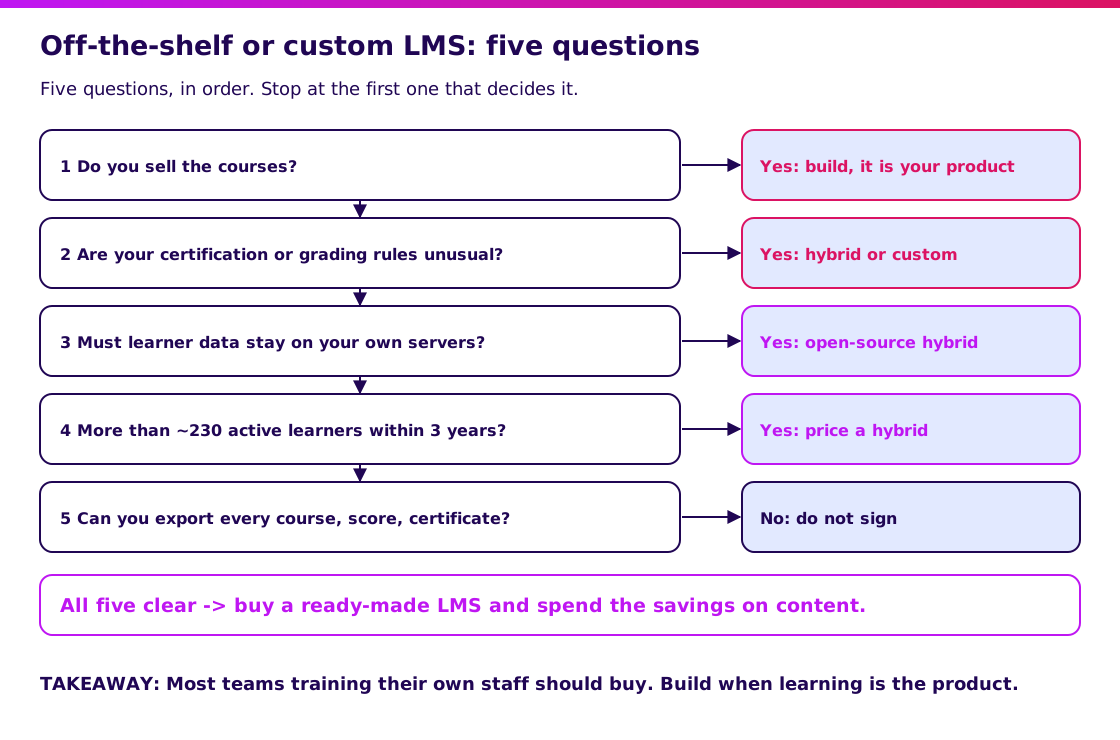
- Do you sell the courses? If learning is your product, as in a paid academy or certification body, owning the platform is usually worth it.
- Are your rules unusual? Multi-level certification, regulator-specific reports or complex grading often break ready-made workflows.
- Must learner data stay on your own servers? Some regulated organisations and campuses require it. An open-source hybrid can do that.
- Will you have more than about 230 active learners within three years? On our assumptions, per-user fees then cost more than a hybrid. Redo the sum with your own quotes.
- Can you export every course, score and certificate? If not, do not sign, whatever you choose.
Honest answer: most Growing Businesses training under 200 staff should simply buy. A good ready-made LMS is cheaper and faster than anything we would build for them. See the full build-or-buy reasoning in our build vs buy guide.
Validate it in 2 weeks. Before you spend heavily on a learning management system, Blueprint & Prototype tests your assumptions: a spec, a clickable prototype in front of real learners, and a real cost estimate. The two-week promise covers prototype validation; it does not guarantee a production launch.
At Synetica, Blueprint & Prototype takes 2 weeks, Production Grade Software takes 8 weeks, and Launch & Grow runs as an ongoing monthly retainer. If the answer is hybrid or custom, the 8-week build starts from the validated scope.
How do you choose a learning management system? A vendor checklist
Choose with your own course and your own learners, not with the vendor’s demo. Use this checklist before you sign:
- Upload one of your real courses, including a quiz, during the trial.
- Ask ten real learners to finish it on their own phones and time how long it takes.
- Check that the completion report your HR or academic team needs comes out without manual work.
- Confirm it imports and exports SCORM packages and your learner list.
- Ask how it syncs people from your HR or academic system, and who maintains that link.
- Ask where data is stored and how you get all of it back if you leave.
- Check the price at your learner count in year two and year three, not only year one.
- Ask who answers support, in which language and how fast.
- Ask for two customers of your size and call them.
- Agree who owns course content, setup and training for new admins.
Use our vendor due diligence guide for the questions behind each point.
How much does a learning management system cost in Indonesia?
LMS cost is driven by learner count, hosting choice and how much you customise. In our fictional example, the three-year totals run from IDR 300 million to IDR 720 million at 300 learners, and the ranking changes as learner numbers grow.
The price drivers are:
- Active learners: the main driver of ready-made pricing; check whether you pay for all users or only active ones.
- Hosting: cloud SaaS, your own cloud account, or on-premise servers.
- Content production: filming and building courses often costs more than the platform itself.
- Integrations: syncing HR, academic or payment systems adds setup and maintenance.
- Custom features: certification rules, branded apps and payment flows for paid courses.
Budget for content separately. An empty LMS is a well-built library with no books.
How do you implement a learning management system without failing?
Launch one course to one team, measure completion, then expand. Big-bang launches fail because the whole catalogue, every learner and every login problem arrive on the same day.
- Weeks 1-2: scope. Pick one mandatory course and one team of 30 to 50 people. Clean the learner list.
- Weeks 3-4: pilot. Run the course. Track completion, login problems and quiz results.
- Weeks 5-6: fix and connect. Fix what confused people. Connect the HR or academic sync.
- Week 7 onward: expand. Add one department or faculty and one course at a time.
Name one owner for the LMS who is responsible for the learner list and the reports. Without one, enrolments drift, old staff stay assigned and managers stop trusting the numbers.
What would I tell a founder choosing a learning management system?
Start from the report you need, then pick the smallest platform that produces it. If the report is “who completed safety training”, almost any ready-made LMS will do.
- Training fewer than 200 staff on standard topics: buy a ready-made LMS and spend the savings on good content.
- Running a campus or thousands of learners: look at an open-source core with a hybrid layer, and host where your data rules require.
- Selling courses or certifications: this is your product. Validate demand with a prototype before building; our MVP guide shows how.
My next step would be to book a scoping conversation with your learner count, the one report you need most, and the two or three platforms you are considering.
FAQ — Learning management systems
What is a learning management system?
It is software that hosts courses, assigns them to learners, tracks progress and scores, and reports who completed what. Companies use it for staff training; campuses use it for online classes.
What is the best learning management system?
There is no single best one. The best LMS fits your learner count over three years, works well on phones, exports your data and produces the report you need without manual work.
How much does a learning management system cost?
It depends on learners, hosting and customisation. In our fictional 300-learner example, three-year cost ranges from IDR 300 million for an open-source hybrid to IDR 720 million for a custom build, with ready-made at IDR 388 million.
Can a learning management system be custom built?
Yes. Custom fits unique certification rules, paid courses and deep integrations, but it costs most upfront. A hybrid builds only the unique parts on an open-source core.
Which is better, a learning management system or a ready-made app?
A ready-made LMS is better for standard staff training and smaller teams. A hybrid or custom LMS is better when you have many learners, strict data rules, or sell learning as a product.
Related Posts
Aditya S
Business Development Manager, Synetica.
Put it into practice
Need help putting this into practice?
We turn the ideas in this article into a prototype tested with real users in 2 weeks (from Rp49jt)—or production-grade software in 8 weeks (from Rp100jt).