Omnichannel: Connecting Online and Offline Retail
What is omnichannel? Compare a ready-made platform, a hybrid sync layer and a custom build for retail, with features, examples, three-year cost and a phased rollout.
 By Aditya S November 13, 2026 Updated November 19, 2026 16 min read
Omnichannel is a way of running retail so that your stores, webstore, marketplaces and chat all sell from one stock count and serve one customer record. If a customer has ever paid for a shirt online that your shop floor sold an hour earlier, omnichannel is the fix you are looking for.
I’m Aditya S, Business Development Manager at Synetica, a tech-based business consultancy combining strategy and execution for Dreamers and Growing Businesses. This guide uses a fictional fashion retailer with 8 stores so you can check every number. The figures are teaching assumptions, not Synetica client results, vendor prices or industry benchmarks.
You’ll learn what omnichannel is, how it differs from multichannel, how a ready-made platform, a hybrid and a custom build compare, which features matter, how to check a vendor, what it costs and how to roll it out in phases.
TL;DR — the whole guide in five lines
- Omnichannel is one stock count, not more channels: opening a marketplace shop is multichannel; sharing stock, orders and customers across every channel is omnichannel.
- Fix the product list first: if the same shirt has three different codes in three channels, no platform can sync it.
- Buy the connectors: ready-made platforms already connect to the big marketplaces, and keeping those connections alive is work you do not want.
- Count your stores before you count features: in our example ready-made is cheapest below 12 stores, and the hybrid wins from 12.
- Build custom only for rules no platform runs: in our example a full custom platform pays off only from about 40 stores.
What is omnichannel?
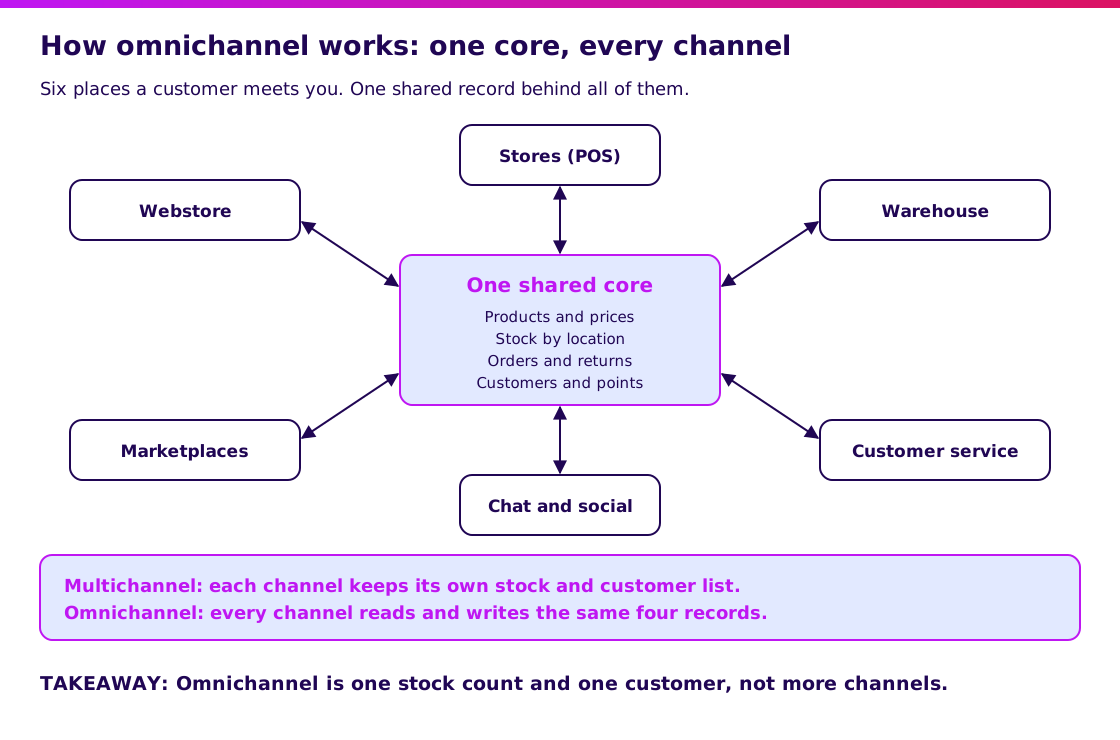
Omnichannel is a retail model in which every sales and service channel reads and writes the same products, stock, orders and customer data. Think of an airline: you can book on the app, change the seat at the counter and board at the gate, because all three look at one booking.
Its core functions are:
- Share one product list with the same code, name and price rules in every channel.
- Show one stock count by location, updated after every sale wherever it happens.
- Collect every order in one queue, whether it came from the till, the webstore or a marketplace.
- Recognise one customer across channels, with one purchase history and one points balance.
- Fulfil from anywhere: ship from the warehouse or a store, or let the customer pick up and return in any store.
The customer never sees the word “omnichannel”. They only notice that the stock shown online is really there, and that the store knows what they bought last week.
Omnichannel vs multichannel vs single channel
Multichannel means you sell in several places; omnichannel means those places share one set of records. Most retailers who say “we are already omnichannel” are multichannel with a hard-working admin in between.
| Single channel | Multichannel | Omnichannel | |
|---|---|---|---|
| Where you sell | Stores only, or online only | Stores, webstore and marketplaces | The same channels |
| Stock | One count | One count per channel, updated by hand | One count by location, updated automatically |
| Orders | One system | One inbox per channel | One queue for every channel |
| Customer data | One list | One list per channel | One profile, one points balance |
| Breaks when | You want a second channel | Two channels sell the last item | The product list is messy |
A point of sale system records what the store sells. Omnichannel connects that till to every other place you sell.
What are the benefits of omnichannel for retail?
The main benefit of omnichannel is that customers who use several channels tend to buy more, and you stop losing sales to stock you could not see.
Harvard Business Review reported a study of 46,000 shoppers at one US retailer. 73% of them used more than one channel, and those shoppers spent on average 4% more in store and 10% more online than single-channel shoppers. Read the study summary in Harvard Business Review. That is one retailer in one market, so treat it as a direction, not a forecast for your shop.
For a Growing Business, the benefits you can measure in the first quarter are plainer:
- Fewer cancelled orders, because a channel cannot sell an item another channel just sold.
- Less re-typing, because online orders arrive in the same system as store sales.
- Stock that works harder, because an item sitting in a quiet store can fill an online order.
- One view of each customer, so a promotion does not go to someone who bought the item yesterday.
How much time does omnichannel save? A worked example
The first payback of omnichannel is fewer oversold orders and fewer hours spent copying numbers between screens. Here is a fictional fashion retailer with 8 stores, its own webstore and two marketplace shops. It receives 100 online orders a day.
| Daily task | Multichannel, by hand | With omnichannel |
|---|---|---|
| Update stock in three online channels | 90 minutes | 0 minutes (automatic sync) |
| Re-type 100 online orders into the POS (1.2 minutes each) | 120 minutes | 0 minutes (one order queue) |
| Cancel and refund oversold orders (15 minutes each) | 60 minutes (4 orders) | 15 minutes (1 order) |
| Match channel payouts to orders | 30 minutes | 10 minutes |
| Check sync errors | 0 minutes | 20 minutes |
| Total per day | 300 minutes | 45 minutes |
That is 5 hours against 45 minutes. About 4 hours 15 minutes saved a day, or roughly 128 hours over a 30-day month. Time your own admin for a week and replace these numbers before you trust them.
The other change is three fewer cancelled orders a day, about 90 a month. We do not put a rupiah value on that, because it depends on your average order and on how many of those customers would have come back. Multiply by your own figures.
Omnichannel: ready-made vs hybrid vs custom
A ready-made omnichannel platform is cheapest for a small chain; a hybrid keeps your current POS and builds only the sync layer; a custom platform costs most and pays off only for large chains or unusual rules. Ready-made examples include Shopify POS, Jubelio and Ginee. We name them as examples only, and make no claim about their prices or features.
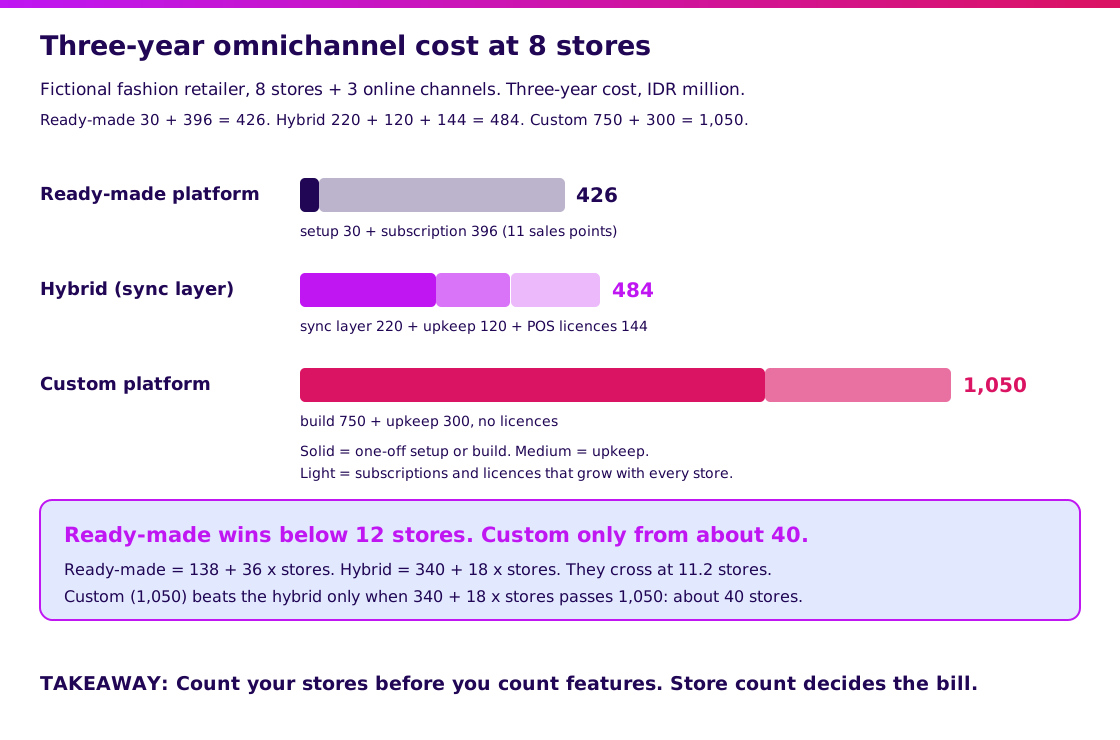
Here is how the three compare for our fictional retailer with 8 stores and 3 online channels, which makes 11 sales points.
| Ready-made platform | Hybrid (current POS + custom sync layer) | Custom platform | |
|---|---|---|---|
| Upfront cost | IDR 30m setup and data migration | IDR 220m sync layer | IDR 750m POS, order management and webstore |
| Running cost | IDR 1m per sales point per month | IDR 40m a year upkeep + IDR 0.5m per store per month for the POS | IDR 100m a year, no per-store fee |
| Time to start | 3 to 6 weeks | 8 to 12 weeks | 5 to 7 months |
| Flexibility | Medium: the platform’s rules | High for stock and order rules | High |
| Best for | Fewer than 12 stores, standard retail | 12 stores or more, or a POS you cannot replace | About 40 stores or more, or rules no platform runs |
Three-year cost at 8 stores: ready-made is 30 + 11 × 1 × 36 = IDR 426 million. Hybrid is 220 + 3 × 40 + 8 × 0.5 × 36 = IDR 484 million. Custom is 750 + 3 × 100 = IDR 1,050 million.
What do the omnichannel cost numbers show?
Two things stand out. First, store count decides the winner. With three online channels, ready-made costs 138 + 36 × stores and the hybrid costs 340 + 18 × stores. They cross at 11.2 stores, so ready-made is cheaper up to 11 stores and the hybrid is cheaper from 12.
Second, custom is far away. The hybrid only passes IDR 1,050 million when 340 + 18 × stores does, at about 40 stores. Below that, you would build custom for a reason other than cost. Real quotes include volume discounts and per-order fees, so use the method, not the numbers.
Which omnichannel features are essential?
Pick features by the mistake you want to stop, not by the number of channels on the vendor’s slide. These six cover most Growing Businesses:
- Sync stock in near real time: reduce the available count in every channel within minutes of a sale. See how APIs connect systems.
- Hold a safety buffer: stop selling online when the last one or two pieces are on a shop floor, where they may be in someone’s hands.
- Route each order: send it to the warehouse or the store that can fill it fastest, by a rule you can change.
- Merge customer profiles: match a marketplace buyer and a store member by phone number or email, with their consent.
- Handle returns anywhere: accept an online purchase at a store counter and put the item back into that store’s stock.
- Export everything: get products, stock, orders and customers out in a standard format, so you can change platforms later.
AI recommendations and personalised offers are nice to have. They depend on clean stock and customer data, so add them after the six above work. Read how inventory connects to POS and accounting.
What are examples of omnichannel in retail?
A good omnichannel example starts with something the customer wants to do, and ends with one record that makes it possible. Five common ones:
| Example | What the customer does | What has to be shared |
|---|---|---|
| Click and collect | Buys online, picks up in a store | Stock by store, order status |
| Ship from store | Orders online; the nearest store packs it | Stock by store, order routing |
| Endless aisle | Asks in store for a size that is out; staff order it from another location | Stock across all locations |
| Return anywhere | Brings an online purchase back to a store | Orders, refunds, stock |
| One membership | Earns and spends points in any channel | Customer profile, points ledger |
Start with one. Click and collect is usually the simplest, because it only needs accurate stock by store and an order status the store staff can see.
When is an off-the-shelf omnichannel platform enough, and when do you need custom?
Off-the-shelf is enough when you run a small chain with standard retail rules and can replace your current POS. Build only the part a platform cannot give you. Run these five questions in order and stop at the first one that decides it.
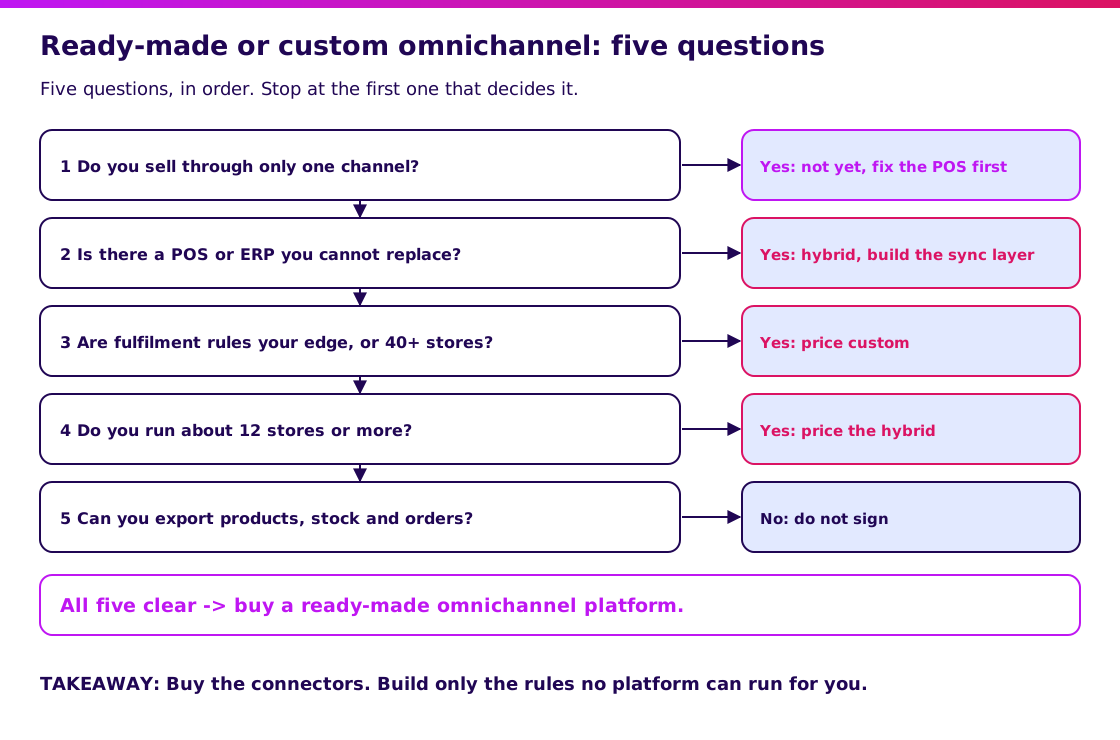
- Do you sell through only one channel? Then you do not need omnichannel yet. Get the till and the stock count right first. Read our multi-branch POS guide.
- Is there a POS or ERP you cannot replace? Then keep it and build the sync layer between it and your online channels. That is the hybrid.
- Are fulfilment rules your edge, or do you run 40 stores or more? Consignment stock, B2B price lists or your own delivery fleet are rules most platforms do not run. Price a custom build.
- Do you run about 12 stores or more? On our assumptions, per-store subscriptions then cost more than a hybrid. Redo the sum with your own quotes.
- Can you export products, stock, orders and customers? If not, do not sign, whatever you choose.
What is the honest answer for most retailers?
Honest answer: most retailers with fewer than 12 stores should buy a ready-made omnichannel platform and spend their effort on a clean product list and store discipline. We would not build marketplace connectors for them that a subscription already maintains. See the full reasoning in our build vs buy guide.
Validate it in 2 weeks. Before you spend heavily on omnichannel, Blueprint & Prototype tests your assumptions: a spec, a clickable prototype of the order and stock flow in front of the store staff who will use it, and a real cost estimate. The two-week promise covers prototype validation; it does not guarantee a production launch.
At Synetica, Blueprint & Prototype takes 2 weeks, Production Grade Software takes 8 weeks, and Launch & Grow runs as an ongoing monthly retainer. If the answer is a sync layer or a custom platform, the 8-week build starts from the validated scope.
How do you choose an omnichannel platform? A vendor checklist
Choose with your own products and your own busiest day, not with the vendor’s demo shop. Use this checklist before you sign:
- Load 50 of your real products in the trial, including ones with sizes and colours.
- Sell the last piece in one channel and time how long the others take to show it as sold out.
- Place two orders for the same last item at the same moment and see what happens.
- Return an online order at a store till and check where the stock goes.
- Ask which marketplaces and couriers are connected today, and who fixes a connection when a marketplace changes its rules.
- Ask what happens to store sales when the internet is down, and how they sync afterwards.
- Ask where data is stored and how you get all of it back if you leave.
- Check the price at your store count and order volume in year two and year three.
- Ask for two customers of your size and call them.
- Agree who owns the product list, stock counts and staff training.
Use our vendor due diligence guide for the questions behind each point.
How much does omnichannel cost in Indonesia?
Omnichannel cost is driven by how many stores and channels you connect, how many orders pass through and how unusual your rules are. In our fictional example, the three-year totals run from IDR 426 million to IDR 1,050 million at 8 stores.
| Price driver | What to check | Why it moves the cost |
|---|---|---|
| Stores and channels | Whether the price is per store, per channel or per user | The main driver of ready-made pricing |
| Order volume | Whether there is a fee per order above a limit | A busy sale month can change the bill |
| Existing systems | Whether your POS and accounting have an API | Each system without one adds custom work |
| Product data | Duplicate codes, missing sizes, different names per channel | Cleaning usually takes longer than connecting |
| Fulfilment rules | Ship from store, consignment, B2B prices | Pushes you from ready-made towards custom |
Budget for product-data cleaning and a full stock count separately. A sync that starts from a wrong count spreads the wrong number to every channel in minutes.
How do you implement omnichannel without failing?
Start with one product list and one stock count, prove they stay right, then add channels and customer features. Big-bang launches fail because every channel changes on the same day and nobody knows which one broke the stock.
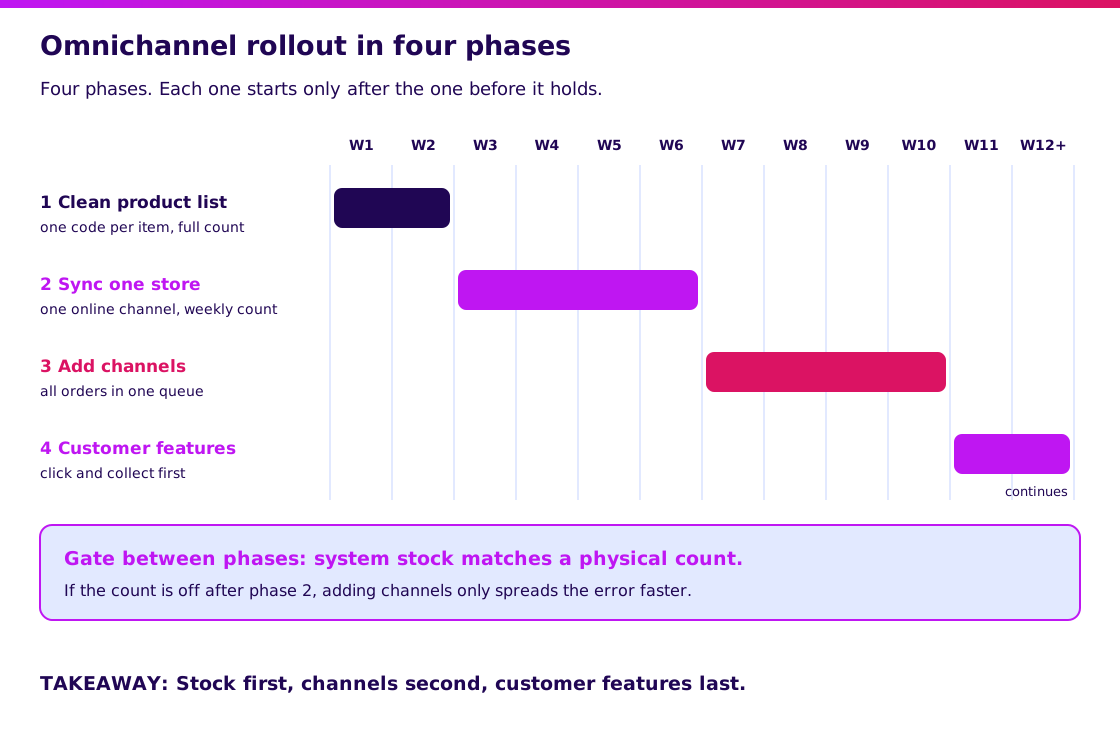
- Weeks 1-2: clean the product list. Give every item one code, one name and one unit across all channels. Do a full stock count.
- Weeks 3-6: sync one store and one online channel. Run it for a month and compare system stock with a physical count every week.
- Weeks 7-10: add the other channels and stores. Bring all orders into one queue. Stop re-typing.
- Week 11 onward: add customer features. Launch click and collect first, then returns anywhere, then one membership.
Name one owner for the product list. Without one, each channel admin creates their own version of an item and the oversold orders come back. If your stock records need work first, our stock management guide shows where to start.
What would I tell a retailer choosing omnichannel?
Start from the mistake that costs you most this month, then connect the smallest set of channels that stops it. If the problem is “we cancel marketplace orders every weekend”, stock sync between the stores and that marketplace will do.
- Fewer than 12 stores, standard retail: buy a ready-made platform and put the effort into the product list.
- A POS or ERP you cannot replace, or 12 stores and more: keep the till and build the sync layer.
- Unusual fulfilment rules or about 40 stores: validate the order flow with a prototype before building. Our MVP guide shows how.
My next step would be to book a scoping conversation with your store count, your list of channels, the POS you use today and last month’s number of cancelled orders.
FAQ — Omnichannel
What is omnichannel?
It is a retail model in which stores, webstore, marketplaces and chat share one product list, one stock count, one order queue and one customer record, so a customer can buy, pick up and return in any channel.
What is the best omnichannel platform?
There is no single best one. The best platform connects to the marketplaces and couriers you use, fits your store count over three years, works when a store is offline and lets you export all your data.
How much does omnichannel cost?
It depends on stores, channels, order volume and rules. In our fictional example with 8 stores and 3 online channels, three-year cost ranges from IDR 426 million for a ready-made platform to IDR 1,050 million for a custom platform, with a hybrid at IDR 484 million.
Can omnichannel be custom built?
Yes. Custom fits large chains and retailers whose fulfilment rules no platform runs. A hybrid builds only the sync layer between the POS you already have and your online channels.
Which is better, custom omnichannel or a ready-made app?
A ready-made app is better for retailers with fewer than about 12 stores and standard rules. A hybrid is better from about 12 stores or when the POS cannot be replaced, and custom is better from about 40 stores or for unusual fulfilment rules.
Related Posts
Aditya S
Business Development Manager, Synetica.
Put it into practice
Need help putting this into practice?
We turn the ideas in this article into a prototype tested with real users in 2 weeks (from Rp49jt)—or production-grade software in 8 weeks (from Rp100jt).