
Accounting Information System: Concept and Implementation
What is an accounting information system? Learn its components and cycles, compare ready-made, hybrid and custom, and see three-year cost and a phased rollout.
 By Aditya S November 14, 2026 Updated November 19, 2026 17 min read
An accounting information system is the people, procedures, data and software that turn every business transaction into financial reports you can trust. If your team bought an accounting app and month-end is still a week of re-typing and arguing over numbers, the app is one part of that system and the other parts are missing.
I’m Aditya S, Business Development Manager at Synetica, a tech-based business consultancy combining strategy and execution for Dreamers and Growing Businesses. This guide uses a fictional distributor with 60 staff so you can check every number. The figures are teaching assumptions, not Synetica client results, vendor prices or industry benchmarks.
You’ll learn what an accounting information system is, its components and cycles, how ready-made, hybrid and custom options compare, which features matter, how to check a vendor, what it costs and how to roll it out in phases.
TL;DR — the whole guide in five lines
- Software is one of six components: an accounting information system also needs people, procedures, data, infrastructure and controls, and no app writes those for you.
- Write the procedures before you buy: decide who approves, who records and who reconciles, then pick the tool that enforces it.
- Keep the ledger standard: a ready-made accounting application is right for most companies, and it is the cheapest option in our example at every team size below 68 finance users.
- Price integration per hour it removes: in our example the hybrid costs about IDR 79,000 for each hour of re-typing it takes away, so it pays from about 1,800 documents a month.
- Never switch a ledger in one day: run the old and new systems side by side for one full month and cut over only when the two trial balances match.
What is an accounting information system?
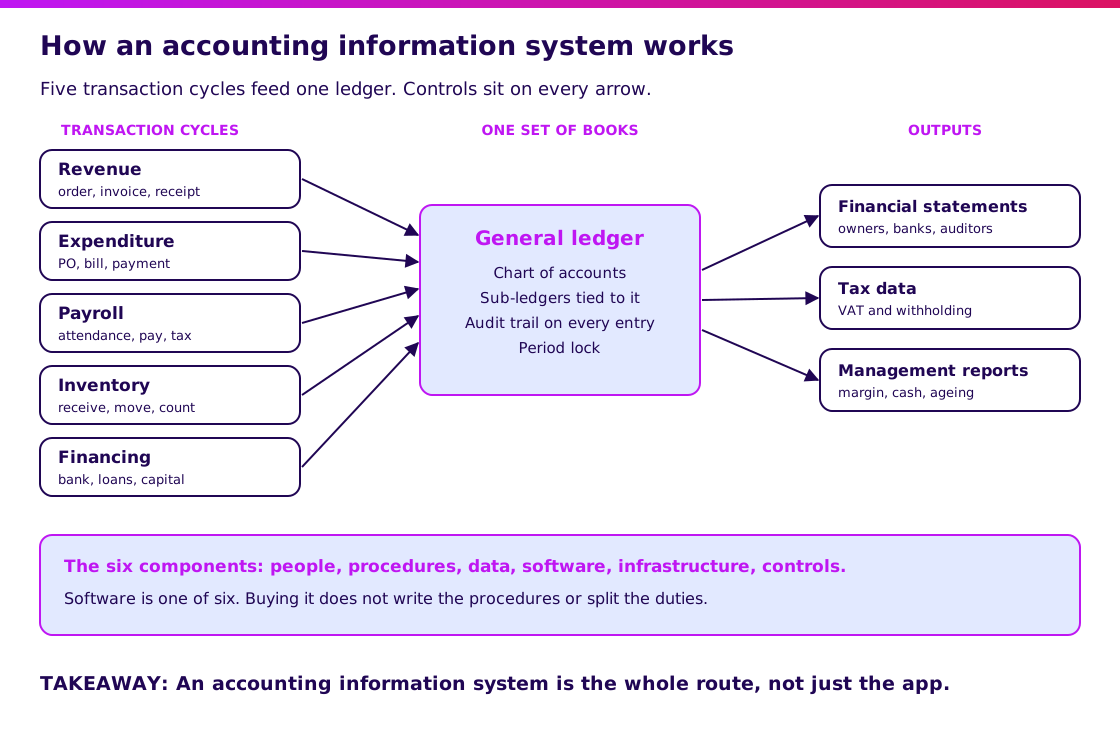
An accounting information system (AIS) is a system that collects, records, stores and processes financial data, then reports it to the people who make decisions. Think of a kitchen: the stove matters, but the meal also depends on the recipe, the cooks, the ingredients and someone tasting before the plate goes out.
Its core functions are:
- Capture each transaction once, at the point where it happens: the sale, the purchase, the payment.
- Post it to the right account by a fixed rule, so two people recording the same event get the same entry.
- Store the evidence with it: who entered it, who approved it, which document supports it.
- Produce reports for owners, banks, auditors, the tax office and managers from the same data.
- Protect the numbers with controls, so nobody can both create a supplier and pay that supplier.
Accounting software is the tool inside this system. An AIS is the tool plus everything around it that makes the tool’s output believable.
What are the components of an accounting information system?
An accounting information system has six components: people, procedures, data, software, infrastructure and internal controls. Most failed projects bought the fourth and skipped the other five.
| Component | What it is | What goes wrong without it |
|---|---|---|
| People | Staff who enter, approve and review, and the managers who read reports | Nobody owns a wrong number |
| Procedures | Written steps for each transaction, including who approves | Each branch records the same sale differently |
| Data | Chart of accounts, customers, suppliers, items, opening balances | Duplicate customers, reports that do not add up |
| Software | The accounting application and the systems that feed it | Spreadsheets fill the gaps |
| Infrastructure | Devices, network, cloud hosting, backups | A lost laptop is a lost ledger |
| Internal controls | Approval limits, split duties, period lock, audit trail | Errors and fraud go unseen until the audit |
For the controls row, the standard reference is the COSO framework, which names five parts of internal control: control environment, risk assessment, control activities, information and communication, and monitoring. See the COSO internal control guidance. You do not need the full framework on day one. You need the three or four control activities that match your largest risks.
Accounting information system vs accounting software vs ERP
Accounting software is a product you can buy; an accounting information system is how your company runs its books; ERP is one database for accounting and operations together.
| Accounting software | Accounting information system | ERP | |
|---|---|---|---|
| What it is | An application | People, procedures, data, software, infrastructure and controls | One system for finance, stock, sales, purchasing and more |
| Scope | Ledger, invoices, bank, reports | Every route a transaction takes to the ledger | The whole company’s operations |
| You get it by | Subscribing or installing | Designing procedures and then choosing tools | A longer implementation project |
| Breaks when | Other systems cannot feed it | Procedures are unwritten | You try to switch everything at once |
If you are choosing the application itself, read our accounting software build vs buy guide. If you want one system for every department, start with what ERP is.
What are the benefits of an accounting information system?
The main benefit of an accounting information system is one set of numbers that everyone accepts, produced without re-typing. The benefits you can measure in the first quarter are:
- A faster month-end, because sales and purchases reach the ledger on the day they happen.
- Fewer corrections, because each transaction is entered once.
- Answers during an audit, because every entry shows who made it and which document supports it.
- Earlier warnings, because overdue invoices and low cash appear in a report before they appear in the bank account.
An accounting information system is also the finance part of a wider management information system. Managers trust the dashboards only when the ledger under them is right.
How much time does an accounting information system save? A worked example
The first payback is hours your finance team stops spending on copying data between screens. Here is a fictional distributor with 60 staff. Sales staff raise 1,200 invoices a month in an order system, purchasing tracks 480 supplier bills in spreadsheets, and finance re-types both into the accounting application.
| Monthly task | Separate systems, re-typed | Integrated system |
|---|---|---|
| Re-type 1,200 sales invoices (3 minutes each) | 60 hours | 0 hours (posted automatically) |
| Enter 480 supplier bills (4 minutes each) | 32 hours | 8 hours (1 minute each to check the match) |
| Reconcile bank accounts | 20 hours | 6 hours |
| Find and fix differences between sub-ledgers and the general ledger | 24 hours | 6 hours |
| Build month-end reports | 16 hours | 4 hours |
| Review exception and control reports | 0 hours | 8 hours |
| Total per month | 152 hours | 32 hours |
That is 120 hours saved a month, or 15 working days of 8 hours. Time your own month-end and replace these numbers before you trust them.
Split the saving in two. Integration removes the re-typing: 60 + 24 = 84 hours a month. The other 36 hours come from bank rules, tied sub-ledgers and standard reports, which any ready-made accounting application already has. That split matters for the cost section below.
Accounting information system: ready-made vs hybrid vs custom
A ready-made accounting application is cheapest; a hybrid keeps that application and builds the integration to your other systems; a custom system costs most and fits only when accounting logic is your product. Ready-made examples include Accurate Online, Jurnal by Mekari and Xero. We name them as examples only, and make no claim about their prices or features.
Here is how the three compare for our fictional distributor with 10 finance users.
| Ready-made application | Hybrid (ready-made + custom integration) | Custom system | |
|---|---|---|---|
| Upfront cost | IDR 25m setup and opening balances | IDR 25m setup + IDR 150m integration | IDR 600m build |
| Running cost | IDR 0.35m per user per month | The same subscription + IDR 30m a year upkeep | IDR 90m a year, no per-user fee |
| Time to start | 3 to 6 weeks | 8 to 12 weeks | 5 to 7 months |
| Flexibility | Medium: the vendor’s settings | High for data flow and one or two rules | High |
| Best for | Standard books, low document volume | About 1,800 re-typed documents a month or more | Accounting logic is your product, or 49 finance users or more |
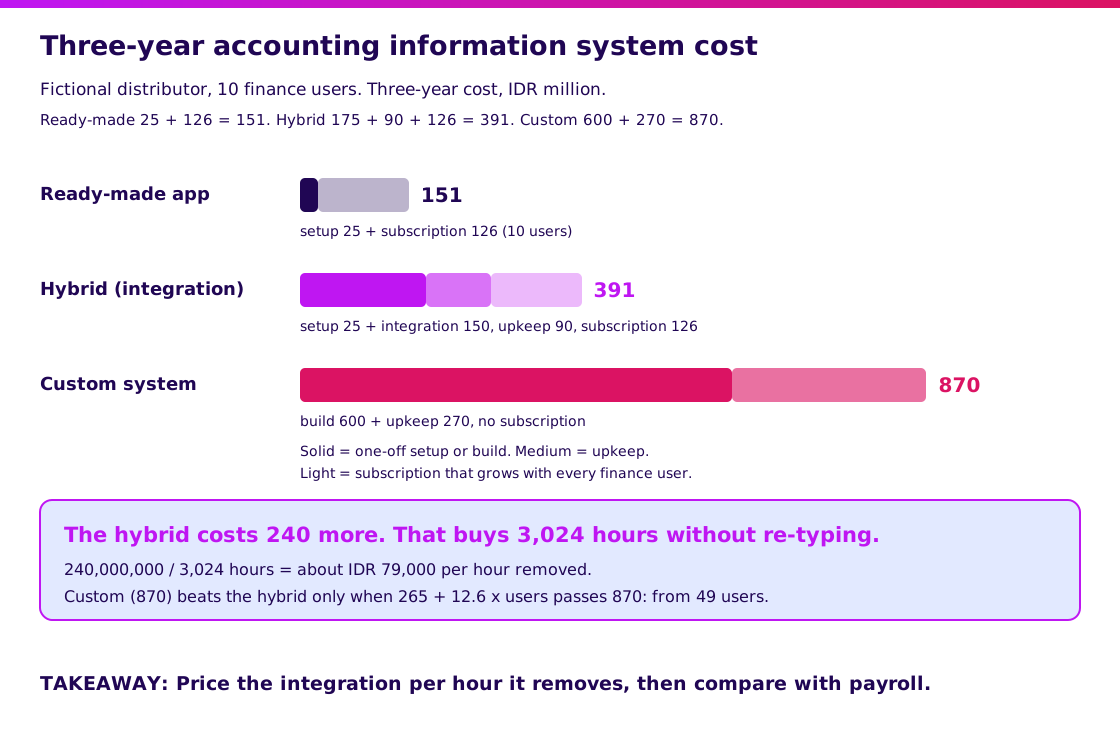
Three-year cost at 10 users: ready-made is 25 + 10 × 0.35 × 36 = IDR 151 million. Hybrid is 25 + 150 + 3 × 30 + 126 = IDR 391 million. Custom is 600 + 3 × 90 = IDR 870 million.
What do the accounting information system cost numbers show?
Two things stand out. First, the hybrid is a price per hour. It costs IDR 240 million more than ready-made over three years, and it removes 84 hours of re-typing a month, which is 3,024 hours. That is about IDR 79,000 for each hour removed.
Assume an hour of finance staff time costs this company IDR 75,000 with salary and benefits. Then 3,024 hours are worth IDR 226.8 million, which is IDR 13.2 million less than the integration costs. On time alone, the hybrid just misses at this volume. It breaks even at about 89 hours a month, roughly 1,800 documents at 3 minutes each.
Second, custom is far away. Ready-made costs 25 + 12.6 × users and the hybrid costs 265 + 12.6 × users. Custom at 870 is cheaper than the hybrid from 49 users and cheaper than ready-made from 68. Real quotes include tiered pricing and add-on fees, so use the method, not the numbers.
Which accounting information system features are essential?
Pick features by the error you want to stop, not by the length of the module list. These six cover most Growing Businesses:
- Post from source systems: receive sales, purchases and stock movements through a connection, with no re-typing. See how APIs connect systems.
- Match before paying: compare the purchase order, the goods receipt and the supplier bill, and hold the payment when they differ.
- Split duties by role: stop one user from both creating a supplier and approving its payment.
- Lock closed periods: prevent changes to a month after it has been reviewed.
- Log every change: record who created, edited or deleted an entry, and when.
- Export everything: get the general ledger, sub-ledgers and audit trail out in a standard format, so you can change tools later.
Indonesian tax rules also require bookkeeping records to be kept for years, so check the retention period and e-invoice needs with your tax adviser before you choose. For the full feature list of the application layer, read our accounting application guide.
What are examples of accounting information systems?
A useful example names the cycle that carries most of your transactions and the control that protects it. Four common ones:
| Business | Busiest cycle | What the system must do | Key control |
|---|---|---|---|
| Distributor | Revenue: order to cash | Post invoices from sales orders and track what is overdue | Credit limit checked before delivery |
| Retailer | Revenue: till to bank | Post each day’s sales from the point of sale | Cash counted against the system every day |
| Service or project firm | Revenue: time to invoice | Bill by milestone or hours and match costs to projects | Invoice approved against a signed milestone |
| Manufacturer | Inventory and production | Value materials, work in progress and finished goods | Stock counts compared with the ledger |
Start with the busiest cycle. If stock is yours, our inventory integration guide shows how stock, POS and accounting connect.
When is an off-the-shelf accounting information system enough, and when do you need custom?
Off-the-shelf is enough when your books follow standard rules and the volume you re-type is small. Build only the part no application gives you. Run these five questions in order and stop at the first one that decides it.
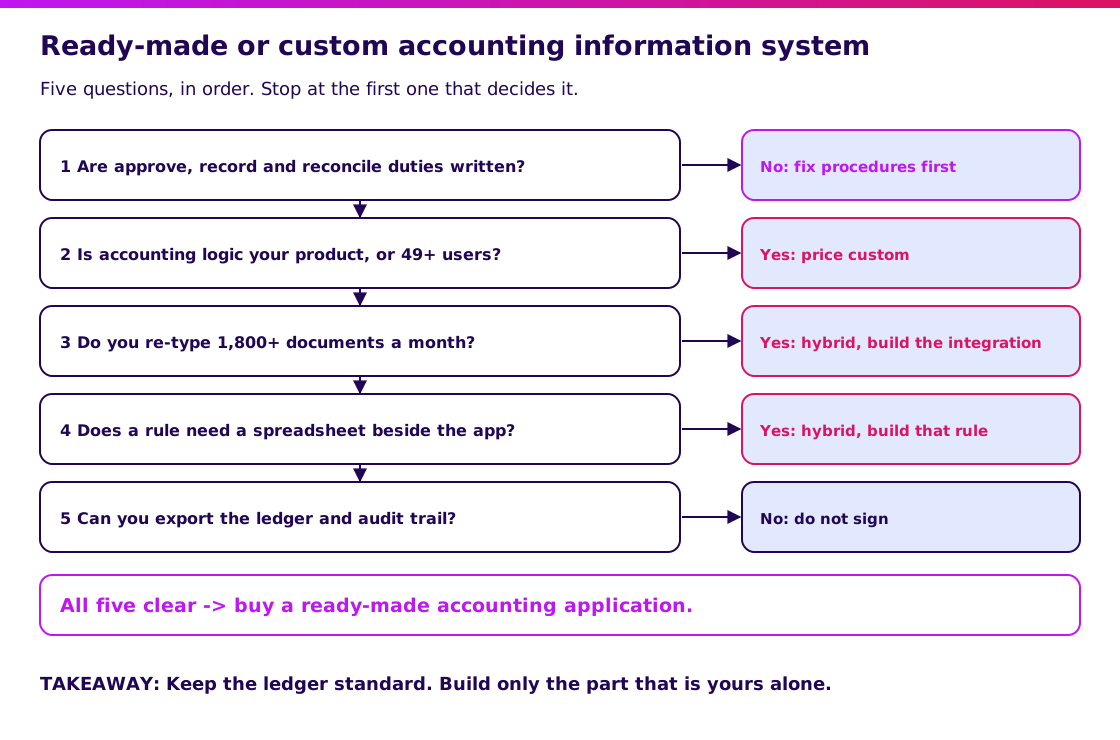
- Are the duties written down: who approves, who records, who reconciles? If not, write them first. Software enforces a procedure; it cannot invent one.
- Is accounting logic your product, or do you have 49 finance users or more? A lender calculating interest or a cooperative sharing surplus runs rules that packages do not. Price a custom system.
- Do you re-type about 1,800 documents a month or more? On our assumptions the integration then pays for itself. Redo the sum with your own volume and payroll.
- Does one rule force a spreadsheet beside the application? Consolidating several entities or billing by milestone are typical. Keep the ledger and build that one rule.
- Can you export the ledger, sub-ledgers and audit trail? If not, do not sign, whatever you choose.
What is the honest answer for most companies?
Honest answer: most companies should buy a ready-made accounting application and spend their effort on procedures and clean master data. We would not rebuild a general ledger that a subscription already maintains and keeps in line with tax changes. See the full reasoning in our build vs buy guide.
Validate it in 2 weeks. Before you spend heavily on an accounting information system, Blueprint & Prototype tests your assumptions: a spec, a clickable prototype of the riskiest transaction flow in front of the finance staff who will use it, and a real cost estimate. The two-week promise covers prototype validation; it does not guarantee a production launch.
At Synetica, Blueprint & Prototype takes 2 weeks, Production Grade Software takes 8 weeks, and Launch & Grow runs as an ongoing monthly retainer. If the answer is an integration or a custom system, the 8-week build starts from the validated scope.
How do you choose an accounting information system? A vendor checklist
Choose with your own transactions and your own month-end, not with the vendor’s demo company. Use this checklist before you sign:
- Load your real chart of accounts and 50 real transactions in the trial.
- Post one sale from your order system through to the ledger and count the manual steps.
- Try to create a supplier and approve its payment with the same user.
- Close a period, then try to edit an entry inside it.
- Change an entry and check that the audit trail shows the old value, the new value and the user.
- Ask which tax reports and e-invoice exports are supported today, and who updates them when rules change.
- Ask where data is stored, how backups run and how you get all of it back if you leave.
- Check the price at your user count in year two and year three.
- Ask for two customers of your size and call them.
- Agree who owns the chart of accounts, opening balances and staff training.
Use our vendor due diligence guide for the questions behind each point.
How much does an accounting information system cost in Indonesia?
The cost of an accounting information system is driven by how many finance users you have, how many systems must feed the ledger and how unusual your rules are. In our fictional example, the three-year totals run from IDR 151 million to IDR 870 million at 10 finance users.
| Price driver | What to check | Why it moves the cost |
|---|---|---|
| Finance users | Whether the price is per user, per entity or per transaction | The main driver of ready-made pricing |
| Systems to connect | Whether your POS, order and stock systems have an API | Each system without one adds custom work |
| Entities and branches | Whether each company needs its own books and a combined report | Consolidation is often an add-on or a custom rule |
| Data migration | Years of history, duplicate customers, unreconciled balances | Cleaning usually takes longer than loading |
| Special rules | Milestone billing, landed cost, interest calculation | Pushes you from ready-made towards hybrid or custom |
Budget separately for writing procedures and training staff. They are the cheapest of the six components and the ones most often left out of the quote.
How do you implement an accounting information system without failing?
Write the procedures, put one cycle live, run a parallel month, then cut over. Big-bang launches fail because the opening balances, the staff and the integrations are all new on the same day, and nobody can tell which one caused a wrong number.
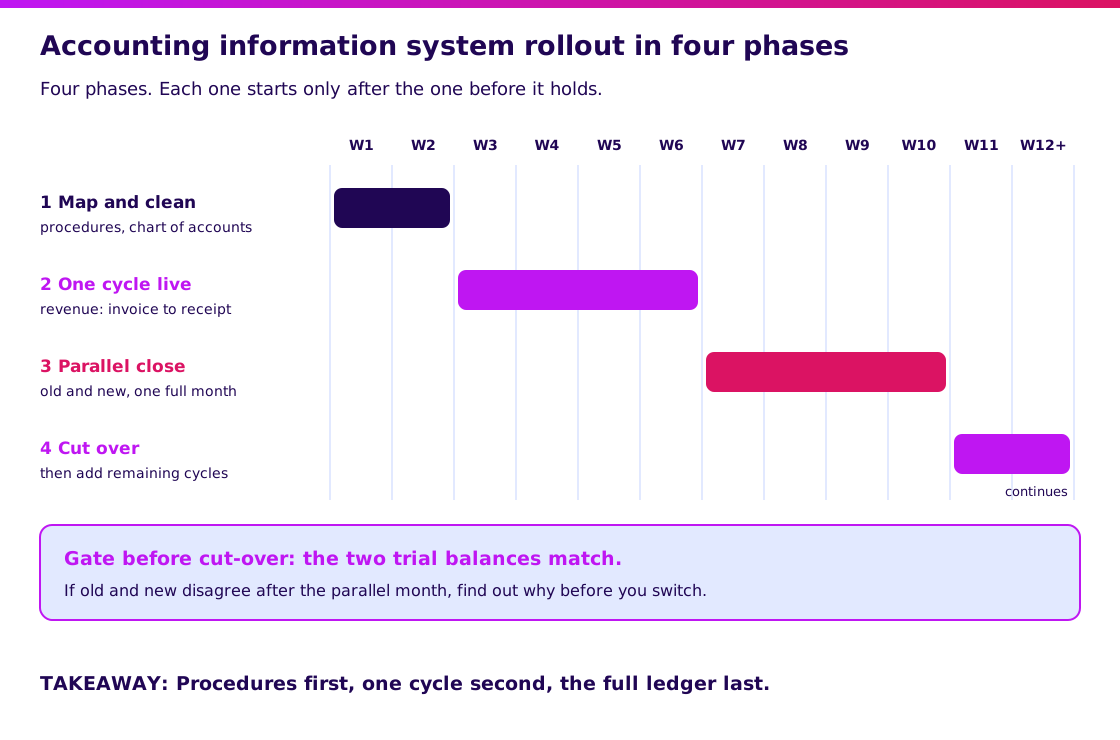
- Weeks 1-2: map and clean. Write the steps and approvals for each cycle. Tidy the chart of accounts, customers and suppliers.
- Weeks 3-6: put one cycle live. Start with revenue, from invoice to receipt. Compare its totals with the old records every week.
- Weeks 7-10: run a parallel close. Record one full month in both systems and compare the two trial balances line by line.
- Week 11 onward: cut over. Stop the old system, then add purchasing, stock and payroll one at a time.
Name one owner for the chart of accounts. Without one, every department asks for its own account and the reports stop being comparable. If managers also need live cash and margin views, our company finance application guide covers the dashboard layer.
What would I tell a founder choosing an accounting information system?
Start from the number you trust least this month, then fix the route that produces it. If the problem is “receivables in the report never match what customers say they owe”, fix the revenue cycle and leave the rest alone for now.
- Standard books, fewer than about 1,800 re-typed documents a month: buy a ready-made application and write the procedures.
- More volume, or one rule that lives in a spreadsheet: keep the ledger and build the integration or that rule.
- Accounting logic is your product, or about 49 finance users: validate the riskiest flow with a prototype before building. Our MVP guide shows how.
My next step would be to book a scoping conversation with your monthly document count, the list of systems that hold financial data, the number of finance users and how many days your last month-end took.
FAQ — Accounting information system
What is an accounting information system?
It is the combination of people, procedures, data, software, infrastructure and internal controls that collects, records and processes financial transactions and turns them into reports for owners, managers, auditors and the tax office.
What is the best accounting information system?
There is no single best one. The best system fits your busiest transaction cycle, connects to the systems that already hold your sales and purchases, enforces split duties and a period lock, and lets you export all your data.
How much does an accounting information system cost?
It depends on finance users, systems to connect, entities and special rules. In our fictional example with 10 finance users, three-year cost ranges from IDR 151 million for a ready-made application to IDR 870 million for a custom system, with a hybrid at IDR 391 million.
Can an accounting information system be custom built?
Yes. Custom fits companies whose accounting logic is part of their product, such as lenders and cooperatives, and very large finance teams. A hybrid builds only the integration or the one rule a ready-made application lacks.
Which is better, a custom accounting information system or a ready-made app?
A ready-made app is better for standard books and low document volume. A hybrid is better from about 1,800 re-typed documents a month or when one rule needs a spreadsheet, and custom is better when accounting logic is your product or from about 49 finance users.
Related Posts
Aditya S
Business Development Manager, Synetica.
Put it into practice
Need help putting this into practice?
We turn the ideas in this article into a prototype tested with real users in 2 weeks (from Rp49jt)—or production-grade software in 8 weeks (from Rp100jt).