What Is a Management Information System? Functions, Types and Examples
What is a management information system? Learn its functions, types and modules, what it costs over three years, and when to buy or build, with a worked example.
 By Aditya S November 6, 2026 Updated November 12, 2026 9 min read

A management information system (MIS, or sistem informasi manajemen in Indonesian) is the combination of people, processes and software that collects everyday business data and turns it into reports managers use to decide. It is the difference between guessing last month’s margin and reading it.
I’m Aditya S, Business Development Manager at Synetica, a tech-based business consultancy combining strategy and execution for Dreamers and Growing Businesses. This guide uses a fictional 60-person company so you can check every number. The figures are teaching assumptions, not Synetica client results, vendor prices or industry benchmarks.
You’ll learn what an MIS does, which types exist, which modules matter, what it costs, how to choose between ready-made and custom, and how to roll it out without a big-bang failure.
TL;DR — the whole guide in five lines
- An MIS is a data pipeline, not a program: staff enter records once, and managers read them as reports at three levels.
- Modules beat feature lists: start with the two or three that hold your money and stock, not all twelve.
- Ready-made is cheapest early: in our example IDR 279 million over three years, against IDR 560 million for custom.
- Headcount changes the answer: custom overtakes ready-made at about 125 users on these assumptions.
- Roll out in phases: one module, one team, one month, then the next. Big-bang launches are how systems fail.
What is a management information system?
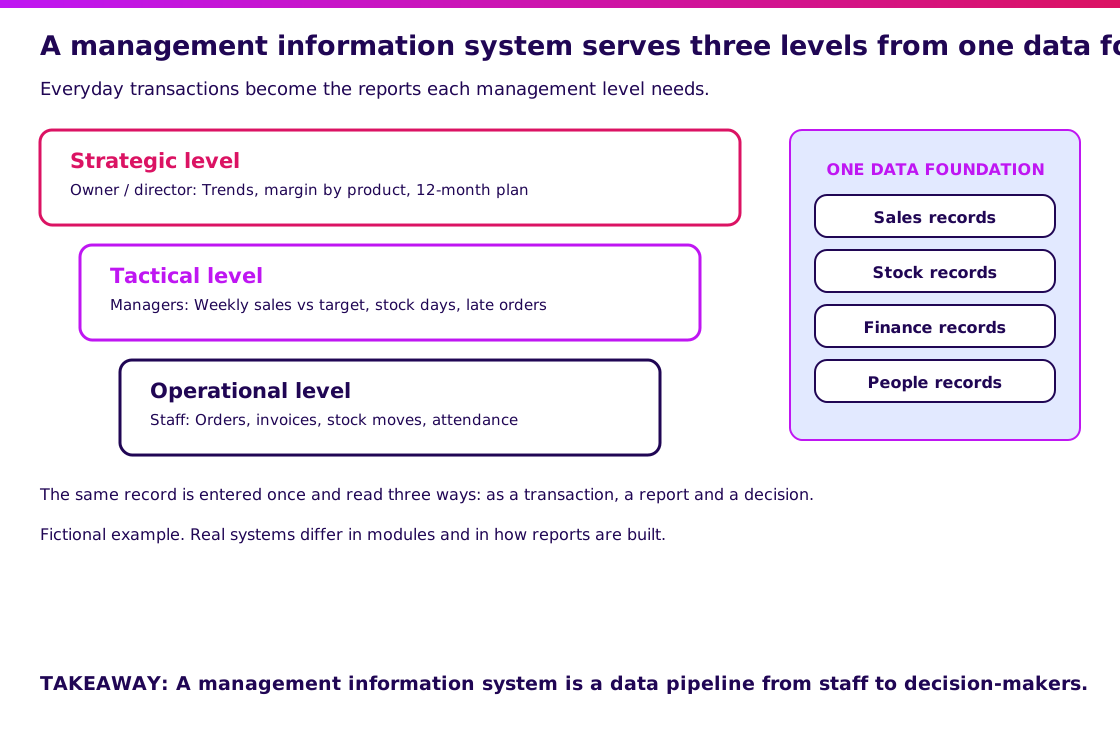
A management information system collects operational data, stores it in one place and presents it as reports for planning and control. Think of a car dashboard: the engine does the work, and the dashboard tells the driver what is happening so they can react.
Its core functions are:
- Record transactions such as orders, invoices, stock movements and attendance.
- Store them in one shared database instead of separate spreadsheets.
- Process raw records into totals, trends and exceptions.
- Report to the right person at the right level, on schedule or on demand.
- Support decisions such as reordering stock, chasing late payments or planning staffing.
An MIS is not the same as an ERP. An ERP (enterprise resource planning) system is a large, integrated suite that often includes an MIS layer. Compare the two in our ERP guide.
What types of management information systems are there?
MIS types are usually grouped by the management level they serve: operational, tactical and strategic. Smaller companies often run all three from one tool.
| Type | Who uses it | Typical output | Example question |
|---|---|---|---|
| Operational (transaction processing) | Staff | Orders, invoices, stock records | Was this order shipped? |
| Tactical (management reporting) | Managers | Weekly sales vs target, stock days | Which branch is behind target? |
| Strategic (executive reporting) | Owners, directors | Margin by product, trend lines | Which product line should we grow? |
| Industry-specific | Specialist teams | Clinic, school or logistics reports | How full were beds last week? |
If your industry has special rules, look at a vertical system. See how this works in a hospital information system and in an academic information system.
Ready-made vs custom: which management information system should you choose?
Ready-made is faster and cheaper to start; custom fits your process and has flatter cost as you grow. A hybrid takes a ready-made core and adds custom modules where your process is unique.
Take a fictional trading company with 60 staff. All inputs below are invented.
| Ready-made (SaaS) | Hybrid | Custom build | |
|---|---|---|---|
| Upfront cost | IDR 20m setup | IDR 15m setup + IDR 150m custom module | IDR 350m build |
| Running cost | IDR 120,000 per user per month | IDR 80,000 per user per month + IDR 30m a year for the module | IDR 70m a year |
| Time to start | Days to weeks | 6 to 10 weeks | 8 to 12 weeks |
| Flexibility | Low: the vendor’s process | Medium | High |
| Best for | Standard processes, small teams | Standard core, one unique process | Process is your competitive edge |
Three-year cost: ready-made is 20 + 60 × 0.12 × 36 = IDR 279.2 million. Hybrid is 15 + 60 × 0.08 × 36 + 150 + 3 × 30 = IDR 427.8 million. Custom is 350 + 3 × 70 = IDR 560 million.
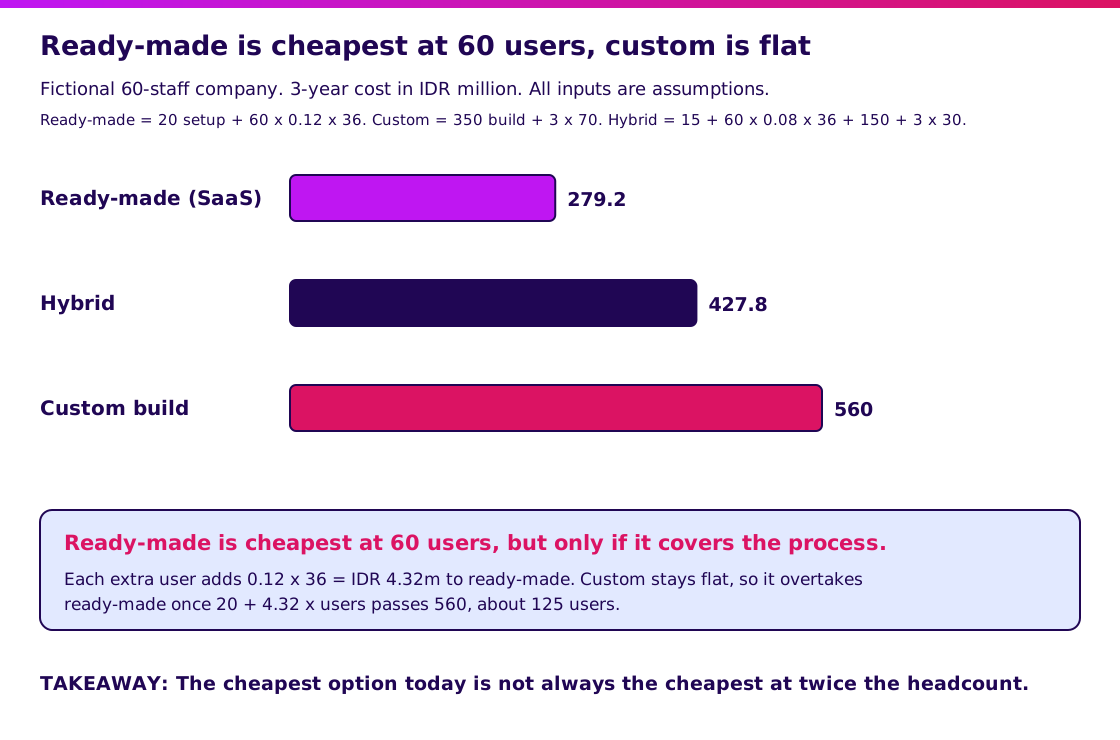
Each extra user adds 0.12 × 36 = IDR 4.32 million to ready-made. It overtakes custom when 20 + 4.32 × users passes 560, about 125 users. Real quotes include tiers, discounts and add-on fees, so use the method, not the numbers. Open the cost diagram at full size.
Which modules should a management information system have?
Start with the modules that hold your money and stock, and add the rest only when a real decision depends on them. Each module should let a user do something specific.
- Sales and orders: capture quotes and orders, track status, flag late deliveries.
- Inventory: record stock in and out, show stock days, trigger reorders.
- Finance: issue invoices, track receivables, close the month.
- Purchasing: raise purchase orders and compare supplier prices.
- HR and attendance: record staff, leave and payroll inputs.
- Reporting dashboard: show the five numbers each manager checks weekly. When those numbers come from several systems, business intelligence is the next step.
Most companies get 80% of the value from the first two or three. Learn how APIs connect these modules to other tools.
When is a ready-made system enough, and when do you need custom?
Ready-made is enough when it covers most of your process and the process is not what sets you apart. Run five questions in order and stop at the first one that decides it.
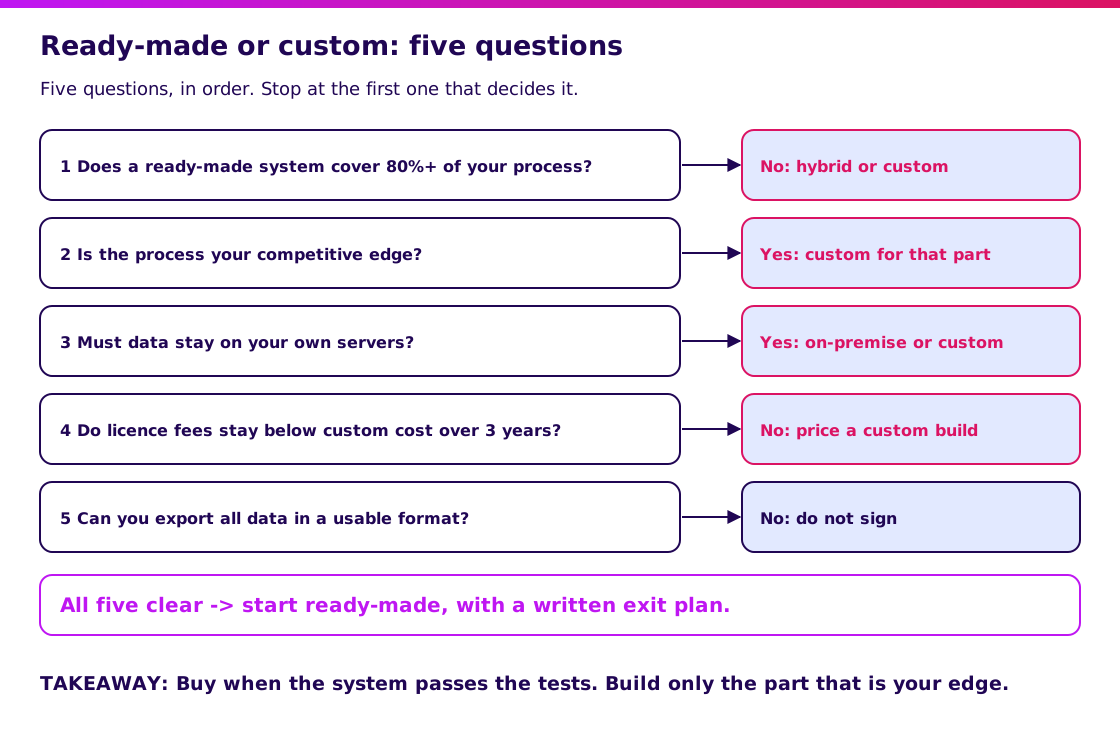
- Does a ready-made system cover 80% or more of your process? If not, expect workarounds, or consider hybrid or custom.
- Is this process your competitive edge? If yes, owning it is usually worth more than renting it.
- Must your data stay on your own servers? Some regulated or sensitive data must.
- Do licence fees stay below the custom cost over three years? Redo the sum with your own headcount.
- Can you export all your data in a usable format? If not, do not sign.
The 80% rule is a rule of thumb for this guide, not a standard. Open the decision diagram at full size.
Validate it in 2 weeks. Blueprint & Prototype tests your assumptions before you spend on a large system, turning them into a prototype, agreed scope and a real cost estimate. The two-week promise covers prototype validation; it does not guarantee a production launch.
At Synetica, Blueprint & Prototype takes 2 weeks, Production Grade Software takes 8 weeks, and Launch & Grow runs as an ongoing monthly retainer. If the answer is custom, the 8-week build starts from the validated scope.
How do you choose a management information system vendor?
Choose by evidence from your own data, not by the demo. Use this checklist before you sign:
- List the five reports your managers read every week.
- Ask the vendor to produce those reports from a sample of your real data.
- Check that data import and export work in a format you can open.
- Ask who answers support requests, in which language and within what time.
- Ask where data is stored and what happens to it if you leave.
- Count the workarounds in the trial; many workarounds mean poor fit.
- Ask for two customers of similar size and call them.
- Get a written price for year two and year three, not only year one.
- Check how updates are released and whether they can break your setup.
- Agree who owns configuration and who trains new staff.
Use our vendor due diligence guide for the questions behind each point.
How much does a management information system cost?
Cost depends on users, modules, integrations and whether you rent or build. In our fictional example, the three-year totals range from IDR 279 million to IDR 560 million, and the ranking flips as headcount grows.
The price drivers are:
- Number of users: drives per-user fees for ready-made systems.
- Number of modules: each adds setup, training and testing.
- Integrations: connecting accounting, e-commerce or banking adds work.
- Data migration: cleaning and importing old spreadsheets is often underestimated.
- Support level: response time and training change the yearly fee.
Ask every vendor for a three-year total with the same user count so you compare like with like.
How do you roll out a management information system without failing?
Roll out one module to one team at a time, and keep the old way running in parallel until the numbers match. Big-bang launches fail because everything changes on one day.
- Weeks 1-2: scope and data. Agree the first module and clean the data it needs.
- Weeks 3-6: pilot. One team uses it daily. Fix what breaks.
- Weeks 7-8: parallel run. Run old and new side by side and compare totals.
- Week 9 onward: next module. Repeat the cycle, with one owner per module.
Name an owner for each module who is responsible for data quality. Without one, reports drift out of date and managers go back to spreadsheets.
What would I tell a founder choosing a management information system?
Start with the decisions you struggle to make today, then pick the smallest system that answers them. Do not buy twelve modules to use two.
For a Growing Business replacing spreadsheets, a ready-made system with two modules is often the fastest win. For a Dreamer, start with a prototype that tests demand; our MVP guide shows how.
My next step would be to book a scoping conversation with your five weekly reports, headcount and the two or three systems you are considering.
FAQ — Understanding management information systems
What is a management information system?
It is the people, processes and software that collect business data and turn it into reports managers use to plan and control the business.
What is the best management information system?
There is no single best one. The best system covers at least 80% of your process, exports your data and fits your headcount budget over three years.
How much does a management information system cost?
It varies by users, modules and integrations. In our fictional 60-person example, three-year cost ranges from IDR 279 million to IDR 560 million, depending on whether you rent, mix or build.
Can a management information system be custom built?
Yes. Custom fits a unique process and keeps cost flatter as headcount grows, but it takes longer and costs more upfront. A hybrid builds only the unique part.
Which is better, a management information system or a ready-made app?
A ready-made app is better when your process is standard and the team is small. A custom or hybrid MIS is better when the process is your edge or headcount is high.
Related Posts
Aditya S
Business Development Manager, Synetica.
Put it into practice
Need help putting this into practice?
We turn the ideas in this article into a prototype tested with real users in 2 weeks (from Rp49jt)—or production-grade software in 8 weeks (from Rp100jt).